PDF(2345 KB)
PDF(2345 KB)
PDF(2345 KB)
防治松材线虫高效复配制剂的药效分析
Analysis of the efficacy of efficient combined formulations against Bursaphelenchus xylophilus
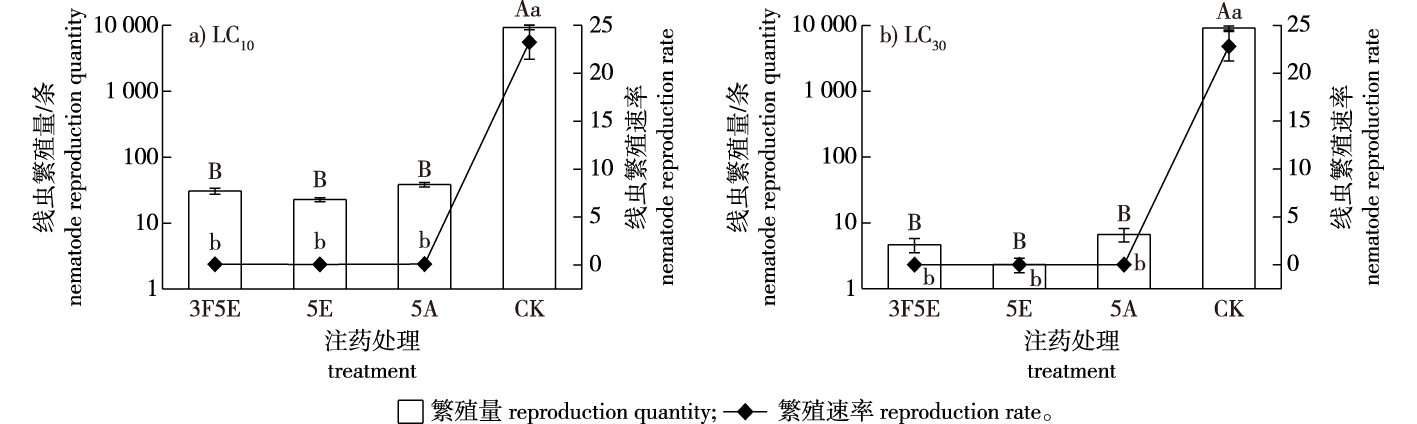
【目的】研究一种自制新型复配杀线虫剂3%(质量分数,下同)氟吡菌酰胺-5%甲维盐微乳剂,探究其对松材线虫(Bursaphelenchus xylophilus)的毒力活性及其在防治松材线虫病方面的潜力,为研发出更加高效且具备快速输导能力的药剂提供参考。【方法】采用浸虫法测定这种新型复配微乳剂(3%氟吡菌酰胺-5%甲维盐微乳剂)以及另外两种市售常用药剂(5%甲维盐微乳剂和5%阿维菌素乳油)的杀线效果;以这3种药剂的两种亚致死浓度(LC10和LC30)处理松材线虫来检测其对线虫繁殖能力的抑制效果;在林间将这3种药剂进行树干注射,观察药剂的可吸收性,以及被树体成功吸收药剂对马尾松造成的敏感性状况;在注药90 d后采集注干松树的枝干样本,检测分析药剂在树体内的输导分布动态;并在注药后100 d对处理马尾松进行人工接种松材线虫,观察统计各药剂对松材线虫病的防治效果。【结果】3%氟吡菌酰胺-5%甲维盐自配微乳剂、5%甲维盐微乳剂、5%阿维菌素乳油处理松材线虫24 h后,测定的致死中浓度(LC50)数值分别为2.644 0、27.678 4、42.891 1 mg/L。3 种供试药剂中,3%氟吡菌酰胺-5%甲维盐微乳剂的杀线能力最强,并且经过低浓度药剂处理过的松材线虫的种群繁殖数量均显著低于对照组。3种药剂注干7 d后,自制复配药剂和5%阿维菌素乳油能够被树体完全吸收,5%甲维盐微乳剂难以被吸收。各药剂注射180 d后,自制复配药剂对树体造成的敏感性情况轻微,注药点的木质部产生轻微的变色情况,5%阿维菌素乳油对树体造成的敏感性严重,注药点的木质部产生了严重的变色情况。在注药90 d后,在树体顶部能够检测到所有药剂的残留。在注干点以下0.5 m位置,复配3%氟吡菌酰胺-5%甲维盐微乳剂中氟吡菌酰胺残留含量(质量分数,下同)达到最高,为0.13 mg/kg,甲维盐残留含量0.07 mg/kg,5%阿维菌素残留含量0.1 mg/kg。2种药剂残留含量均在注干点以上0.5 m位置达到最高,此部位复配药剂中的氟吡菌酰胺的残留含量为55.65 mg/kg,残留含量显著高于其余药物。并且从整体看,复配药剂中的氟吡菌酰胺在树体内的残留含量高于甲维盐的残留含量以及5%阿维菌素乳油。于当年7月中旬接种松材线虫,在接种270 d后注射过药剂的马尾松均保持健康,而未经药剂处理的马尾松在接种后100 d出现感染迹象,表明所有药剂都能有效预防松材线虫病的发生。【结论】毒力效果分析表明,新型自制复配药剂对松材线虫具有较强的毒力作用,在林间对马尾松进行注射后,其可吸收性良好,马尾松对其敏感性轻微,并且在松树体内有良好的输导效果。同时,能够预防松材线虫的感染,具备良好的防效,可继续开展配方的优化以及林间的大面积应用。
【Objective】Injecting agents into pine trees to prevent pine wilt disease is an effective control measure. This study aimed to develop more efficient and fast-delivery agents by combining two different drugs to create a novel microemulsion. The virulence activity of this combined (3% fluopyram-5% emamectin benzoate) microemulsion against Bursaphelenchus xylophilus and its potential for controlling pine wilt disease were explored.【Method】The nematocidal effects of the newly developed combined microemulsion, along with two commonly used agents for pine wilt disease-5% emamectin benzoate microemulsion and 5% avermectin emulsifiable concentrate-were assessed using the insect immersion method. B. xylophilus was treated with lethal concentrations (LC10 and LC30) of each agent to determine their impact on nematode reproduction. Three agents were injected into the trunks of Pinus massoniana trees in the forest to observe agent absorption and tree sensitivity to successfully absorbed agents. After 90 days of injection, samples of the treated trees were collected to analyze the dynamic distribution of drug transport within the tree body. Additionally, 100 days after inoculation, the treated trees were artificially inoculated with B. xylophilus to observe and statistically analyze the control effects of each agent on pine wilt disease.【Result】The LC50 values after 24 hours of treatment with the 3% fluopyram-5% emamectin benzoate microemulsion, 5% emamectin benzoate microemulsion, and 5% avermectin emulsifiable concentrate on pine wood nematodes were 2.644 0, 27.678 4, and 42.891 1 mg/L, respectively. Among the tested agents, the 3% fluopyram-5% emamectin benzoate microemulsion exhibited the strongest nematocidal activity. The population reproduction of nematodes treated with low concentrations of the agents was significantly lower than the control group. Seven days after injection, both the self-made combined microemulsion and 5% avermectin emulsifiable concentrate were fully absorbed by the tree, whereas absorption of the 5% emamectin benzoate microemulsion was more limited. After 180 days, the self-made combined microemulsion showed minimal sensitivity to the tree, with slight discoloration at the injection point, while the 5% avermectin emulsifiable concentrate caused significant discoloration of the xylem at the injection site. After 90 days, residual concentrations of all agents were detected at the top of the tree. The highest residual concentration of fluopyram (0.13 mg/kg) was found 0.5 m below the injection point in the combined 3% fluopyram-5% emamectin benzoate microemulsion, while emamectin benzoate had a residual concentration of 0.07 mg/kg, and 5% avermectin's residual concent ration had 0.1 mg/kg. The highest residual concentrations of all agents were observed 0.5 m above the injection point, with fluopyram in the combined microemulsion reaching 55.65 mg/kg, significantly higher than the other agents. Overall, the residual concentration of fluopyram was higher than that of emamectin benzoate in the combined microemulsion and higher than 5% avermectin emulsifiable concentrate. Inoculation with pine wood nematodes in mid-July showed that, 270 days after inoculation, the trees treated with the agents remained healthy, while untreated trees exhibited signs of infection 100 days post-inoculation. All agents effectively prevented the onset of pine wilt disease.【Conclusion】The toxicity analysis of the new self-made combined agent demonstrates its strong nematocidal effect, good absorbability after injection into P. massoniana, and mild sensitivity to the tree. It also exhibits excellent transport ability within the tree and provides effective prevention against pine wood nematode infection. Further optimization of the formula and large-scale application in forest management is recommended.
松材线虫病 / 复配药剂 / 毒力分析 / 树干注射 / 氟吡菌酰胺-甲维盐微乳剂 / 杀线剂
pine wilt disease / combined agents / toxicity analysis / trunk injection / fluopyram-emamectin benzoate / nematicide
| [1] |
|
| [2] |
|
| [3] |
|
| [4] |
|
| [5] |
叶建仁. 松材线虫病在中国的流行现状、防治技术与对策分析[J]. 林业科学, 2019, 55(9):1-10.
|
| [6] |
李卫斌, 安炳贞, 孔玉辉, 等. 基于无人机遥感影像的松材线虫病监测方法概述[J]. 林业工程学报, 2023, 8(2):21-29.
|
| [7] |
|
| [8] |
|
| [9] |
甘绍泽, 王晓飞, 陈旭华, 等. 注干施用“松线静”(5%阿维菌素乳油)防控松材线虫病研究[J]. 温带林业研究, 2023, 6(3):42-47.
|
| [10] |
|
| [11] |
|
| [12] |
尹福强, 宋珍, 徐琴, 等. 多花黄精灰霉病病原菌Botrytis deweyae生物学特性及防治药剂筛选[J]. 江苏农业学报, 2024, 40(10):1818-1825.
|
| [13] |
The Asian citrus psyllid (ACP), Diaphorina citri Kuwayama, is one of the most devastating pests in citrus orchards, and has caused huge economic losses worldwide. Chemical control is the most effective way for psyllid control. Herein, the toxicity of nine insecticides to ACP adults and the joint action of thiamethoxam + spirotetramat were determined by a topical application method in the laboratory; field plot experiments were conducted to evaluate the control efficacy of one self‐made thiamethoxam + spirotetramat 40% suspension concentrate (SC) comparing with thiamethoxam 21% SC, spirotetramat 22.4% SC, tolfenpyrad 15% SC and bifenthrin 100 g/L emulsifiable concentrate against ACP using foliar sprays in 2018–2019.
|
| [14] |
凌文政, 曹海潮, 余佳敏, 等. 氟吡菌酰胺纳米纤维剂的研制及其对南方根结线虫的生物活性[J]. 中国农业科学, 2024, 57(15):2997-3009.
【目的】根结线虫病已成为制约我国设施农业发展的重要影响因素,其中以南方根结线虫(Meloidogyne incognita)危害最为严重,目前我国杀线虫剂类型较少,为实现新剂型创制,本研究基于静电纺丝技术制备氟吡菌酰胺纳米纤维剂,评价其对南方根结线虫的生物活性,以丰富作物根结线虫病高效防治药剂剂型类别,拓展纳米纤维剂应用场景。【方法】采用同轴静电纺丝技术,以不同生物可降解材料为壳材,以溶剂化氟吡菌酰胺为芯材,制备两种氟吡菌酰胺纳米纤维剂(Flu@NF)。利用SEM、EDS、TEM、FTIR、TGA等,表征Flu@NF的形貌结构、元素组成、官能组分与热稳定性能;以41.7%氟吡菌酰胺悬浮剂为对照药剂,评价Flu@NF对南方根结线虫2龄幼虫(J2)与卵的生物活性。【结果】在高压+15 kV,芯-壳溶液流速比1﹕4,与接收器边距24 cm的条件下,成功制备了以聚乙二醇(PEG)/聚己内酯(PCL)与醋酸纤维素(CA)为壳材的PEG/PCL-Flu@NF与CA-Flu@NF,平均直径分别为316与440 nm,且两种载药纤维符合芯-壳的内外微观结构,壳层厚度分别为71.15和24.84 nm,载药量分别为15.32%与20.37%,经壳材包覆后,氟吡菌酰胺的热稳定性显著提高。相较于氟吡菌酰胺悬浮剂,载药纤维的缓释性能显著提高,在不同浓度下,随处理时间的延长线虫死亡率显著提高,于高浓度(25 mg·L<sup>-1</sup>)处理24 h后,两种纤维剂对2龄幼虫的致死率均高于98%,于低浓度(4 mg·L<sup>-1</sup>)处理24 h后,两种纤维剂对2龄幼虫的致死率分别为91.4%和79.6%;PEG/PCL-Flu@NF与CA-Flu@NF对线虫卵孵化均具有较好的抑制作用,于高浓度(25 mg·L<sup>-1</sup>)下处理3 d后卵未孵化率分别为71.8%和89.2%,于低浓度(4 mg·L<sup>-1</sup>)下处理3 d后卵未孵化率分别为59.4%和76.2%。【结论】基于同轴静电纺丝技术,以PEG/PCL与CA分别为壳材制备的纳米纤维对氟吡菌酰胺具有优异的包覆效果,纤维剂通过缓释作用保护作物根系,对南方根结线虫具有较高生物活性,其在防控根结线虫病的应用方面具有巨大潜力。
|
| [15] |
|
| [16] |
Fluensulfone and fluopyram are new nematicides whose mode of action is not fully understood. Differences in the nematicidal activity of these compounds among two Meloidogyne incognita populations and a Meloidogyne javanica population, and the effect of sublethal exposure to the nematicide on their infection process were studied in vitro.
|
| [17] |
Fluopyram is a novel nematicide compound with systemic activity, and it is a potential chemical agent for controlling pine wilt disease, which is devastating pine trees worldwide. Here, a fluopyram suspension concentrate (SC) was used to determine its efficacy in controlling pine wilt disease, its distribution in pine tree tissues, and its environmental degradation. Fluopyram SC had an evident inhibitory effect on Pestalotiopsis sp. and showed a good preventive effect on pine wilt disease in healthy pine seedlings. In the field application, after spraying onto the canopy of pine trees, fluopyram was absorbed and translocated downward to all parts of the tree via the branches and needles, and its distribution was stable at 30 days post-application (all samples’ mean residual concentration = 1.166 mg/kg). In addition, the maximum concentration of fluopyram residue in soil and water was 1.139 and 0.099 mg/kg, respectively, at 30 days post-application when fluopyram was significantly degraded. The control efficiency of fluopyram SC in the forest reached 90.48% when the formulation was sprayed by agricultural unmanned aerial vehicles. The half-life of fluopyram SC was 346.6 days, with a persistence of 3 years. These results indicate that spraying fluopyram SC could effectively reduce the number of pine trees dying from pine wilt disease.
|
| [18] |
龙鼎新, 伍一军, 李薇, 等. 8种化学药剂单独及两两联合染毒对松材线虫杀灭作用试验[J]. 浙江林业科技, 2006, 26(5):39-42.
|
| [19] |
谈家金, 杨荣铮, 吴慧平. 不同地理种群的松材线虫对马尾松的致病力差异[J]. 植物检疫, 2000, 14(6):324-325.
|
| [20] |
曹娜, 赵小云, 宋鲜梅, 等. 阿维菌素与常用杀虫剂复配对Q型烟粉虱的增效作用及田间防效[J]. 农药, 2019, 58(11):849-855,858.
|
| [21] |
|
| [22] |
The pine wood nematode (PWN), <i>Bursaphelenchus xylophilus</i> is a well-known devastating pathogen of economic importance in the Republic of Korea and other countries. In the Republic of Korea, trunk injection of nematicides is the preferred method of control. In this study, the efficacy of 16 locally produced formulations of emamectin benzoate against the PWN are compared through determining their sublethal toxicities and reproduction inhibition potentials. Nematodes were treated with varying concentrations of the tested chemicals in multi-well culture plates, and rates of paralysis and mortality were determined after 24 h. Reproduction inhibition potential was tested by inoculating pre-treated nematodes onto <i>Botrytis cinerea</i>, and in pine twig cuttings. Despite the uniformity in the concentration of the active ingredient, efficacy was contrastingly different among formulations. The formulations evidently conformed to three distinct groups based on similarities in sublethal activity (group 1: LC<sub>95</sub> of 0.00768-0.01443 mg/ml; group 2: LC<sub>95</sub> of 0.03202-0.07236 mg/ml, and group 3: LC<sub>95</sub> of as high as 0.30643-0.40811 mg/ml). Nematode paralysis generally occurred at the application dose of 0.0134-0.1075 μg/ml, and there were significant differences in nematode paralysis rates among the products. Nematode reproduction was only evident at lower doses both on <i>B. cinerea</i> and pine twigs, albeit the variations among formulations. Group 1 formulations significantly reduced nematode reproduction even at a lower dose of 0.001075 µg/ml. The variations in efficacy might be attributed to differences in inert ingredients. Therefore, there is need to analyze the potential antagonistic effects of the large number of additives used in formulations.
|
| [23] |
朱丽华, 林丽, 蒋鹏, 等. 不同致病力松材线虫的繁殖能力和移动能力比较[J]. 东北林业大学学报, 2017, 45(12):76-79.
|
| [24] |
The pine wood nematode (PWN), Bursaphelenchus xylophilus (Steiner & Buhrer) Nickle, is the pathogen of pine wilt disease (PWD) which can devastate forests. PWN can be of high or low severity and the mechanisms underlying the differences in virulence are unclear. Therefore, it is necessary to study the relationship between differentiation of PWN severity and its resistance to the main defensive substances of pine species (i.e., α-pinene and H2O2). The feeding rate and fecundity of PWN was examined at different levels of virulence under conditions of α-pinene and H2O2 stress. Moreover, the expression patterns of the main resistance genes of PWN with different virulence were determined under conditions of α-pinene and H2O2 stress. The feeding rate and fecundity of the high virulence strain AMA3 were higher than those of the low virulence strain YW4. The expression levels of the autophagy gene BxATG5, cytochrome P450 gene BxCYP33D3, and glutathione S-transferase genes BxGST1 and BxGST3 in AMA3 increased significantly upon exposure to α-pinene for 2 h, while these genes showed smaller degrees of upregulation in YW4. Under conditions of H2O2 stress, the expression levels of BxATG5, catalase genes Bxy-ctl-1and Bxy-ctl-2, and the 2-cysteine peroxiredoxin gene BxPrx in AMA3 were higher than those in YW4. These findings suggest that high virulence PWN has greater resistance to pine defensive substances α-pinene and H2O2 than low virulence PWN, and resistance genes mediate the differential resistance of PWN strains. This study will contribute to the clarification of the mechanism underlying virulence differentiation of PWN and will advance understanding of the pathogenic mechanism of PWD.
|
| [25] |
谭瑞娜, 郝昕, 邓振, 等. 松材线虫谷胱甘肽S转移酶基因响应阿维菌素胁迫功能研究[J]. 中南林业科技大学学报, 2023, 43(8):159-168.
|
| [26] |
|
| [27] |
申继忠. 影响农药产品使用价值和寿命的因素分析[J]. 世界农药, 2021, 43(1):10-22,33.
|
| [28] |
莫启进, 卓梅芳, 王健, 等. 松脂掺杂物中氯化钠的快速检测[J]. 广西林业科学, 2014, 43(1):105-107.
|
| [29] |
李长强, 叶建仁, 张婉君, 等. 注干施用甲维盐防治松材线虫病的研究[J]. 中国植保导刊, 2022, 42(3):16-19.
|
| [30] |
孙太凡. 绿色农药剂型:微乳剂的研究进展[J]. 黑龙江八一农垦大学学报, 2007, 19(6):86-88.
|
| [31] |
张扬, 杨鼎超, 李正昀, 等. 高效新型杀松材线虫剂的筛选及其林间防效[J]. 植物保护学报, 2017, 44(5):856-862.
|
| [32] |
向帆, 叶建仁, 张婉君. 注干施用 3 种药剂防治松材线虫病研究[J]. 南京林业大学学报(自然科学版), 2025, 49(3):95-101.
|
| [33] |
In an earlier paper the authors reported the creation of a novel emamectin benzoate 40 g litre(-1) liquid formulation (Shot Wan Liquid Formulation). The injection of this formulation exerted a preventative effect against the pine wilt disease caused by the pine wood nematode, Bursaphelenchus xylophilus (Steiner & Buhrer) Nickle, and this effect lasted for at least 3 years. The present study was carried out to show experimentally that the marked effect of this formulation was due to the presence and persistence in pine tissues of sufficient amounts of emamectin benzoate to inhibit nematode propagation. A cleanup procedure prior to quantitative analysis of emamectin benzoate by fluorescence HPLC was devised. The presence of the compound in concentrations sufficient to inhibit nematode propagation in the shoots of current growth and its persistence for 3 years explained the marked preventative effect. Non-distribution of emamectin benzoate in some parts of the lower trunk suggested that the formulation should be injected at several points for large trees in order to distribute the compound uniformly to lower branches.
|
| [34] |
In 1979, the anthelmintic activity of abamectin, a mixture of avermectins B1a and B1b, was first reported. Since then, multiple articles have investigated avermectins' degradation and its efficacy against a wide variety of pests under different conditions and using different modes of application. However, there is a gap in the literature of analysing abamectin properties and its performance as a non‐fumigant nematicide when applied liquid or granular vs. new avenues of application based on seed and seedling treatment. Therefore, this article reviewed literature to discuss the mode of action, environmental aspects, the nematicidal effectiveness of treatment forms and the range of activity to address these topics.
|
| [35] |
|
/
| 〈 |
|
〉 |