PDF(1590 KB)
 PDF(1590 KB)
 PDF(1590 KB)
松梢螟和云杉梢斑螟发生与林分及立地因子的关系
Relationship between the occurrence of Dioryctria rubella and D. schuezeella and stand and site factors
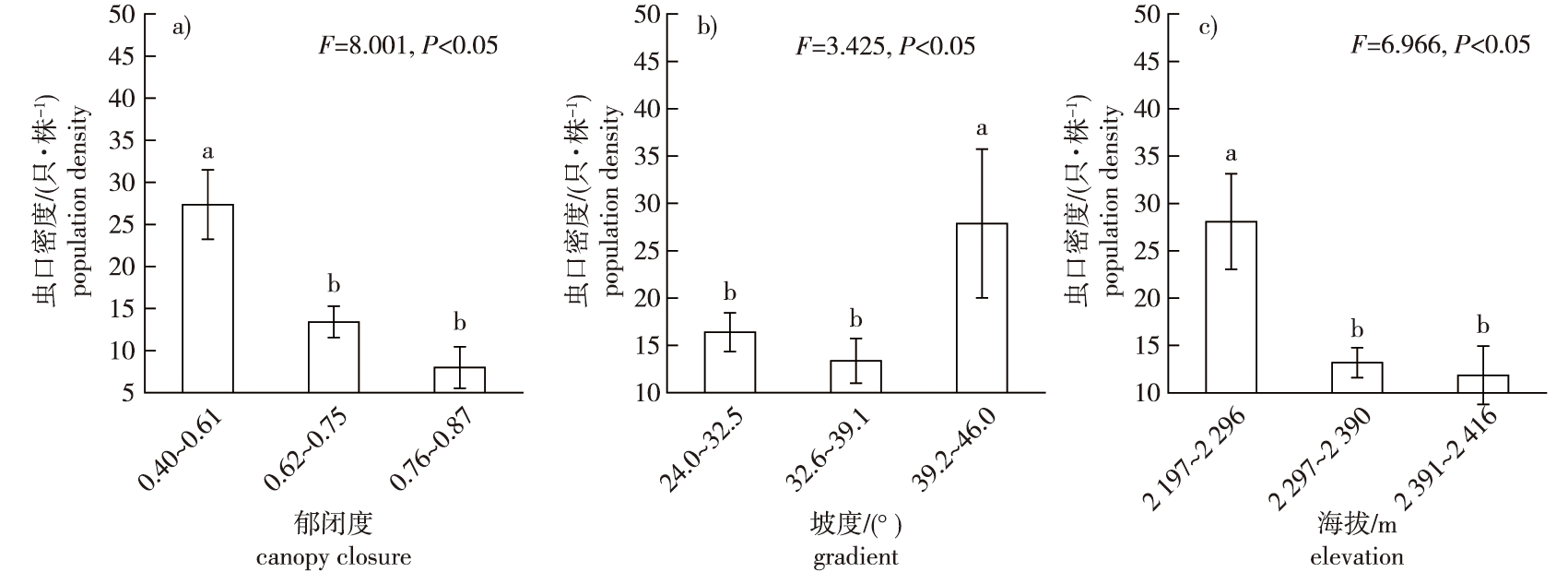
【目的】 研究不同林分及立地因子与松梢螟(Dioryctria rubella)和云杉梢斑螟(Dioryctria schuezeella)幼虫发生的关系,为监测林区2种梢斑螟幼虫的发生提供技术指导。【方法】以宁夏罗山林区油松林松梢螟幼虫、青海云杉林云杉梢斑螟幼虫为研究对象,调查林分密度(x1)、郁闭度(x2)、树高(x3)、枝下高(x4)、冠幅(x5)、胸径(x6)、草本盖度(x7)、灌木丰富度(x8)、灌木多样性指数(x9)等9个林分因子和海拔(x10)、腐殖层厚度(x11)、坡度(x12)、坡向(x13)、坡位(x14)等5个立地因子及相关幼虫虫口密度。利用逐步回归分析筛选影响2种梢斑螟幼虫虫口密度的关键因子,建立关键因子与幼虫虫口密度的线性预测模型;采用偏相关分析、方差分析和多重比较分析关键因子与幼虫虫口密度间的关系。【结果】郁闭度、海拔和坡度是影响松梢螟幼虫发生的关键因子,坡向、胸径和灌木多样性指数是影响云杉梢斑螟幼虫发生的关键因子;建立的松梢螟(y1)和云杉梢斑螟(y2)幼虫虫口密度的线性预测模型分别为y1=208.565-0.075 x10-70.712 x2+0.865 x12和y2=-100.995+17.268 x13+1.499 x6+60.596 x9;海拔和郁闭度与松梢螟幼虫虫口密度呈极显著负相关(P<0.01),坡度与松梢螟幼虫虫口密度呈极显著正相关(P<0.01),坡向、胸径和灌木多样性指数均与云杉梢斑螟幼虫虫口密度呈极显著正相关(P<0.01)。【结论】松梢螟幼虫在林分郁闭度小于0.62、海拔小于2 297 m和坡度大于39.1°的油松林易发生,云杉梢斑螟幼虫在半阴坡、胸径大于24.83 cm和灌木多样性指数大于0.33的青海云杉林易发生,这些林地应作为两类害虫发生监测与防治的重点区域。
【Objective】 This study aims to investigate the relationships between various stand and site factors and the occurrence of Dioryctria rubella and D. schuezeella larvae, so as to provide guidance for monitoring these two shoot moth species in forest areas.【Method】Field investigations were conducted on D. rubella larvae in Pinus tabuliformis forests and D. schuezeella larvae in Picea crassifolia forests in the Luoshan forests area of Ningxia. Nine stand factors were measured: stand density (x1), canopy closure (x2), tree height (x3), height under branch (x4), crown width (x5), DBH (x6), herb cover (x7), shrub richness (x8), and shrub diversity index (x9), along with five site factors: elevation (x10), humus layer thickness (x11), slope (x12), aspect (x13), slope position (x14), and corresponding larval population density. Stepwise regression analysis was used to identify the key factors influencing larval population density and to establish linear prediction models. Partial correlation analysis, analysis of variance(ANOVA), and multiple comparison tests were applied to analyze relationships between key factors and larval population density.【Result】Canopy closure, elevation, and slope were identified as the key factors affecting the occurrence of D. rubella larvae, while aspect, DBH, and shrub diversity index were the key factors affecting the occurrence of D. schuezeella larvae. The linear prediction models for larval population density were established as follows, for D. rubella: y1=208.565-0.075 x10-70.712 x2+0.865 x12, for D.schuezeella: y2=-100.995+17.268 x13+1.499 x6+60.596 x9. Elevation and canopy cover showed highly significant negative correlations with D. rubella larval population density (P<0.01), whereas slope showed a highly significant positive correlation with it(P<0.01). Aspect, DBH and shrub diversity index all exhibited a highly significant positive correlations with D. schuezeella larval population density(P<0.01).【Conclusion】 D. rubella larvae are more likely to occur in P. tabuliformis forests with canopy closure less than 0.62, elevation below 2 297 m, and slope greater than 39.1°. D. schuezeella larvae tend to occur in P. crassifolia forests on semi-shady slopes, with DBH greater than 24.83 cm and shrub diversity index greater than 0.33. These specific forest conditions should be prioritized for pest monitoring and control measures.
松梢螟 / 云杉梢斑螟 / 虫口密度 / 林分因子 / 立地因子 / 油松 / 青海云杉
Dioryctria rubella / Dioryctria schuezeella / larval population density / stand factor / site factor / Pinus tabuliformisi Picea crassifolia
| [1] |
田恒德, 严敖金. 微红梢斑螟的研究[J]. 南京林业大学学报(自然科学版), 1989, 13(1):54-63.
|
| [2] |
吴磊, 玉舒中, 常明山, 等. 微红梢斑螟蛀孔在马尾松上空间分布研究[J]. 环境昆虫学报, 2015, 37(1):193-198.
|
| [3] |
李桂琴. 云杉梢斑螟生物学特性与防治[J]. 中国森林病虫, 2003, 22(1):3-5.
|
| [4] |
李丹春, 付作霖, 徐红霞, 等. 白龙江林区油松林分因子对中华松针蚧危害的影响[J]. 林业科学研究, 2021, 34(3):180-186.
|
| [5] |
|
| [6] |
|
| [7] |
刘威, 王晶晶, 师梦楠, 等. 茶园阴坡和阳坡土壤微生物群落结构与土壤理化因子的关系[J]. 江苏农业学报, 2024, 40(2):251-259.
|
| [8] |
程立超, 迟德富, 王文帆. 立地因子和林分因子对兴安落叶松鞘蛾的影响[J]. 湖南农业大学学报(自然科学版), 2015, 41(6):636-640.
|
| [9] |
马菁. 基于信息量法的落叶松锉叶蜂发生模型研究[J]. 中国植保导刊, 2018, 38(11):29-34.
|
| [10] |
|
| [11] |
|
| [12] |
|
| [13] |
|
| [14] |
|
| [15] |
|
| [16] |
郑旭, 赵文静, 刘兴满, 等. 苏北滨海盐渍土土壤基本性质及其对中山杉生长的影响[J]. 江苏农业学报, 2023, 39(9):1854-1861.
|
| [17] |
任德智, 葛立雯, 罗大庆. 小尺度森林郁闭度测定方法及应用[J]. 林业科技开发, 2014(1):94-97.
|
| [18] |
周润惠, 唐永彬, 王敏, 等. 威远不同年龄桉树人工林林下物种多样性和土壤理化性质[J]. 应用与环境生物学报, 2021, 27(3):742-748.
|
| [19] |
邵方丽, 余新晓, 郑江坤, 等. 北京山区防护林优势树种分布与环境的关系[J]. 生态学报, 2012, 32(19):6092-6099.
|
| [20] |
王鸿哲, 陈辉, 康云霞. 中国针叶树种实害虫研究进展[J]. 西北林学院学报, 2003, 18(3):54-59,75.
|
| [21] |
周宏威, 纪皓文, 吴羿轩, 等. 基于YOLOv8算法改进模型检测梢斑螟虫蛀树木[J]. 森林工程, 2025, 41(1):126-138.
|
| [22] |
宋玉双, 李娟, 周艳涛, 等. 我国梢斑螟属害虫研究及防治进展[J]. 中国森林病虫, 2020, 39(6):29-41.
|
| [23] |
赵阳, 朱景乐, 刘攀峰, 等. 立地条件和人为干扰对杜仲梦尼夜蛾种群数量的影响[J]. 环境昆虫学报, 2016, 38(6):1170-1177.
|
| [24] |
佟富春, 金哲东, 王庆礼, 等. 长白山北坡土壤动物群落物种共有度的海拔梯度变化[J]. 应用生态学报, 2003, 14(10):1723-1728.
|
| [25] |
张涪平. 西藏不同海拔种植区害虫天敌的调查[J]. 中国生物防治学报, 1998, 14(1):46-47.
|
| [26] |
彭彬, 马志龙, 卡德艳·卡德尔, 等. 伊犁地区苹果小吉丁虫在野苹果树上危害特性研究[J]. 新疆农业大学学报, 2018, 41(2):121-127.
|
| [27] |
|
| [28] |
|
| [29] |
梁军, 胡瑞瑞, 黄咏槐, 等. 赤松林上调力及群落结构对昆嵛山腮扁叶蜂的调控机制及作用[J]. 环境昆虫学报, 2018, 40(2):276-281.
|
/
| 〈 |
|
〉 |