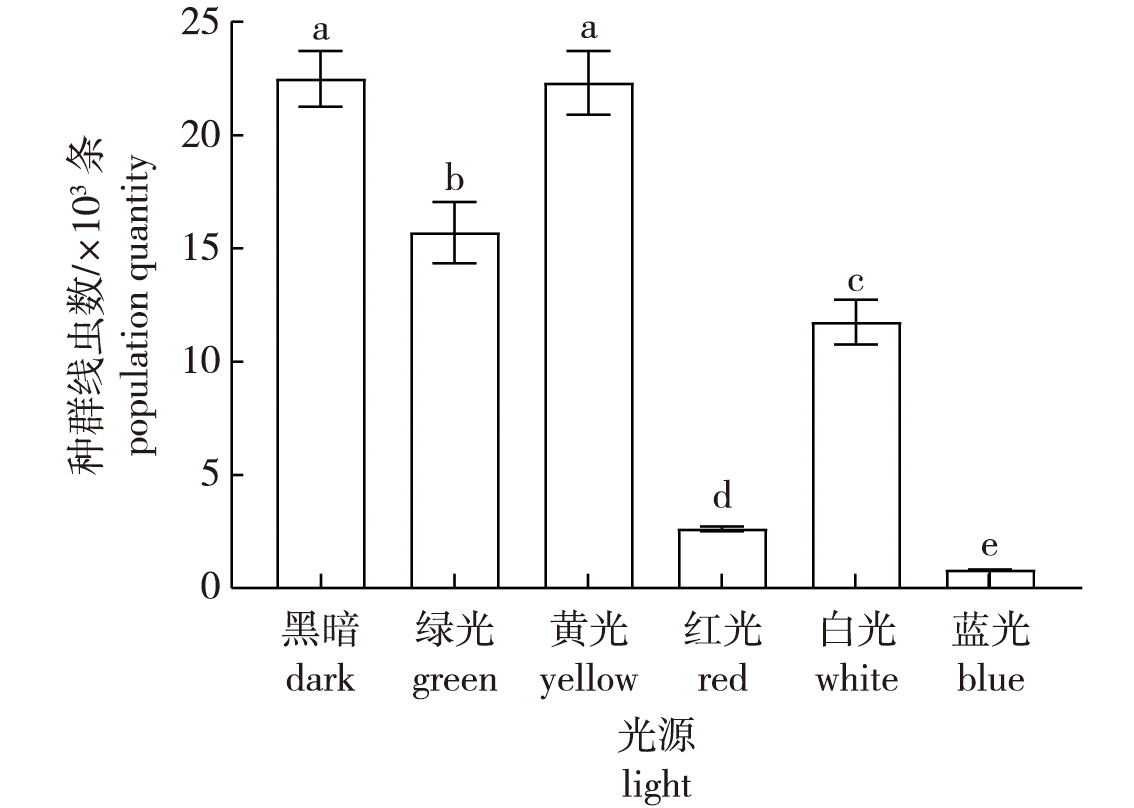
【目的】松材线虫定殖在松树体内,处在黑暗条件,对光照极为敏感,呈现出显著的趋避反应。通过对不同光照条件下松材线虫种群数量变化的统计,进一步阐明光照影响种群增长的机理,为松材线虫在光学和基础生物学方面的研究和防治提供新的观点。【方法】采用5种颜色的光源,包括绿、黄、红、白和蓝色,探讨不同颜色光照对松材线虫种群的影响,并对不同蓝光强度对松材线虫卵孵化率、雌雄比、体长和胚胎发育的作用做进一步研究。【结果】不同光照影响结果显示蓝光对松材线虫种群数量抑制效果最好,能够显著降低其种群数量的增长。进一步研究松材线虫的发育和繁殖行为发现,与对照组相比,当光照度低于1 000 lx 时,蓝光基本上不会对其繁殖造成明显影响。然而,当光照度上升到 1 250 lx 时,松材线虫的繁殖数量、卵孵化率、发育速度、个体大小等大幅下降,其雌雄比例也出现了显著的变化。【结论】当蓝光照度达到1 000 lx以上,能够显著抑制松材线虫的卵孵化率、发育进程以及成虫的体长。蓝光是一种重要的环境因子,能够通过影响松材线虫的基因表达进一步干扰其生理周期、卵形态的变化,从而影响其种群扩增。
【Objective】Pine wood nematode (Bursaphelenchus xylophilus) typically live in dark environments and are extremely sensitive to light, exhibiting a strong avoidance response. By studying the inhibitory effects under different light conditions on their population growth, key mechanisms of how light affects the growth of B. xylophilus populations can be revealed. This research also aims to elucidate the underlying mechanisms that inhibit population growth, laying a solid foundation for future optical and basic biological studies on pine wood nematodes and providing new perspectives for their control.【Method】Five light wavelengths (clours)—green, yellow, red, white and blue—were employed to investigate the effects of various light conditions on the nematode population. Additionally, the effects of different blue light intensities on egg hatching rate, sex ratio, body length, and embryonic development were further explored.【Result】Blue light exhibited the strongest inhibitory effect on B. xylophilus, significantly suppressing population growth. Further research on the effects of different blue light intensities on reproductive behavior showed that when the light intensity is below 1 000 lx, blue light has no significant effect on reproduction. However, when the intensity increased to 1 250 lx, compared to the control group, the number of offspring, egg hatching rate, developmental speed, and individual size of the nematodes significantly decreased. Additionally, there are notable changes in the male-to-female sex ratio.【Conclusion】In summary, blue light at intensities above 1 000 lx significantly inhibits the egg hatching rate, developmental progress, and adult body size of B. xylophilus. As an important environmental and physical factor, blue light can influence microbial life cycles, morphological changes, and gene expression, thereby regulating its physiological and metabolic processes.
 PDF(2203 KB)