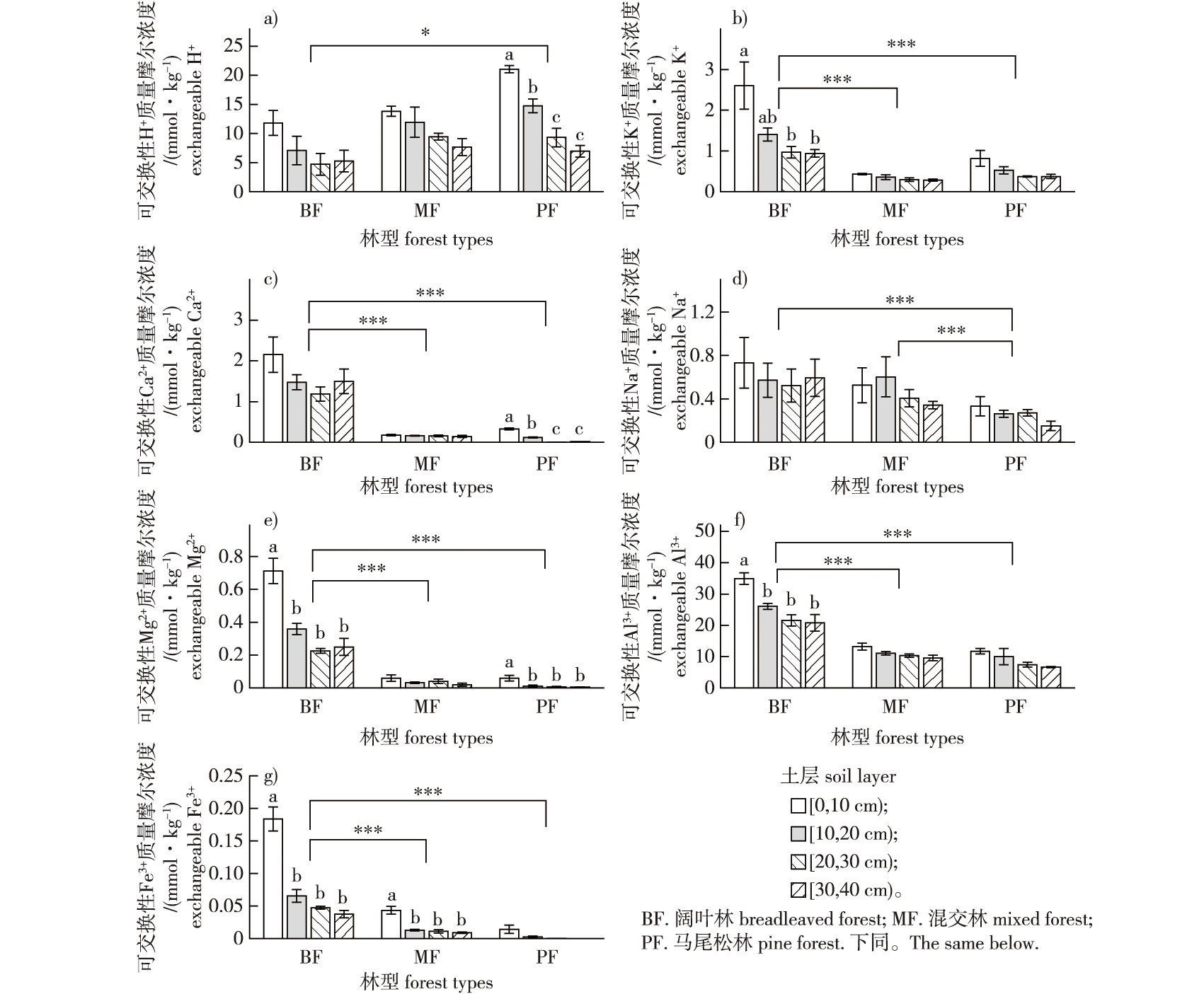
【目的】 探讨南亚热带森林土壤可交换性阳离子垂直分布格局及其影响因素,为南亚热带森林生态系统的保护和可持续发展提供理论支持。【方法】选取位于广东肇庆鼎湖山国家级自然保护区的3种南亚热带代表性森林为研究对象,即季风常绿阔叶林(阔叶林/原始林)、马尾松和阔叶树混交林(混交林/次生林)、马尾松针叶林(针叶林/人工林),并测定这3种森林[0,10)、[10,20)、[20,30)和[30,40) cm土层可交换性阳离子(H+、Al3+、K+、Na+、Ca2+、Mg2+和Fe3+)、阳离子交换量(cation exchange capacity, CEC)、铝饱和度(aluminum saturation, Al-S)、盐基饱和度(base saturation, BS)和土壤pH。【结果】3种森林土壤pH普遍低于4.2,盐基饱和度低于8%,而铝饱和度普遍高于60%。在垂直分布格局上,随土壤深度的增加,3种森林土壤可交换性阳离子含量、阳离子交换总量、盐基饱和度和可交换性酸(致酸离子含量)普遍呈现下降的趋势,但是土壤pH和铝饱和度呈现上升趋势。总体来看,阔叶林地土壤的阳离子交换量、盐基饱和度、铝饱和度和可交换性阳离子(除H+外)含量均显著高于混交林和针叶林,但土壤pH低于其他2个林型;混交林和针叶林地土壤可交换性阳离子分布特征类似。【结论】南亚热带森林属于酸敏感生态系统,土壤养分离子贫乏,处于铝化合物缓冲体系内。土壤可交换性阳离子主要集中在表层土壤,土地利用历史及其遗留效应是导致3类森林土壤酸化状态不同的重要原因。全球环境变化下,针对森林恢复和治理,建议更多关注钙和镁等盐基离子缺乏,而不是土壤铝毒问题。
【Objective】 This study aims to explore the vertical distribution patterns of exchangeable cations in southern subtropical forest soils and identify their potential influencing factors, so as to provide theoretical support for the conservation and sustainable development of southern subtropical forest ecosystems.【Method】Three representative southern subtropical forests in the Dinghushan National Nature Reserve, Guangdong Province were selected for this study. These forests include the monsoon evergreen broadleaved forest (broadleaved forest/primary forest), mixed Pinus massoniana/broadleaved forest (mixed forest/secondary forest), and P. massoniana forest (pine forest/planted forest). The exchangeable cations (H+, Al3+, K+, Na+, Ca2+, Mg2+ and Fe3+), cation exchange capacity (CEC), aluminum saturation (Al-S), base saturation (BS), and pH in different soil layers [0, 10), [10, 20), [20, 30), and [30, 40) cm of three forests were analyzed.【Result】The results indicated that pH was generally lower than 4.2, BS was below 8%, and Al-S was typically higher than 60% across the three forests. Along the soil profile, the concentrations of exchangeable cations, CEC, BS, and exchangeable acidity generally decreased with increasing soil depth, while soil pH and Al-S showed an increasing trend. Overall, the broadleaved forest had significantly higher CEC, BS, Al-S, and exchangeable cation contents (except for H+) than the other two forests, but had lower soil pH. The mixed and coniferous forests exhibited similar patterns in exchangeable cation distribution. 【Conclusion】In conclusion, the southern subtropical forests of China are acid-sensitive ecosystems characterized by nutrient-poor soils within an aluminum buffering system. Exchangeable cations are predominantly concentrated in the upper soil layers. Land-use history and its legacy effects contribute to the varying soil acidification status among these three forests. Given the global change, it is essential to prioritize the replenishment of key cations like calcium and magnesium, rather than focusing solely on aluminum toxicity, in forest restoration and management efforts.
 PDF(1893 KB)