PDF(2399 KB)

磷酸二氢钾处理对娜塔栎叶色变化的影响
高亚楠, 向娥, 张雪雨, 杜恬恬, 黄涛, 朱铭玮, 段雨, 孙李勇, 李淑娴
南京林业大学学报(自然科学版) ›› 2025, Vol. 49 ›› Issue (6) : 189-195.
PDF(2399 KB)
 PDF(2399 KB)
磷酸二氢钾处理对娜塔栎叶色变化的影响
Effect of KH2PO4 treatment on the leaf color change of Quercus texana
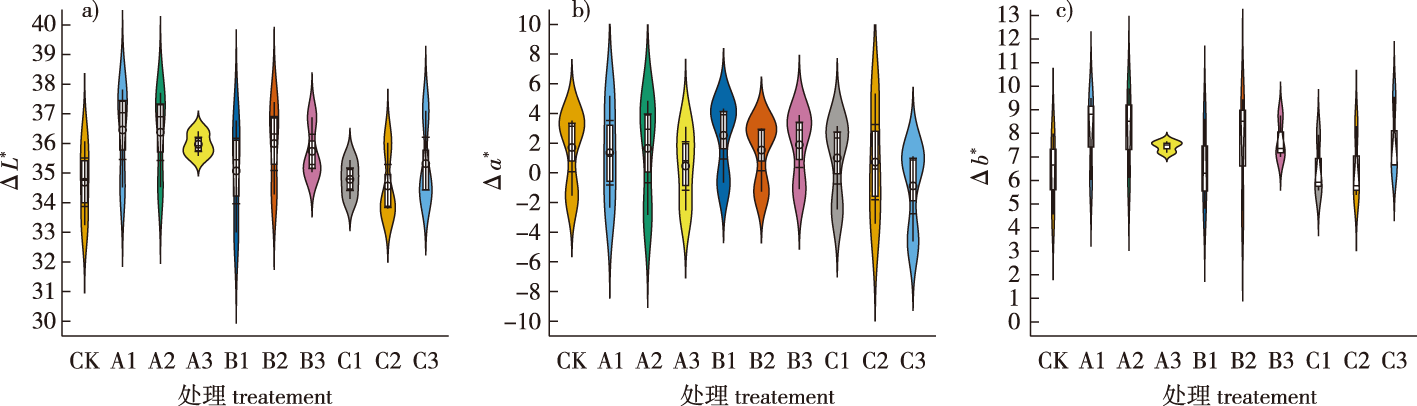
【目的】探究不同时期喷施不同浓度磷酸二氢钾(KH2PO4)对娜塔栎(Quercus texana)叶片呈色的影响,阐明磷、钾元素与叶色变化的关系,为娜塔栎在长江流域的景观应用提供理论依据与技术支撑。【方法】以6年生娜塔栎实生苗为试材,在不同时期对其叶面喷施不同浓度的KH2PO4溶液。采用色差仪测定叶片L*、a*、b*色差空间参数(CIE),计算明亮度(ΔL*)、红度值(Δa*)、黄度值(Δb*);同步测定叶绿素、花色素苷及可溶性糖含量,综合分析生理指标与叶色的关联性。【结果】① 8月30日喷施0.4% KH2PO4处理的叶片娜塔栎叶片ΔL*(明亮度)提升最高;8月30日喷施0.6% KH2PO4处理的叶片Δb*(黄度)增加最高;9月15日喷施0.4%KH2PO4处理的叶片Δa*(红度)增幅最大。② 随生育期推进,叶绿素含量持续下降,花色素苷含量及花色素苷含量与叶绿素含量比值(K值)整体上升,可溶性糖含量呈先升后降趋势。③ 指标相关性分析表明:b*值与L*值呈显著正相关(P<0.05),a*值与花色素苷含量呈显著正相关(P<0.05),花色素苷含量与叶绿素含量呈负相关,花色素苷/叶绿素比值与叶绿素含量呈显著负相关(P<0.05),花色素苷含量与可溶性糖含量呈极显著正相关(P<0.01)。④ 主成分分析提取2个主成分,累计贡献率79.8%,其中PC1贡献率52.6%。基于隶属函数法综合评价显示,9月15日喷施0.8% KH2PO4处理的综合效果最优(D值最高)。【结论】通过生理指标与叶色参数的关联分析,确定9月15日叶面喷施0.8% KH2PO4为最佳处理方案,可显著提升娜塔栎秋季叶色表现。
【Objective】The study aims to explore the effects of spraying potassium dihydrogen phosphate (KH2PO4) at different concentrations and periods on the leaf color of Quercus texana. The relationship between phosphorus and potassium nutrition and leaf color change is elucidated, thereby providing a theoretical basis and technical support for the landscape application of Q. texana in the Yangtze River Basin.【Method】Six-year-old seedlings of Q. texana were sprayed with different concentrations of potassium dihydrogen phosphate solution at different growth stages. The CIE L*, a* and b* color space parameters of leaves were measured using a colorimeter, and the brightness difference (ΔL*), red-green difference (Δa*), and yellow-blue difference (Δb*) were then calculated. Concurrently, the contents of chlorophyll, anthocyanin and soluble sugar were determined. Finally, the correlations between physiological indexes and leaf color was comprehensively analyzed.【Result】(1) The ΔL* (brightness) increase was maximized by spraying 0.4% KH2PO4 on August 30, and the Δb* (yellowness) increase was maximized by spraying 0.6% KH2PO4 on August 30, whereas the Δa* (redness) enhancement was maximized by spraying 0.4% KH2PO4 on September 15.(2) As the growth period progressed, a decline in chlorophyll content was observed, accompanied by an increase in anthocyanin content and the anthocyanin/chlorophyll ratio (K value). The soluble sugar content initially increased and then decreased. (3) The researchers found signifficantly positively correlated between the b* value and the L* value (P<0.05), as well as a significant positive correlation between the a* value and the anthocyanin content (P<0.05). In addition, a negative correlation was observed between anthocyanin and chlorophyll (P<0.05), and a significant positive correlation was observed between anthocyanin and soluble sugar content (P<0.01). (4)Principal component analysis (PCA) extracted two principal components, with a cumulative contribution rate of 79.8%, of which the first component (PC1) contributed 52.6%. The comprehensive evaluation, based on the membership function method, showed that the comprehensive effect of spraying 0.8% KH2PO4 on September 15 was the best (with the highest D value).【Conclusion】Through the correlation analysis of physiological indexes and leaf color parameters, it was determined that the optimum treatment scheme for significanlty improve the leaf color performance of Q. texana in autumn was through the application of 0.8% KH2PO4 on September 15.
娜塔栎 / 磷酸二氢钾(KH2PO4) / 叶色差 / 生理指标 / 主成分分析(PCA)
Quercus texana / KH2PO4 / leaf color difference / physiological index / principal component analysis (PCA)
| [1] |
许志钊, 杨秀云, 王祎琛, 等. 黄连木变色期叶片色素变化规律及呈色机理[J]. 南京林业大学学报(自然科学版), 2024, 48(2): 97-104.
|
| [2] |
刘振平, 张吉立, 张金安, 等. 营养元素对紫叶矮樱叶片色素性质及光合特性的影响[J]. 北方园艺, 2010(2): 104-106.
|
| [3] |
胡静静, 沈向, 李雪飞, 等. 黄连木秋季叶色变化与可溶性糖和矿质元素的关系[J]. 林业科学, 2010, 46(2): 80-86.
|
| [4] |
于伟. 不同遮荫度对 ‘红叶' 南天竹 (Nandina domestica ‘Hongye') 叶色的影响[D]. 雅安: 四川农业大学, 2017.
|
| [5] |
周开兵, 梁柱, 黄海林. 叶面喷施磷、钾、钙对三月红荔枝果实品质和着色的影响[J]. 亚热带植物科学, 2007, 36(1): 27-30, 35.
|
| [6] |
张敏, 钱猛, 倪竞德, 等. 乌桕秋叶转色前后生理特性及超微结构的变化[J]. 东北林业大学学报, 2012, 40(1): 20-24.
|
| [7] |
倪铭, 高振洲, 吴文, 等. 不同氮素施肥方法对纳塔栎容器苗生长及非结构性碳水化合物积累的影响[J]. 南京林业大学学报(自然科学版), 2021, 45(4): 107-113.
|
| [8] |
卜晓婷, 付威, 李淑娴, 等. 幼化和外源激素对娜塔栎嫩枝扦插生根的影响及其生根解剖学观察[J]. 南京林业大学学报(自然科学版), 2024, 48(2): 129-136.
|
| [9] |
李宏归. 娜塔栎对盐胁迫的生理响应及赤霉素的缓解作用研究[D]. 长沙: 中南林业科技大学, 2022.
|
| [10] |
安然. 北美栎树叶色变化的生理基础及花青素积累的转录组学初探[D]. 泰安: 山东农业大学, 2020.
Physiological basis of leaf coloration and transcriptomic analysis for anthocyanin accumulation in north American oak[D]. Tai'an: Shandong Agricultural University, 2020.DOI:10.27277/d.cnki.gsdnu.2020.000166.
|
| [11] |
高俊凤. 植物生理学实验指导[M]. 北京: 高等教育出版社, 2006.
|
| [12] |
唐前瑞, 陈德富, 陈友云, 等. 红檵木叶色变化的生理生化研究[J]. 林业科学, 2006, 42(2): 111-115.
|
| [13] |
李合生. 现代植物生理学[M]. 2版. 北京: 高等教育出版社, 2006.
|
| [14] |
丁丽萍, 马力, 占玉芳, 等. 基于主成分分析的不同激素处理下宁夏枸杞扦插生根效果的综合评价[J]. 经济林研究, 2017, 35(2): 110-115.
|
| [15] |
魏媛, 闫伟, 杨瑞. 四种秋色叶树种转色期叶色变化的生理特性[J]. 现代园艺, 2014(7): 17-19.
|
| [16] |
李永进, 张浩, 李邯, 等. 基于Lab特征值的元宝枫叶片呈色模式分析[J/OL]. 分子植物育种, 2023: 1-10. (2023-08-10).
|
| [17] |
齐睿. 彩叶植物叶片转色期叶色表达与色素含量关系研究[D]. 郑州: 河南农业大学, 2019.
|
| [18] |
|
| [19] |
曲扬, 谢华, 曲文章, 等. 不同NPK营养水平对甜菜营养、光合效率及产量形成的影响 (二) NPK营养水平对甜菜营养状况的影响[J]. 中国甜菜糖业, 2012(4): 1-8.
|
| [20] |
王立华, 孙杰, 杜永江. 肥料三要素对玉米杂交制种的生理作用[J]. 玉米科学, 2002, 10(S1): 82-85.
|
| [21] |
|
| [22] |
赵东辉, 高玉福, 荣立苹, 等. 紫花槭秋季叶片呈色生理变化研究[J]. 经济林研究, 2019, 37(2): 114-119.
|
| [23] |
安然, 王树凤, 陈益泰, 等. 栎树秋季叶色多样性及相关生理特性的变化[J]. 林业科学研究, 2022, 35(2): 78-88.
|
| [24] |
张瑞粉. 中红杨叶色变化规律及外施KH2PO4对叶色影响的研究[D]. 郑州: 河南农业大学, 2010.
|
| [25] |
左云. 施肥和遮荫对乌桕叶色变化的影响[D]. 南京: 南京林业大学, 2017.
|
/
| 〈 |
|
〉 |