盐胁迫对4个杜梨半同胞家系幼苗的影响及耐盐机理研究

于晓晶, 缪李飞, 杨甲定, 封超年

南京林业大学学报(自然科学版) ›› 2026, Vol. 50 ›› Issue (2) : 107-118.

PDF(2388 KB)
PDF(2388 KB)
南京林业大学学报(自然科学版) ›› 2026, Vol. 50 ›› Issue (2) : 107-118. DOI: 10.12302/j.issn.1000-2006.202408035
研究论文

盐胁迫对4个杜梨半同胞家系幼苗的影响及耐盐机理研究

作者信息 +

Effects of salt stress on seedlings of four half-sib families of Pyrus betutifolia and the mechanisms of salt tolerance

Author information +
文章历史 +

摘要

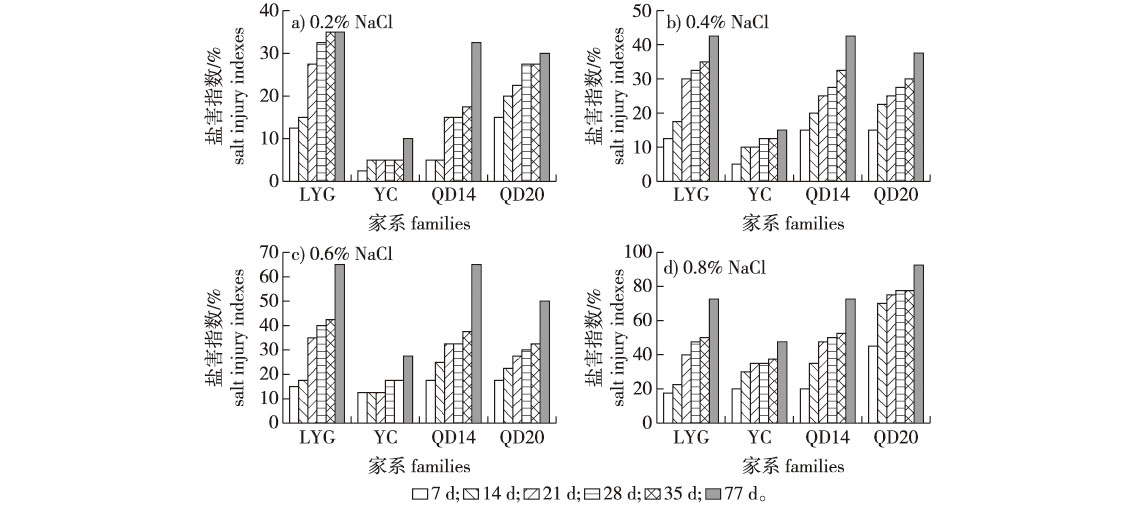
【目的】比较杜梨(Pyrus betutifolia)4个半同胞家系(YC、LYG、QD14、QD20)的耐盐能力,分析其耐盐机制,为沿海地区杜梨种质筛选、种植和推广提供科学依据。【方法】以滨海地区的4个杜梨半同胞家系幼苗为材料,采用盆栽法进行77 d NaCl处理(设置0、0.2%、0.4%、0.6%和0.8% 5个质量分数梯度,以NaCl质量占土壤饱和含水质量百分比计),测定并比较各家系的盐害指数、叶片数、总根长、根表面积、根总体积、根系活力、可溶性糖与脯氨酸含量,以及叶、茎、根中Na+、K+、Ca2+含量与K+/Na+(质量比,下同)、Ca2+/Na+。【结果】随着NaCl浓度升高,盐害指数逐渐上升,植株地上与地下部生长指标及根系活力总体呈下降趋势,但YC家系的部分生长指标在低盐条件下表现出促进效应。叶片中可溶性糖和脯氨酸含量随盐浓度增加而持续积累。叶、茎、根中Na+含量均随盐浓度上升而增加,高盐处理下增幅尤为显著;K+与Ca2+含量则多呈先升后降的变化趋势。叶片和根部K+/Na+、Ca2+/Na+均随盐浓度升高而显著下降。不同家系对盐胁迫的响应存在显著差异,其中YC家系耐盐性较强,其根系对Na+具有较高的截留能力,能够有效限制Na+向地上部运输,从而减轻离子毒害。【结论】在盐胁迫条件下,不同杜梨家系的耐盐性存在显著差异,其中YC家系耐盐性最强,LYG和QD14不耐长期盐胁迫,QD20家系不耐高盐胁迫。杜梨主要通过将Na+限制在根部来维持地上部较低的Na+水平,同时稳定K+与Ca2+含量,以减轻盐胁迫对叶片等关键器官的伤害。

Abstract

【Objective】This study aims to compare the salt tolerance among four half-sib families of Pyrus betutifolia (YC, LYG, QD14 and QD20) by measuring relevant growth and physiological indicators, and to analyze their salt tolerance mechanisms, thereby providing a scientific basis for the selection, cultivation and promotion of P. betutifolia germplasm in coastal regions.【Method】Seeds of P. betutifolia were collected from three coastal regions: Qingdao, Shandong Province, Lianyungang, Jiangsu Province, and Yancheng, Jiangsu Province. All collection sites were located within 30 km of the coastline. Seeds were harvested from healthy, superior mother trees older than 10 years, and only current-year seeds were gathered. Four half-sib families of P. betutifolia, designated as QD14, QD20, LYG and YC, were established from the collected seeds. The experiment was conducted at the Baima Teaching and Research Base of Nanjing Forestry University, located in Baima Town, Lishui District, Nanjing. On January 20, 2019, healthy seeds from the four half-sib families of P. betutifolia, which were plump and free from pests and diseases, were selected and subjected to low-temperature stratification in sand to promote germination. Subsequently, the seeds were germinated at room temperature. After germination, the seeds were transplanted into plastic pots containing a growth medium (the volume ratio of organic nutrient soil to perlite is 9∶1; dry mass 150 g). On June 20, 2019, uniformly healthy seedlings with consistent plant height and ground diameter were selected and irrigated with saline solutions at concentrations of 0, 0.2%, 0.4%, 0.6% and 0.8% (mass fraction, where the NaCl mass was calculated as a percentage of the saturated water content of the soil). For each family and each NaCl concentration treatment, a total of 40 seedlings were utilized. Measurements of the salt injury index, root activity, leaf number, root growth indicators (total root length, root surface area, total root volume), soluble sugar and proline contents in leaves, as well as Na+, K+ and Ca2+ contents in leaves, stems and roots were conducted on days 7, 14, 21, 28, 35 and 77 after treatment initiation.【Result】With increasing salt concentration, the salt injury index showed a progressive rise, whereas the growth parameters of both above-and below-ground organs, as well as root activity, declined gradually. However, certain growth traits in the YC family, along with some below-ground growth parameters in the QD14 and QD20 families, exhibited a mild stimulatory effect under low salt conditions. As the salt concentration increased, the contents of soluble sugar and proline in the leaves, as well as the Na+ content in the leaves, stems and roots, exhibited a gradual upward trend. In all four P. betutifolia families and across most NaCl treatments, the root consistently displayed the highest Na+ accumulation. An exception was observed in the LYG family under 0.8% NaCl treatment, where the Na+ content in the leaves exceeded that in both the stems and roots. The contents of K+ and Ca2+ generally exhibited an initial increase followed by a decrease under increasing salt stress. In both leaves and roots, the ratios of K+/Na+ and Ca2+/Na+ decreased significantly as the salt concentration rose. Growth and physiological parameters varied considerably among the different families of P. betutifolia in response to elevated salt concentrations. Among the four families evaluated, the YC family demonstrated relatively superior performance in both above-ground and below-ground parts, maintaining higher levels across multiple growth and physiological indicators under salt stress conditions.【Conclusion】Among the four families evaluated, the YC family exhibited the strongest salt tolerance to salt stress compared to the others. In contrast, the LYG and QD14 families showed could not tolerate long-term salt exposure, while the QD20 family was could not tolerate high salt concentrations. Under salt stress conditions, P. betutifolia primarily restricted Na+ accumulation within the root system, thereby maintaining relatively low Na+ levels in above-ground tissues. Concurrently, the contents of K+ and Ca2+ remained relatively stable, which contributed to the mitigation of salt-induced damage to leaves and other aerial organs.
关键词

盐胁迫 / 杜梨 / 半同胞家系 / 耐盐能力 / 根系 / 离子分布

Key words

salt stress / Pyrus betutifolia / half-sib family / salt tolerance / root / ion distribution

引用本文

导出引用
于晓晶, 缪李飞, 杨甲定, . 盐胁迫对4个杜梨半同胞家系幼苗的影响及耐盐机理研究[J]. 南京林业大学学报(自然科学版). 2026, 50(2): 107-118 https://doi.org/10.12302/j.issn.1000-2006.202408035
YU Xiaojing, MIAO Lifei, YANG Jiading, et al. Effects of salt stress on seedlings of four half-sib families of Pyrus betutifolia and the mechanisms of salt tolerance[J]. Journal of Nanjing Forestry University (Natural Sciences Edition). 2026, 50(2): 107-118 https://doi.org/10.12302/j.issn.1000-2006.202408035
中图分类号: S725   

参考文献

[1]
赵可夫, 李法曾, 张福锁. 中国盐生植物[M]. 2版. 北京: 科学出版社, 2013.
ZHAO K F, LI F Z, ZHANG F S. Halophytes in China[M]. 2nd ed. Beijing: Science Press, 2013.
[2]
杨真, 王宝山. 中国盐渍土资源现状及改良利用对策[J]. 山东农业科学, 2015, 47(4):125-130.
YANG Z, WANG B S. Present status of saline soil resources and countermeasures for improvement and utilization in China[J]. Shandong Agricultural Sciences, 2015, 47(4):125-130. DOI: 10.14083/j.issn.1001-4942.2015.04.032.
[3]
RUBTSOV G A. Geographical distribution of the genus Pyrus and trends and factors in its evolution[J]. The American Naturalist, 1944, 78(777):358-366. DOI: 10.2307/2458066.
[4]
王德芬, 谭俊超, 李鼎立, 等. 四种野生梨离体培养体系的建立及耐盐性比较[J]. 北方园艺, 2015(21):102-106.
WANG D F, TAN J C, LI D L, et al. Establishment of the system in vitro culture and comparison of salt tolerance in 4 species of wild pear[J]. Northern Horticulture, 2015(21):102-106. DOI: 10.11937/bfyy.201521027.
[5]
ROBBANI M, BANNO K, YAMAGUCHI K, et al. Selection of dwarfing pear rootstock clones from Pyrus betutifolia and P. calleryana seedlings[J]. Journal of the Japanese Society for Horticultural Science, 2006, 75(1):1-10. DOI: 10.2503/jjshs.75.1.
[6]
赵亚楠, 张懿, 谭旭, 等. 杜梨组培苗两步生根技术体系优化[J]. 中国农业大学学报, 2021, 26(11):105-112.
ZHAO Y N, ZHANG Y, TAN X, et al. Optimizing two-step rooting techniques of in vitro cultured Pyrus betulifolia[J]. Journal of China Agricultural University, 2021, 26(11):105-112. DOI: 10.11841/j.issn.1007-4333.2021.11.10.
[7]
李承秀, 燕语, 程甜甜, 等. 中国北方4省区杜梨古树等种质资源调查[J]. 江苏林业科技, 2021, 48(4):45-48.
LI C X, YAN Y, CHENG T T, et al. Investigation of germplasm resources of Pyrus betulifolia in north region of China[J]. Journal of Jiangsu Forestry Science & Technology, 2021, 48(4):45-48. DOI: 10.3969/j.issn.1001-7380.2021.04.009.
[8]
李晓庆, 王星斗, 樊艳, 等. 盐胁迫对杜梨吸收根生长指标的影响[J]. 山西农业大学学报(自然科学版), 2021, 41(5):62-67.
LI X Q, WANG X D, FAN Y, et al. Effects of salt stress on the growth index of absorbing roots of Pyrus betulifolia[J]. Journal of Shanxi Agricultural University (Natural Science Edition), 2021, 41(5):62-67. DOI: 10.13842/j.cnki.issn1671-8151.202105048.
[9]
霍宏亮, 王超, 杨祥, 等. 杜梨对盐碱胁迫的生理响应及耐盐碱性评价[J]. 植物遗传资源学报, 2022, 23(2):480-492.
HUO H L, WANG C, YANG X, et al. Physiological response and saline-alkali tolerance evaluation of Pyrus betulifolia resources under saline-alkali stress[J]. Journal of Plant Genetic Resources, 2022, 23(2):480-492. DOI: 10.13430/j.cnki.jpgr.20210918001.
[10]
张艳, 田嘉, 张峰, 等. 梨FWL5基因克隆及表达分析[J]. 分子植物育种, 2022, 20(15):4940-4947.
ZHANG Y, TIAN J, ZHANG F, et al. Cloning and expression analysis of FWL5 gene in pear[J]. Molecular Plant Breeding, 2022, 20(15):4940-4947. DOI: 10.13271/j.mpb.020.004940.
[11]
靳丛, 郭巧会, 陈国栋, 等. 杜梨精氨酸脱羧酶基因PbADC的克隆与表达分析[J]. 核农学报, 2021, 35(2):306-313.
JIN C, GUO Q H, CHEN G D, et al. Cloning and expression analysis of PbADC in Pyrus betulifolia[J]. Journal of Nuclear Agricultural Sciences, 2021, 35(2):306-313. DOI: 10.11869/j.issn.100-8551.2021.02.0306.
[12]
缪李飞, 于晓晶, 张秋悦, 等. 4个杜梨半同胞家系苗期耐盐性分析[J]. 南京林业大学学报(自然科学版), 2020, 44(5):157-166.
MIAO L F, YU X J, ZHANG Q Y, et al. Salt tolerance of four half-sib families of Pyrus betutifolia Bunge from coastal areas[J]. Journal of Nanjing Forestry University (Natural Sciences Edition), 2020, 44(5):157-166. DOI: 10.3969/j.issn.1000-2006.202003044.
[13]
查霞娟, 孙岚, 肖崇彬, 等. 苹果砧木耐盐性比较试验[J]. 中国果树, 1986(2):5-9.
ZHA X J, SUN L, XIAO C B, et al. Comparative experiment on salt tolerance of apple rootstock[J]. China Fruits, 1986(2):5-9. DOI: 10.16626/j.cnki.issn1000-8047.1986.02.002.
[14]
李合生. 植物生理生化实验原理和技术[M]. 北京: 高等教育出版社, 2000.
LI H S. Principles and techniques of plant physiological biochemical experiment[M]. Beijing: Higher Education Press, 2000.
[15]
胡晓立, 李彦慧, 陈东亮, 等. 3种李属彩叶植物对NaCl胁迫的生理响应[J]. 西北植物学报, 2010, 30(2):370-376.
HU X L, LI Y H, CHEN D L, et al. Physiological responses of three colored-leaf species of Prunus under NaCl stress[J]. Acta Botanica Boreali-Occidentalia Sinica, 2010, 30(2):370-376.
[16]
杨佳鑫, 李庆卫, 郭子燕, 等. 3个梅花品种幼苗耐盐性综合评价[J]. 西北农林科技大学学报(自然科学版), 2019, 47(8):65-74.
YANG J X, LI Q W, GUO Z Y, et al. Comprehensive evaluation on salt tolerance of three Prunus mume varieties[J]. Journal of Northwest A & F University (Natural Science Edition), 2019, 47(8):65-74. DOI: 10.13207/j.cnki.jnwafu.2019.08.009.
[17]
STOREY R, WALKER R R. Citrus and salinity[J]. Scientia Horticulturae, 1998, 78(1/2/3/4):39-81. DOI: 10.1016/S0304-4238(98)00190-3.
[18]
王树凤, 胡韵雪, 孙海菁, 等. 盐胁迫对2种栎树苗期生长和根系生长发育的影响[J]. 生态学报, 2014, 34(4):1021-1029.
WANG S F, HU Y X, SUN H J, et al. Effects of salt stress on growth and root development of two oak seedlings[J]. Acta Ecologica Sinica, 2014, 34(4):1021-1029. DOI: 10.5846/stxb201209291363.
[19]
於朝广, 李颖, 谢寅峰, 等. NaCl胁迫对中山杉幼苗生长及离子吸收、运输和分配的影响[J]. 植物生理学报, 2016, 52(9):1379-1388.
YU C G, LI Y, XIE Y F, et al. Effects of Na Cl stress on growth and absorption,transportation and distribution of ions in Zhongshanshan seedlings[J]. Plant Physiology Journal, 2016, 52(9):1379-1388. DOI: 10.13592/j.cnki.ppj.2016.0272.
[20]
LAMERS J, VAN DER MEER T, TESTERINK C. How plants sense and respond to stressful environments[J]. Plant Physiology, 2020, 182(4):1624-1635. DOI: 10.1104/pp.19.01464.
[21]
ZENDA T, LIU S T, WANG X, et al. Comparative proteomic and physiological analyses of two divergent maize inbred lines provide more insights into drought-stress tolerance mechanisms[J]. International Journal of Molecular Sciences, 2018, 19(10):3225. DOI: 10.3390/ijms19103225.
[22]
OLIVER M J, JAIN R, BALBUENA T S, et al. Proteome analysis of leaves of the desiccation-tolerant grass,Sporobolus stapfianus,in response to dehydration[J]. Phytochemistry, 2011, 72(10):1273-1284. DOI: 10.1016/j.phytochem.2010.10.020.
[23]
翟晨蕾, 刘文娟, 张霞, 等. 玉米抗旱突变体edt1抗旱机制的初步解析[J]. 植物生理学报, 2018, 54(1):103-112.
ZHAI C L, LIU W J, ZHANG X, et al. Dissection of drought tolerance mechanism in maize EMS mutant edt1[J]. Plant Physiology Journal, 2018, 54(1):103-112. DOI: 10.13592/j.cnki.ppj.2017.0133.
[24]
郭楠楠, 陈学林, 张继, 等. 柽柳组培苗抗氧化酶及渗透调节物质对NaCl胁迫的响应[J]. 西北植物学报, 2015, 35(8):1620-1625.
GUO N N, CHEN X L, ZHANG J, et al. Changes in antioxidase activity and osmotic adjusting substance of Tamarix chinensis seedlings under NaCl stress[J]. Acta Botanica Boreali-Occidentalia Sinica, 2015, 35(8):1620-1625. DOI: 10.7606/j.issn.1000-4025.2015.08.1620.
[25]
ZHU J K. Plant salt tolerance[J]. Trends in Plant Science, 2001, 6(2):66-71. DOI: 10.1016/S1360-1385(00)01838-0.
[26]
李霞, 高树桃, 吴红, 等. NaCl胁迫对3个桂花品种离子吸收和运输的影响[J]. 江苏农业科学, 2022, 50(23):116-122.
LI X, GAO S T, WU H, et al. Impacts of NaCl stress on ion absorption and transportation of three Osmanthus cultivars[J]. Jiangsu Agricultural Sciences, 2022, 50(23):116-122. DOI: 10.15889/j.issn.1002-1302.2022.23.017.
[27]
郝汉, 曹磊, 陈伟楠, 等. 盐胁迫对槲树(Quercus dentata)幼苗离子平衡及其生理生化特性的影响[J]. 生态学报, 2020, 40(19):6897-6904.
HAO H, CAO L, CHEN W N, et al. Effects of salt stress on the ion balance and physiological-biochemical characteristics of Quercus dentata seedlings[J]. Acta Ecologica Sinica, 2020, 40(19):6897-6904. DOI: 10.5846/stxb201906211314.
[28]
罗达, 吴正保, 史彦江, 等. 盐胁迫对3种平欧杂种榛幼苗叶片解剖结构及离子吸收、运输与分配的影响[J]. 生态学报, 2022, 42(5):1876-1888.
LUO D, WU Z B, SHI Y J, et al. Effects of salt stress on leaf anatomical structure and ion absorption,transportation and distribution of three Ping’ou hybrid hazelnut seedlings[J]. Acta Ecologica Sinica, 2022, 42(5):1876-1888. DOI: 10.5846/stxb202102260542.
[29]
李焕勇, 唐晓倩, 杨秀艳, 等. NaCl处理对西伯利亚白刺幼苗中矿质元素含量的影响[J]. 植物生理学报, 2017, 53(12):2125-2136.
LI H Y, TANG X Q, YANG X Y, et al. Effects of Na Cl stress on mineral element contents in Nitraria sibirica seedlings[J]. Plant Physiology Journal, 2017, 53(12):2125-2136. DOI: 10.13592/j.cnki.ppj.2017.0212.
[30]
刘正祥, 张华新, 杨秀艳, 等. NaCl胁迫下沙枣幼苗生长和阳离子吸收、运输与分配特性[J]. 生态学报, 2014, 34(2):326-336.
LIU Z X, ZHANG H X, YANG X Y, et al.Growth,and cationic absorption,transportation and allocation of Elaeagnus angustifolia seedlings under NaCl stress[J]. Acta Ecologica Sinica, 2014, 34(2):326-336. DOI: 10.5846/stxb201303270530.
[31]
LIU J, ZHU J K. A calcium sensor homolog required for plant salt tolerance[J]. Science, 1998, 280(5371):1943-1945. DOI: 10.1126/science.280.5371.1943.
[32]
乌凤章, 王贺新. 盐胁迫对高丛越橘幼苗生长及离子平衡的影响[J]. 生态学杂志, 2019, 38(11):3335-3341.
WU F Z, WANG H X. Effects of salt stress on growth and ion homeostasis of highbush blueberry seedlings[J]. Chinese Journal of Ecology, 2019, 38(11):3335-3341. DOI: 10.13292/j.1000-4890.201911.031.
[33]
雷志华, 陈军营, 陈新建. 钙依赖蛋白激酶(CDPKs)在植物钙信号转导中的生理功能[J]. 福建林业科技, 2007, 34(3):244-249,254.
LEI Z H, CHEN J Y, CHEN X J. The physiological functions of calcium-dependent protein kinases in plant calcium signal transduction[J]. Journal of Fujian Forestry Science and Technology, 2007, 34(3):244-249,254. DOI: 10.13428/j.cnki.fjlk.2007.03.061.
[34]
MITTLER R. Oxidative stress,antioxidants and stress tolerance[J]. Trends in Plant Science, 2002, 7(9):405-410. DOI: 10.1016/S1360-1385(02)02312-9.
[35]
韩金龙, 李慧, 蔺经, 等. 核黄素对盐胁迫下杜梨叶片抗氧化系统的影响[J]. 江苏农业学报, 2015, 31(4):893-898.
HAN J L, LI H, LIN J, et al. The regulatory role of riboflavin in antioxidant system of Pyrus betutifolia in response to salt tolerance[J]. Jiangsu Journal of Agricultural Sciences, 2015, 31(4):893-898. DOI: 10.3969/j.issn.1000-4440.2015.04.029.

基金

宿迁市科技计划项目(K202436)
江苏省农业科技自主创新资金项目(CX(16)1005)
宿迁学院人才引进科研启动基金项目(校2025XRC012)

责任编辑: 吴祝华
PDF(2388 KB)

Accesses

Citation

Detail

段落导航
相关文章

/