PDF(1800 KB)
 PDF(1800 KB)
 PDF(1800 KB)
注干施用3种药剂防治松材线虫病研究
Study on the control of Bursaphelenchus xylophilus by trunk injection with three kinds of agents
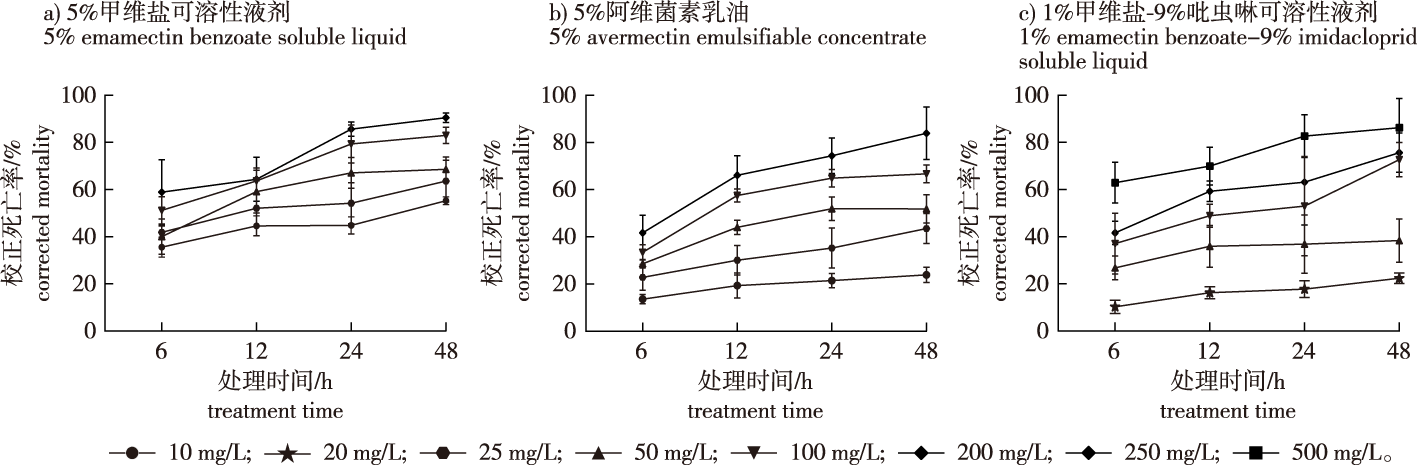
【目的】确定不同药剂注干后在松树体内的输导残留情况及防病效果,筛选出持效性强、防治效果好的树干注射剂,为树干注射预防松材线虫病提供基础数据。【方法】采用浸虫法测定5%(体积分数,下同)甲维盐可溶性液剂、5%阿维菌素乳油和1%甲维盐-9%吡虫啉可溶性液剂等3种药剂对松材线虫(Bursaphelenchus xylophilus)的室内毒杀效果;将3种药剂以亚致死浓度LC20喷洒至灰葡萄孢(Botrytis cinerea)上,以无菌水为对照,接种松材线虫来检测其对线虫取食繁殖的影响;在林间用3种药剂进行树干注射,分析注干1 a和660 d后药剂在马尾松体内输导残留情况。于注干后次年6月对注干马尾松进行二次人工接种松材线虫,观察统计注干1 a后对松材线虫病的防病效果。【结果】5%甲维盐可溶性液剂、5%阿维菌素乳油和1%甲维盐-9%吡虫啉可溶性液剂3种药剂处理线虫24 h后的致死中浓度(LC50)分别为10.879 8、57.008 7、93.693 9 mg/L。在喷洒了亚致死浓度LC20药剂的灰葡萄孢上接种线虫,3种药剂均能显著抑制线虫的取食速率,还能显著降低线虫的种群数量(分别为333、466和500条/皿,对照为47 766条/皿),其差异显著。在3种药剂注干1 a后,均由注药点位置往上输导,除5%阿维菌素乳油外,其他两种均能在顶梢检测到药剂的存在,其中5%甲维盐可溶性液剂残留含量(质量分数)为0.006 3 mg/kg;复配药剂中吡虫啉残留含量(质量分数)最高,为0.213 0 mg/kg;甲维盐残留含量(质量分数)为0.082 3 mg/kg。甲维盐与复配药剂中的吡虫啉分别在注干点以上2.0 m与0.5 m处存在药量的蓄积,含量远远高出其他部位,其残留含量(质量分数)分别为12.863 6、128.395 2 mg/kg。注干660 d后,树体内各药剂残留含量较上年有所减少,但各药剂均在顶梢能检测到残留,其中复配药剂总残留含量(质量分数)最高为0.125 1 mg/kg,甲维盐残留含量(质量分数)为0.074 1 mg/kg,阿维菌素残留含量(质量分数)为0.012 4 mg/kg。与注干1 a时的结果相比,随着高度的增加,甲维盐可溶性液剂与复配药剂不再出现某个部位药残量最高的情况,而是残留含量逐渐减少。对注干450 d后的松树人工接种松材线虫,枝条接种75 d后调查,在5%甲维盐可溶性液剂、5%阿维菌素乳油和1%甲维盐-9%吡虫啉可溶性液剂注干的松树上,防病效果均为100%。继续观察发现,5%阿维菌素乳油的预防效果明显更好。【结论】5%甲维盐可溶性液剂、5%阿维菌素乳油和1%甲维盐-9%吡虫啉可溶性液剂等3种药剂对松材线虫不仅具有较强的毒杀能力,而且注干后在松树体内具有良好的输导性和持久性。同时,在预防松材线虫感染方面,都在注干第2年仍然具有较好的预防性效果。在本试验的3种药剂中,又以5%阿维菌素乳油有更好的林间防效,可在林区内进行大面积推广和应用。
【Objective】This study aimed to evaluate the conduction residues and disease prevention efficacy of different chemicals in pine trees following trunk injection and identify trunk injections with strong persistence and effective control, providing a theoretical basis for the use of trunk injections to prevent pine wood nematode (Bursaphelenchus xylophilus).【Method】The insecticidal efficacy of 5% emamectin benzoate soluble liquid, 5% avermectin emulsifiable concentrate, and 1% emamectin benzoate-9% imidacloprid soluble liquid on B. xylophilus was assessed using the dipping method. The sublethal concentration (LC20) of each pesticide was applied to Botrytis cinerea and inoculated with B. xylophilus to assess their effects on nematode feeding and reproduction. Subsequently, these pesticides were injected into the trunks of Pinus massoniana in the forest, and the translocation of residues within the trees was analyzed one year and 660 days after injection. In June of the second year (2022), P. massoniana was artificially inoculated with B. xylophilus, and the disease prevention effect was observed and statistically analyzed one year after the injection.【Result】After 24 hours of treatment, the LC50 values for the three agents were determined to be 10.879 8 mg/L, 57.008 7 mg/L, and 93.693 9 mg/L, respectively. When B. cinerea was inoculated with nematodes and treated with sublethal concentrations (LC20) of these pesticides, all three significantly inhibited nematode feeding rates and reduced nematode populations (333, 466, and 500 nematodes, respectively, compared to 47 766 nematodes/dish in the control). One year after injection, the pesticides were found to translocate upward from the injection sites in P. massoniana. Residual amounts were detected in the upper branches, except for the 5% avermectin emulsifiable concentrate. Among the treatments, the 5% emamectin benzoate soluble liquid exhibited the lowest residual concentration at 0.006 3 mg/kg, while the mixed formulation showed the highest residual concentrations of imidacloprid (0.213 0 mg/kg) and emamectin benzoate (0.082 3 mg/kg). These compounds accumulated at higher levels in areas 2.0 m and 0.5 m from the injection points, with concentrations of 12.863 6 mg/kg and 128.395 2 mg/kg, respectively. After 660 days, residual concentrations of all formulations decreased, although residues remained detectable in the upper branches. The highest residual compound concentration was 0.125 1 mg/kg, followed by 5% emamectin benzoate soluble liquid at 0.074 1 mg/kg, and 5% avermectin emulsifiable concentrate at 0.012 4 mg/kg. Unlike the results after one year, where certain areas exhibited the highest residual concentrations for the 5% emamectin benzoate soluble liquid and the mixed formulation, the residual concentrations decreased with height over time. Pine trees inoculated with B. xylophilus 450 days post-injection and analyzed 75 days after inoculation showed a 100% disease prevention rate with all three pesticides. Continuous observation revealed that 5% avermectin emulsifiable concentrate had a significantly better preventive effect.【Conclusion】The three agents-5% emamectin benzoate soluble liquid, 5% avermectin emulsifiable concentrate, and 1% emamectin benzoate-9% imidacloprid soluble liquid—not only exhibit strong toxicity to B. xylophilus but also demonstrate good translocation and persistence in P. massoniana following trunk injection. Additionally, these injections maintain a strong preventive effect against pine wood nematode infection even into the second year. Among the agents tested, 5% avermectin emulsifiable concentrate shows the best overall control efficacy and should be considered for large-scale application in forest management.
松材线虫病 / 树干注射 / 药剂残留 / 防病效果 / 杀线剂 / 甲维盐 / 阿维菌素乳油 / 甲维盐-吡虫啉
pine wilt disease / trunk injection / agent residues / effect of disease prevention / nematicide / emamectin benzoate / avermectin emulsifiable concentrate / emamectin benzoate-imidacloprid
| [1] |
史兴文, 陈绍银. 金寨县松材线虫病防治探究[J]. 南方农业, 2020, 14(23):66-67.
|
| [2] |
孙永春. 南京中山陵发现松材线虫[J]. 江苏林业科技, 1982(4):27-47.
|
| [3] |
苗力, 王禹, 李瑞红, 等. 松材线虫病的危害、传播途径和防控措施[J]. 吉林林业科技, 2023, 52(1):44-45.
|
| [4] |
葛迎春, 韩冰, 张华伟, 等. 树干注射施药技术的应用分析[J]. 现代农村科技, 2020(10):30-31.
|
| [5] |
|
| [6] |
|
| [7] |
李长强, 叶建仁, 张婉君, 等. 注干施用甲维盐防治松材线虫病的研究[J]. 中国植保导刊, 2022, 42(3):16-19.
|
| [8] |
林茂松, 周明国. 2%阿维菌素乳油对松材线虫的生物活性测定[J]. 农药学学报, 2001(3):40-44.
|
| [9] |
|
| [10] |
艾辉建, 刘志明, 黄金玲, 等. 几种杀线剂对南方根结线虫的田间药效试验[J]. 南方农业学报, 2012, 43(7):961-964.
|
| [11] |
谈家金, 杨荣铮, 吴慧平. 不同地理种群的松材线虫对马尾松的致病力差异[J]. 植物检疫, 2000(6):324-325.
|
| [12] |
张扬, 杨鼎超, 李正昀, 等. 高效新型杀松材线虫剂的筛选及其林间防效[J]. 植物保护学报, 2017, 44(5):856-862.
|
| [13] |
张印海. 树干注药技术对松材线虫病的预防效果[J]. 现代园艺, 2023, 46(4):10-11, 30.
|
| [14] |
朱丽华, 林丽, 蒋鹏, 等. 不同致病力松材线虫的繁殖能力和移动能力比较[J]. 东北林业大学学报, 2017, 45(12):76-79.
|
| [15] |
|
| [16] |
|
| [17] |
孙薇, 张立华, 王勇军, 等. 注干施药后黄山松体内甲维盐含量检测及残留动态分析[J]. 浙江林业科技, 2022, 42(4):83-87.
|
| [18] |
张娇, 叶建仁, 陈婷婷, 等. 松材线虫高效复配制剂的药效分析[J]. 南京林业大学学报(自然科学版), 2025, 49(3):73-80.
|
/
| 〈 |
|
〉 |