PDF(2246 KB)

林下植被管理措施对尾巨桉人工林土壤质量的影响
卢澳邹, 张焕朝, 王会利, 庄舜尧, 范美娟, 宋盈盈, 黄晨
南京林业大学学报(自然科学版) ›› 2026, Vol. 50 ›› Issue (2) : 215-224.
PDF(2246 KB)
 PDF(2246 KB)
林下植被管理措施对尾巨桉人工林土壤质量的影响
Effects of understory vegetation management measures on soil quality of Eucalyptus urophylla × grandis plantation
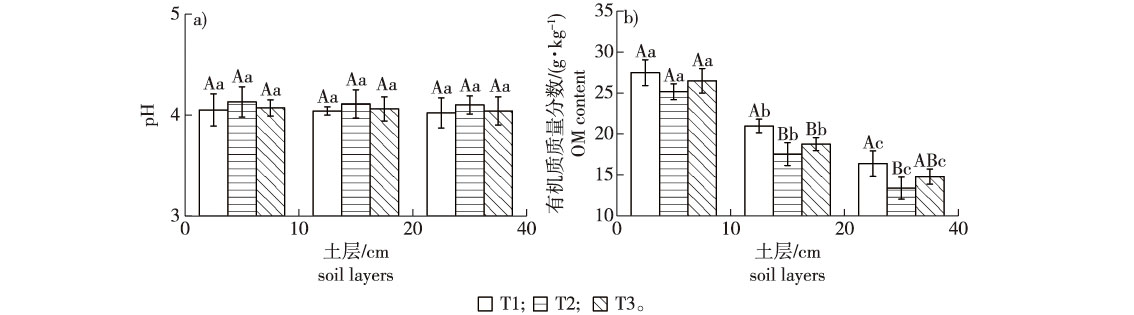
【目的】在长期林分经营中,为了保证目的树种正常生长,通常选择去除人工林的林下植被。研究不同林下植被管理措施对尾巨桉(Eucalyptus urophylla × grandis)人工林土壤理化、生物性质的影响,同时评价土壤质量的变化,为桉树人工林林下植被的科学管理提供理论依据。【方法】以广西壮族自治区南宁市的第4代尾巨桉人工林(林分株行距2 m×3 m)为对象,分别使用人工抚育、除草剂抚育和人工+除草剂抚育等3种处理方法去除尾巨桉人工林的林下植被,于2023年8月采集不同处理林地中[0,10)、[10,20)、[20,40) cm这3个土层的土壤样品,分析不同林下植被管理措施下尾巨桉人工林地的土壤理化及生物性质差异。随后采用全量数据集(TDS)和最小数据集(MDS)对不同林下植被管理措施林地的土壤质量进行综合评价,并通过线性回归分析验证本研究所建立最小数据集的准确性。【结果】不同林下植被管理措施林地的土壤理化、生物性质以及土壤综合质量存在明显差异。人工抚育林地土壤物理性质良好,[0,10)cm土层的土壤密度显著低于人工+除草剂抚育林地,总孔隙度和最大持水量显著高于人工+除草剂抚育林地,而不同林下植被管理措施林地土壤的毛管孔隙度、毛管持水量和田间持水量差异不显著;在[0,40)cm土层,不同林下植被管理措施林地土壤的有机质、全氮、碱解氮、速效钾、微生物生物量碳(MBC)、微生物生物量氮(MBN)和微生物生物量磷(MBP)含量优劣依次为人工抚育>人工+除草剂抚育>除草剂抚育;土壤有效磷含量在不同林下植被管理措施林地的优劣依次为除草剂抚育>人工+除草剂抚育>人工抚育。在同一林下植被管理措施林地中,随着土层深度增加,土壤总孔隙度、非毛管孔隙度、最大持水量和有机质、全氮、全磷、速效养分、微生物生物量养分含量明显降低,土壤密度明显增加。将MBC、MBN、MBP含量作为生物活性指标,结合土壤物理、化学指标构建出由MBP、MBC、毛管持水量、非毛管孔隙度和pH组成的最小数据集,基于最小数据集得到的不同林下植被管理措施林地土壤质量评价结果与基于全量数据集得到的结果一致,土壤质量指数大小排序为人工抚育>人工+除草剂抚育>除草剂抚育。【结论】人工去除林下植被使林地土壤综合质量较好,通过除草剂去除林下植被导致林地土壤质量进一步衰退,在桉树人工林经营中应以人工抚育为主,尽量减少除草剂的使用频率,从而达到维护土壤质量,保证桉树人工林持续高质量经营的目的。
【Objective】Understory vegetation is frequently removed during long-term stand management to promote the growth of target tree species. This study aims to investigate the effects of different understory vegetation management measures on soil physicochemical and biological properties in Eucalyptus urophylla×grandis and to assess associated changes in soil quality, while thereby providing a theoretical basis for the scientific management of Eucalyptus plantation understory vegetation.【Method】The research was conducted in a fourth-generation E. urophylla×grandis plantation (plant spacing: 2 m × 3 m) in Nanning, Guangxi Zhuang Autonomous Region, China. Three understory vegetation removal methods were applied: artificial tending, herbicide tending, and a combination of artificial and herbicide tending. Soil samples were collected in August 2023 from three depth layers [0,10), [10,20), [20,40) cm in plots subjected to each treatment. The samples were analyzed to determine differences in soil physicochemical and biological properties. Soil quality was comprehensively evaluated using the total dataset (TDS) and a minimum dataset (MDS) approach. The accuracy of the newly established MDS was validated through linear regression analysis.【Result】Different understory vegetation management measures led to distinct differences in soil properties and overall soil quality. The forest land soil receiving artificial tending maintained superior physical properties, in the 0-10 cm soil layer, bulk density was significantly lower, while total porosity and maximum water-holding capacity were significantly higher compared to artificial and herbicide tending forest land. However, capillary porosity, capillary water-holding capacity, and field water-holding capacity were not significantly affected by the different understory vegetation management measures. Within the 0-40 cm soil layer, the contents of soil organic matter, total nitrogen, alkaline hydrolyzed nitrogen, available potassium, microbial biomass carbon (MBC), microbial biomass nitrogen (MBN), and microbial biomass phosphorus (MBP) generally followed the order: artificial tending> artificial and herbicide tending > herbicide tending. In contrast, the available phosphorus content showed the opposite trend: herbicide tending> artificial and herbicide tending> artificial tending. With increasing soil depth under the same management practice, total porosity, non-capillary porosity, maximum water-holding capacity, and the contents of organic matter, total nitrogen, total phosphorus, available nutrients, and microbial biomass decreased significantly, whereas bulk density increased significantly. Using soil MBC, MBN, and MBP as key biological indicators, a minimum dataset was constructed, comprising MBP, MBC, capillary water-holding capacity, non-capillary porosity, and pH. Soil quality evaluation based on this MDS yielded results consistent with those from the TDS. The soil quality index under different treatments followed the order: artificial tending> artificial and herbicide tending > herbicide tending.【Conclusion】Artificial removal of understory vegetation maintained better soil quality, whereas herbicide application led to further decline in the soil quality of plantation forests. The management of Eucalyptus plantations should prioritize artificial tending, and herbicide use should be minimized to maintain soil quality and ensure the long-term, high-quality management of these Eucalyptus plantations.
尾巨桉 / 林下植被 / 植被管理 / 最小数据集 / 土壤质量
Eucalyptus urophylla×grandis / understory vegetation / vegetation management / minimum data set / soil quality
| [1] |
曹继钊, 李孝忠. 桉树人工林沃土保育与可持续经营思考[J]. 广西林业科学, 2017, 46(2):233-236.
|
| [2] |
吕世凡, 黄方, 董必珍, 等. 4种木材真菌对桉树采伐剩余物的降解试验[J]. 林业科技通讯, 2017(7):82-85.
|
| [3] |
王会利, 吴秦展, 兰文明, 等. 多代连栽桉树人工林林下植被和土壤物理性状的变化[J]. 中南林业科技大学学报, 2023, 43(2):1-9.
|
| [4] |
陆佳, 王华响, 陈利军. 连栽对桉树土壤稀有微生物群落及多功能性的影响[J]. 生态与农村环境学报, 2025, 41(8):1034-1044.
|
| [5] |
何艺玲, 傅懋毅. 人工林林下植被的研究现状[J]. 林业科学研究, 2002, 15(6):727-733.
|
| [6] |
邱超明. 桉树幼林抚育管理的重要性及解决策略[J]. 农业与技术, 2019, 39(8):71-72.
|
| [7] |
曹光球, 费裕翀, 路锦, 等. 林下植被不同管理措施培育杉木大径材林分土壤酶活性差异及质量评价[J]. 林业科学研究, 2020, 33(3):76-84.
|
| [8] |
|
| [9] |
侯文军, 邹明, 李宝福, 等. 施用草甘膦对桉树人工林土壤理化性质的影响[J]. 林业科学, 2020, 56(8):20-26.
|
| [10] |
周晓果, 左晓庆, 温远光, 等. 除草剂对桉树人工林下植物及土壤微生物群落的影响[J]. 生态学报, 2021, 41(17):6749-6763.
|
| [11] |
张万儒. 森林土壤分析方法[M]. 北京: 中国标准出版社, 1999.
|
| [12] |
李振高, 骆永明, 滕应. 土壤与环境微生物研究法[M]. 北京: 科学出版社, 2008.
|
| [13] |
王艺霖, 梁尧, 蔡红光, 等. 基于最小数据集的不同有机物料还田黑土土壤质量评价[J]. 土壤通报, 2024, 55(1):68-75.
|
| [14] |
梁淑敏, 谢瑞芝, 李朝苏, 等. 成都平原不同耕作模式的农田效应研究:Ⅱ.土壤综合质量评价[J]. 中国农业科学, 2011, 44(4):738-744.
|
| [15] |
李桂林, 陈杰, 孙志英, 等. 基于土壤特征和土地利用变化的土壤质量评价最小数据集确定[J]. 生态学报, 2007, 27(7):2715-2724.
|
| [16] |
蒋林, 覃恒, 邓建英, 等. 不同树种和比例对桉树人工混交林土壤肥力质量的影响[J]. 桉树科技, 2022, 39(2):9-14.
|
| [17] |
王嘉琛, 赵隽宇, 黄康庭, 等. 桂北土壤肥力质量对尾叶桉人工林连栽连作的响应[J]. 西南林业大学学报(自然科学), 2019, 39(1):106-113.
|
| [18] |
|
| [19] |
路鹏, 苏以荣, 牛铮, 等. 土壤质量评价指标及其时空变异[J]. 中国生态农业学报, 2007, 15(4):190-194.
|
| [20] |
程彩云, 薛建辉, 马洁. 基于最小数据集的喀斯特不同类型人工林土壤质量评价[J]. 南京林业大学学报(自然科学版), 2025, 49(2):134-142.
|
| [21] |
|
| [22] |
汪景宽, 徐英德, 丁凡, 等. 植物残体向土壤有机质转化过程及其稳定机制的研究进展[J]. 土壤学报, 2019, 56(3):528-540.
|
| [23] |
曹萌萌, 朱利霞, 赵欣, 等. 外源有机碳输入对林地土壤有机碳矿化的影响[J]. 森林工程, 2025, 41 (3):462-470.
|
| [24] |
贾朋聚, 刘亚敏, 刘玉民, 等. 林下植被对桢楠幼林生长和土壤质量的影响[J]. 森林与环境学报, 2025, 45(1):53-61.
|
| [25] |
张友, 戴全厚, 严友进, 等. 施用草甘膦除草剂对土壤质量影响的研究进展[J]. 水土保持学报, 2023, 37(4):7-13.
|
| [26] |
邓晓, 李雅琦. 草甘膦对土壤微生物影响的研究[J]. 农药, 2005, 44(2):59-62.
|
| [27] |
|
| [28] |
|
| [29] |
呼蕾, 和文祥, 高亚军. 草甘膦对土壤微生物量及呼吸强度的影响[J]. 西北农业学报, 2010, 19(7):168-172.
|
| [30] |
陈隆升, 陈永忠, 彭映赫, 等. 草甘膦对油茶林土壤微生物数量及酶活性的影响[J]. 湖南林业科技, 2015, 42(4):32-35.
|
/
| 〈 |
|
〉 |