PDF(3496 KB)
 PDF(3496 KB)
 PDF(3496 KB)
多种政策组合下中国林业高质量发展的系统动力学仿真研究
System dynamics simulation of China’s high-quality forestry development under multi-policy combination
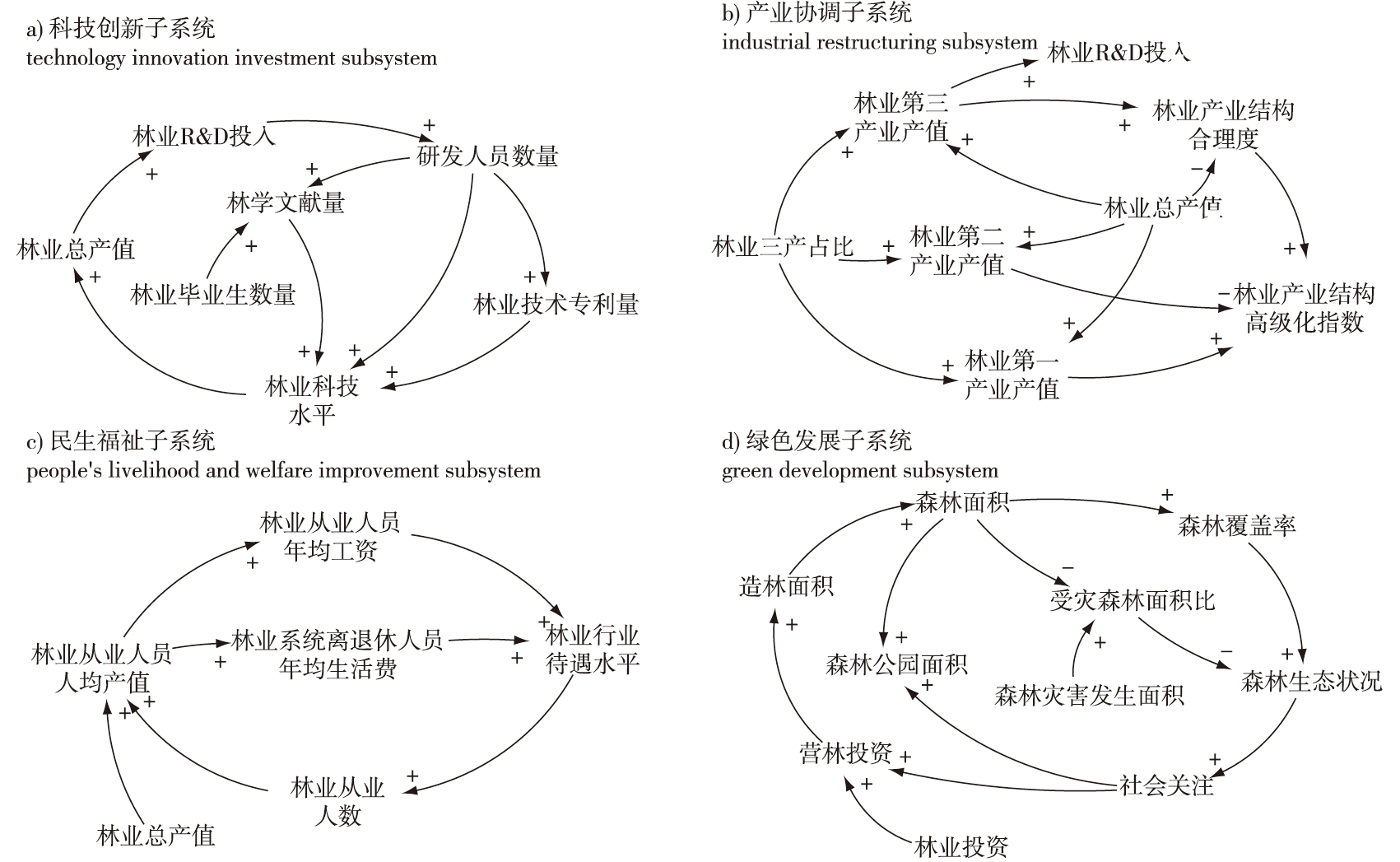
【目的】 林业高质量发展系统内部机理复杂,需通过不同政策组合的优化配置,加强林业高质量发展的政策体系建设,以满足林业高质量发展对于经济、生态和社会多重目标的协调要求。【方法】基于新发展理念,从科技创新、产业协调、民生福祉、绿色发展4个维度构建林业高质量发展系统仿真模型,对4种政策导向下不同政策组合情景的2021—2035年中国林业高质量发展水平进行仿真模拟。【结果】①2035年中国林业高质量发展将达到中高水平,且在一定的政策组合下可达到高水平;②单一政策模式下科技创新投入政策的治理效果最优;③政策组合模式的发展潜力优于单一政策模式;④随着政策数量的叠加,边际效果也有所降低。【结论】根据优先级排序,科技创新和绿色发展应作为当下政策实施的重点,产业结构调整和民生福祉改善则作为长期目标进行推进;推行多部门参与的组合政策,提升林业高质量发展水平;政策制定者需在宏观层面进行统筹,避免多个政策的重复或冲突。
【Objective】 The internal mechanism of the high-quality forestry development system is complex, and it is necessary to strengthen the construction of the policy system for high-quality forestry development through the optimized configuration of different policy combinations to cope with the coordination requirements of high-quality forestry development for multiple economic, ecological and social goals. 【Method】Based on the new development philosophy, a simulation model of high-quality forestry development system was constructed from four dimensions: scientific and technological innovation, industrial coordination, people’s livelihood and green development. The high-quality development level of China’s forestry from 2021 to 2035 was simulated under four policy-oriented scenarios. 【Result】(1) China’s forestry high-quality development will reach a medium-high level, and can even reach a high level under certain policy combinations in 2035. (2) The development potential of the scenario of scientific and technological innovation priority under the implementation of a single policy is the best. (3) The development potential of combined policies is better than that of single policies. (4) As the number of policies accumulates, the marginal effect decreases. 【Conclusion】Based on priority, technological innovation and green development should be the focus of current policy implementation, while industrial restructuring and the improvement of people’s well-being should be pursued as long-term objectives. Promote the implementation of integrated policies involving multiple departments to enhance the level of high-quality forestry development. Policymakers should coordinate at the macro level to avoid the duplication or conflict of multiple policies.
林业高质量发展 / 系统动力学 / 多情景模拟 / 政策仿真
high-quality forestry development / system dynamics / multi-scenario simulation / policy simulation
| [1] |
杜运周, 刘秋辰, 陈凯薇, 等. 营商环境生态、全要素生产率与城市高质量发展的多元模式——基于复杂系统观的组态分析[J]. 管理世界, 2022, 38(9):127-145.
|
| [2] |
任晓猛, 钱滔, 潘士远, 等. 新时代推进民营经济高质量发展:问题、思路与举措[J]. 管理世界, 2022, 38(8):40-54.
|
| [3] |
|
| [4] |
|
| [5] |
王仕稳, 韦伟, 山仑, 等. 宁南山区生态产业的现状、问题及高质量发展对策[J]. 水土保持通报, 2022, 42(2):362-368.
|
| [6] |
宁攸凉, 李岩, 马一博, 等. 我国林7业产业发展面临的挑战与对策[J]. 世界林业研究, 2021, 34(4):67-71.
|
| [7] |
彭华福, 杨诺. 我国林业产业高质量发展策略研究[J]. 林产工业, 2023, 60(8):84-86.
|
| [8] |
朱洪革, 何津源, 宁哲. 黑龙江省林业高质量发展对策研究[J]. 农业经济, 2022(3):39-41.
|
| [9] |
宁攸凉, 沈伟航, 宋超, 等. 林业产业高质量发展推进策略研究[J]. 农业经济问题, 2021, 42(2):117-122.
|
| [10] |
吕金蔚, 刘冰. “双碳”目标下林业碳汇高质量发展的路径研究[J]. 林业经济问题, 2022, 42(6):666-672.
|
| [11] |
叶遄, 余忠, 戴永务, 等. 中国林业产业高质量发展现代化路径选择[J]. 林业经济问题, 2022, 42(1):45-53.
|
| [12] |
陈小雨, 管志杰. 中国林业高质量发展水平的测度及区域差异分析[J]. 中国林业经济, 2022(1):7-11.
|
| [13] |
温赛赛, 贯君, 杨跃. 中国林业高质量发展评价指标体系构建与测度[J]. 林业经济问题, 2022, 42(3):241-252.
|
| [14] |
贝淑华, 王圆, 沈杰. 创新对林业高质量发展水平的影响研究[J]. 林业经济, 2023, 45(8):5-19.
|
| [15] |
|
| [16] |
|
| [17] |
张瀚丹, 李娅. 数字经济与林业高质量发展的耦合协调关系研究[J]. 林业经济, 2023, 45(11):50-72.
|
| [18] |
吴松泽, 陈潜. 林业高质量发展与新质生产力的耦合协调关系研究[J]. 林业经济问题, 2024, 44(2):128-135.
|
| [19] |
|
| [20] |
|
| [21] |
岳庆如, 张智光. 引入反哺机制的林纸绿色供应链多主体利益分配的动力学仿真研究[J]. 南京林业大学学报(自然科学版), 2023, 47 (3): 217-224.
|
| [22] |
陈景华, 陈姚, 陈敏敏. 中国经济高质量发展水平、区域差异及分布动态演进[J]. 数量经济技术经济研究, 2020, 37(12):108-126.
|
| [23] |
李黎明, 谢子春, 梁毅劼. 创新驱动发展评价指标体系研究[J]. 科技管理研究, 2019, 39(5):59-69.
|
| [24] |
袁春剑. 中国生态经济发展水平的统计测度[J]. 统计与决策, 2024, 40(3):106-111.
|
/
| 〈 |
|
〉 |