PDF(2268 KB)

基于高光谱的不同林分冠层可燃物水分特征研究
张水锋, 张金池, 张阳, 郑怀兵, 顾哲衍, 刘鑫
南京林业大学学报(自然科学版) ›› 2025, Vol. 49 ›› Issue (6) : 238-246.
PDF(2268 KB)
 PDF(2268 KB)
基于高光谱的不同林分冠层可燃物水分特征研究
Research on canopy water content of different forest stands based on hyperspectral analysis
【目的】林分冠层可燃物水分参数在森林植物生理状态与火灾风险评估中发挥着重要的作用,本研究主要探讨了利用野外高光谱探测数据估算植被冠层可燃物水分特征参数的方法,为快速无损地获取植被冠层水分特征信息以评估森林可燃物火险提供新的途径。【方法】针对马尾松(Pinus massoniana)、火炬松(Pinus taeda)、香樟(Camphora officinarum)和石楠(Photinia serratifolia)共4种林分的冠层样本,通过野外采样测定和室内实验获取了样本叶片的光谱反射数据、叶面积、鲜质量和干质量,以及林分样本的叶面积指数(LAI)等数据,并分别对LAI和水分特征变量[可燃物含水率(FMC)、等效水厚度(EWT)、冠层水平可燃物含水率(FMCC)和冠层水平等效水厚度(EWTC)]及其相关性进行了分析。采用偏最小二乘回归法(PLSR)和人工神经网络(ANN)法对水分特征参数FMCC和EWTC进行预测估算。【结果】4种林分的FMCC和EWTC汇总样本的估算和验证过程表明,PLSR方法的决定系数均大于ANN法,而均方根误差(RMSE)则均小于ANN法。在4种不同类型林分冠层可燃物的水分特征变量EWTC与FMCC值估算中,采用PLSR方法分析的R2均值为0.73,RMSEcv均值为0.22,马尾松表现最优(EWTC的R2=0.80,RMSECV为0.02;FMCC的R2=0.74,RMSECV为0.19);而采用ANN法的 均值为0.76,RMSECV均值为0.20,采用ANN-2作为输入的马尾松FMCC估算 (=0.91,RMSECV为0.12)和火炬松的EWTC值估算 (=0.90,RMSECV为0.01)表现最优。【结论】EWTC与FMCC均可从反射光谱中获得较为准确的估算,FMCC作为一种基于质量的变量,通过PLSR和ANN法均可获得高于基于面积的变量EWTC的估算精度。在决定光谱发射率方面,植物质量可能比植物面积发挥更大的作用,即可燃物的质量因素对光谱反射率水分特征反演的影响更大,叶片面积影响则相对较小。总体来看,野外探测的林分冠层高光谱数据用于估算可燃物水分特征参数的效果较好,可辅助森林可燃物火险预测预报和风险等级评估。
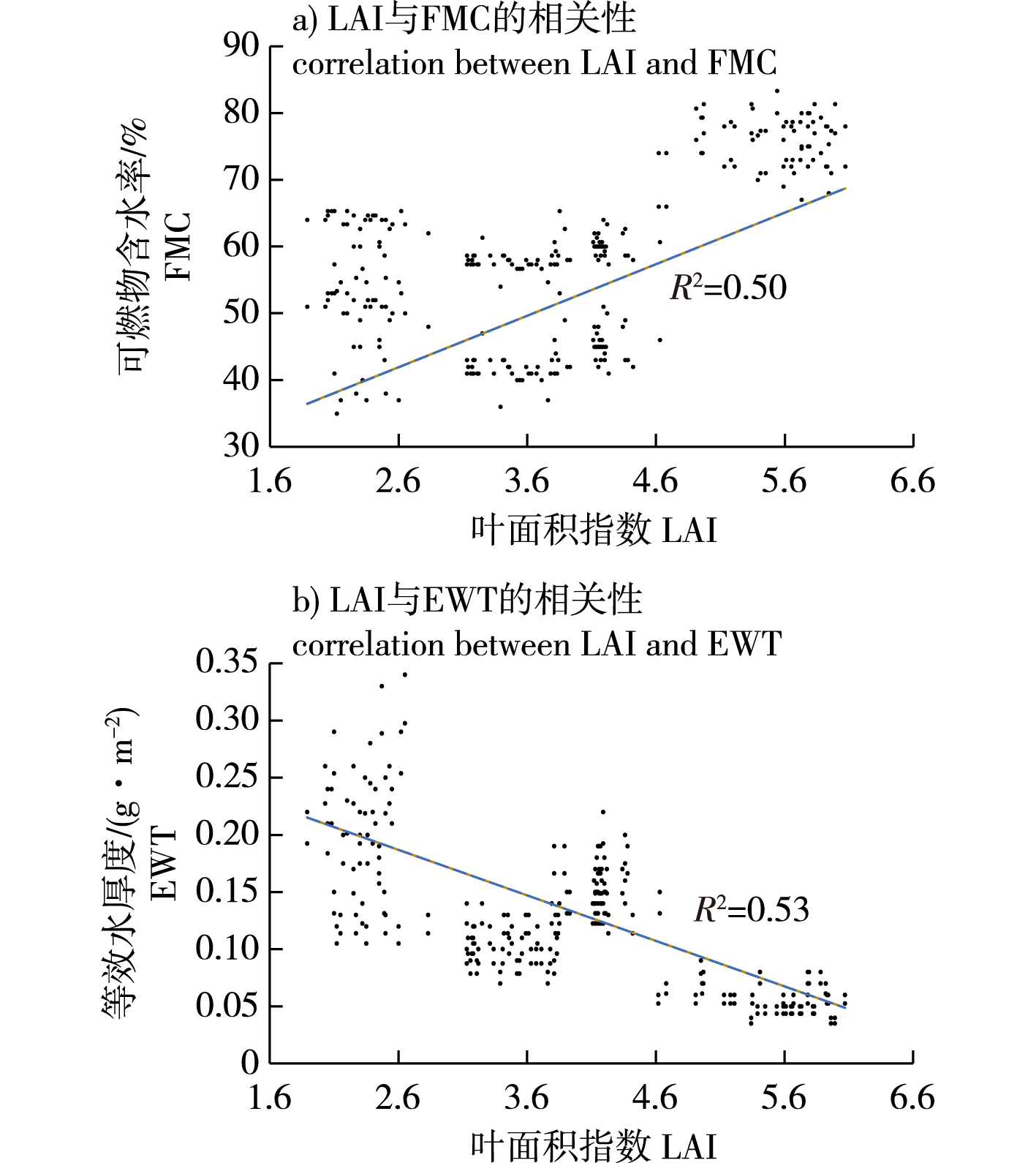
【Objective】Canopy fuel moisture parameters play a crucial role in assessing the physiological status of forest plants and fire risk. This study primarily explores methods for estimating vegetation canopy fuel moisture characteristic parameters using field hyperspectral data, providing a new approach for rapidly and non-destructively acquiring vegetation canopy moisture characteristic information to assess forest fuel fire risk.【Method】For canopy samples from four forest types, including Pinus massoniana, P. taeda, Camphora officinarum and Photinia serratifolia, spectral reflectance data, leaf area, fresh weight, dry weight, and leaf area index (LAI) were obtained through field sampling and laboratory experiments. Correlations between LAI and moisture characteristic variables (FMC, EWT, FMCC and EWTC) were analyzed. Partial least squares regression (PLSR) and artificial neural networks (ANN) were used to predict and estimate the moisture characteristic parameters FMCC and EWTC.【Result】The correlation between LAI and FMCC (R2=0.86) was significantly higher than that between LAI and EWTC(R2=0.04), while the correlation between LAI and EWT (R2=0.52) was slightly higher than that between LAI and FMC (R2=0.50). The estimation and validation processes for the aggregated samples of FMCC and EWTC across the four forest stand types showed that the coefficient of determination for the PLSR method was higher than that for the ANN, while the root mean square error was lower. In the estimation of EWTC and FMCC values for canopy fuel moisture characteristic variables in the four different forest types, the mean R2 value was 0.73 and the mean RMSEcv was 0.22 when using the PLSR method. P. massoniana showed the best performance (FMCC: R2=0.80, RMSECV=0.02; EWTC: R2=0.74, RMSECV=0.19). When using the ANN method, the mean R2 value was 0.76 and the mean RMSEcv was 0.20. The best performance was observed for the estimation of FMCC in P. massoniana (=0.91, RMSECV=0.12) and EWTC in P. taeda (=0.90, RMSECV=0.01) using ANN-2 as input.【Conclusion】Both EWTC and FMCC can be accurately predicted from reflectance spectra. As a mass-based variable, FMCC can achieve higher estimation accuracy than the area-based variable EWTC through both PLSR and ANN methods. Plant mass may play a more significant role than plant area in determining spectral emissivity, indicating that fuel mass factors have a greater impact on the inversion of spectral reflectance moisture characteristics, while leaf area has a relatively smaller influence. Overall, the hyperspectral data of forest stand canopy obtained through field measurements are effective in estimating fuel moisture characteristic parameters, and can provide valuable support for forest fuel fire risk prediction, forecasting, and level assessment.
林分冠层 / 高光谱 / 可燃物含水率 / 等效水厚度 / 北亚热带
canopy / hyperspectral / fuel moisture content / equivalent water thickness / north subtropical zone
| [1] |
|
| [2] |
|
| [3] |
赵志霞, 李正才, 周君刚, 等. 火烧对北亚热带杉木林土壤有机碳的影响[J]. 林业科学研究, 2016, 29(2):301-305.
|
| [4] |
李史欣, 张福全, 林海峰. 基于机器学习算法的森林火灾风险评估研究[J]. 南京林业大学学报(自然科学版), 2023, 47(5):49-56.
|
| [5] |
|
| [6] |
|
| [7] |
|
| [8] |
|
| [9] |
|
| [10] |
|
| [11] |
|
| [12] |
|
| [13] |
张玉春, 孔林毅, 郭瀚文, 等. 燃料载荷和含水率对平坡地表火蔓延影响实验研究[J]. 消防科学与技术, 2022, 41(2):261-265.
|
| [14] |
|
| [15] |
|
| [16] |
|
| [17] |
|
| [18] |
|
| [19] |
张佳华, 许云, 姚凤梅, 等. 植被含水量光学遥感估算方法研究进展[J]. 中国科学:技术科学, 2010, 40(10):1121-1129.
|
| [20] |
|
| [21] |
|
| [22] |
王希, 陈桂芬, 曹丽英, 等. 等效水厚度梯度的玉米叶片氮素反演模型研究[J]. 光谱学与光谱分析, 2022, 42(9):2913-2918.
|
| [23] |
马岩川, 刘浩, 陈智芳, 等. 基于高光谱指数的棉花冠层等效水厚度估算[J]. 中国农业科学, 2019, 52(24):4470-4483.
|
| [24] |
仝春艳, 马驿, 杨振忠, 等. 基于角度指数的油菜叶片等效水厚度估算研究[J]. 核农学报, 2019, 33(1):187-198.
|
| [25] |
闻宏睿, 国巧真, 魏书精, 等. 基于PROSAIL模型的广州市过渡带森林植被冠层可燃物含水率估算[J]. 热带地理, 2023, 43(3):545-553.
|
| [26] |
全兴文, 何彬彬, 刘向茁, 等. 多模型耦合下的植被冠层可燃物含水率遥感反演[J]. 遥感学报, 2019, 23(1):62-77.
|
| [27] |
沙莎, 胡蝶, 王丽娟, 等. 基于Landsat 8 OLI数据的黄土高原植被含水量的估算模型研究[J]. 遥感技术与应用, 2016, 31(3):558-563.
|
| [28] |
冯小兵, 曾宇怀, 吴泽鹏, 等. 基于卫星多光谱的广东亚热带森林FMC遥感反演[J]. 电子科技大学学报, 2022, 51(3):432-437.
|
| [29] |
张水锋, 彭徐剑, 张思玉. 火干扰对人工林土壤团聚体结构稳定性的影响[J]. 西南林业大学学报(自然科学), 2023, 43(3):103-110.
|
| [30] |
江津凡, 万福绪, 孙祥. 苏北防火林带8种主要树种抗火能力的分析[J]. 南京林业大学学报(自然科学版), 2012, 36(2):151-154.
|
| [31] |
侯继萍, 芦建国, 余义亮, 等. 紫金山登山道主要树种抗火性研究[J]. 火灾科学, 2020, 29(2):106-114.
|
| [32] |
戴春霞, 刘芳, 葛晓峰. 基于高光谱技术的茶鲜叶含水率检测与分析[J]. 茶叶科学, 2018, 38(3):281-286.
|
| [33] |
|
| [34] |
|
| [35] |
|
/
| 〈 |
|
〉 |