覆盖经营类型对雷竹林土壤性状和N2O排放及温度敏感性的影响

庄子淼, 李丽, 王维枫, 姜萌微, 杨滨锴, 王福升, 高山虎

南京林业大学学报(自然科学版) ›› 2026, Vol. 50 ›› Issue (3) : 121-130.

PDF(2107 KB)
PDF(2107 KB)
南京林业大学学报(自然科学版) ›› 2026, Vol. 50 ›› Issue (3) : 121-130. DOI: 10.12302/j.issn.1000-2006.202411011
研究论文

覆盖经营类型对雷竹林土壤性状和N2O排放及温度敏感性的影响

作者信息 +

The effects of different mulching practices on soil properties, N2O emissions, and temperature sensitivity in Phyllostachys violascens ‘Prevernalis’ forests

Author information +
文章历史 +

摘要

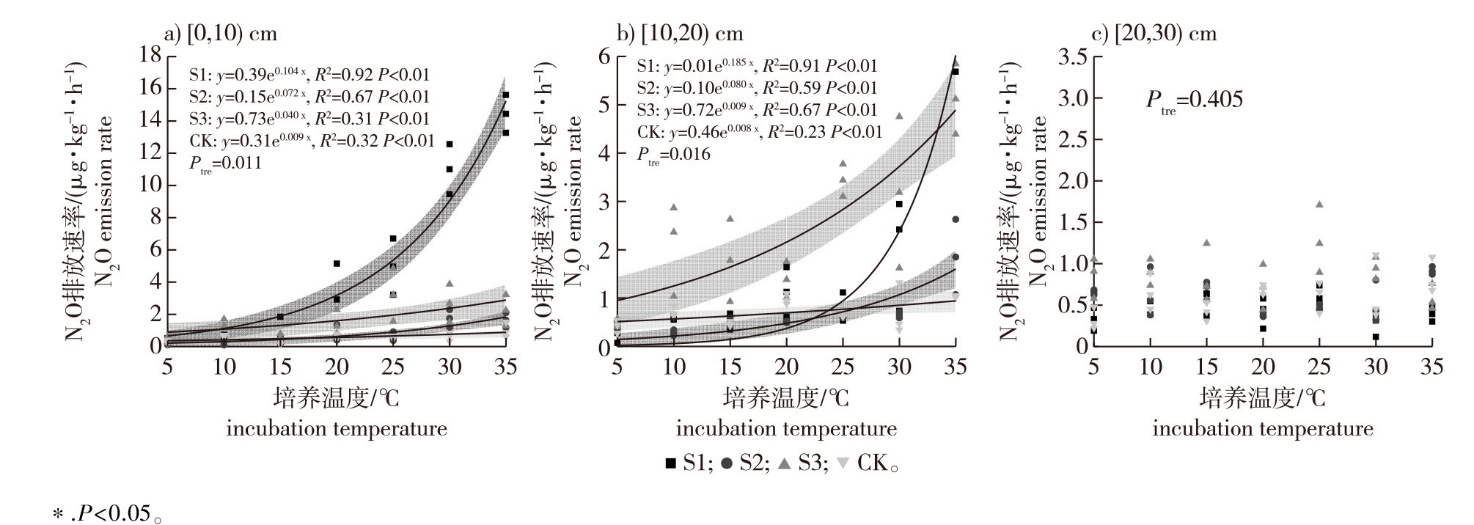
【目的】了解不同覆盖经营模式对雷竹(Phyllostachys violascens ‘Prevernalis’)林土壤性状、N2O排放和温度敏感性的影响,以制定科学的竹林经营策略,促进竹产业的可持续发展。【方法】选择并测定4种覆盖经营模式[S1.砻糠覆盖8 a后弃耕2 a(施肥8 a);S2.砻糠连续覆盖10 a并考虑竹林年龄比和密度(施肥10 a);S3.砻糠覆盖5 a后弃耕5 a(施肥5 a);CK.无覆盖经营]的雷竹林地不同土层下土壤性状,采用实验室变温培养法测定土壤N2O的排放速率和温度敏感性(Q10),并估算了N2O年排放量。【结果】不同覆盖经营模式对雷竹林地土壤理化性质产生了明显影响,覆盖经营降低了[0,10) cm土壤容重,增加pH值和土壤养分,其中S3处理变化最大,土壤含水率(SWC)、有机碳(SOC)及全氮(TN)和全磷(TP)含量均显著高于其他处理。覆盖S1处理下的N2O排放最为敏感,S1处理的[0,10) cm土层的N2O累计排放量显著高于其他3种类型,而在[10,20)和[20,30) cm土层,S3处理下的N2O累计排放量显著高于其他处理。S2、CK处理下的N2O累计排放量在不同土层间差异不显著;不同覆盖类型的N2O排放Q10值为1.22~6.38,S1处理的Q10最高,[0,10)和[10,20) cm土层分别为2.84和6.38,CK的Q10最低(1.35和1.22)。S1处理下的[0,10)和[10,20) cm土层N2O年排放估算量均为所有覆盖经营类型中最大,而S2处理下的[0,10)cm土层的最小;所有处理[0,10)和[10,20) cm土壤N2O排放速率都与温度呈正相关,与土壤容重(BD)呈显著负相关。不同经营模式下土壤N2O排放与SOC正相关性最强(R=0.70)。【结论】覆盖经营会增加土壤N2O排放并增加Q10。相比于其他不连续覆盖经营模式, 合理的种植密度和年龄比下,连续覆盖S2处理具有相对低的N2O排放量和较高的生产力,是一种环境友好型的可持续竹林经营模式。

Abstract

【Objective】This study aims to evaluate how different mulching management practices affect soil physicochemical properties, N2O emissions, and their temperature sensitivity in Lei bamboo (Phyllostachys violascens ‘Prevernalis’) stands. Understanding these effects is crucial for developing sustainable bamboo management strategies that mitigate N2O emissions and promote the long-term sustainability of the bamboo industry.【Method】Four mulching regimes were examined: rice husk mulching for eight years followed by two years of abandonment, fertilized for eight years (S1); continuous rice husk mulching for ten years under optimized age structure and planting density, fertilized for ten years (S2); rice husk mulching for five years followed by five years of abandonment, fertilized for eight years (S3); and no mulching(CK). Soil physicochemical properties were analyzed across different soil depths. N2O emission rates and temperature sensitivity (Q10) were determined using laboratory incubation under controlled temperature gradients, and annual N2O emissions were subsequently estimated.【Result】Mulching management significantly modified soil properties in P. violascens ‘Prevernalis’ stands. Compared with the control, mulching decreased bulk density while increasing soil pH and nutrient contents in the 0-10 cm layer, with the greatest improvements observed under S3. Soil water content (SWC), soil organic carbon (SOC), total nitrogen (TN), and total phosphorus (TP) in S3 were significantly higher than those under other treatments. Among the treatments, S1 showed the highest sensitivity to N2O emissions, exhibiting significantly greater cumulative N2O fluxes in the 0-10 cm layer than the other treatments, while S3 had the highest cumulative N2O emissions in the ≥10-20 and ≥20-30 cm layers. The cumulative N2O emissions of S2 and CK did not differ significantly across soil depths. The Q10 values of N2O emissions ranged from 1.22 to 6.38, with the highest under S1 (2.84 and 6.38 in the 0-10 and ≥10-20 cm layers, respectively) and the lowest under CK (1.35 and 1.22). Estimated annual N2O emissions were also greatest under S1 and lowest under S2 in the 0-10 cm layer. Across all treatments, N2O emission rates in the 0-10 and ≥10-20 cm layers were positively correlated with soil temperature but negatively correlated with bulk density. SOC showed the strongest positive correlation with N2O emissions (R = 0.70).【Conclusion】Mulching practices increased both N2O emissions and their temperature sensitivity (Q10). Among the different management regimes, continuous rice husk mulching (S2) with appropriate stand density and age structure resulted in relatively low N2O emissions while maintaining high productivity. This indicates that S2 represents an environmentally friendly and sustainable management strategy for P. violascens ‘Prevernalis’ cultivation.
关键词

竹林地覆盖 / 雷竹 / N2O排放 / 土壤温度敏感性 / 土壤性状

Key words

bamboo forest land mulching / Phyllostachys violascens ‘Prevernalis’ / N2O emission / soil temperature sensitivity / soil properties

引用本文

导出引用
庄子淼, 李丽, 王维枫, . 覆盖经营类型对雷竹林土壤性状和N2O排放及温度敏感性的影响[J]. 南京林业大学学报(自然科学版). 2026, 50(3): 121-130 https://doi.org/10.12302/j.issn.1000-2006.202411011
ZHUANG Zimiao, LI Li, WANG Weifeng, et al. The effects of different mulching practices on soil properties, N2O emissions, and temperature sensitivity in Phyllostachys violascens ‘Prevernalis’ forests[J]. Journal of Nanjing Forestry University (Natural Sciences Edition). 2026, 50(3): 121-130 https://doi.org/10.12302/j.issn.1000-2006.202411011
中图分类号: S718;Q958.1   

参考文献

[1]
ZHANG J Y, JIANG J H, TIAN G M. The potential of fertilizer management for reducing nitrous oxide emissions in the cleaner production of bamboo in China[J]. Journal of Cleaner Production, 2016, 112: 2536-2544. DOI:10.1016/j.jclepro.2015.10.086.
[2]
YOKESSA M, MARETTE S. Climate change; reports on climate change from university of paris saclay provide new insights (a tax coming from the IPCC carbon prices cannot change consumption: evidence from an experiment)[J]. Global Warming Focus, 2019, 11: 18. DOI:10.3390/su11184834.
[3]
ZHU X, BURGER M, DOANE T A, et al. Ammonia oxidation pathways and nitrifier denitrification are significant sources of N2O and NO under low oxygen availability[J]. PNAs, 110(16): 6328-6333. DOI:10.1073/pnas.1219993110.
[4]
ZHANG M, FAN C H, LI Q L, et al. A 2-yr field assessment of the effects of chemical and biological nitrification inhibitors on nitrous oxide emissions and nitrogen use efficiency in an intensively managed vegetable cropping system[J]. Agriculture, Ecosystems & Environment, 2015, 201: 43-50. DOI:10.1016/j.agee.2014.12.003.
[5]
CIAIS P, DOLMAN A J, BOMBELLI A, et al. Current systematic carbon-cycle observations and the need for implementing a policy-relevant carbon observing system[J]. Biogeosciences, 2014, 11(13): 3547-3602. DOI: 10.5194/bg-11-3547-2014.
[6]
SONG Y Z, LI Y F, CAI Y J, et al. Biochar decreases soil N2O emissions in Moso bamboo plantations through decreasing labile N concentrations, N-cycling enzyme activities and nitrification/denitrification rates[J]. Geoderma, 2019, 348:135-145. DOI:10.1016/j.geoderma.2019.04.025.
[7]
LAZICKI P, GEISSELER D, LLOYD M. Nitrogen mineralization from organic amendments is variable but predictable[J]. Journal of Environmental Quality, 2020, 49(2): 483-495. DOI:10.1002/jeq2.20030.
[8]
SONG X Z, CHEN X F, ZHOU G M, et al. Observed high and persistent carbon uptake by Moso bamboo forests and its response to environmental drivers[J]. Agricultural and Forest Meteorology, 2017, 247: 467-475. DOI:10.1016/j.agrformet.2017.09.001.
[9]
冯鹏飞, 李玉敏. 2021年中国竹资源报告[J]. 世界竹藤通讯, 2023, 21(2): 100-103.
FENG P F. LI Y M. China’s bamboo resources in 2021[J]. World Bamboo and Rattan, 2023, 21(2): 100-103. DOI:10.12168/sjzttx.2023.02.019.
[10]
JIANG P K, XU Q F, XU Z H, et al. Seasonal changes in soil labile organic carbon pools within a Phyllostachys praecox stand under high rate fertilization and winter mulch in subtropical China[J]. Forest Ecology and Management, 2006, 236(1): 30-36. DOI:10.1016/j.foreco.2006.06.010.
[11]
KADER M A, SENGE M, MOJID M A, et al. Recent advances in mulching materials and methods for modifying soil environment[J]. Soil and Tillage Research, 2017, 168: 155-166. DOI:10.1016/j.still.2017.01.001.
[12]
LIU Y L, ZHOU G M, DU H Q, et al. Response of carbon uptake to abiotic and biotic drivers in an intensively managed Lei bamboo forest[J]. Journal of Environmental Management, 2018, 223: 713-722. DOI: 10.1016/j.jenvman.2018.06.046.
[13]
CHEN Q Y, LIU Z J, ZHOU J B, et al. Long-term straw mulching with nitrogen fertilization increases nutrient and microbial determinants of soil quality in a maize-wheat rotation on China’s Loess Plateau[J]. Science of The Total Environment, 2021, 775: 145930. DOI:10.1016/j.scitotenv.2021.145930.
[14]
FLEISCHER E, KHASHIMOV I, HÖLZEL N, et al. Carbon exchange fluxes over peatlands in western Siberia: possible feedback between land-use change and climate change[J]. Science of The Total Environment, 2016, 545: 424-433. DOI:10.1016/j.scitotenv.2015.12.073.
[15]
GRUNWALD D, KAISER M, LUDWIG B. Effect of biochar and organic fertilizers on C mineralization and macro-aggregate dynamics under different incubation temperatures[J]. Soil and Tillage Research, 2016, 164: 11-17. DOI:10.1016/j.still.2016.01.002.
[16]
TIAN H Q, YANG J, XU R T, et al. Global soil nitrous oxide emissions since the preindustrial era estimated by an ensemble of terrestrial biosphere models: magnitude, attribution, and uncertainty[J]. Global Change Biology, 2019, 25(2): 640-659. DOI:10.1111/gcb.14514.
[17]
LI Y F, ZHANG J J, CHANG S X, et al. Long-term intensive management effects on soil organic carbon pools and chemical composition in Moso bamboo (Phyllostachys pubescens) forests in subtropical China[J]. Forest Ecology and Management, 2013, 303: 121-130. DOI:10.1016/j.foreco.2013.04.021.
[18]
CHAI R S, NIU Y F, HUANG L D, et al. Mitigation potential of greenhouse gases under different scenarios of optimal synthetic nitrogen application rate for grain crops in China[J]. Nutrient Cycling in Agroecosystems, 2013, 96(1): 15-28. DOI:10.1007/s10705-013-9574-9.
[19]
LIU J, JIANG P K, LI Y F, et al. Responses of N2O flux from forest soils to land use change in subtropical China[J]. The Botanical Review, 2011, 77(3): 320-325. DOI:10.1007/s12229-011-9074-z.
[20]
GAI X, LI S C, ZHANG X P, et al. Changes in soil phosphorus availability and associated microbial properties after chicken farming in Lei bamboo (Phyllostachys praecox) forest ecosystems[J]. Land Degradation & Development, 2021, 32(10): 3008-3022. DOI:10.1002/ldr.3963.
[21]
LIU T, PENG D, TAN Z, GUO J, ZHANG Y. Effects of stand density on soil respiration and labile organic carbon in different aged Larix principis-rupprechtii plantations[J]. Ecological Processes, 2021, 10(1): 44. DOI:10.1186/s13717-021-00323-7.
[22]
ZHANG J C, ZENG G M, CHEN Y N, et al. Effects of physico-chemical parameters on the bacterial and fungal communities during agricultural waste composting[J]. Bioresource Technology, 2011, 102(3): 2950-2956. DOI:10.1016/j.biortech.2010.11.089.
[23]
YOO J C, BEIYUAN J Z, WANG L, et al. A combination of ferric nitrate/EDDS-enhanced washing and sludge-derived biochar stabilization of metal-contaminated soils[J]. Science of The Total Environment, 2018, 616: 572-582. DOI:10.1016/j.scitotenv.2017.10.310.
[24]
且天真, 李娟, 王莉, 等. 不同绿肥翻压还田对土壤物理性状的影响[J]. 江苏农业科学, 2024, 52(14): 262-270.
QIE T Z, LI J, WANG L. et al. Effects of different green manures returning to fields on soil physical properties[J]. Jiangsu Agricultural Sciences, 2024, 52(14): 262-270. DOI:10.15889/j.issn.1002-1302.2024.14.036.
[25]
LEE Y B, LORENZ N, DICK L K, et al. Cold storage and pretreatment incubation effects on soil microbial properties[J]. Soil Science Society of America Journal, 2007, 71(4): 1299-1305. DOI:10.2136/sssaj2006.0245.
[26]
WANG R J, XU J X, NIU J C, et al. Temperature sensitivity of soil organic carbon mineralization under contrasting long-term fertilization regimes on loess soils[J]. Journal of Soil Science and Plant Nutrition, 2022, 22(2): 1915-1927. DOI:10.1007/s42729-022-00782-3.
[27]
CHEN Y, ZHANG X D, HE H B, et al. Carbon and nitrogen pools in different aggregates of a Chinese Mollisol as influenced by long-term fertilization[J]. Journal of Soils and Sediments, 2010, 10(6): 1018-1026. DOI:10.1007/s11368-009-0123-8.
[28]
孙正, 苏荣琳, 徐鹏, 等. 添加磷对水稻-油菜轮作土壤N2O排放影响[J]. 环境科学, 2019, 40(7): 3355-3360.
SUN Z, SU R L, XU P, et al. Effect of phosphorus addition on N2O emissions from rice-rapeseed rotation soils[J]. Environmental Science, 2019, 40(7): 3355-3360. DOI:10.13227/j.hjkx.201811131.
[29]
余洁, 苗淑杰, 乔云发, 等. 小麦秸秆添加对不同类型土壤有机碳矿化的影响[J]. 农业环境科学学报, 2024, 43(9): 2041-2049.
YU J, MIAO S J, QIAO Y F, et al. Effects of wheat straw addition on organic carbon mineralization in different types of soils[J]. Journal of Agro-Environment Science, 2024, 43(9): 2041-2049. DOI:10.11654/jaes.2023-0752.
[30]
YANG X, ZHU Y M, XU Y J, et al. Simulated warming and low O2 promote N2O and N2 emissions in subtropical montane forest soil[J]. Journal of Soils and Sediments, 2022, 22(10): 2706-2719. DOI:10.1007/s11368-022-03234-8.
[31]
CHEN H, HOU H J, WANG X Y, et al. The effects of aeration and irrigation regimes on soil CO2 and N2O emissions in a greenhouse tomato production system[J]. Journal of Integrative Agriculture, 2018, 17(2): 449-460. DOI: 10.1016/S2095-3119(17)61761-1.
[32]
LAI V T, FARQUHARSON R, DENTON D M. High soil temperatures alter the rates of nitrification, denitrification and associated N2O emissions[J]. Journal of Soils and Sediments, 2019, 19(5): 2176-2189. DOI:10.1007/s11368-018-02238-7.
[33]
WANG X, YANG X, ZHANG Z, et al. Long-term effect of temperature on N2O emission from the denitrifying activated sludge[J]. Journal of Bioscience & Bioengineering, 2014, 117(3): 298-304. DOI:10.1016/j.jbiosc.2013.08.009.
[34]
JAT S L, PARIHAR C M, DEY A, et al. Dynamics and temperature sensitivity of soil organic carbon mineralization under medium-term conservation agriculture as affected by residue and nitrogen management options[J]. Soil and Tillage Research, 2019, 190: 175-185. DOI:10.1016/j.still.2019.02.005.
[35]
SINGH J S, GUPTA V K. Soil microbial biomass: a key soil driver in management of ecosystem functioning[J]. Science of The Total Environment, 2018, 634: 497-500. DOI:10.1016/j.scitotenv.2018.03.373.
[36]
GRIFFITHS B S, PHILIPPOT L. Insights into the resistance and resilience of the soil microbial community[J]. FEMS Microbiology Reviews, 2013, 37(2): 112-129. DOI:10.1111/j.1574-6976.2012.00343.x.
[37]
SENBAYRAM M, CHEN R, BUDAI A, et al. N2O emission and the N2O/(N2O+N2) product ratio of denitrification as controlled by available carbon substrates and nitrate concentrations[J]. Agriculture, Ecosystems & Environment, 2012, 147: 4-12. DOI:10.1016/j.agee.2011.06.022.
[38]
LIU Y L, GE T D, ZHU Z K, et al. Carbon input and allocation by rice into paddy soils: a review[J]. Soil Biology and Biochemistry, 2019, 133: 97-107. DOI:10.1016/j.soilbio.2019.02.019.
[39]
CURTIN D, BEARE M H, HERNANDEZ-RAMIREZ G. Temperature and moisture effects on microbial biomass and soil organic matter mineralization[J]. Soil Science Society of America Journal, 2012, 76(6): 2055-2067. DOI:10.2136/sssaj2012.0011.
[40]
FENG Z, SHENG Y, CAI F, et al. Separated pathways for biochar to affect soil N2O emission under different moisture contents[J]. Science of the Total Environment, 2018, 645: 887-894. DOI:10.1016/j.scitotenv.2018.07.224.
[41]
吕晓东, 王婷. 旱地农田氧化亚氮排放研究进展[J]. 甘肃农业科技, 2018(10): 67-73.
X D, WANG T. Research progress on nitrous oxide emissions from greenhouses in dryland[J]. Gansu Agricultural Science and Technology, 2018(10): 67-73. DOI:10.3969/j.issn.1001-1463.2018.10.021.
[42]
EDWARDS J D, PITTELKOW C M, KENT A D, et al. Dynamic biochar effects on soil nitrous oxide emissions and underlying microbial processes during the maize growing season[J]. Soil Biology and Biochemistry, 2018, 122: 81-90. DOI:10.1016/j.soilbio.2018.04.008.
[43]
ZONG Y T, LI Z C, GUI R Y, et al. Manganese losses induced by severe soil acidification in the extensive Lei bamboo (Phyllostachys violascens) plantation stands in eastern China[J]. Chemosphere, 2023, 339: 139669. DOI:10.1016/j.chemosphere.2023.139669.
[44]
NI H J, SU W H, FAN S H, et al. Effects of intensive management practices on rhizosphere soil properties, root growth, and nutrient uptake in Moso bamboo plantations in subtropical China[J]. Forest Ecology and Management, 2021, 493: 119083. DOI:10.1016/j.foreco.2021.119083.
[45]
卢妍, 宋长春, 王毅勇, 等. 植物对沼泽湿地生态系统N2O排放的影响[J]. 生态与农村环境学报, 2007, 23(4): 72-75.
LU Y, SONG C C, WANG Y Y, et al. Influence of plants on N2O emission from wetland ecosystem[J]. Journal of Ecology and Rural Environment, 2007, 23(4): 72-75. DOI:10.3969/j.issn.1673-4831.2007.04.016.
[46]
MAHARJAN B, VENTEREA R T. Nitrite intensity explains N management effects on N2O emissions in maize[J]. Soil Biology and Biochemistry, 2013, 66: 229-238. DOI:10.1016/j.soilbio.2013.07.015.
[47]
MEIJIDE A, CÁRDENAS L M, SÁNCHEZ-MARTÍN L, et al. Carbon dioxide and methane fluxes from a barley field amended with organic fertilizers under Mediterranean climatic conditions[J]. Plant and Soil, 2010, 328(1): 353-367. DOI:10.1007/s11104-009-0114-y.
[48]
刘丽媛, 徐艳, 朱书豪, 等. 有机肥配施对中国农田土壤容重影响的整合分析[J]. 农业资源与环境学报, 2021, 38(5): 867-873.
LIU L Y, XU Y, ZHU S H, et al. Meta-analysis on the responses of soil bulk density to supplementation of organic fertilizers in croplands in China[J]. Journal of Agricultural Resources and Environment, 2021, 38(5): 867-873. DOI:10.13254/j.jare.2020.0500.
[49]
韩凡香, 陈倩, 包正育, 等. 秸秆带状覆盖种植马铃薯农田土壤温度及其气温响应特征[J]. 甘肃农业大学学报, 2023, 58(3): 67-75.
HAN F X, CHEN Q, BAO Z Y, et al. Soil temperature characteristics and its response to air temperature in potato fields with straw strip mulching[J]. Journal of Gansu Agricultural University, 2023, 58(3): 67-75. DOI:10.13432/j.cnki.jgsau.2023.03.009.
[50]
HE W T, YANG J Y, DRURY C F, et al. Estimating the impacts of climate change on crop yields and N2O emissions for conventional and no-tillage in southwestern Ontario, Canada[J]. Agricultural Systems, 2018, 159: 187-198. DOI:10.1016/j.agsy.2017.01.025.

基金

国家重点研发计划(2021YFD2200404)
国家自然科学基金项目(031100028)

责任编辑: 王国栋
PDF(2107 KB)

Accesses

Citation

Detail

段落导航
相关文章

/