苏北石质山地9个造林树种地上生物量分配特征与异速生长模型

涂颢川, 王叶乔, 郑婧婧, 李雄杰, 汪贵斌, 余鹏飞

南京林业大学学报(自然科学版) ›› 2026, Vol. 50 ›› Issue (4) : 207-216.

PDF(2445 KB)
PDF(2445 KB)
南京林业大学学报(自然科学版) ›› 2026, Vol. 50 ›› Issue (4) : 207-216. DOI: 10.12302/j.issn.1000-2006.202412003
第二十八届中国科协年会———全球气候变化下的林草智能设计育种专题(执行主编 曹福亮 范国强 尹佟明 张怀清)
研究论文

苏北石质山地9个造林树种地上生物量分配特征与异速生长模型

作者信息 +

Characteristics of aboveground biomass allocation and allometric models for nine afforestation species in the rocky mountainous areas of northern Jiangsu Province

Author information +
文章历史 +

摘要

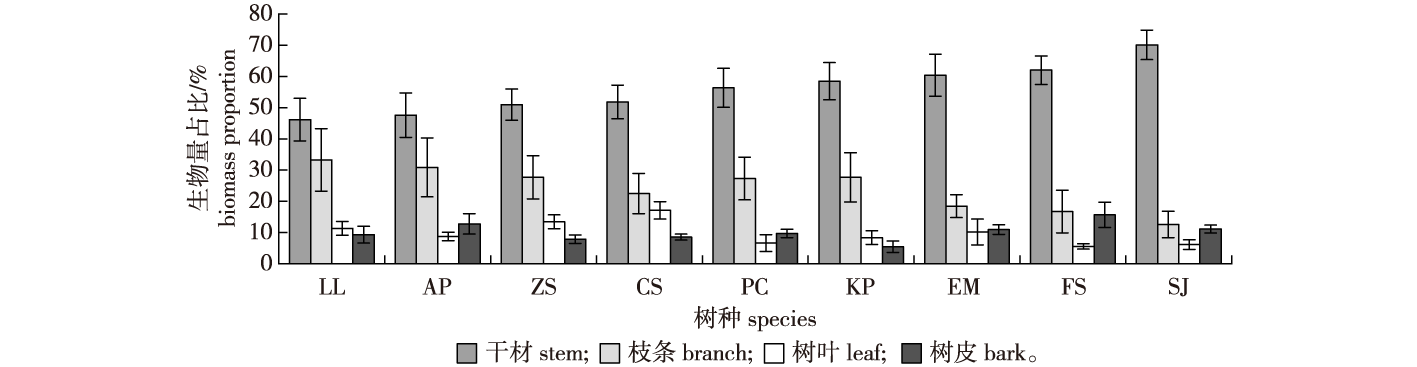
【目的】探究苏北石质山地9个造林树种地上器官生物量分配特征,构建并筛选其单树种及混合树种生物量最优估算模型,为该地区人工林生物量及碳汇能力的评估提供理论依据。【方法】以徐州市石质山地女贞(Ligustrum lucidum)、五角枫(Acer pictum)、黄连木(Pistacia chinensis)、青桐(Firmiana simplex)、国槐(Styphnolobium japonicum)、白杜(Euonymus maackii)、朴树(Celtis sinensis)、榉树(Zelkova serrata)和栾树(Koelreuteria paniculata)等9个树种的人工林为对象,采用径阶标准木法选取并收获样木,测定样木干材(去皮树干)、树皮、枝条和树叶生物量,计算各器官占地上生物量的比例,分析生物量分配特征。以胸径(D)、树高(H)及其组合(D2HDH)为自变量,采用非线性模型的对数回归形式构建各单树种和混合树种生物量最优模型。【结果】9个树种的生物量分配总体呈现为干材(55.99%)占比最高,枝条(24.12%)和树皮(10.16%)次之,树叶生物量(9.73%)占比最低。各树种总体表现为:随胸径增长,干材生物量比例显著下降(P<0.05),树皮和树叶生物量比例极显著下降(P<0.01),枝条生物量比例极显著上升(P<0.01)趋势。单树种生物量模型中以DD2H作为单一自变量的模型为最优(R2=0.649~0.998),混合树种生物量模型则以DH作为双变量及以D作为单一自变量的模型为最优(R2=0.506~0.944)。【结论】植物通过调节器官间资源分配以适应环境,形成不同的生物量分配格局。胸径(D)与生物量的关联性强于树高(H),单树种和混合树种筛选出的最优模型自变量均包含D、或DH、或D2H。在生物量估算中,单树种模型因区域和物种特异性,预测精度较高。

Abstract

【Objective】This study aims to explore the biomass allocation characteristics of aboveground organs for nine afforestation tree species in the rocky mountainous areas of northern Jiangsu, construct and screen optimal biomass estimation models for both single and mixed tree species, and provide a theoretical basis for evaluating the biomass and carbon sink capacity of plantations in this region.【Method】Taking the plantations of nine tree species in the rocky mountains of Xuzhou, including Ligustrum lucidum, Acer pictum, Pistacia chinensis, Firmiana simplex, Styphnolobium japonicum, Euonymus maackii, Celtis sinensis, Zelkova serrata, and Koelreuteria paniculata as the research objects, the diameter class standard tree method was used to select and harvest sample trees. The biomass of stem (peeled trunk), bark, branches, and leaves of the sample trees was measured, the proportion of each organ in the aboveground biomass was calculated, and the biomass allocation characteristics were analyzed. Taking diameter at breast height (D), tree height (H), and their combinations (D2H, D and H) as independent variables, the logarithmic regression form of the nonlinear model was used to construct the optimal biomass models for each single tree species and mixed tree species.【Result】The biomass allocation of the nine tree species generally showed that the stem wood (55.99%) had the highest proportion, followed by branches (24.12%) and bark (10.16%), and the leaf (9.73%) had the lowest proportion. At the overall level of each tree species, with the increase of DBH, the proportion of stem wood biomass decreased significantly (P<0.05), the proportions of bark and leaf biomass decreased extremely significantly (P<0.01), and the proportion of branch biomass increased extremely significantly (P<0.01). In the single tree species biomass model, the models with D and D2H as single independent variables were the best (R2=0.649-0.998), while the mixed tree species biomass model had the best models with D and H as bivariate variables and D as a single independent variable (R2=0.506-0.944).【Conclusion】Plants adapt to the environment by regulating the resource allocation between organs, forming different biomass allocation patterns. The correlation between DBH (D) and biomass is stronger than that of tree height (H). The independent variables of the optimal models screened for single tree species and mixed tree species all include D, or D and H, or D2H. In biomass estimation, the single tree species model has higher prediction accuracy due to its regional and species specificity.
关键词

苏北石质山地 / 人工林 / 造林树种 / 生物量 / 分配格局 / 异速生长模型

Key words

rocky mountainous areas of northern Jiangsu Province / plantation / afforestation species / biomass / allocation pattern / allometric model

引用本文

导出引用
涂颢川, 王叶乔, 郑婧婧, . 苏北石质山地9个造林树种地上生物量分配特征与异速生长模型[J]. 南京林业大学学报(自然科学版). 2026, 50(4): 207-216 https://doi.org/10.12302/j.issn.1000-2006.202412003
Tu Haochuan, Wang Yeqiao, Zheng Jingjing, et al. Characteristics of aboveground biomass allocation and allometric models for nine afforestation species in the rocky mountainous areas of northern Jiangsu Province[J]. Journal of Nanjing Forestry University (Natural Sciences Edition). 2026, 50(4): 207-216 https://doi.org/10.12302/j.issn.1000-2006.202412003
中图分类号: S757   

参考文献

[1]
Duveneck M J, Scheller R M. Climate-suitable planting as a strategy for maintaining forest productivity and functional diversity[J]. Ecological Applications, 2015, 25(6):1653-1668. DOI:10.1890/14-0738.1.
[2]
马学威, 熊康宁, 张俞, 等. 森林生态系统碳储量研究进展与展望[J]. 西北林学院学报, 2019, 34(5):62-72.
Ma X W, Xiong K N, Zhang Y, et al. Research progresses and prospects of carbon storage in forest ecosystems[J]. Journal of Northwest Forestry University, 2019, 34(5):62-72. DOI:10.3969/j.issn.1001-7461.2019.05.10.
[3]
董利虎, 李凤日. 大兴安岭东部主要林分类型乔木层生物量估算模型[J]. 应用生态学报, 2018, 29(9):2825-2834.
Dong L H, Li F R. Stand-level biomass estimation models for the tree layer of main forest types in east Daxing’an Mountains,China[J]. Chinese Journal of Applied Ecology, 2018, 29(9):2825-2834. DOI:10.13287/j.1001-9332.201809.014.
[4]
姚正阳, 刘建军. 西安市4种城市绿化灌木单株生物量估算模型[J]. 应用生态学报, 2014, 25(1):111-116.
Yao Z Y, Liu J J. Models for biomass estimation of four shrub species planted in urban area of Xi’an City,northwest China[J]. Chinese Journal of Applied Ecology, 2014, 25(1):111-116. DOI:10.13287/j.1001-9332.2014.01.015.
[5]
张志, 田昕, 陈尔学, 等. 森林地上生物量估测方法研究综述[J]. 北京林业大学学报, 2011, 33(5):144-150.
Zhang Z, Tian X, Chen E X, et al. Review of methods on estimating forest above ground biomass[J]. Journal of Beijing Forestry University, 2011, 33(5):144-150. DOI:10.13332/j.1000-1522.2011.05.026.
[6]
Subedi M R, Sharma R P. Allometric biomass models for bark of Cinnamomum tamala in mid-hill of Nepal[J]. Biomass and Bioenergy, 2012, 47:44-49. DOI:10.1016/j.biombioe.2012.10.006.
[7]
Jucker T, Caspersen J, Chave J, et al. Allometric equations for integrating remote sensing imagery into forest monitoring programmes[J]. Global Change Biology, 2017, 23(1):177-190. DOI:10.1111/gcb.13388.
[8]
Luo Y J, Wang X K, Ouyang Z Y, et al. A review of biomass equations for China’s tree species[J]. Earth System Science Data, 2020, 12(1):21-40. DOI:10.5194/essd-12-21-2020.
[9]
尹惠妍, 张志伟, 李海奎. 中国主要乔木树种生物量方程[J]. 中南林业科技大学学报, 2019, 39(5):63-69.
Yin H Y, Zhang Z W, Li H K. Biomass equations of primary Arbor tree species in China[J]. Journal of Central South University of Forestry & Technology, 2019, 39(5):63-69. DOI:10.14067/j.cnki.1673-923x.2019.05.010.
[10]
刘晓曼, 王超, 高吉喜, 等. 服务“双碳”目标的中国人工林生态系统碳增汇途径[J]. 生态学报, 2023, 43(14):5662-5673.
Liu X M, Wang C, Gao J X, et al. Approaches to carbon sequestration enhancement in China's plantation ecosystem for carbon peaking and carbon neutrality goals[J]. Acta Ecologica Sinica, 2023, 43(14):5662-5673.
[11]
刘建峰. 我国常见树种通用生物量相对生长方程建模研究[D]. 金华: 浙江师范大学, 2021.
Liu J F. Modeling study of generic allometric biomass equations for common tree species in China[D]. Jinhua: Zhejiang Normal University, 2021.
[12]
杨学民, 秦飞, 马占元, 等. 徐州石灰岩山地风景林营建的主要技术[J]. 中国水土保持科学, 2011, 9(4):36-40.
Yang X M, Qin F, Ma Z Y, et al. Techniques of scenic forest construction at the limestone mountains in Xuzhou area[J]. Science of Soil and Water Conservation, 2011, 9(4):36-40. DOI:10.16843/j.sswc.2011.04.007.
[13]
石聪. 徐州侧柏人工林生态系统碳储量影响因素研究[D]. 南京: 南京林业大学, 2012.
Shi C. The factor on carbon stocks of Platyclatdus orientalis plantation in Xuzhou[D]. Nanjing: Nanjing Forestry University, 2012.
[14]
董波, 万福绪, 严妍, 等. 徐州市石灰岩山地不同植被恢复模式的碳储量[J]. 水土保持通报, 2015, 35(3):288-292.
Dong B, Wan F X, Yan Y, et al. Carbon storage of different forest restoration patterns in limestone mountains of Xuzhou City[J]. Bulletin of Soil and Water Conservation, 2015, 35(3):288-292. DOI:10.13961/j.cnki.stbctb.2015.03.059.
[15]
李瑞霞, 凌宁, 郝俊鹏, 等. 林龄对侧柏人工林碳储量以及细根形态和生物量的影响[J]. 南京林业大学学报(自然科学版), 2013, 37(2):21-27.
Li R X, Ling N, Hao J P, et al. Effects of stand ages on carbon storage,fine root morphology and biomass in Platycladus orientalis plantation[J]. Journal of Nanjing Forestry University (Natural Sciences Edition), 2013, 37(2):21-27. DOI:10.3969/j.issn.1000-2006.2013.02.004.
[16]
李朝, 周伟, 关庆伟, 等. 徐州石灰岩山地侧柏人工林生物量及其影响因子分析[J]. 安徽农业大学学报, 2010, 37(4):669-674.
Li Z, Zhou W, Guan Q W, et al. Biomass and its influencing factors of Platyclatdus orientalis plantation in the limestone mountains of Xuzhou[J]. Journal of Anhui Agricultural University, 2010, 37(4):669-674. DOI:10.13610/j.cnki.1672-352x.2010.04.030.
[17]
谢龙飞, 李凤日, 董利虎. 基于贝叶斯似乎不相关回归方法的天然蒙古栎生物量模型构建[J]. 应用生态学报, 2022, 33(7):1937-1947.
Xie L F, Li F R, Dong L H. Constructing biomass models for natural Quercus mongolica based on Bayesian seemingly unrelated regression[J]. Chinese Journal of Applied Ecology, 2022, 33(7):1937-1947. DOI:10.13287/j.1001-9332.202207.019.
[18]
刘茂秀, 史军辉, 王新英, 等. 塔河流域天然胡杨林不同林龄地上生物量及碳储量[J]. 水土保持通报, 2016, 36(5):326-332,339.
Liu M X, Shi J H, Wang X Y, et al. Above ground biomass and carbon storage of Populus euphratica plantation with different ages in Tahe River basin[J]. Bulletin of Soil and Water Conservation, 2016, 36(5):326-332,339. DOI:10.13961/j.cnki.stbctb.2016.05.058.
[19]
李玉凤, 秦佳双, 马姜明, 等. 南亚热带马尾松人工林地上生物量模型构建及分配特征[J]. 广西师范大学学报(自然科学版), 2021, 39(4):170-180.
Li Y F, Qin J S, Ma J M, et al. Establishment of above-ground biomass model and distribution characteristics of Pinus massoniana plantations in southern subtropical[J]. Journal of Guangxi Normal University (Natural Science Edition), 2021, 39(4):170-180. DOI:10.16088/j.issn.1001-6600.2020091606.
[20]
梅莉, 张卓文, 谷加存, 等. 水曲柳和落叶松人工林乔木层碳、氮储量及分配[J]. 应用生态学报, 2009, 20(8):1791-1796.
Mei L, Zhang Z W, Gu J C, et al. Carbon and nitrogen storages and allocation in tree layers of Fraxinus mandshurica and Larix gmelinii plantations[J]. Chinese Journal of Applied Ecology, 2009, 20(8):1791-1796. DOI:10.13287/j.1001-9332.2009.0297.
[21]
赵厚本, 周光益, 李兆佳, 等. 南亚热带常绿阔叶林4个常见树种的生物量分配特征与异速生长模型[J]. 林业科学, 2022, 58(2):23-31.
Zhao H B, Zhou G Y, Li Z J, et al. Biomass allocation and allometric growth models of four common tree species in southern subtropical evergreen broad-leaved forest[J]. Scientia Silvae Sinicae, 2022, 58(2):23-31. DOI:10.11707/j.1001-7488.20220203.
[22]
冷寒冰, 景军, 奉树成. 上海两种常绿阔叶树种生物量分配及异速生长模型[J]. 生态学杂志, 2018, 37(12):3590-3596.
Leng H B, Jing J, Feng S C. Biomass distribution and allometric model of two evergreen broad-leaved tree species in Shanghai[J]. Chinese Journal of Ecology, 2018, 37(12):3590-3596. DOI:10.13292/j.1000-4890.201812.002.
[23]
黄采艺, 文仕知, 周维, 等. 不同林龄西藏林芝云杉的生物量和生产力[J]. 中南林业科技大学学报, 2015, 35(8):81-87,93.
Huang C Y, Wen S Z, Zhou W, et al. Study on biomass and productivity of different aged Picea asperata forest in Nyingchi prefecture in Tibet[J]. Journal of Central South University of Forestry & Technology, 2015, 35(8):81-87,93. DOI:10.14067/j.cnki.1673-923x.2015.08.017.
[24]
朱玉伟, 桑巴叶, 王永红, 等. 新疆农田防护林不同林龄生物量及碳储量[J]. 西北林学院学报, 2018, 33(2):116-122.
Zhu Y W, Sang B Y, Wang Y H, et al. Carbon storage and biomass of farmland shelter belt forests with different ages in Xinjiang[J]. Journal of Northwest Forestry University, 2018, 33(2):116-122.
[25]
陈小花, 陈宗铸, 雷金睿, 等. 海南岛3种人工林树种地上生物量分配特征及区域差异[J]. 热带作物学报, 2019, 40(4):815-821.
Chen X H, Chen Z Z, Lei J R, et al. Above ground biomass distribution characteristics and regional differences of three artificial plantation in Hainan Island[J]. Chinese Journal of Tropical Crops, 2019, 40(4):815-821. DOI:10.3969/j.issn.1000-2561.2019.04.028.
[26]
何怀江, 叶尔江·拜克吐尔汉, 张春雨, 等. 吉林蛟河针阔混交林12个树种生物量分配规律[J]. 北京林业大学学报, 2016, 38(4):53-62.
He H J, Yeerjiang Baiketuerhan, Zhang C Y, et al. Biomass allocation of twelve tree species in coniferous and broad-leaved mixed forest in Jiaohe,Jilin Province,northeast China[J]. Journal of Beijing Forestry University, 2016, 38(4):53-62. DOI:10.13332/j.1000-1522.20150430.
[27]
刘坤, 曹林, 汪贵斌, 等. 银杏生物量分配格局及异速生长模型[J]. 北京林业大学学报, 2017, 39(4):12-20.
Liu K, Cao L, Wang G B, et al. Biomass allocation patterns and allometric models of Ginkgo biloba[J]. Journal of Beijing Forestry University, 2017, 39(4):12-20. DOI:10.13332/j.1000-1522.20160374.
[28]
Weiner J. Allocation,plasticity and allometry in plants[J]. Perspectives in Plant Ecology,Evolution and Systematics, 2004, 6(4):207-215. DOI:10.1078/1433-8319-00083.
[29]
Yuen J Q, Fung T, Ziegler A D. Review of allometric equations for major land covers in SE Asia:uncertainty and implications for above-and below-ground carbon estimates[J]. Forest Ecology and Management, 2016, 360:323-340. DOI:10.1016/j.foreco.2015.09.016.
[30]
Vincent J B, Henning B, Saulei S, et al. Forest carbon in lowland Papua New Guinea:local variation and the importance of small trees[J]. Austral Ecology, 2015, 40(2):151-159. DOI:10.1111/aec.12187.
[31]
Fonseca W, Alice F E, Rey-Benayas J M. Carbon accumulation in abov eground and below ground biomass and soil of different age native forest plantations in the humid tropical lowlands of Costa Rica[J]. New Forests, 2012, 43(2):197-211. DOI:10.1007/s11056-011-9273-9.
[32]
孟盛旺, 谷振军, 肖平江, 等. 江西省吉安地区火炬松地上生物量分配特征及模型研建[J]. 北京林业大学学报, 2022, 44(12):41-51.
Meng S W, Gu Z J, Xiao P J, et al. Characteristics of above ground biomass allocation and model construction for loblolly pine in Ji’an Region,Jiangxi Province of eastern China[J]. Journal of Beijing Forestry University, 2022, 44(12):41-51. DOI:10.12171/j.1000-1522.20210400.
[33]
Chaturvedi R K, Raghubanshi A S. Allometric models for accurate estimation of above ground biomass of teak in tropical dry forests of India[J]. Forest Science, 2015, 61(5):938-949. DOI:10.5849/forsci.14-190.
[34]
贺丽, 严俊霞, 段兰兰, 等. 山西高原主要林型生物量异速生长模型[J]. 中国水土保持科学(中英文), 2023, 21(6):102-110.
He L, Yan J X, Duan L L, et al. Biomass allometric model of main forest types in Shanxi Plateau[J]. Science of Soil and Water Conservation, 2023, 21(6):102-110. DOI:10.16843/j.sswc.2023.06.011.
[35]
孟延山, 孟俐君, 王静洁, 等. 青海省2种主要树种的生物量分配格局和单木生物量模型[J]. 西部林业科学, 2019, 48(6):21-28.
Meng Y S, Meng L J, Wang J J, et al. Models for estimating biomass and its allocation patterns in organs of two major tree species in Qinghai Province[J]. Journal of West China Forestry Science, 2019, 48(6):21-28. DOI:10.16473/j.cnki.xblykx1972.2019.06.004.
[36]
孙操稳, 仲文雯, 洑香香, 等. 青钱柳幼林地上部分生物量生长模型研究[J]. 南京林业大学学报(自然科学版), 2022, 46(1):138-144.
Sun C W, Zhong W W, Fu X X, et al. A study on growth and above ground biomass production of juvenile Cyclocarya paliurus plantations[J]. Journal of Nanjing Forestry University (Natural Sciences Edition), 2022, 46(1):138-144. DOI:10.12302/j.issn.1000-2006.202010032.
[37]
周昊, 叶尔江·拜克吐尔汉, 何怀江, 等. 东北地区主要造林树种幼苗期生物量分配特征与异速生长模型[J]. 林业科学, 2023, 59(11):23-32.
Zhou H, Yeerjiang Baiketuerhan, He H J, et al. Biomass distribution characteristics and species-specific allometric equations for afforestation species in northeast China[J]. Scientia Silvae Sinicae, 2023, 59(11):23-32. DOI:10.11707/j.1001-7488.LYKX20220428.
[38]
Hossain M, Saha C, Rubaiot Abdullah S M, et al. Allometric biomass,nutrient and carbon stock models for Kandelia candel of the Sundarbans,Bangladesh[J]. Trees, 2016, 30(3):709-717. DOI:10.1007/s00468-015-1314-0.
[39]
Sileshi G W. A critical review of forest biomass estimation models,common mistakes and corrective measures[J]. Forest Ecology and Management, 2014, 329:237-254. DOI:10.1016/j.foreco.2014.06.026.
[40]
Chaturvedi R K, Raghubanshi A S, Singh J S. Biomass estimation of dry tropical woody species at juvenile stage[J]. The Scientific World Journal, 2012, 2012:790219. DOI:10.1100/2012/790219.
[41]
Chave J, Andalo C, Brown S, et al. Tree allometry and improved estimation of carbon stocks and balance in tropical forests[J]. Oecologia, 2005, 145(1):87-99. DOI:10.1007/s00442-005-0100-x.

基金

江苏省碳达峰碳中和科技创新专项资金项目(BE2022420)

责任编辑: 郑琰燚
PDF(2445 KB)

Accesses

Citation

Detail

段落导航
相关文章

/