PDF(1580 KB)

不同营林措施对樟子松林赤松梢斑螟的防治效果
翟信, 孟昭军, 葛于成, 檀明明, 李颜颜, 李欣素, 宗晓东, 迟德富
南京林业大学学报(自然科学版) ›› 2026, Vol. 50 ›› Issue (5) : 180-188.
PDF(1580 KB)
 PDF(1580 KB)
不同营林措施对樟子松林赤松梢斑螟的防治效果
The control effect of different silvicultural strategies on Dioryctria sylvestrella in Pinus sylvestris var. mongolica forests
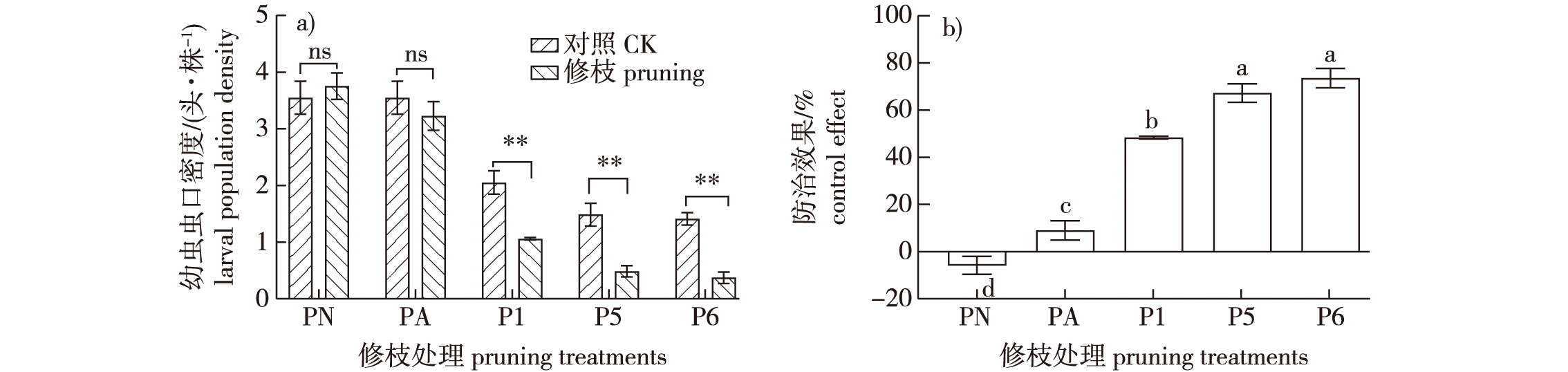
【目的】探讨樟子松(Pinus sylvestris var. mongolica)林4种营林措施下不同处理方式对赤松梢斑螟(Dioryctria sylvestrella)的防治效果,为寻找一种生态、高效和可持续控制赤松梢斑螟的方法提供实践参考。【方法】在樟子松林共设置4种营林措施、14种处理方式及对照纯林。人工修枝措施包括修枝后1、5、6 a和靠近与远离农田且当年修枝;混交林措施包括杨树(Populus spp.)、云杉(Picea spp.)、红松(Pinus koraiensis)、柠条(Caragana korshinskii)分别与樟子松形成两树种混交林及云杉、红松和樟子松3树种混交林;间伐措施为10%、20%强度间伐樟子松林;不同造林密度措施为3 333和1 111株/hm2的樟子松林;以及各处理方式相应对照,即未做任何处理的、造林密度均为1 667株/hm2的樟子松纯林。通过林间调查各处理林分赤松梢斑螟幼虫数量,统计其虫口密度,分析其防治效果,比较4种营林措施对赤松梢斑螟的调控作用。【结果】人工修枝后1、5、6 a樟子松林对赤松梢斑螟防治效果达48.38%~73.58%;樟子松和杨树混交林(5樟5杨)、樟子松和云杉混交林(6樟4云)、樟子松和红松混交林(6樟4红)及樟子松、云杉、红松混交林(4樟3云3红)对赤松梢斑螟的防治效果达41.72%~77.48%;10%间伐、20%间伐及造林密度3 333和1 111株/hm2等方式对赤松梢斑螟的防治效果达71.23%~84.93%;以上11种营林处理方式下赤松梢斑螟幼虫虫口密度均显著低于对照纯林(P<0.05),而靠近农田与远离农田且当年修枝樟子松林和樟子松-柠条混交林(5樟5柠)对赤松梢斑螟幼虫虫口密度控制作用及其防治效果均较差。【结论】4种营林措施中,11种营林处理方式对赤松梢斑螟有较好的控制效果,防效在41.72%~84.93%;其中,修枝后5 a、修枝后6 a、樟杨混交、樟红混交、樟云红混交、10%间伐、20%间伐、3 333和1 111株/hm2造林密度处理方式防治效果达67%以上。该研究成果可为樟子松林赤松梢斑螟的防治提供实践依据,但在防治赤松梢斑螟时,建议修枝林分应远离农田,减少樟子松与柠条混交(5樟5柠)栽植,注意混交树种的搭配和选择。
【Objective】 This study aims to evaluate the control efficiencies of 14 treatment methods under four silvicultural strategies against Dioryctria sylvestrella in Pinus sylvestris var. mongolica forests, to identify an ecological, efficient, and sustainable control approach for D. sylvestrella. 【Method】 Four silvicultural strategies were implemented, comprising 14 treatment methods and control plots of pure Pinus sylvestris var. mongolica forests. The manual pruning strategies included: forests with one, five, and six years after pruning, as well as stands pruned in the current year that were either near or far from agricultural fields. The mixed forest strategies included: two-species mixed forests of Pinus sylvestris var. mongolica with Populus spp., Picea spp., Pinus koraiensis, and Caragana korshinskii, respectively, and a three-species mixed forest of Pinus sylvestris var. mongolica, Picea spp. and Pinus koraiensis. The thinning strategies included: Pinus sylvestris var. mongolica forests thinned at intensities of 10% and 20%. The strategies of different afforestation densities included two types of Pinus sylvestris var. mongolica forests with afforestation densities of 3 333 individuals/hm2 and 1 111 individuals/hm2. Each treatment method, had a corresponding control, which was a pure Pinus sylvestris var. mongolica forest without any treatment and with an afforestation density of 1 667 individuals/hm2. The number of D. sylvestrella larvae in each treated forest stand, was investigated, and its population density was counted. The control effect was analyzed, and the control effects of the four silvicultural strategies on D. sylvestrella were compared. 【Result】 One, five, and six years after pruning, Pinus sylvestris var. mongolica plantations demonstrated pest control efficacy ranging from 48.38% to 73.58% against D. sylvestrella. In mixed-species plantations, the following combinations showed pest control efficacies ranging from 41.72% to 77.48%: Pinus sylvestris var. mongolica mixed with Populus spp. (number ratio is 5∶5), Pinus sylvestris var. mongolica mixed with Picea spp. (number ratio is 6∶4), Pinus sylvestris var. mongolica mixed with Pinus koraiensis (number ratio is 6∶4), and a tripartite mix of Pinus sylvestris var. mongolica, Picea spp., and Pinus koraiensis number ratio is (number ratio is 4∶3∶3). Silvicultural treatments involving 10% and 20% thinning, as well as afforestation densities of 3 333 individuals/hm2 and 1 111 individuals/hm2, resulted in pest control efficacies ranging from 71.23% to 84.93%. Among these 11 silvicultural treatments, the larval population density of D. sylvestrella was significantly reduced compared to the control (P<0.05). Conversely, in the current year pruning and mixed plantations of Pinus sylvestris var. mongolica with C. korshinskii (number ratio is 5∶5), pest control efficacy was significantly lower, regardless of proximity to agricultural fields. 【Conclusion】The 11 silvicultural treatment methods examined demonstrated effective control of D. sylvestrella, with efficacy rates ranging from 41.72% to 84.93%. Treatments that included five and six years after pruning, mixed planting of Pinus sylvestris var. mongolica with Populus spp., mixed planting of Pinus sylvestris var. mongolica with Pinus koraiensis, mixed planting of Pinus sylvestris var. mongolica with Picea spp., and Pinus koraiensis, thinning at 10% and 20%, and afforestation densities of 3 333 individuals/hm2 and 1 111 individuals/hm2, all achieved control efficacies exceeding 67%. The results of this study provide a practical basis for controlling D. sylvestrella in Pinus sylvestris var. mongolica forests. However, pruning should be carried out away from agricultural fields, mixed planting of Pinus sylvestris var. mongolica and C. korshinskii (number ratio is 5∶5) should be minimized, and careful species selection should be considered for mixed plantations.
樟子松 / 赤松梢斑螟 / 营林措施 / 虫口密度 / 防治效果
Pinus sylvestris var. mongolica / Dioryctria sylvestrella / silvicultural strategies / population density / control effect
| [1] |
宋效惠, 闫敦梁, 迟德富. 樟子松梢斑螟发生规律及防治技术[J]. 东北林业大学学报, 2021, 49(3): 132-138.
|
| [2] |
徐静. 帽儿山地区樟子松优良种源选择及其对气候因子的响应[D]. 哈尔滨: 东北林业大学, 2017.
|
| [3] |
李兴鹏, 陈越渠, 于海英, 等. 红松球果及枝梢害虫研究进展[J]. 中国森林病虫, 2017, 36(5): 35-41.
|
| [4] |
宋玉双, 李娟, 张天栋, 等. 我国梢斑螟属害虫经济重要性分析[J]. 中国森林病虫, 2021, 40(1): 1-5.
|
| [5] |
国家林业和草原局公告(2019年第20号)(全国林业有害生物普查情况)_国家林业和草原局政府网[EB/OL]. [2024-06-02]. https://www.forestry.gov.cn/search/100193.
|
| [6] |
卢孟, 解丹, 宋效惠, 等. 依据COI基因及形态特征鉴定蛀害红松和樟子松的梢斑螟[J]. 东北林业大学学报, 2020, 48(5): 83-87.
|
| [7] |
|
| [8] |
|
| [9] |
王琪, 严善春, 严俊鑫, 等. 健康和虫害的红松挥发物对赤松梢斑螟及其寄生蜂寄主选择行为的影响[J]. 生态学报, 2013, 33(23): 7437-7444.
|
| [10] |
吕春鹤, 贾妮娅, 孙德莹, 等. 辽宁东部地区梢斑螟种类鉴定及防治试验[J]. 中国森林病虫, 2023, 42(3): 48-52.
|
| [11] |
梁军生, 王旭, 谭新辉, 等. 微红梢斑螟蛀害对马尾松幼林生长的影响及剪梢防治技术研究[J]. 湖南林业科技, 2011, 38(1): 18-21.
|
| [12] |
高卓田, 张江, 刘恒泰, 等. 微红梢斑螟的化学防治研究[J]. 河北林业科技, 2021(3): 20-22.
|
| [13] |
王建军, 栾庆书, 金若忠, 等. 单波长太阳能灯诱杀微红梢斑螟[J]. 东北林业大学学报, 2015, 43(1): 117-119.
|
| [14] |
宋玉双, 李娟, 周艳涛, 等. 我国梢斑螟属害虫研究及防治进展[J]. 中国森林病虫, 2020, 39(6): 29-41.
|
| [15] |
吕春鹤, 刘超, 张美丽, 等. 三种无公害杀虫剂无人机施药防治赤松梢斑螟效果对比试验[J]. 中国森林病虫, 2021, 40(6): 40-43.
|
| [16] |
赵建设, 张易成, 刘彪, 等. 诱虫灯对害虫诱捕规律及防治效果研究进展[J]. 南方农业, 2022, 16(18): 1-7.
|
| [17] |
江宇, 吴雅琳, 许迪, 等. 修枝对人工林生态系统影响研究进展[J]. 世界林业研究, 2024, 37(2): 46-52.
|
| [18] |
邱立新. 营林技术在林业有害生物防治中的应用进展及发展趋势[J]. 中国森林病虫, 2014, 33(4): 28-32, 10.
|
| [19] |
高卓田, 殷小娟, 张江, 等. 微红梢斑螟发生规律及防治研究[J]. 河北林业科技, 2022(1): 27-29.
|
| [20] |
徐波, 严善春, 聂唯良, 等. 2种红松种实害虫的生物学特性及危害特征的补充研究[J]. 林业科学, 2010, 46(7): 188-192.
|
| [21] |
李淑华, 李晓坤, 顾喜光. 天然红松林卫生清理后红松球果螟危害及动态[J]. 林业科技, 1996, 21(6): 21-22.
|
| [22] |
王春胜, 赵志刚, 吴龙敦, 等. 修枝高度对西南桦拟木蠹蛾为害的影响[J]. 西北林学院学报, 2012, 27(6): 120-123.
|
| [23] |
胡雅茹, 张燕如, 姜海燕, 等. 不同处理中间锦鸡儿引发柠条种子小蜂行为反应及其挥发物成分分析[J]. 山西农业大学学报(自然科学版), 2023, 43(2): 111-120.
|
| [24] |
刘敏, 刘宇杰, 付宁宁, 等. 7种松树挥发物分析及其主要萜烯类物质对红脂大小蠹行为选择的影响[J]. 环境昆虫学报, 2021, 43(1): 48-59.
|
| [25] |
牛豪杰, 王琪, 严善春. 红松人工纯林3种梢斑螟成虫种群动态分析[J]. 中南林业科技大学学报, 2020, 40(1): 59-66.
|
| [26] |
贺睿智, 李泽林, 吴健桢, 等. 林口红松球果害虫幼虫鉴定及发生时序[J]. 东北林业大学学报, 2022, 50(10): 108-112.
|
| [27] |
魏小虎, 牟顺泰, 张永晖, 等. 小陇山林区钝鞘中脉叶蜂虫口密度与林木混交的相关性[J]. 陕西林业科技, 2023, 51(3): 98-103.
|
| [28] |
陈海波, 郭丽, 张真, 等. 杨树人工林种间混交对生长性状和食叶害虫抗性的影响[J]. 林业科学, 2021, 57(8): 133-140.
|
| [29] |
郭树平, 薛茂贤. 透光抚育后天然红松母树林主要球果种子和枝梢害虫的动态分析[J]. 林业科技, 1995, (4): 29-30.
|
| [30] |
|
| [31] |
冯奥哲, 孔涛, 孙溥璠, 等. 沙地不同密度樟子松人工林土壤矿化氮质量分数与矿化特征[J]. 东北林业大学学报, 2021, 49(10): 96-103.
|
| [32] |
尹明宇, 吴波, 乌云塔娜, 等. 初植密度对科尔沁沙地樟子松人工林生长和健康状况及土壤化学性质的影响[J]. 西北农林科技大学学报(自然科学版), 2024, 52(7): 42-52.
|
| [33] |
彭晓滢, 郭赓, 蒯杰, 等. 坡位对杉木人工林土壤有机碳及其活性组分特征的影响[J]. 生态与农村环境学报, 2024, 40(10): 1319-1327.
|
黑龙江讷河市新江林场李文艳和陈玉良,龙江县错海林场宋金辉和李洋,东北林业大学林学院研究生王雪强、丁锡垚、刘全、蓝平洋、陈世凯和周有缘,以及两地相关工作人员对外业调查给予帮助!
/
| 〈 |
|
〉 |