PDF(2000 KB)

生物炭与有机肥配施对青钱柳-茶复合系统土壤性质及叶片养分的影响
肖凯英, 方升佐, 邓锐, 王珊珊, 汪健仁, 黄金水
南京林业大学学报(自然科学版) ›› 2026, Vol. 50 ›› Issue (4) : 146-154.
PDF(2000 KB)
 PDF(2000 KB)
生物炭与有机肥配施对青钱柳-茶复合系统土壤性质及叶片养分的影响
Effects of combined application of biochar and organic fertilizer on soil properties and leaf nutrients in a compound system of Cyclocarya paliurus and Camellia sinensis
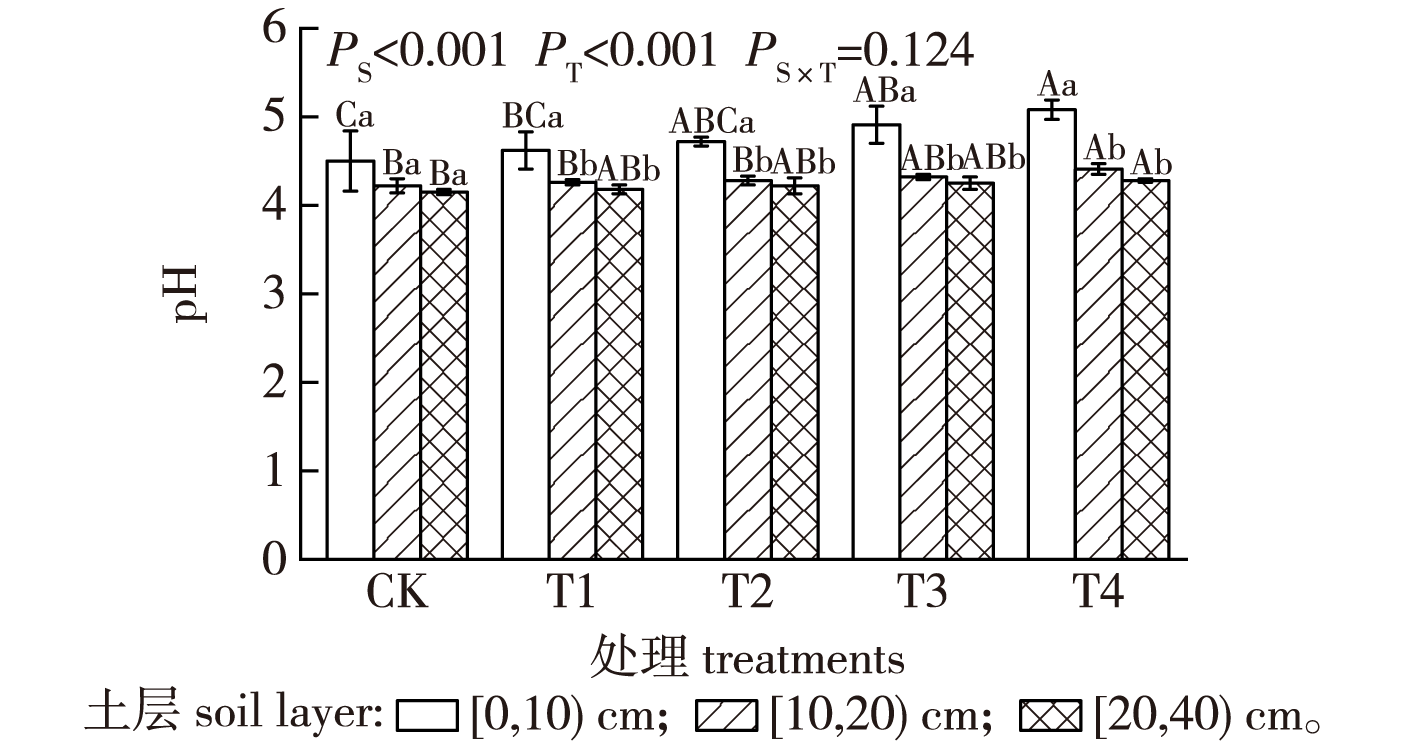
【目的】青钱柳(Cyclocarya paliurus)是我国特有集药用、食用和材用等价值于一身的单种属植物。探究青钱柳-茶复合系统土壤养分、酶活性及植物叶片养分对生物炭与有机肥配施的响应,筛选出最适配施比例,为青钱柳-茶复合系统的经营管理提供有机栽培方案。【方法】针对青钱柳-茶复合系统,采用完全随机区组设计,设置CK(不施肥)、T1(100%有机肥,即4 500 kg/hm2)、T2[15%(质量占比,下同)生物炭+85%有机肥,即675 kg/hm2+3 825 kg/hm2]、T3(30%生物炭+70%有机肥,即1 350 kg/hm2+3 150 kg/hm2)、T4(50%生物炭+50%有机肥,即2 250 kg/hm2+2 250 kg/hm2)等5种不同生物炭与有机肥质量配施比例,探讨不同配施处理对复合经营系统不同层次([0,10)、[10,20)和[20,40)cm)土壤养分、酶活性及青钱柳和茶树叶片养分含量的影响。【结果】双因素方差分析表明,不同施肥处理和土层深度对土壤pH均有显著影响(P<0.05)。随着生物炭添加比例增加,表层[0,10)cm土壤pH显著提高(P<0.05)。与CK相比,T4处理下[0,10)cm土壤pH提高了12.89%,[10,20)cm提高了4.50%,[20,40)cm提高了3.13%;不同生物炭与有机肥配施显著影响土壤养分含量(P<0.05),与CK相比,生物炭与有机肥配施显著提高了土壤氮磷全量及速效养分含量(P<0.05),且随着生物炭施用比例的增加呈现先升后降的趋势;不同施肥处理和土层深度对土壤酶活性均有极显著影响(P<0.001)。生物炭与有机肥配施显著提高了表层[0,10)cm土壤的β-葡萄糖苷酶(βG)和酸性磷酸酶(ACP)活性(P<0.05),且均在T2处理达到最大值,分别比CK处理提高22.6%和47.0%。总体上,βG、β-N-乙酰氨基葡萄糖苷酸(NAG)和ACP活性呈现出随着生物炭添加量的增加而降低的趋势;不同生物炭与有机肥配施处理对青钱柳叶片氮磷养分含量有显著影响(P<0.05)。青钱柳叶片N含量在T3处理最高,比CK处理高12.4%;而青钱柳叶片P含量在T4处理最低,T1处理最高(约比T4处理高6%)。而茶树叶片的氮磷全量养分含量在不同处理间无显著影响(P>0.05),但整体上在T2处理下达到最大值。偏最小二乘法结构方程模型(PLSPM)分析结果显示,生物炭与有机肥配施对土壤pH和土壤酶活性的影响均为极显著正向调控(P<0.01),路径系数分别达0.899和0.752;生物炭与有机肥配施主要通过改善土壤pH和酶活性来提高土壤有效氮和有效磷的含量,且土壤速效养分对植物叶片养分吸收有显著正向影响。【结论】合理的生物炭与有机肥配施能显著提高土壤pH和土壤酶活性,加速土壤中养分转化,促进青钱柳和茶树的养分吸收利用。现有研究结果表明,以质量配比15%生物炭+85%有机肥配施效果最佳,但这种配施比例应根据立地条件和林分年龄的变化而不断调整。
【Objective】Wheel wingnut (Cyclocarya paliurus), native to China, is the sole species in its genus. Grown for its medicine food homologous and fine timber tree species as well as for an ornamental plant, there exists a great development and application prospect for C. paliurus resources. This study explores the responses of soil nutrients, soil enzymes activities and leaf nutrients to combined application of biochar and organic fertilizer in a compound system of C. paliurus and tea(Camellia sinensis), to select an optimal application mass ratio of biochar and organic fertilizer, and to provide organic cultivation scheme for the management of C. paliurus and tea compound system.【Method】A completely randomized block design was established in the compound system of C. paliurus and tea, comprising five treatments with different application mass ratios of biochar and organic fertilizer: CK (no fertilization), T1 (100% organic fertilizer, as 4 500 kg/hm2), T2 (15% biochar + 85% organic fertilizer, as 675 kg/hm2+3 825 kg/hm2), T3 (30% biochar + 70% organic fertilizer, as 1 350 kg/hm2+3 150 kg/hm2), and T4 (50% biochar + 50% organic fertilizer, as 2 250 kg/hm2+2 250 kg/hm2). The study examined the effects of these treatments on soil nutrients and enzyme activities across different soil layers ((0,10], (10,20], and (20,40] cm), as well as on the leaf nutrient content of both plant species.【Result】Two-way ANOVA indicates that both different fertilization treatments and soil layer depth have significant impacts on soil pH (P<0.05). With the increase of biochar application ratio, soil pH in the surface layer (0,10] cm significantly increases (P<0.05). Compared with CK treatment, the treatment with T4 increases the pH by 12.89%, 4.50% and 3.13% in the soils of (0,10], (10,20] and (20,40] cm respectively. Application of biochar combined with organic fertilizers significantly affects soil nutrients (P<0.05). Compared to the CK, the combined application of biochar and organic fertilizer significantly increases both the soil total and available nutrient contents of nitrogen and phosphorus in the soil (P<0.05), and shows a trend of first increasing and then decreasing with increasing biochar application ratio. Both fertilizer treatments and soil layer depth have a highly significant effect on soil enzyme activities (P<0.001). Combined application of biochar and organic fertilizer also significantly enhances the activities of β-glucoside (βG) and acid phosphatase (ACP) in the soil layers of (0,10] cm (P<0.05), which all reach the maximum values at the T2 treatment and significantly increase by 22.6% and 47.0% respectively when compared with CK treatment. In general, the activities of βG, NAG and ACP show a decreasing trend with the increase of biochar addition. Different treatments have significant effects on leaf nutrient contents of nitrogen and phosphorus in C. paliurus (P<0.05). The highest N content in C. paliurus leaves is observed under T3 treatment, with 12.4% greater than the CK, while the lowest P content is detected under T4 treatment and the highest P content is under T1 treatment (about 6% higher than T4 treatment). However, no significant effect on nutrient contents of nitrogen and phosphorus in tea leaves is detected among different treatments (P>0.05), with the maximum value appearing in the T2 treatment as a whole. The partial least squares path modeling (PLSPM) analysis results show that the effects of combined application of biochar and organic fertilizer on soil pH and soil enzyme activity are highly significant positive regulation (P<0.01), and the path coefficients reach 0.899 and 0.752 respectively. Meanwhile, a combined application of biochar and organic fertilizer can increase the content of available nitrogen and available phosphorus in soil by improving soil pH and soil enzyme activity, and soil available nutrients have a significant positive effect on the plant leaf nutrient uptake.【Conclusion】A reasonable combined application of biochar and organic fertilizer can significantly improve soil pH and soil enzyme activity, accelerate soil nutrient conversion, and promote nutrient uptake and utilization of C. paliurus and tea tree, while the application mass ratio of 15% biochar and 85% organic fertilizer can achieve the effect. However, the proportion of such combined application should be continuously improved based on the site conditions and stand ages.
生物炭 / 有机肥 / 土壤养分 / 土壤酶活性 / 青钱柳-茶复合系统 / 林茶间作
biochar / organic fertilizer / soil nutrients / soil enzymes activity / compound system of wheel wingnut (Cyclocarya paliurus) and tea(Camellia sinensis) / tea-tree intercropping
| [1] |
方升佐. 青钱柳产业发展历程及资源培育研究进展[J]. 南京林业大学学报(自然科学版), 2022, 46(6):115-126.
|
| [2] |
|
| [3] |
国家卫生和计划生育委员会. 关于批准裸藻等8种新食品原料的公告(2013年第10号)[EB/OL].(2013-10-30)[2024-12-15]. https://zwfw.nhc.gov.cn/kzx/tzgg/xspylsp_225/201310/t20131030_1282.html.
|
| [4] |
肖润林, 王久荣, 单武雄, 等. 不同遮荫水平对茶树光合环境及茶叶品质的影响[J]. 中国生态农业学报, 2007, 15(6):6-11.
|
| [5] |
王钰茹, 黄兴成, 张贝贝, 等. 不同养分管理对有机茶产量、养分、品质及效益的影响[J]. 中国农业大学学报, 2025, 30(3):131-140.
|
| [6] |
季凌飞, 倪康, 马立锋, 等. 不同施肥方式对酸性茶园土壤真菌群落的影响[J]. 生态学报, 2018, 38(22):8158-8166.
|
| [7] |
尹荣秀, 王文华, 郭灿, 等. 有机肥对茶园土壤及茶叶产量与品质的影响研究进展[J]. 茶叶通讯, 2020, 47(1):6-12.
|
| [8] |
|
| [9] |
|
| [10] |
陈丽美, 李小英, 岳学文, 等. 竹炭与有机肥混施对火龙果产量和品质影响及其改土作用[J]. 生态环境学报, 2019, 28(11):2231-2238.
|
| [11] |
黄永东, 杜应琼, 陈永坚, 等. 农业废弃物生物炭理化性质的差异及对菜心产量的影响[J]. 生态环境学报, 2018, 27(2):356-363.
|
| [12] |
|
| [13] |
|
| [14] |
|
| [15] |
文慧宝, 杜双江, 程贵庆, 等. 生物炭与有机肥配施对白菜生长品质、土壤养分及酶活性的影响[J]. 江苏农业科学, 2023, 51(20):224-230.
|
| [16] |
王锦涛, 刘伟杰, 刘丙祥, 等. 秸秆和牛粪生物炭对矿区菜地土壤中镉的钝化效果和小白菜生长的影响[J]. 生态与农村环境学报, 2024, 40(11): 1524-1532.
|
| [17] |
鲍士旦. 土壤农化分析[M]. 3版. 北京: 中国农业出版社, 2000.
|
| [18] |
吕付泽, 杨雅丽, 鲍雪莲, 等. 免耕不同秸秆覆盖量对土壤酶活性及土壤有机碳含量的影响[J]. 土壤与作物, 2024, 13(2):140-153.
|
| [19] |
袁访, 李开钰, 杨慧, 等. 生物炭施用对黄壤土壤养分及酶活性的影响[J]. 环境科学, 2022, 43(9):4655-4661.
|
| [20] |
娄伟, 李梦媛, 严翔, 等. 微生物水溶肥对赣南脐橙品质及重金属含量的影响[J]. 中国南方果树, 2023, 52(5):30-35.
|
| [21] |
高欣欣, 刘高源, 刘少春, 等. 机械压实对蔗田土壤和甘蔗根系的影响研究进展[J]. 热带农业科学, 2020, 40(11):29-34.
|
| [22] |
|
| [23] |
刘柏延, 陈姗姗, 苏丽影, 等. 生物炭对甘薯生长和产量性状的影响[J]. 东北农业科学, 2023, 48(5):117-121.
|
| [24] |
|
| [25] |
|
| [26] |
|
| [27] |
李怡博, 翟春贺, 苏梦迪, 等. 微生物肥与高碳基肥配施对植烟土壤微生物数量和土壤肥力的影响[J]. 烟草科技, 2021, 54(4):23-32.
|
| [28] |
|
| [29] |
|
| [30] |
|
| [31] |
|
| [32] |
邹珊, 段文标, 王亚飞, 等. 阔叶红松林皆伐后不同恢复方式下土壤有机碳形态与矿化速率变化[J]. 森林工程, 2024, 40(6):79-90.
|
| [33] |
赵蕊蕊, 刘勇, 王凯. 生物炭和有机肥对毛白杨人工林地木质分解及土壤养分循环相关酶活性的影响[J]. 林业科学, 2023, 59(11):1-11.
|
| [34] |
|
| [35] |
梅宇, 张朔. 2022年中国茶叶生产与内销形势分析[J]. 中国茶叶, 2023, 45(4):25-30.
|
| [36] |
|
| [37] |
吕付泽, 杨雅丽, 鲍雪莲, 等. 免耕不同秸秆覆盖量对黑土微生物群落及其残留物的影响[J]. 应用生态学报, 2023, 34(4):903-912.
|
| [38] |
|
| [39] |
|
| [40] |
|
| [41] |
|
| [42] |
|
/
| 〈 |
|
〉 |