PDF(2690 KB)
 PDF(2690 KB)
 PDF(2690 KB)
麋鹿生境适宜性评价及生态容纳量估算
Habitat suitability evaluation and ecological carrying capacity estimation of milu (Elaphurus davidianus)
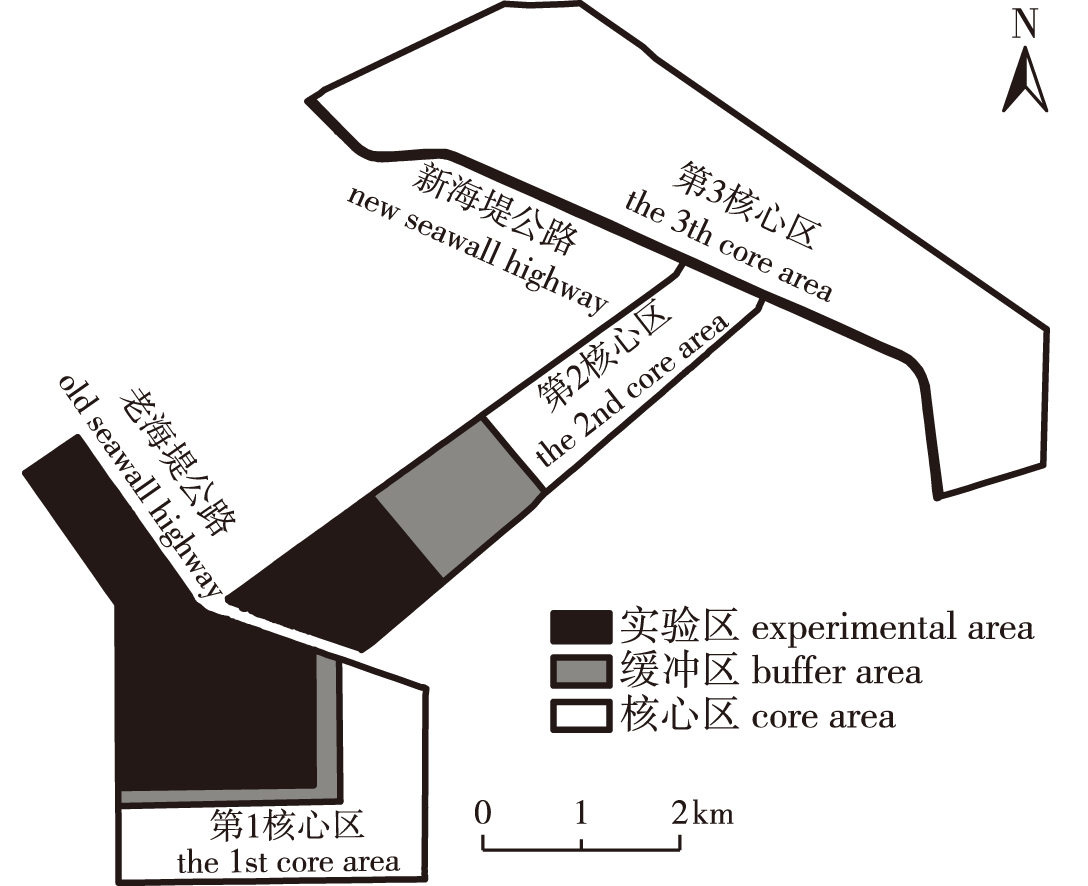
【目的】开展麋鹿(Elaphurus davidianus)生境适宜性评价并估算其生态容纳量,为麋鹿种群结构调控与栖息地生态修复提供参考依据。【方法】以江苏大丰麋鹿国家级自然保护区为研究对象,利用高分辨率无人机(UAV)技术替代传统的样线样方调查方法,获取麋鹿出现点数据与土地利用分类图,选取10个生境评价因子,运用层次分析法(AHP)确定权重,采用ArcGIS 10.8进行加权总和分析,得出麋鹿夏季不同等级生境分布图;结合不同等级生境面积占比情况及各类草本植物的养分含量估算保护区麋鹿夏季生态容纳量。【结果】保护区内麋鹿种群主要出现在第1放养区东部靠近水源的草地及裸地和第3放养区南部靠近狗牙根(Cynodon dactylon)群落及裸地等区域,受麋鹿种群内部转移影响,第2放养区内出现的麋鹿数量较少。裸地为保护区主要的土地利用类型,其面积占比最大,为34.97%;其次为林地,面积占比为25.63%;建筑用地面积占比最小,为0.43%。各类草地面积占比为18.08%,其中,芦苇(Phragmites australis)群落面积占比最大,为6.50%。集合层次分析法-地理信息系统(AHP-GIS)方法的接受者操作特征(ROC)曲线下的面积(AUC)值为0.788,大于0.75,可用于评价夏季麋鹿生境适宜性。适宜生境(包含最适宜生境、适宜生境和较适宜生境)主要位于核心区的水域、裸地、林地、芦苇群落和低草地等区域,其中,麋鹿最适宜生境(约235.87 hm2)占保护区总面积的8.85%,主要分布在第2核心区北部和第3核心区中南部等区域;较适宜生境(约965.09 hm2)面积占比最大,为36.19%;不适宜生境(包含较不适宜生境和最不适宜生境,约862.17 hm2)占总面积的32.33%,主要分布在第1放养区西部和第3放养区中部以北等区域。保护区夏季空间容纳量约为894头;芦苇生物量最高,为680.15 g/m2,碱蓬(Suaeda glauca)粗蛋白和粗脂肪质量分数均最高,分别为10.53%、3.07%,狼尾草(Pennisetum alopecuroides)的粗纤维含量最高,各类草本植物可提供的总能量为2.856×10⁹ kJ,相应的营养容纳量约为131头。【结论】保护区现有麋鹿8 216头,远超生态容纳量;将第2核心区部分麋鹿转移至第3核心区开展植被恢复及水系清淤疏浚等措施已取得较好成效。未来应进一步提升保护区麋鹿生境适宜性等级,同时增加雄性麋鹿占比以降低种群增长率,并在深入研究麋鹿潜在生境适宜区域基础上,建立新的分群保护区,缓解现有保护区的生态容纳压力。
【Objective】This study evaluated the habitat suitability for milu(Elaphurus davidianus)and estimated its ecological capacity, aiming to provide a scientific basis for regulating milu population structure and restorating their habitat to better.【Method】Taking Dafeng Milu National Nature Reserve in Jiangsu Province as the research site, this study utilized high-resolution unmanned aerial vehicle (UAV) technology as an alternative to traditional line-transect and quadrat survey methods to collect milu occurrence points data and generate land-use classification maps. Ten habitat evaluation factors were selected, and analytic hierarchy process (AHP) was applied to determine their weights. Using ArcGIS software for weighted overlay analysis, the summer habitat distribution map of milu across different suitability grades was generated. The summer ecological carrying capacity of milu was estimated by combining the area proportions of different habitat grades with the nutritional content of herbaceous plants.【Result】Milu population in the reserve are primarily identified in grassland and bareland near water sources in the eastern part of the first grade stocking area, as well as in areas adjacent to Cynodon dactylon community and bareland in the southern part of the third grade stocking area. Due to internal population transfers, fewer milu are observed in the second grade stocking area. Bareland is the dominant land-use type, covering 34.97% of the reserve, followed by woodland (25.63%), while construction land account for the smallest proportion (0.43%). Grassland collectively occupy 18.08%, with Phragmites australis community being the largest (6.50%). The area under the curve (AUC) of receiver operating characteristic (ROC) for AHP-GIS model is 0.788 (> 0.75), confirming its applicability for evaluating summer habitat suitability. Suitable habitats (including high suitable, suitable, and low suitable habitats) are predominantly located in core areas encompassing water source, bareland, woodland, Phragmites australis community, and low grassland. High suitable habitats (about 235.87 hm2, 8.85% of the reserve) are concentrated in the northern part of the second grade core area and the central-southern part of the third grade core area. Low suitable habitats (about 965.09 hm2, 36.19%) represent the largest proportion; Unsuitable habitats (containing low unsuitable habitat and unsuitable habitat, about 862.17 hm2, 32.33% of the reserve) are mainly distributed in the western part of the first grade stocking area and the northern-central part of the third grade stocking area. The estimated summer spatial carrying capacity is approximately 894 individuals. Phragmites australis community exhibit the highest biomass (680.15 g/m2), Suaeda glauca have the highest crude protein (10.53%) and crude fat (3.07%) contents, and Pennisetum alopecuroides show the highest crude fiber content. The total energy provided by herbaceous plants is 2.856×10⁹ kJ, corresponding to a nutritional carrying capacity of approximately 131 individuals.【Conclusion】The current population of milu in the reserve has reached 8 216 individuals, significantly exceeding the ecological carrying capacity; The translocation of a portion of milu from second grade core area to third grade core area, combined with vegetation restoration and the dredging of water systems, has yielded significant and positive outcomes. Future recommendations include enhancing the habitat suitability level for milu within the reserve, increasing the proportion of male milu to moderate population growth rates. Additionally, based on thorough research into potential habitat suitability areas, the establishment of new sub-population reserves will help alleviate the current ecological capacity pressure on the existing reserve.
生境适宜性 / 生态容纳量 / 地理信息系统(GIS) / 层次分析法(AHP) / 大丰麋鹿国家级自然保护区
habitat suitability / ecological carrying capacity / geographic information system (GIS) / analytic hierarchy process (AHP) / Dafeng Milu National Nature Reserve, Jiangsu Province
| [1] |
高文佳, 吴永波, 邹兴红. 江苏大丰滨海湿地麋鹿春夏秋季生境选择[J]. 生态学杂志, 2023, 42(11):2682-2689.
|
| [2] |
杨超, 范韦莹, 蔡晓斌, 等. 基于MaxEnt模型的湖北石首麋鹿国家级自然保护区散养麋鹿夏季生境适宜性评价[J]. 长江流域资源与环境, 2022, 31(2):336-344.
|
| [3] |
王宝川, 刘晨, 田孟良. 应用层次分析法和地理信息系统技术对四川杜仲适宜栽培区区划[J]. 东北林业大学学报, 2020, 48(9):20-25.
|
| [4] |
|
| [5] |
陈玉玲, 谢爱萍. 基于AHP+ArcGIS的大樱桃种植适宜性区划[J]. 经济林研究, 2021, 39(3):66-73.
|
| [6] |
曾浩威, 凌成星, 张军, 等. 基于融合MaxEnt和HSI模型的驼鹿生境适宜性评价[J]. 林业资源管理, 2023,(4):115-122.
|
| [7] |
胡继平, 杨筱, 姜鑫贵, 等. 基于层次分析法的野生动物及其栖息地生态影响评价研究[J]. 西部林业科学, 2022, 51(3):24-31.
|
| [8] |
|
| [9] |
|
| [10] |
|
| [11] |
唐娜娜, 唐旭军. 基于景观质量评价的桂林漓江风景区生态优化设计[J]. 森林工程, 2024, 40(3):66-75.
|
| [12] |
刘国锋, 琚望静, 冶建明, 等. 基于AHP-GIS的西北干旱区聚落选址适宜性评价研究——以吐鲁番市为例[J]. 中国农业资源与区划, 2021, 42(8):129-139.
|
| [13] |
张树苗, 田恒玖, 李夷平, 等. 基于简化基因组测序的麋鹿遗传资源多样性及种群结构分析[J]. 野生动物学报, 2023, 44(4):788-797.
|
| [14] |
|
| [15] |
张付贤, 孟庆辉, 蒋志刚, 等. 麋鹿沧桑命运与未来保护展望[J]. 生态学报, 2022, 42(1):1-10.
|
| [16] |
杨丽雯, 张渊媛, 杨峥, 等. 基于最大熵模型的麋鹿潜在栖息地分析与保护对策[J]. 生态学杂志, 2024, 43(8):2539-2550.
|
| [17] |
梁兵宽, 李夷平, 陈颀, 等. 麋鹿非繁殖期生境适宜度评价指标探讨[J]. 林业资源管理, 2019,(3):41-48.
|
| [18] |
陈星, 张林源, 刘艳菊, 等. 基于FAHP的半散养及圈养麋鹿栖息环境评价指标体系构建[J]. 天津师范大学学报(自然科学版), 2015, 35(3):169-173.
|
| [19] |
夏昕, 任静, 李立, 等. 洞庭湖区麋鹿再野化初期秋冬季生境选择[J]. 生物多样性, 2021, 29(8):1087-1096.
|
| [20] |
张旭, 王玲玲, 黄峰, 等. 长江中游地区麋鹿生境适宜性分析与生态廊道构建[J]. 华中师范大学学报(自然科学版), 2023, 57(3):404-411.
|
| [21] |
郭兴健, 邵全琴. 基于无人机遥感的三江源国家公园藏野驴种群数量及生境时空变化研究[J]. 生态学报, 2023, 43(19):7886-7895.
|
| [22] |
安玉亭, 刘彬, 王立波, 等. 不同麋鹿干扰强度对栖息地土壤理化特性的影响[J]. 生态学报, 2020, 40(11):3571-3578.
|
| [23] |
丁晶晶, 薛欢, 朱立峰, 等. 江苏大丰野生麋鹿种群及其栖息地保护[J]. 野生动物学报, 2015, 36(3):265-269.
|
| [24] |
王淏林, 张怀胜, 朱建强, 等. 麋鹿食物组成及其分析方法研究进展[J]. 生物多样性, 2024, 32(1):150-165.
|
| [25] |
丁玉华. 达氏麋鹿[M]. 南京: 南京师范大学出版社, 2017.
|
| [26] |
刘金根, 薛建辉, 王磊, 等. 江苏大丰麋鹿自然保护区栖息地退化特征[J]. 生态学杂志, 2011, 30(8):1793-1798.
|
| [27] |
|
| [28] |
丁晶晶. 大丰野放麋鹿的活动区域格局及生境选择研究[D]. 南京: 南京师范大学, 2017.
|
| [29] |
丁玉华, 孙华金, 郭耕, 等. 麋鹿同性爬跨的行为研究[J]. 野生动物学报, 2020, 41(2):309-313.
|
| [30] |
李弛, 杨道德, 张玉铭, 等. 麋鹿夜间卧息地选择的季节变化[J]. 生物多样性, 2016, 24(9):1031-1038.
|
| [31] |
张朔. 基于AHP-GIS和MaxEnt模型预测气候变化下云南省小粒咖啡潜在生态适宜区分布[D]. 昆明: 昆明理工大学, 2022.
|
| [32] |
姚莉, 邓春秀, 唐彪, 等. 基于最大熵模型(Max Ent)和地理信息系统(GIS)的四川省眉山市东坡区晚熟柑橘适宜性评价[J]. 中国农业科学, 2025, 58(4):748-758.
|
| [33] |
李佳, 李言阔, 缪泸君, 等. 江西桃红岭国家级自然保护区梅花鹿生境适宜性评价[J]. 生态学报, 2014, 34(5):1274-1283.
|
| [34] |
|
| [35] |
徐安宏, 俞晓鹏. 大丰麋鹿保护现状与可持续发展策略探讨[J]. 安徽农业科学, 2019, 47(5):107-109.
|
| [36] |
朱怡, 吴永波, 周子尧, 等. 基于高光谱数据的互花米草营养成分反演[J]. 北京林业大学学报, 2020, 42(9):92-99.
|
| [37] |
孟根同, 张明海, 周绍春. 黑龙江凤凰山国家级自然保护区野猪冬季容纳量及最适种群密度[J]. 生态学报, 2013, 33(3):957-963.
|
| [38] |
朱世兵, 靳勇超,
|
| [39] |
孟玉萍, 李坤, 张林源, 等. 北京麋鹿苑麋鹿采食量测定分析[J]. 特产研究, 2010, 32(4):39-42.
|
| [40] |
|
| [41] |
|
| [42] |
刘晶晶, 张舟, 张权, 等. 基于参数优化MaxEnt模型的气候变化下青头潜鸭(Aythya baeri)在长江流域的潜在适生区预测[J]. 生态与农村环境学报, 2025, 41(3): 295-307.
|
/
| 〈 |
|
〉 |