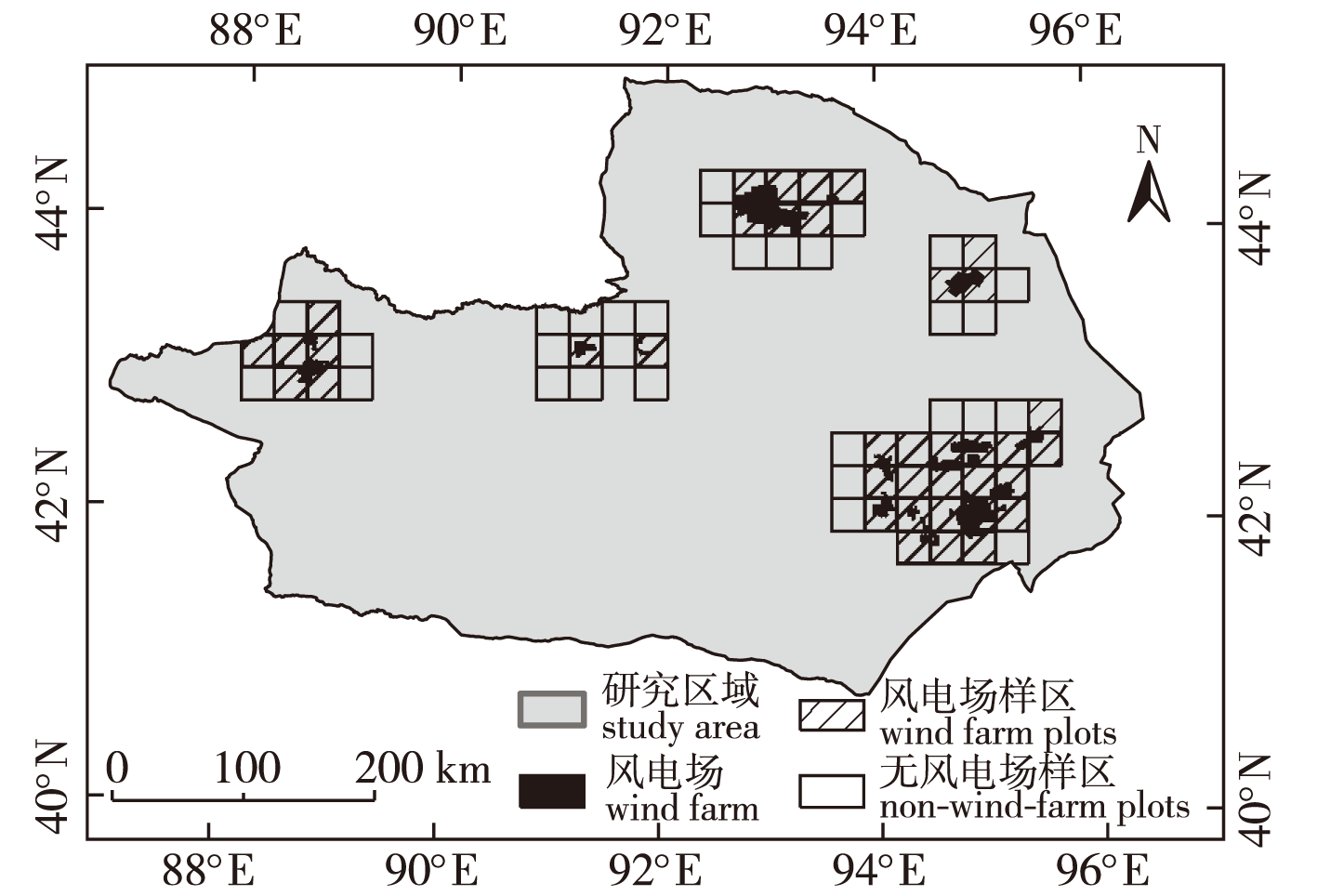
【目的】新疆吐哈地区作为西北地区重要的可再生能源基地,尚缺乏关于道路和风电场对鸟类多样性及分布影响的本地化研究数据。通过调查吐哈地区的鸟类多样性,评估道路和风电场建设与鸟类多样性和分布的空间耦合关系,为区域能源开发与生态保护协同提供科学依据。【方法】于2023—2024年在新疆吐哈地区进行了6次鸟类多样性调查,在样区内采用样线法记录鸟类分布位点数据。通过计算其Shannon-Wiener指数、功能丰富度指数等多样性指标,分析风电场和道路密度与鸟类多样性的关系。同时,采用配对t检验、卡方检验、Spearman相关性检验、线性模型和Logistic回归模型等方法,评估不同类群(生态类群、食性、巢类型、居留型)鸟类对道路和风电场干扰的响应差异。【结果】调查的65个样区内,共记录鸟类分布位点数据591条,鸟类数量2 916只,包括16目35科82属126种。风电场样区的Shannon-Wiener指数显著低于无风电场样区;功能丰富度和均匀度指数极显著、显著低于无风电场样区;功能离散度指数则显著高于无风电场样区,但在Rao’s二次熵指数中不存在显著差异。风电场样区与非风电场样区不同食性、居留型鸟类分布频次存在显著和极显著差异。Spearman相关性分析结果表明,道路密度与Shannon-Wiener指数、功能均匀度指数和Rao’s二次熵指数存在显著以上负相关,和功能离散度指数存在极显著正相关;风电场密度与Shannon-Wiener指数、功能丰富度指数和Rao’s二次熵指数存在显著以上负相关。线性模型分析结果显示,功能离散度指数随道路密度增加而增加,Rao’s二次熵指数随风电场密度增加而降低。不同鸟类类群对道路和风电场干扰的响应存在显著差异。距离风电场50与1 000 m梯度下鸟类物种数与鸟类分布数量均不存在显著差异。【结论】道路与风电场的建设对新疆吐哈地区鸟类多样性水平与分布可能存在一定的负面影响,并在不同类群间存在显著差异,建议加大调查强度,以更全面地评估道路和风电场等人造设施对生物多样性的潜在影响。
【Objective】As a crucial renewable energy base in northwestern China, the Turpan-Hami region of Xinjiang currently lacks localized research data of the impacts of roads and wind farms on avian diversity and distribution. This study aims to investigate avian diversity in the Turpan-Hami region, evaluate the spatial coupling relationships between the construction of roads and wind farms and avian diversity and distribution, and provide a scientific basis for coordinating regional energy development and ecological conservation.【Method】From 2023 to 2024, six avian diversity surveys were conducted in the Turpan-Hami region of Xinjiang. Bird distribution data were recorded using the line transect method within sample plots. Diversity indices, including the Shannon-Wiener index and functional richness index, were calculated to analyze the relationships between wind farm and road density and avian diversity. Additionally, paired t-tests, Chi-square tests, Spearman’s correlation analysis, linear models, and logistic regression models were employed to assess response differences among bird groups categorized by ecological guild, diet, nest type, and residency status to disturbances from roads and wind farms.【Result】Across the 65 sample plots surveyed, a total of 591 bird distribution records were obtained, comprising 2 916 individuals from 126 species, 82 genera, 35 families, and 16 orders. The Shannon-Wiener index in wind farm plots is significantly lower than that in non-wind-farm plots. Functional richness and evenness indices are highly significantly and significantly lower, respectively, in wind-farm plots, while functional divergence is significantly higher. However, no significant difference is observed in Rao’s quadratic entropy index between the two plot types. Significant and highly significant differences are found in the distribution frequencies of birds with different dietary preferences and residency status between wind farm and non-wind-farm plots. Spearman’s correlation results indicate that road density is significantly negatively correlated with the Shannon-Wiener index, functional evenness index, and Rao’s quadratic entropy index, and highly significantly positively correlated with functional divergence index. Wind farm density shows significant negative correlations with the Shannon-Wiener index, functional richness index, and Rao’s quadratic entropy index. Linear model results reveal that functional divergence index increases with road density, while Rao’s quadratic entropy index decreases with wind farm density. Significant differences are observed in the responses of different bird groups to road and wind farm disturbances. No significant differences are detected in either species richness or abundance of birds at distances of 50 and 1 000 m from wind farms.【Conclusion】The construction of roads and wind farms may exert certain negative impacts on avian diversity and distribution, with significant variations among different functional groups. Further research with intensified survey efforts is recommended to more comprehensively assess the potential effects of artificial infrastructures such as roads and wind farms on biodiversity, thereby providing a scientific foundation for harmonizing regional energy development and ecological conservation.
 PDF(2046 KB)