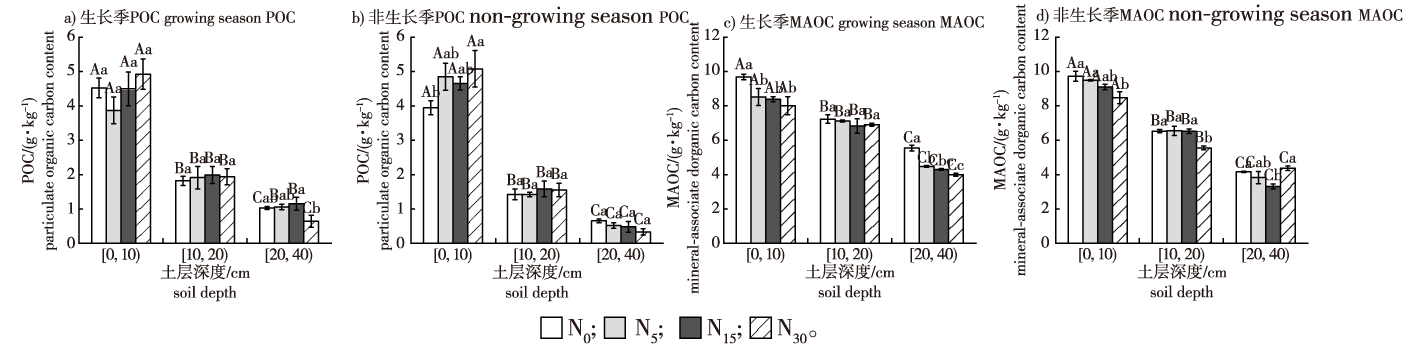
【目的】大气氮沉降显著影响陆地生态系统碳循环过程。土壤颗粒有机碳(POC)和矿物结合态有机碳 (MAOC)是土壤有机碳(SOC)的主要组成部分,研究氮添加对其动态变化的影响,对于理解和预测人工林土壤SOC含量对长期氮沉降的响应与适应机制具有重要的理论和实践指导意义。【方法】以江苏东台林场‘I-35’杨树(Populus deltoides cv. I-35)人工林为研究对象,于2012年5月建立人工模拟大气氮沉降的长期固定实验样地,实验设置4种不同施氮处理,分别为施氮量0 g/(m2·a)(N0)、5 g/(m2·a)(N5)、15 g/(m2·a)(N15)、30 g/(m2 · a)[N30],每个施氮处理设置4个重复,共16块样地。本研究于2023年8月(生长季)和2024年1月(非生长季)采集不同氮处理样地内的土壤样品,测定土壤pH、铵态氮、硝态氮、土壤总有机碳、可溶性有机碳、微生物生物量碳含量等,以及POC、MAOC含量。采集生长季凋落叶和细根,测定其全碳含量、碳氮比(C/N)、生物量等。采用方差分析、相关性分析、冗余分析等方法,探讨影响不同氮添加水平下土壤POC和MAOC含量变化的主要影响因子。【结果】总体上氮添加后土壤MAOC含量显著降低,但氮添加只对非生长季[0,10) cm(表层)土壤POC含量有显著影响。生长季N5、N15、N30处理下表层和[20,40) cm(下层)土壤MAOC含量均显著降低,[10,20) cm(中层)土壤MAOC含量变化不显著。非生长季N15处理下层土壤MAOC含量显著降低,N30处理下表层和中层土壤MAOC含量显著降低。生长季各氮处理对土壤POC含量均无显著影响,非生长季N30处理下表层土壤POC含量显著增加。从垂直分布上看,土壤 POC 和 MAOC 含量整体上随土层加深而显著降低。从季节变化上看,生长季土壤POC和MAOC含量整体上高于非生长季,中层和下层土壤变化显著。双因素方差分析表明,氮处理和土层深度的交互作用对土壤MAOC含量有极显著影响,对土壤POC含量无显著影响。相关性分析结果表明,土壤MAOC含量与凋落叶全碳含量呈显著正相关,土壤POC和MAOC含量均与总土壤有机碳、可溶性有机碳、铵态氮、全氮、微生物生物量碳含量及土壤含水率呈显著正相关,与土壤pH、碳氮比(质量比)呈显著负相关。冗余分析结果表明,土壤POC和MAOC含量均与微生物生物量碳含量呈显著正相关,与土壤硝态氮含量呈显著负相关。【结论】本研究结果表明长期氮添加促进了POC的积累,降低了MAOC的积累,指示未来长期的全球氮沉降可能对土壤有机碳库的积累和整体稳定性产生不利影响,这对森林生态系统土壤碳的长期储存具有重要意义。
【Objective】The atmospheric nitrogen deposition may significantly alter carbon cycling processes in terrestrial ecosystems. Soil particulate organic carbon (POC) and mineral-associated organic carbon (MAOC) are the main components of SOC. The effect of nitrogen addition on their dynamic changes is critical for understanding and predicting the response and adaptation mechanisms of SOC in plantation forests under long-term nitrogen deposition.【Method】Taking the plantation of Populus deltoides cv. I-35 in the Dongtai Forest Farm, Jiangsu Province, experimental plots were established in May 2012 to simulate atmospheric nitrogen deposition artificially. Four nitrogen application levels were set, i.e. 0 g/(m2·a)(N0), 5 g/(m2·a)(N5),15 g/(m2·a)(N15), and 30 g/(m2· a) (N30). Each nitrogen treatment included four replicated plots, resulting in 16 plots. We collected soil, litter, and fine root samples from each plot at different nitrogen treatments in August 2023 (growing season) and January 2024 (non-growing season), respectively. The soil was analyzed for pH, ammonium nitrogen, nitrate nitrogen, total soil organic carbon, dissolved organic carbon, microbial biomass carbon, and other physicochemical properties, as well as for POC and MAOC fractions. Litter and fine roots were analyzed for total carbon, carbon-to-nitrogen ratio, and biomass. The changes in the concentrations of soil POC and MAOC under different nitrogen addition levels and their driving factors were investigated by two-way ANOVA, correlation and redundancy analysis (RDA).【Result】Nitrogen addition significantly reduced the content of MAOC overall but had no significant effect on the content of soil POC, except in the [0,10) cm (surface) soil during the non-growing season. Moreover, during the growing season, N5, N15, and N30 treatments significantly reduced MAOC content in both surface and [20,40) cm (lower) soil layers. The effects on MAOC content in the middle soil layer were not significant. During the non-growing season, the N15 treatment significantly reduced MAOC content in the lower soil layer, while the N30 treatment significantly reduced MAOC content in the surface and [10,20) cm (middle) soil layers. All nitrogen treatments had no significant effect on POC during the growing season, while the N30 treatment significantly increased the content of POC in the surface layer during the non-growing season. The contents of soil POC and MAOC generally decreased significantly with increasing soil depth. Regarding seasonal variation, the soil POC and MAOC were overall higher in the growing season than in the non-growing season, with significant changes observed in the middle and lower soil layers. Two-way ANOVA indicated that the interaction between nitrogen treatment and soil depth had a highly significant effect on MAOC but no significant effect on POC. Correlation analysis showed that MAOC was positively correlated with total carbon in leaf litter. Both POC and MAOC were significantly positively correlated with total soil organic carbon, dissolved organic carbon, microbial biomass carbon, ammonium nitrogen, soil moisture, and total nitrogen. In contrast, they were negatively correlated with pH, carbon-to-nitrogen ratio, and nitrate nitrogen. Redundancy analysis revealed that POC and MAOC were significantly positively correlated with microbial biomass carbon and total carbon, and significantly negatively correlated with nitrate nitrogen.【Conclusion】The findings of this study demonstrate that long-term nitrogen addition promotes the accumulation of particulate organic carbon (POC) while reducing the accumulation of mineral-associated organic carbon (MAOC). This suggests that prolonged global nitrogen deposition may negatively impact the accumulation and overall stability of soil organic carbon pools, which holds significant implications for the long-term storage of soil carbon in forest ecosystems.
 PDF(2076 KB)