基于随机森林和结构方程的大兴安岭天然白桦林碳汇驱动因素分析

汲梦萱, 梅雪松, 董灵波

南京林业大学学报(自然科学版) ›› 2026, Vol. 50 ›› Issue (4) : 255-263.

PDF(2019 KB)
PDF(2019 KB)
南京林业大学学报(自然科学版) ›› 2026, Vol. 50 ›› Issue (4) : 255-263. DOI: 10.12302/j.issn.1000-2006.202503017
第二十八届中国科协年会———全球气候变化下的林草智能设计育种专题(执行主编 曹福亮 范国强 尹佟明 张怀清)
研究论文

基于随机森林和结构方程的大兴安岭天然白桦林碳汇驱动因素分析

作者信息 +

Driving factors on carbon sequestration for natural Betula platyphylla forests in the Greater Khingan Mountains based on random forest and structural equation

Author information +
文章历史 +

摘要

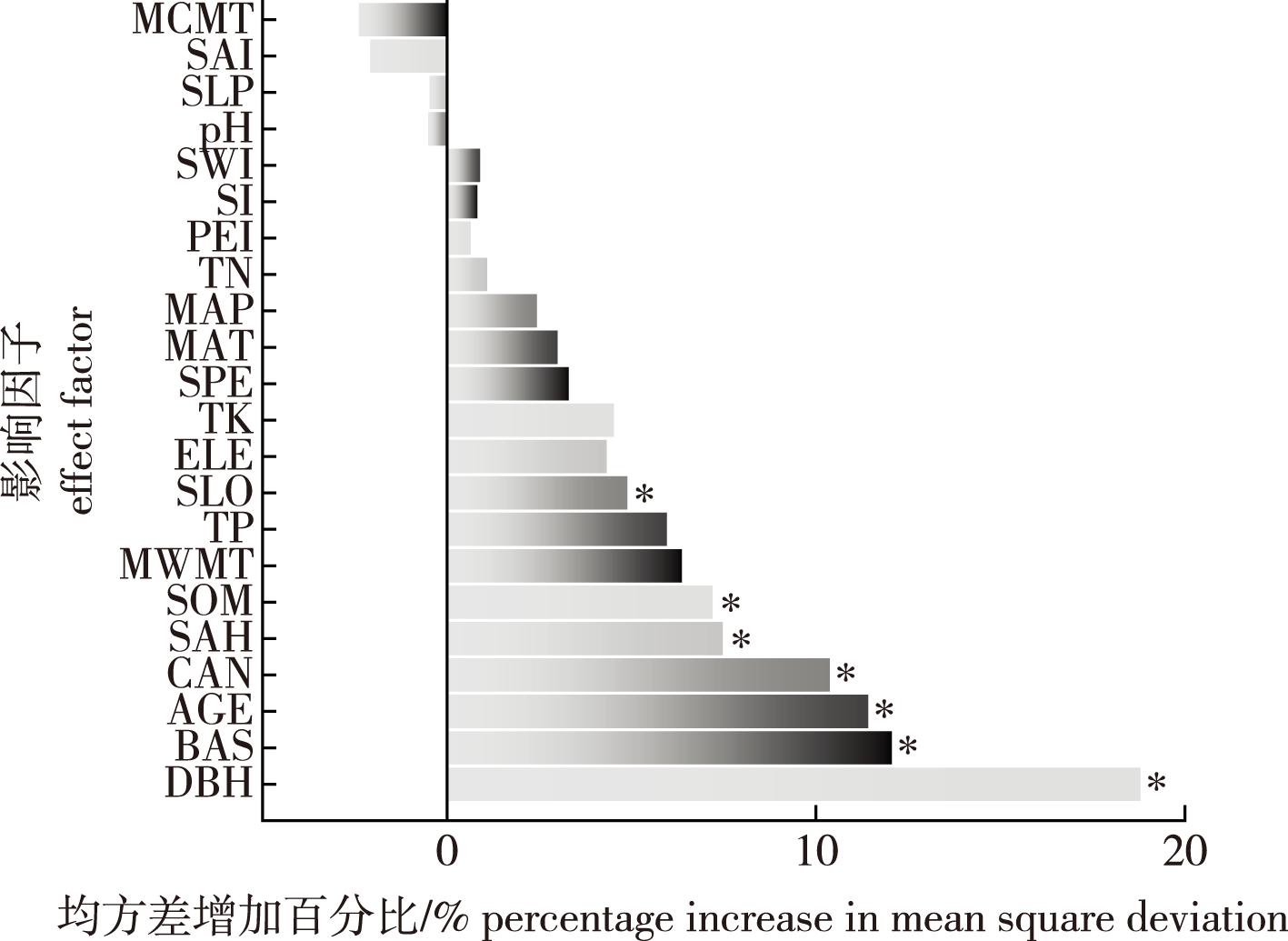
【目的】量化生物和非生物因素对大兴安岭地区天然白桦(Betula platyphylla)林碳汇量的影响,识别制约其碳汇功能的关键可控因子,为提升该地区天然白桦林碳汇功能提供理论依据。【方法】以大兴安岭地区第7次和第8次森林资源一类调查的175块固定样地数据为基础,结合随机森林算法和结构方程模型,量化生物因子(林分、生物多样性)和非生物因子(地形、气候、土壤)对天然白桦林碳汇量的直接和间接影响。【结果】①大兴安岭天然白桦林的年均碳汇量为(1.48±0.84) t/(hm2·a)。②随机森林算法结果表明,林分特征是对碳汇量影响最大的因子(贡献度60.09%),其影响分别约为土壤指标、气候特征、地形指标、生物多样性指标的3、6、9、11倍。③结构方程模型结果显示,天然白桦林碳汇量随着郁闭度的增加而增加(总路径系数β=0.030),而随着林分平均年龄(β=-0.643)、平均胸径(β=-0.489)、平均树高(β=-0.298)、坡度(β=-0.133)、土壤有机质含量(β=-0.039)和林分断面积(β=-0.007)的增加而减少。【结论大兴安岭天然白桦林林分平均年龄、平均胸径和平均树高是影响森林碳汇量的关键可控驱动因子,在未来经营活动中,可通过合理疏伐维持多层次、多样化的森林结构,以提高森林碳汇能力。

Abstract

【Objective】This study aims to quantify the impact of biotic and abiotic factors on the carbon sequestration capacity of natural Betula platyphylla forests in the Greater Khingan Mountains, and to identify and extract the key controllable factors that constrain their carbon sequestration function. The research provides a theoretical basis for enhancing the carbon sequestration function of natural B. platyphylla forests in this region.【Method】The research was based on data from 175 fixed plots of the 7th and 8th National Forest Inventory in the the Greater Khingan Mountains. It combined random forests and structural equation modeling (SEM) to quantify the direct and indirect effects of biotic factors (forest stand characteristics, biodiversity) and abiotic factors (terrain, climate, soil) on carbon sequestration.【Result】(1) The results showed that the average annual carbon sequestration of natural B. platyphylla forests in the region was (1.48±0.84) t/(hm2·a). (2) Random forests results indicated that stand characteristics were the most dominant factor influencing carbon sequestration (contribution: 60.09%), with their contribution approximately threefold that of soil indicators, sixfold that of climatic indicators, ninefold that of site condition indicators, and elevenfold that of tree species diversity indicators. (3) SEM results indicated that carbon sequestration increased with canopy density (total path coefficient β = 0.030), while it decreased with stand average age (β = -0.643), diameter at breast height (DBH) (β = -0.498), stand average tree height (β = -0.298), slope (β = -0.133), soil organic matter content (β = -0.039), basal area at the stand level (β =-0.007).【Conclusion】Therefore, stand average age, stand average DBH, and stand average tree height were key manageable driving factors influencing forest carbon sequestration. In future management activities, appropriate thinning can be implemented to maintain a multi-layered and diverse forest structure, which can enhance the forest’s carbon sequestration capacity.
关键词

碳汇量 / 天然白桦林 / 随机森林算法 / 结构方程模型 / 驱动因素

Key words

carbon sequestration / natural Betula platyphylla forests / random forest algorithm / structural equation modelling / driving factor

引用本文

导出引用
汲梦萱, 梅雪松, 董灵波. 基于随机森林和结构方程的大兴安岭天然白桦林碳汇驱动因素分析[J]. 南京林业大学学报(自然科学版). 2026, 50(4): 255-263 https://doi.org/10.12302/j.issn.1000-2006.202503017
Ji Mengxuan, Mei Xuesong, Dong Lingbo. Driving factors on carbon sequestration for natural Betula platyphylla forests in the Greater Khingan Mountains based on random forest and structural equation[J]. Journal of Nanjing Forestry University (Natural Sciences Edition). 2026, 50(4): 255-263 https://doi.org/10.12302/j.issn.1000-2006.202503017
中图分类号: S757   

参考文献

[1]
Dixon R K, Solomon A M, Brown S, et al. Carbon pools and flux of global forest ecosystems[J]. Science, 1994, 263(5144):185-190. DOI:10.1126/science.263.5144.185.
[2]
Magnussen S, Köhl M, Olschofsky K. Error propagation in stock-difference and gain-loss estimates of a forest biomass carbon balance[J]. European Journal of Forest Research, 2014, 133(6):1137-1155. DOI:10.1007/s10342-014-0828-0.
[3]
Li Y, Bao W K, Bongers F, et al. Drivers of tree carbon storage in subtropical forests[J]. Science of the Total Environment, 2019, 654:684-693. DOI:10.1016/j.scitotenv.2018.11.024.
[4]
Sullivan M J P, Talbot J, Lewis S L, et al. Diversity and carbon storage across the tropical forest biome[J]. Scientific Reports, 2017, 7:39102. DOI:10.1038/srep39102.
[5]
Ruiz-Benito P, Gómez-Aparicio L, Paquette A, et al. Diversity increases carbon storage and tree productivity in Spanish forests[J]. Global Ecology and Biogeography, 2014, 23(3):311-322. DOI:10.1111/geb.12126.
[6]
兰秀, 杜虎, 宋同清, 等. 广西主要森林植被碳储量及其影响因素[J]. 生态学报, 2019, 39(6):2043-2053.
Lan X, Du H, Song T Q, et al. Vegetation carbon storage in the main forest types in Guangxi and the related influencing factors[J]. Acta Ecologica Sinica, 2019, 39(6):2043-2053. DOI:10.5846/stxb201803210557.
[7]
Shi Y J, Xu L, Zhou Y F, et al. Quantifying driving factors of vegetation carbon stocks of Moso bamboo forests using machine learning algorithm combined with structural equation model[J]. Forest Ecology and Management, 2018, 429:406-413. DOI:10.1016/j.foreco.2018.07.035.
[8]
Wang Z C, Wang G Y, Li Y X, et al. Determinants of carbon sequestration in thinned forests[J]. Science of the Total Environment, 2024, 951:175540. DOI:10.1016/j.scitotenv.2024.175540.
[9]
兰洁, 雷相东, 何潇, 等. 吉林省天然阔叶混交林生态系统多功能性及驱动因素[J]. 生态学报, 2021, 41(13):5128-5141.
Lan J, Lei X D, He X, et al. Multi-functionality of natural mixed broad-leaved forests and driving forces in Jilin Province[J]. Acta Ecologica Sinica, 2021, 41(13):5128-5141. DOI:10.5846/stxb202101290310.
[10]
李虹谕, 杨会侠, 丁国权, 等. 中国森林碳储量分析[J]. 林业科技通讯, 2022(12):29-32.
Li H Y, Yang H X, Ding G Q, et al. Analysis of forest carbon storage in China[J]. Forest Science and Technology, 2022(12):29-32. DOI:10.13456/j.cnki.lykt.2022.05.23.0001.
[11]
李伟克, 舒立福, 王明玉, 等. 黑龙江大兴安岭林区雷击火与人为火发生规律及变化趋势[J]. 林业科学, 2024, 60(4):136-146.
Li W K, Shu L F, Wang M Y, et al. Occurrence pattern and changing trend of lightning induced fires and human-caused fires in Daxing’anling forest region of Heilongjiang Province[J]. Scientia Silvae Sinicae, 2024, 60(4):136-146. DOI:10.11707/j.1001-7488.LYKX20230259.
[12]
GB/T 38590—2020 森林资源连续清查技术规程[S].
GB/T 38590—2020 Technical regulations for continuous forest inventory[S].
[13]
Cook-Patton S C, Leavitt S M, Gibbs D, et al. Mapping carbon accumulation potential from global natural forest regrowth[J]. Nature, 2020, 585(7826):545-550. DOI:10.1038/s41586-020-2686-x.
[14]
汪亚琴. 长江流域中上游天然林资源保护工程对森林碳汇的影响研究[D]. 杨凌: 西北农林科技大学, 2023.
Wang Y Q. Influence of natural forest resources in the middle and upper reaches of Yangtze River Basin[D]. Yangling: Northwest A & F University, 2023.
[15]
董利虎. 黑龙江省主要树种相容性生物量模型研究[D]. 哈尔滨: 东北林业大学, 2012.
Dong L H. Study on the compatible models of tree biomass for main species in Heilongjiang Province[D]. Harbin: Northeast Forestry University, 2012.
[16]
Breiman L. Random forests[J]. Machine Learning, 2001, 45(1):5-32. DOI:10.1023/A:1010933404324.
[17]
高若楠, 谢阳生, 雷相东, 等. 基于随机森林模型的天然林立地生产力预测研究[J]. 中南林业科技大学学报, 2019, 39(4):39-46.
Gao R N, Xie Y S, Lei X D, et al. Study on prediction of natural forest productivity based on random forest model[J]. Journal of Central South University of Forestry & Technology, 2019, 39(4):39-46. DOI:10.14067/j.cnki.1673-923x.2019.04.008.
[18]
Liaw A, Wiener M. Classification and regression by random forest[J]. R news, 2002, 2(3): 18-22.
[19]
马梦晨. 基于随机森林方法的中小企业信用风险评估研究[J]. 特区经济, 2023(1):141-144.
Ma M C. Research on credit risk assessment of small and medium-sized enterprises based on random forest method[J]. Special Zone Economy, 2023(1):141-144.
[20]
曹小玉, 李际平, 赵文菲, 等. 基于结构方程模型分析林分空间结构对草本物种多样性的影响[J]. 生态学报, 2020, 40(24):9164-9173.
Cao X Y, Li J P, Zhao W F, et al. Effects of stand spatial structure on herbaceous species diversity in forests based on structural equation modeling[J]. Acta Ecologica Sinica, 2020, 40(24):9164-9173. DOI:10.5846/stxb202001280179.
[21]
Xu L, Shi Y J, Fang H Y, et al. Vegetation carbon stocks driven by canopy density and forest age in subtropical forest ecosystems[J]. Science of the Total Environment, 2018, 631:619-626. DOI:10.1016/j.scitotenv.2018.03.080.
[22]
董灵波, 田栋元, 陈莹, 等. 基于结构方程模型的兴安落叶松天然林更新影响因素[J]. 应用生态学报, 2021, 32(8):2763-2772.
Dong L B, Tian D Y, Chen Y, et al. Clarifying the factors affecting Larix gmelinii forest regeneration based on structural equation model[J]. Chinese Journal of Applied Ecology, 2021, 32(8):2763-2772. DOI:10.13287/j.1001-9332.202108.010.
[23]
何潇. 吉林省天然针阔混交林林分生物量影响因素与模型研究[D]. 北京: 中国林业科学研究院, 2022.
He X. Influencing factors and models of stand biomass for natural conifer-broad-leaved mixed forest in Jilin Province[D]. Beijing: Chinese Academy of Forestry, 2022.
[24]
何潇, 李海奎, 曹磊, 等. 退化森林生态系统中林分碳储量的驱动因素:以内蒙古大兴安岭为例[J]. 林业科学研究, 2020, 33(2):69-76.
He X, Li H K, Cao L, et al. The factors affecting carbon storage in degraded forest ecosystem:a case study from Daxing’anling areas of Inner Mongolia[J]. Forest Research, 2020, 33(2):69-76. DOI:10.13275/j.cnki.lykxyj.2020.02.009.
[25]
王维芳, 崔梦琦, 邢凯然. 包含哑变量的大兴安岭天然白桦林碳密度模型[J]. 森林工程, 2024, 40(5):74-81.
Wang W F, Cui M Q, Xing K R. Carbon density model of natural birch forest in the Daxing’an mountains based on dummy variables[J]. Forest Engineering, 2024, 40(5):74-81.
[26]
Kweon D, Comeau P G. Factors influencing productivity of pine-dominated stands in South Korea[J]. Journal of Environmental Management, 2023, 330:117250. DOI:10.1016/j.jenvman.2023.117250.
[27]
伏鸿峰, 闫伟, 陈晶晶. 内蒙古大兴安岭林区森林碳储量及其动态变化研究[J]. 干旱区资源与环境, 2013, 27(9):166-170.
Fu H F, Yan W, Chen J J. Forest carbon storage and it’s dynamics in Da-Xing mountains of Inner Mongolia[J]. Journal of Arid Land Resources and Environment, 2013, 27(9):166-170. DOI:10.13448/j.cnki.jalre.2013.09.019.
[28]
Vangi E, Dalmonech D, Cioccolo E, et al. Stand age diversity (and more than climate change) affects forests’ resilience and stability,although unevenly[J]. Journal of Environmental Management, 2024, 366:121822. DOI:10.1016/j.jenvman.2024.121822.
[29]
梅雪松, 董灵波, 陈冠谋. 基于结构方程模型的兴安落叶松天然林碳汇量驱动因素[J]. 北京林业大学学报, 2024, 46(9):1-10.
Mei X S, Dong L B, Chen G M. Driving factors of carbon sink in natural Larix gmelinii forests based on structural equation models[J]. Journal of Beijing Forestry University, 2024, 46(9):1-10. DOI:10.12171/j.1000-1522.20230284.
[30]
Croft H, Chen J M, Noland T L. Stand age effects on Boreal forest physiology using a long time-series of satellite data[J]. Forest Ecology and Management, 2014, 328:202-208. DOI:10.1016/j.foreco.2014.05.023.
[31]
张岚棋, 杨华, 张晓红. 天然云冷杉林树木生长与树木大小、竞争和树种多样性的关系[J]. 北京林业大学学报, 2024, 46(5):64-72.
Zhang L Q, Yang H, Zhang X H. Relationship between tree growth and tree size,competition as well as species diversity in spruce-fir natural forests[J]. Journal of Beijing Forestry University, 2024, 46(5):64-72. DOI:10.12171/j.1000-1522.20220409.
[32]
Ali A. Forest stand structure and functioning:current knowledge and future challenges[J]. Ecological Indicators, 2019, 98:665-677. DOI:10.1016/j.ecolind.2018.11.017.
[33]
Brienen R J W, Caldwell L, Duchesne L, et al. Forest carbon sink neutralized by pervasive growth-lifespan trade-offs[J]. Nature Communications, 2020, 11:4241. DOI:10.1038/s41467-020-17966-z.
[34]
窦啸文, 吴登瑜, 张笑菁, 等. 天目山常绿阔叶林胸高断面积生长量影响因子研究[J]. 浙江农林大学学报, 2023, 40(5):1063-1072.
Dou X W, Wu D Y, Zhang X J, et al. Study on the factors affecting breast-height basal area increment of evergreen broad-leaved forest in Mount Tianmu[J]. Journal of Zhejiang A&F University, 2023, 40(5):1063-1072. DOI:10.11833/j.issn.2095-0756.20220651.
[35]
沈浩, 姜姜, 周晨, 等. 江西石城不同起源阔叶林碳储量驱动因子分析[J]. 南京林业大学学报(自然科学版), 2023, 47(4):185-190.
Shen H, Jiang J, Zhou C, et al. Research on factors driving carbon storage in broad-leaved forests of different origins from Shicheng,Jiangxi Province[J]. Journal of Nanjing Forestry University (Natural Sciences Edition), 2023, 47(4):185-190.
[36]
Jucker T, Bouriaud O, Coomes D A. Crown plasticity enables trees to optimize canopy packing in mixed-species forests[J]. Functional Ecology, 2015, 29(8):1078-1086. DOI:10.1111/1365-2435.12428.
[37]
Gough C M, Curtis P S, Hardiman B S, et al. Disturbance,complexity,and succession of net ecosystem production in North America’s temperate deciduous forests[J]. Ecosphere, 2016, 7(6):e01375. DOI:10.1002/ecs2.1375.
[38]
Durán S M, Sánchez-Azofeifa G A, Rios R S, et al. The relative importance of climate,stand variables and liana abundance for carbon storage in tropical forests[J]. Global Ecology and Biogeography, 2015, 24(8):939-949. DOI:10.1111/geb.12304.
[39]
Mensah S, Veldtman R, Assogbadjo A E, et al. Tree species diversity promotes aboveground carbon storage through functional diversity and functional dominance[J]. Ecology and Evolution, 2016, 6(20):7546-7557. DOI:10.1002/ece3.2525.
[40]
Scharlemann J P, Tanner E V, Hiederer R, et al. Global soil carbon:understanding and managing the largest terrestrial carbon pool[J]. Carbon Management, 2014, 5(1):81-91. DOI:10.4155/cmt.13.77.
[41]
Paoli G D, Curran L M, Slik J W F. Soil nutrients affect spatial patterns of aboveground biomass and emergent tree density in southwestern Borneo[J]. Oecologia, 2008, 155(2):287-299. DOI:10.1007/s00442-007-0906-9.
[42]
Zhang Y J, Huang K, Zhang T, et al. Soil nutrient availability regulated global carbon use efficiency[J]. Global and Planetary Change, 2019, 173:47-52. DOI:10.1016/j.gloplacha.2018.12.001.

基金

国家重点研发计划(2023YFF1304002)

责任编辑: 李燕文
PDF(2019 KB)

Accesses

Citation

Detail

段落导航
相关文章

/