基于第九次森林资源连续清查的江苏省森林碳储量特征研究

张丽佳, 阮宏华, 倪健忠, 王国兵, 杨艳, 查全智, 谢友超

南京林业大学学报(自然科学版) ›› 2026, Vol. 50 ›› Issue (5) : 161-170.

PDF(2050 KB)
PDF(2050 KB)
南京林业大学学报(自然科学版) ›› 2026, Vol. 50 ›› Issue (5) : 161-170. DOI: 10.12302/j.issn.1000-2006.202503033
研究论文

基于第九次森林资源连续清查的江苏省森林碳储量特征研究

作者信息 +

Characteristics of forest carbon storage in Jiangsu Province based on the 9th forest resources inventory data

Author information +
文章历史 +

摘要

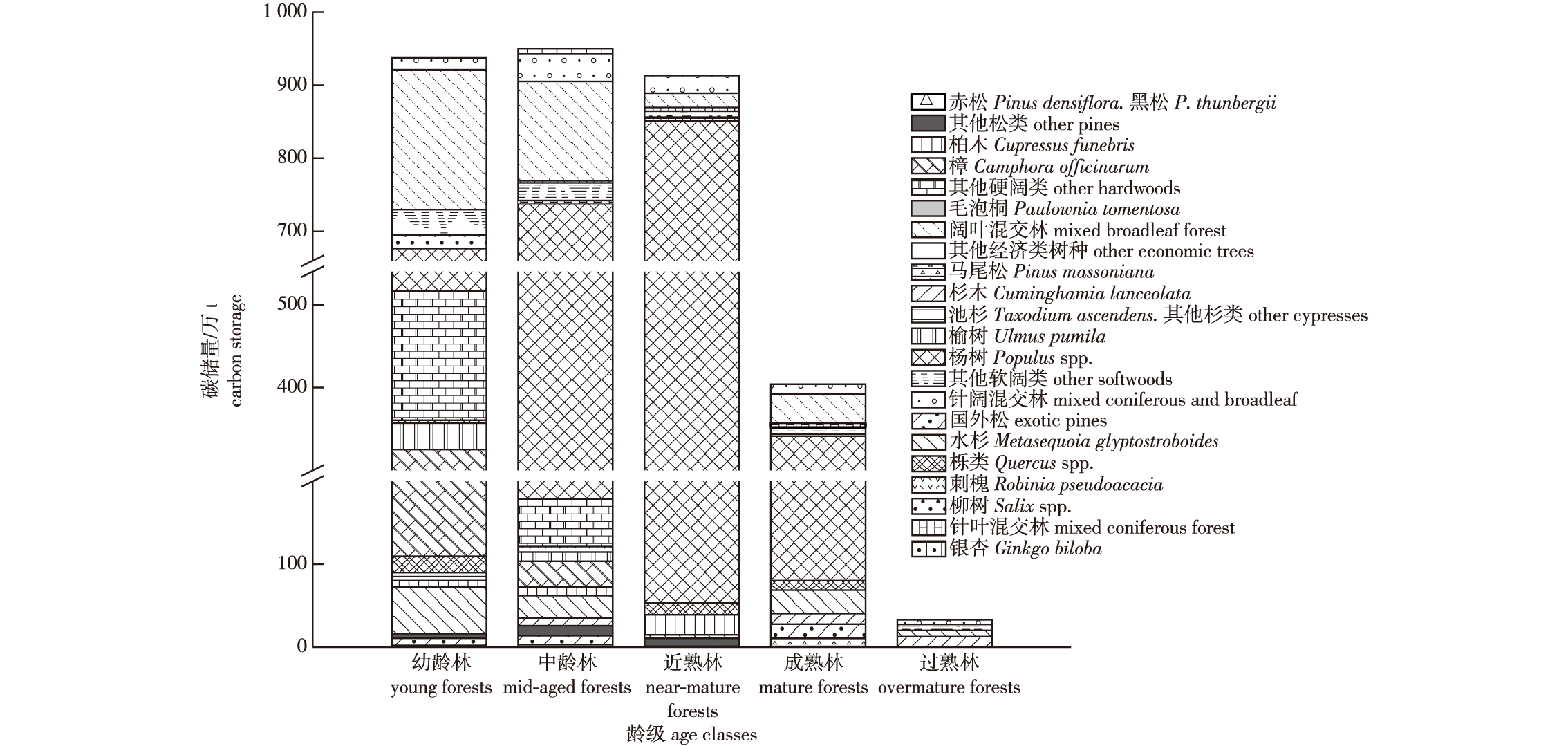
【目的】通过构建植被-土壤全生态系统碳储量评估体系,系统估算江苏省森林生态系统的碳储存能力,揭示当前江苏省森林碳储量现状和问题所在,为制定有效的森林资源管理和碳汇管理政策提供科学依据。【方法】以我国第九次(2014—2018)森林资源清查数据为基础,结合野外典型样地调查数据和相关文献数据,采用蓄积量-生物量换算因子连续函数估算模型,估测江苏省森林资源碳储量、碳密度分布特征,比较分析不同优势树种、龄组、林分起源和林种类型碳储量的分布格局,并根据生态系统各空间层次的生物量密度和含碳系数以及植被面积估算林下灌木层、草本层、凋落物层碳储量;根据不同土层深度的土壤有机碳含量和容重估算1 m深度土壤层碳储量。【结果】①江苏省不同森林类型植被总碳储量为4.752 36×107 t,其中乔木林碳储量占总碳储量的68.26%;碳密度为25.49 t/hm2,其中竹林碳密度最高,为35.75 t/hm2。②优势树种中以杨树(Populus spp.)占比最高,其碳储量占总碳储量的56.90%。乔木林不同龄组的碳储量以中幼龄为主,从大到小排序为中龄林>幼龄林>近熟林>成熟林>过熟林;碳密度表现为随着林龄的增长而增加的趋势。③人工林碳储量高于天然次生林碳储量,人工林碳储量占总碳储量的96.41%,达3.127 06×107 t。④不同林种碳密度大小为用材林>防护林>特用林>经济林,碳储量大小顺序与之相同,用材林占比66.50%。⑤从生态系统来看,江苏省森林生态系统总碳储量为2.080 4×10⁸ t,森林生态系统碳储量空间分布特征,大小排序为土壤层>乔木层>灌木层>草本层>凋落物层。土壤层碳储量为1.588 8×10⁸ t,占森林生态系统总碳储量的76.37%,乔木层次之,占比为16.16%。【结论】江苏省森林碳储量呈显著增长趋势,森林地上部分碳储量和地下土壤碳储量的比例约为3∶7。但与全国平均水平相比,江苏省森林碳密度相对较低,且多以人工林分为主,杨树林面积占比过高,林分以幼中林为主。研究结果可为提高森林的单位面积碳固持能力提供数据参考,有利于森林资源的保护和可持续发展,特别是保护林下灌草和凋落物层,可增加土壤碳储量,构建合理的森林经营模式。

Abstract

【Objective】By constructing a vegetation-soil whole-ecosystem carbon storage assessment system, the carbon sequestration capacity of the forest ecosystem in Jiangsu Province is systematically evaluated. The current status and existing issues of forest carbon storage in Jiangsu Province are revealed, providing a scientific basis for formulating effective forest resource management and carbon sink management policies.【Method】Based on the 9th National Forest Resource Inventory data of China (2014—2018), combined with field survey data of typical plots and relevant literature data, the continuous function estimation model of volume-biomass conversion factor was used to estimate the carbon storage and carbon density distribution of forest resources in Jiangsu Province. The distribution patterns of carbon storage among different dominant tree species, age classes, stand origins, and forest types were compared and analyzed. Carbon storage of understory shrub layer, herb layer, and litter layer was estimated based on the biomass density, carbon coefficient of each spatial layer in the ecosystem, as well as vegetation area. In addition, carbon storage of the one-meter-deep soil layer was estimated based on soil organic carbon content and bulk density at different soil depth.【Result】(1) The total vegetation carbon storage of different forest types in Jiangsu Province is 4.752 36×107 t,among which arbor forest accounts for 68.26% of the total carbon storage, with a carbon density of 25.49 t/hm2. Bamboo forest has the highest carbon density (35.75 t/hm2).(2) Among different dominant tree species, Populus spp. occupies the highest proportion, and its carbon storage accounts for 56.90% of the total. The carbon storage of arbor forests is dominated by young and middle-aged stands, with the order from high to low: middle-aged forests > young forests > near-mature forests > mature forests > over-mature forests. Carbon density shows a trend of increasing with stand age.(3) In terms of different origins, the carbon storage of planted forests is much higher than that of natural secondary forests. Planted forests account for 96.41% of the total carbon storage, reaching 3.127 06×107 t.(4) The order of carbon density among different forest types is: timber forests > protective forests > special-purpose forests > non-timber forests, and the order of carbon storage was consistent with this. Timber forests account for 66.50%.(5) From the perspective of the ecosystem, the total carbon storage of the forest ecosystem is 2.080 4×10⁸ t. The order of spatial distribution of carbon storage in the forest ecosystem is: soil layer > arbor layer > shrub layer > herb layer > litter layer. The carbon storage of the soil layer is 1.588 8×10⁸ t, accounting for 76.37% of the total forest ecosystem carbon storage, followed by the arbor layer(16.16%).【Conclusion】Jiangsu Province demonstrates a substantial growth trend in its forest carbon sequestration. The ratio of aboveground forest carbon storage to underground soil carbon storage is approximately 3∶7. Compared to the national average, the forest carbon density in Jiangsu Province is relatively low, with planted forests as the main type, an excessively high proportion of Populus spp. area, and young and middle-aged stands as dominant forest types. The results provide a data reference for improving the carbon sequestration capacity per unit area of forests, which is conducive to the protection and sustainable development of forest resources—especially the protection of understory shrubs, herbs, and litter layers to increase soil carbon storage and to construct a reasonable forest management model.
关键词

碳储量 / 碳密度 / 森林碳汇 / 杨树人工林 / 森林生态系统 / 土壤层

Key words

carbon storage / carbon density / forest carbon sink / poplar plantation / forest ecosystem / soil layer

引用本文

导出引用
张丽佳, 阮宏华, 倪健忠, 等. 基于第九次森林资源连续清查的江苏省森林碳储量特征研究[J]. 南京林业大学学报(自然科学版). 2026, 50(5): 161-170 https://doi.org/10.12302/j.issn.1000-2006.202503033
Zhang Lijia, Ruan Honghua, Ni Jianzhong, et al. Characteristics of forest carbon storage in Jiangsu Province based on the 9th forest resources inventory data[J]. Journal of Nanjing Forestry University (Natural Sciences Edition). 2026, 50(5): 161-170 https://doi.org/10.12302/j.issn.1000-2006.202503033
中图分类号: S718.5   

参考文献

[1]
刘世荣, 王晖, 李海奎, 等. 碳中和目标下中国森林碳储量、碳汇变化预估与潜力提升途径[J]. 林业科学, 2024, 60(4): 157-172.
Liu S R, Wang H, Li H K, et al. Projections of China’s forest carbon storage and sequestration and ways of their potential capacity enhancement[J]. Scientia Silvae Sinicae, 2024, 60(4):157-172.DOI:10.11707/j.1001-7488.LYKX20230206.
[2]
Cai W X, He N P, Li M X, et al. Carbon sequestration of Chinese forests from 2010 to 2060:spatiotemporal dynamics and its regulatory strategies[J]. Science Bulletin, 2022, 67(8):836-843.DOI: 10.1016/j.scib.2021.12.012.
[3]
Fang J Y, Wang G G, Liu G H, et al. Forest biomass of China: an estimate based on the biomass-volume relationship[J]. Ecological Applications, 1998, 8(4): 1084-1091. DOI:10.2307/2640963.
[4]
李伟, 张翠萍, 李士美. 基于第8次森林资源清查数据的广西森林碳储量特征研究[J]. 西南林业大学学报(自然科学), 2017, 37(3): 127-133.
Li W, Zhang C P, Li S M. Forest carbon storage in Guangxi Province estimated by 8th forest inventory data[J]. Journal of Southwest Forestry University (Natural Sciences), 2017, 37(3):127-133.DOI: 10.11929/j.issn.2095-1914.2017.03.020.
[5]
王会荣, 李爱琴, 王晶晶, 等. 基于第8次森林资源清查数据的安徽森林碳储量特征研究[J]. 西北农林科技大学学报(自然科学版), 2019, 47(7): 78-86.
Wang H R, Li A Q, Wang J J, et al. Characteristics of forest carbon storage in Anhui based on the 8th forest inventory data[J]. Journal of Northwest A & F University (Natural Science Edition), 2019, 47(7):78-86.DOI: 10.13207/j.cnki.jnwafu.2019.07.011.
[6]
涂宏涛, 周红斌, 马国强, 等. 基于第九次森林资源清查的云南森林碳储量特征研究[J]. 西北林学院学报, 2023, 38(3): 185-193.
Tu H T, Zhou H B, Ma G Q, et al. Characteristics of forest carbon storage in Yunnan based on the ninth forest inventory data[J]. Journal of Northwest Forestry University, 2023, 38(3):185-193.DOI: 10.3969/j.issn.1001-7461.2023.03.25.
[7]
王磊, 丁晶晶, 季永华, 等. 江苏省森林碳储量动态变化及其经济价值评价[J]. 南京林业大学学报(自然科学版), 2010, 34(2): 1-5.
Wang L, Ding J J, Ji Y H, et al. The dynamic carbon storage and economic value assessment of forest in Jiangsu Province[J]. Journal of Nanjing Forestry University (Natural Sciences Edition), 2010, 34(2):1-5.DOI: 10.3969/j.issn.1000-2006.2010.02.001.
[8]
贾松伟. 基于森林资源清查资料的河南省森林碳储量及其经济价值研究[J]. 湖北农业科学, 2016, 55(6): 1612-1616.
Jia S W. Study on carbon storage of forest vegetation and its economic value in Henan Province based on continuous forest resources inventory[J]. Hubei Agricultural Sciences, 2016, 55(6):1612-1616.DOI: 10.14088/j.cnki.issn0439-8114.2016.06.061.
[9]
杨加猛, 杜丽永, 蔡志坚, 等. 江苏省森林碳储量的区域分布研究[J]. 中南林业科技大学学报, 2014, 34(7): 84-89.
Yang J M, Du L Y, Cai Z J, et al. Study on regional distribution of forest carbon storage in Jiangsu Province[J]. Journal of Central South University of Forestry & Technology, 2014, 34(7):84-89.DOI: 10.14067/j.cnki.1673-923x.2014.07.018.
[10]
徐钊, 曹国华, 李思刚, 等. 江苏省森林植被碳储量分布结构及变化特征[J]. 西北林学院学报, 2019, 34(2): 69-75+91.
Xu Z, Cao G H, Li S G, et al. Characteristics of carbon storage distribution structure and dynamic change of forest vegetation in Jiangsu Province[J]. Journal of Northwest Forestry University, 2019, 34(2):69-75,91.DOI: 10.3969/j.issn.1001-7461.2019.02.11.
[11]
聂昊, 王绍强, 周蕾, 等. 基于森林清查资料的江西和浙江森林植被固碳潜力[J]. 应用生态学报, 2011, 22(10): 2581-2588.
Nie H, Wang S Q, Zhou L, et al. Carbon sequestration potential of forest vegetation in Jiangxi and Zhejiang Provinces based on national forest inventory[J]. Chinese Journal of Applied Ecology, 2011, 22(10):2581-2588.DOI: 10.13287/j.1001-9332.2011.0366.
[12]
林虹, 马旭, 何再华, 等. 江苏省森林生态系统碳汇现状研究[J]. 林业资源管理, 2014(1): 89-97..
Lin H, Ma X, He Z H, et al. Research on forest ecosystem carbon sinks in Jiangsu Province[J]. Forest Resources Management, 2014(1):89-97.DOI: 10.13466/j.cnki.lyzygl.2014.01.018.
[13]
赵栋. 江苏省森林生态系统碳储量及碳密度研究[D]. 南京: 南京大学, 2014.
Zhao D. Carbon storage and carbon density of forest ecosystem in Jiangsu Province[D]. Nanjing: Nanjing University, 2012.
[14]
郑刚, 戎慧, 程小义, 等. 基于森林资源连续清查的江苏省森林资源动态变化分析[J]. 江苏林业科技, 2017, 44(2): 43-47.
Zheng G, Rong H, Cheng X Y, et al. Dynamic change analysis of forest resources in Jiangsu Province based on continuous inventory of forest resources[J]. Journal of Jiangsu Forestry Science & Technology, 2017, 44(2):43-47.DOI: 10.3969/j.issn.1001-7380.2017.02.010.
[15]
Fang J Y, Chen A P, Peng C H, et al. Changes in forest biomass carbon storage in China between 1949 and 1998[J]. Science, 2001, 292(5525): 2320-2322. DOI:10.1126/science.1058629.
[16]
曾伟生. 云南省森林生物量与生产力研究[J]. 中南林业调查规划, 2005, 24(4):1-3,13.
Zeng W S. Research on forest biomass and productivity in Yunnan[J]. Contral South Forest Inventory and Planning, 2005, 24(4):1-3,13. DOI: 10.3969/j.issn.1003-6075.2005.04.001.
[17]
Zhang C H, Ju W M, Chen J M, et al. China’s forest biomass carbon sink based on seven inventories from 1973 to 2008[J]. Climatic Change, 2013, 118(3-4): 933-948. DOI:10.1007/s10584-012-0666-3.
[18]
Fang J Y, Oikawa T, Kato T, et al. Biomass carbon accumulation by Japan’s forests from 1947 to 1995[J]. Global Biogeochemical Cycles, 2005, 19(2): 2004GB002253. DOI:10.1029/2004GB002253.
[19]
田勇燕, 秦飞, 关庆伟. 江苏徐州市果树经济林的碳储量估算[J]. 中国园艺文摘, 2014, 30(5): 50-52.
Tian Y Y, Qin F, Guan Q W. Estimation of carbon storage of fruit tree economic forest in Xuzhou City[J]. Chinese Horticulture Abstracts, 2014, 30(5):50-52.
[20]
Guo Z D, Hu H F, Li P, et al. Spatio-temporal changes in biomass carbon sinks in China’s forests from 1977 to 2008[J]. Science China Life Sciences, 2013, 56(7): 661-671. DOI:10.1007/s11427-013-4492-2.
[21]
刘成杰. 基于典型样地的山东省森林碳储量及碳密度研究[D]. 泰安: 山东农业大学, 2014.
Liu C J. Forest carbon storage and carbon density in Shandong Province based on typical sample plots[D]. Taian: Shandong Agricultural University, 2014.
[22]
GB/T 43648-2024.主要树种立木生物量模型与碳计量参数[S].
GB/T 43648-2024. Tree biomass models and related parameters to carbon accounting for major tree species[S].
[23]
田勇燕, 秦飞, 言华, 等. 我国常见木本植物的含碳率[J]. 安徽农业科学, 2011, 39(26): 16166-16169.
Tian Y Y, Qin F, Yan H, et al. Carbon content rate in the common woody plants of China[J]. Journal of Anhui Agricultural Sciences, 2011, 39(26):16166-16169.DOI: 10.13989/j.cnki.0517-6611.2011.26.011.
[24]
张瀚月. 中国主要树种生长量与碳汇量测计方法研究与应用[D]. 北京: 北京林业大学, 2022.DOI: 10.26949/d.cnki.gblyu.2022.000006.
Zhang H Y. Research and application of measurement and statistics for the growth and carbon sink of major tree species in China[D]. Beijing: Beijing Forestry University, 2022.DOI: 10.26949/d.cnki.gblyu.2022.000006.
[25]
陈俊华, 刘威君, 蒋川东, 等. 川中丘陵区人工柏木林生物量模型及碳计量参数[J]. 四川林业科技, 2023, 44(6): 32-39.
Chen J H, Liu W J, Jiang C D, et al. Study on biomass model and carbon metrology parameters of artificial cypress forest in hilly areas of central Sichuan[J]. Journal of Sichuan Forestry Science and Technology, 2023, 44(6):32-39.DOI: 10.12172/202308100001.
[26]
樊星, 田大伦, 樊巍, 等. 黄淮海平原主要农林复合树种的含碳率研究[J]. 中南林业科技大学学报, 2014, 34(6): 85-87,93.
Fan X, Tian D L, Fan W, et al. Carbon content of main agro-forestry tree species in the north China Plain[J]. Journal of Central South University of Forestry & Technology, 2014, 34(6): 85-87,93.DOI: 10.14067/j.cnki.1673-923x.2014.06.022.
[27]
吴国训, 唐学君, 阮宏华, 等. 基于森林资源清查的江西省森林碳储量及固碳潜力研究[J]. 南京林业大学学报(自然科学版), 2019, 43(1): 105-110.
Wu G X, Tang X J, Ruan H H, et al. Carbon storage and carbon sequestration potential based on forest inventory data in Jiangxi Province,China[J]. Journal of Nanjing Forestry University (Natural Sciences Edition), 2019, 43(1):105-110.DOI: 10.3969/j.issn.1000-2006.201711051.
[28]
郭琦, 王新杰. 不同混交模式杉木人工林林下植被生物量与土壤物理性质研究[J]. 中南林业科技大学学报, 2014, 34(5): 70-74.
Guo Q, Wang X J. Undergrowth biomass and soil physical properties under Cunninghamia lanceolata with different patterns of mixed forests[J]. Journal of Central South University of Forestry & Technology, 2014, 34(5):70-74.DOI: 10.14067/j.cnki.1673-923x.2014.05.015.
[29]
温卫华. 不同起源毛竹林生态系统生物量与碳储量研究[D]. 南昌: 江西农业大学, 2016.
Wen W H. Study on the ecosystem biomass and carbon storage of different origin phyllostachy edulis[D]. Nanchang: Jiangxi Agricultural University, 2016.
[30]
戴巍, 赵科理, 高智群, 等. 典型亚热带森林生态系统碳密度及储量空间变异特征[J]. 生态学报, 2017, 37(22): 7528-7538.
Dai W, Zhao K L, Gao Z Q, et al. Spatial variation characteristics of carbon density and storage in forest ecosystems in a typical subtropical region[J]. Acta Ecologica Sinica, 2017, 37(22):7528-7538.DOI: 10.5846/stxb201609271947.
[31]
肖君. 福州市主要森林类型林下灌木层生物量和碳密度研究[J]. 林业勘察设计, 2023, 43(1): 1-4.
Xiao J. Study on biomass and carbon density of understory shrub layer in major forest types of Fuzhou City[J]. Forest Survey and Design, 2023, 43(1): 1-4.
[32]
王昭生. 1982-2020年NDVI数据驱动随机森林模型模拟中国森林凋落物碳密度的研究[J]. 遥感技术与应用, 2023, 38(6):1381-1389.
Wang Z S. NDVI-driven model of random forest to simulate forest litter carbon density over China during 1982-2020[J]. Remote Sensing Technology and Application, 2023, 38(6):1381-1389.DOI: 10.11873/j.issn.1004-0323.2023.6.1381.
[33]
王深华, 江军, 刘丰彩, 等. 中国成熟天然林土壤有机碳垂直分异特征[J]. 应用生态学报, 2021, 32(7): 2371-2377.
Wang S H, Jiang J, Liu F C, et al. Vertical differentiation of soil organic carbon in mature natural forests in China[J]. Chinese Journal of Applied Ecology, 2021, 32(7):2371-2377.DOI: 10.13287/j.1001-9332.202107.007.
[34]
樊子豪, 崔鸿侠, 沈琛琛, 等. 神农架林区天然次生林土壤有机碳分布及影响因素[J]. 生态学报, 2024, 44(16): 7130-7139.
Fan Z H, Cui H X, Shen C C, et al. Distribution and influencing factors of soil organic carbon in natural secondary forests of Shennongjia Forestry District[J]. Acta Ecologica Sinica, 2024, 44(16):7130-7139.DOI: 10.20103/j.stxb.202311102438.
[35]
于法展, 陈龙乾, 沈正平, 等. 苏北低山丘陵区典型性森林土壤有机碳空间分布特征[J]. 测绘科学, 2013, 38(6): 52-54,42.
Yu F Z, Chen L Q, Shen Z P, et al. Spatial distribution characteristics of soil organic carbon in typical forestlands in north Jiangsu hilly region[J]. Science of Surveying and Mapping, 2013, 38(6):52-54,42.DOI: 10.16251/j.cnki.1009-2307.2013.06.009.
[36]
刘曦乔, 梁萌杰, 陈龙池, 等. 湖南省森林生态系统碳储量、碳密度及其空间分布[J]. 生态学杂志, 2017, 36(9): 2385-2393.
Liu X Q, Liang M J, Chen L C, et al. Carbon storage,carbon density and spatial distribution of forest ecosystems in Hunan Province[J]. Chinese Journal of Ecology, 2017, 36(9):2385-2393.DOI: 10.13292/j.1000-4890.201709.021.
[37]
周纯亮, 吴明, 刘满强, 等. 中亚热带3种人工林土壤有机碳含量与碳密度的动态变化[J]. 土壤通报, 2010, 41(3): 568-572.
Zhou C L, Wu M, Liu M Q, et al. Changes in soil organic carbon and carbon density of three plantations in mid-subtropics[J]. Chinese Journal of Soil Science, 2010, 41(3):568-572.DOI: 10.19336/j.cnki.trtb.2010.03.012.
[38]
王大鹏, 王文斌, 郑亮, 等. 中国主要人工林土壤有机碳的比较[J]. 生态环境学报, 2014, 23(4): 698-704.
Wang D P, Wang W B, Zheng L, et al. Compared of soil organic carbon of different plantations in China[J]. Ecology and Environmental Sciences, 2014, 23(4):698-704.DOI: 10.16258/j.cnki.1674-5906.2014.04.005.
[39]
高述超, 陈毅青, 陈宗铸, 等. 海南岛森林生态系统碳储量及其空间分布特征[J]. 生态学报, 2023, 43(9): 3558-3570.
Gao S C, Chen Y Q, Chen Z Z, et al. Carbon storage and its spatial distribution characteristics of forest ecosystems in Hainan Island,China[J]. Acta Ecologica Sinica, 2023, 43(9):3558-3570.DOI: 10.5846/stxb202207051909.
[40]
贾黎明, 刘诗琦, 祝令辉, 等. 我国杨树林的碳储量和碳密度[J]. 南京林业大学学报(自然科学版), 2013, 37(2): 1-7.
Jia L M, Liu S Q, Zhu L H, et al. Carbon storage and density of poplars in China[J]. Journal of Nanjing Forestry University (Natural Sciences Edition), 2013, 37(2):1-7.
[41]
张青青, 张桂莲, 伍海兵, 等. 上海市林地土壤有机碳分布特征及其与土壤理化性质的关系[J]. 浙江农林大学学报, 2019, 36(6): 1087-1095.
Zhang Q Q, Zhang G L, Wu H B, et al. Soil organic carbon distribution and its relationship with soil physicochemical properties in different forest types of Shanghai City[J]. Journal of Zhejiang A & F University, 2019, 36(6):1087-1095.DOI: 10.11833/j.issn.2095-0756.2019.06.005.
[42]
袁在翔, 金雪梅, 翟凯燕, 等. 常见绿化树种对土壤碳氮垂直分布及有机碳储量的影响[J]. 南京林业大学学报(自然科学版), 2018, 42(3): 153-158.
Yuan Z X, Jin X M, Zhai K Y, et al. Effects of common urban tree species on vertical distribution of soil carbon & nitrogen and organic carbon storage[J]. Journal of Nanjing Forestry University (Natural Sciences Edition), 2018, 42(3):153-158.DOI: 10.3969/j.issn.1000-2006.201706016.
[43]
敖贵艳, 刘强, 吴伟光, 等. 基于CiteSpace的全球竹林碳汇研究回顾及展望[J]. 浙江农林大学学报, 2021, 38(4): 861-870.
Ao G Y, Liu Q, Wu W G, et al. A review and prospect of global bamboo forest carbon sink research based on CiteSpace[J]. Journal of Zhejiang A & F University, 2021, 38(4):861-870.DOI: 10.11833/j.issn.2095-0756.20200501.
[44]
Xu L, Yu G R, He N P, et al. Carbon storage in China’s terrestrial ecosystems:a synthesis[J]. Scientific Reports, 2018, 8:2806.DOI: 10.1038/s41598-018-20764-9.
[45]
Shi K, Liao J H, Zou X M, et al. Accumulation of soil microbial extracellular and cellular residues during forest rewilding: implications for soil carbon stabilization in older plantations[J]. Soil Biology and Biochemistry, 2024, 188: 109250. DOI:10.1016/j.soilbio.2023.109250.
[46]
刘磊, 贾炜玮, 张小勇, 等. 北方森林乔木层碳储量的估计及空间分析[J]. 森林工程, 2024, 40(4):137-149.
Liu L, Jia W W, Zhang X Y, et al. Estimation and spatial analysis of carbon storage in tree layers of northern forests[J]. Forest Engineering, 2024, 40(4):137-149. DOI:10.7525/j.issn.1006-8023.2024.04.015.
[47]
张煜星, 王雪军, 蒲莹, 等. 1949-2018年中国森林资源碳储量变化研究[J]. 北京林业大学学报, 2021, 43(5): 1-14.
Zhang Y X, Wang X J, Pu Y, et al. Changes in forest resource carbon storage in China between 1949 and 2018[J]. Journal of Beijing Forestry University, 2021, 43(5):1-14.DOI: 10.12171/j.1000-1522.20200237.
[48]
康义, 辛学兵, 裴顺祥, 等. 华北落叶松人工林林下物种多样性特征研究[J]. 西北林学院学报, 2025, 40(1): 23-31, 82.
Kang Y, Xin X B, Pei S X, et al. Undergrowth species diversity characteristics of Larix principis-rupprechtii plantation[J]. Journal of Northwest Forestry University, 2025, 40(1):23-31,82.DOI: 10.3969/j.issn.1001-7461.2025.01.03.
[49]
李奇, 朱建华, 冯源, 等. 中国森林乔木林碳储量及其固碳潜力预测[J]. 气候变化研究进展, 2018, 14(3): 287-294.
Li Q, Zhu J H, Feng Y, et al. Carbon storage and carbon sequestration potential of the forest in China[J]. Climate Change Research, 2018, 14(3):287-294.DOI: 10.12006/j.issn.1673-1719.2017.102.
[50]
刘领, 王艳芳, 悦飞雪, 等. 基于森林清查资料的河南省森林植被碳储量动态变化[J]. 生态学报, 2019, 39(3): 864-873.
Liu L, Wang Y F, Yue F X, et al. Dynamic of forest vegetation carbon storage in Henan Province based on forest inventory data[J]. Acta Ecologica Sinica, 2019, 39(3):864-873.DOI: 10.5846/stxb201807081487.
[51]
杨立青, 刘帅, 吴诗婷, 等. 林下蚯蚓养殖对杨树人工林土壤有机碳含量和组成的影响[J]. 生态与农村环境学报, 2026, 42(3): 405-411.
Yang L Q, Liu S, Wu S T, et al. Effects of understory earthworm cultivation on the content and composition of soil organic carbon in poplar plantations[J]. Journal of Ecology and Rural Environment, 2026, 42(3): 405-411. DOI: 10.19741/j.issn.1673-4831.2025.0231.
[52]
郑辉杰, 彭翔, 李涛, 等. 滨海盐碱地典型人工林土壤有机碳分布特征与关键影响因素研究[J]. 生态与农村环境学报, 2025[2026-04-07]. https://doi.org/10.19741/j.issn.1673-4831.2025.0129.
Zheng H J, Peng X, Li T, et al. Study on distribution characteristics of soil organic carbon and key influencing factors in typical plantations of coastal saline-alkali land[J]. Journal of Ecology and Rural Environment, 2025[2026-04-07]. https://doi.org/10.19741/j.issn.1673-4831.2025.0129. DOI: 10.19741/j.issn.1673-4831.2025.0129.

基金

江苏省林业局揭榜挂帅项目(LYKJ【2022】01)
江苏省林业局造林专项项目(【2021-2022】)
国家重点研发计划(2021YFD2200403)
国家重点研发计划(2023YFD2200404)

责任编辑: 王国栋
PDF(2050 KB)

Accesses

Citation

Detail

段落导航
相关文章

/

〈 〉