PDF(2010 KB)

7种人工林草本层物种多样性及其与生物量的关系
秦宇, 杨光辉, 金光泽, 逄晨, 崔君滕, 钟杰超, 赵芸, 宋昱君, 耿鹏飞
南京林业大学学报(自然科学版) ›› 2026, Vol. 50 ›› Issue (5) : 199-208.
PDF(2010 KB)
 PDF(2010 KB)
7种人工林草本层物种多样性及其与生物量的关系
The relationship between species diversity and biomass in the herbaceous layer of seven plantations
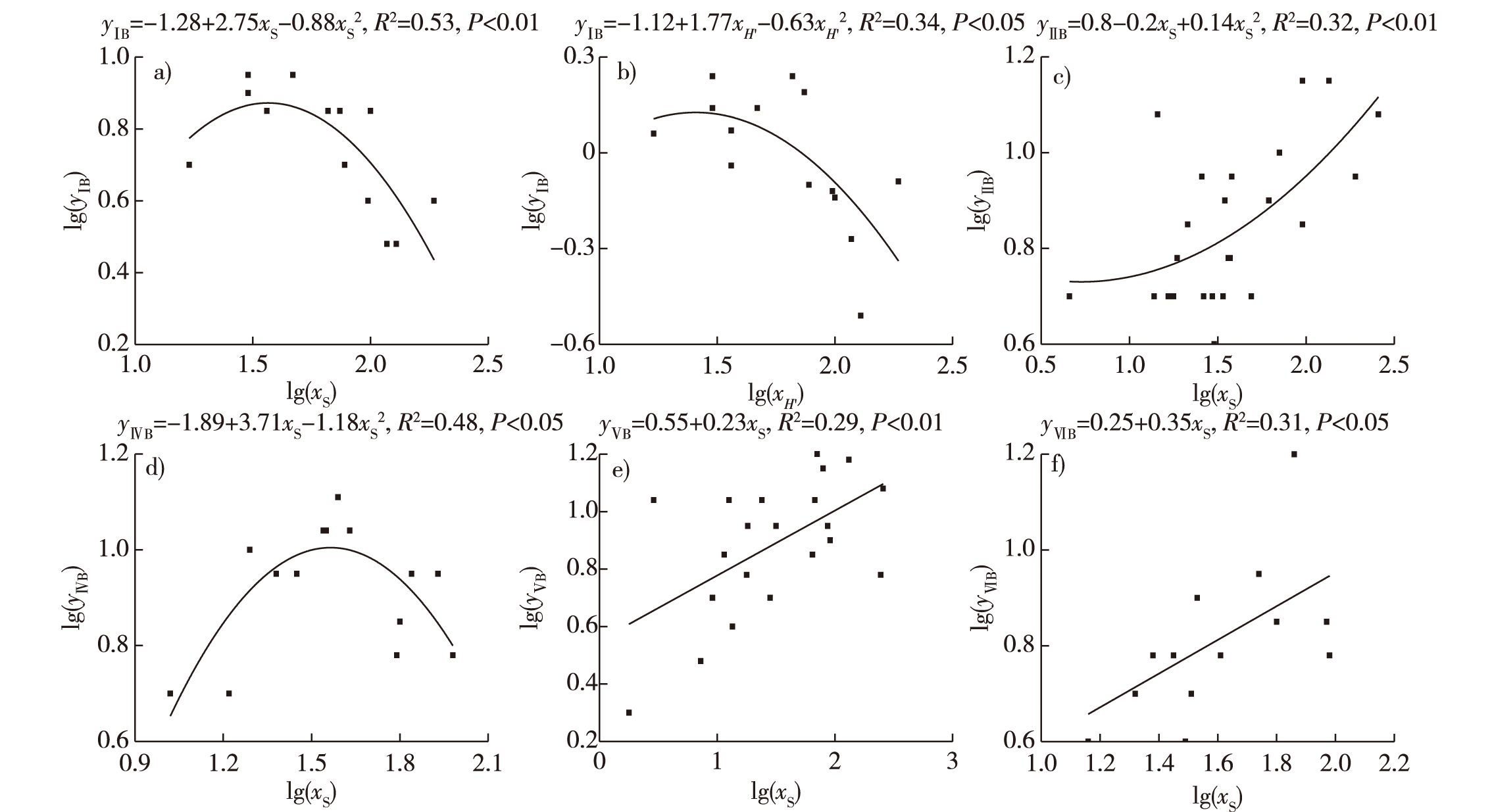
【目的】分析人工林的草本层物种多样性和生物量以及两者的相关关系,为人工林的科学经营提供理论依据。【方法】以青岛市7种主要人工林为研究对象,采用样地调查法系统记录草本层的物种组成、多度与盖度,并同步采用全收获法获取草本层的地上生物量鲜质量,后经实验室烘干换算为干物质生物量,基于调查数据,计算各林型草本层植物的α多样性指数,包括物种丰富度指数 (species richness index)、香农-维纳指数 (Shannon-Wiener index)、辛普森指数 (Simpson index)、均匀度指数 (Pielou’s evenness index)。采用单因素方差分析法 (One-way ANOVA) 对不同林型草本层物种多样性及生物量进行检验,通过一般线性模型 (general linear model, GLM) 分析各林型间草本层物种多样性与生物量的相关性,通过层次分割 (hierarchical partitioning, HP),量化林分特征、土壤因子以及物种多样性对草本层生物量变异的解释度。【结果】①青岛7种人工林的草本层物种组成差异较大,群落相似度较低。②刺槐 (Robinia pseudoacacia)人工林草本层生物量显著高于其他林分类型 (P<0.05),黑杨 (Populus nigra)人工林草本层物种丰富度、黑松 (Pinus thunbergii)人工林香农-维纳多样性指数以及黑松-赤松 (Pinus densiflora)混交林物种均匀度指数均显著高于刺槐人工林 (P<0.05),刺槐人工林辛普森多样性指数显著高于麻栎 (Quercus acutissima)人工林 (P<0.05)。③黑松-赤松混交林、黑杨人工林和刺槐人工林的草本层生物量均与物种多样性指数呈显著的正相关 (P<0.05),赤松人工林与麻栎人工林中生物量与物种多样性指数呈显著的单峰型关系 (P<0.05),其余林型中生物量与物种多样性指数无显著的相关关系。④赤松人工林、麻栎人工林以及黑松-刺槐混交林中土壤因子对生物量的解释度最高 (35.6%、67.0%、69.6%),黑松人工林、黑杨人工林中林分特征对生物量的解释度最高 (50.4%、68.5%),刺槐人工林和黑松-赤松混交林中物种多样性对生物量的解释度最高 (45.6%、52.7%)。【结论】7种林分类型中物种多样性指数与生物量存在显著正相关、单峰型相关关系或无显著相关关系,林分特征和土壤因子对生物量的解释度比物种多样性更高,其影响程度因林分类型的不同而存在差异。
【Objective】This study analyzed the species diversity and biomass of the herbaceous layer across different plantation types in Qingdao, as well as their correlation, aiming to provide a theoretical basis for the scientific management of plantation forests in the region 【Method】Focusing on seven major types of artificial forests in Qingdao, the species composition, abundance, and cover of the herb layer were systematically recorded using the plot survey method. Simultaneously, the total harvest method was employed to obtain the fresh aboveground biomass of the herb layer, which was then oven-dried in the laboratory to convert it into dry biomass. Based on the survey data, the α-diversity indices of herb layer plants in each forest type were calculated, including the species richness index, Shannon-Wiener index, Simpson index, and Pielou’s Evenness index. One-way ANOVA was used to test the species diversity and biomass of the herb layer in different forest types. The correlation between herb layer species diversity and biomass across forest types was analyzed using a General Linear Model (GLM), and Hierarchical Partitioning (HP) was applied to quantify the explanatory power of stand characteristics, soil factors, and species diversity on the variation of herb layer biomass. 【Result】(1) The herbaceous layer species composition varied significantly among the seven plantation types, with low community similarity. (2) Herb layer biomass in Robinia pseudoacacia plantation was significantly higher than that in other forest types (P<0.05). The species richness in Populus nigra plantation, Shannon-Wiener diversity index in Pinus thunbergii plantation, and species evenness index in Pinus thunbergii-P. densiflora plantation were significantly higher than those in R. pseudoacacia plantation (P<0.05). The Simpson diversity index in R. pseudoacacia plantation was significantly higher than that in Quercus acutissima plantations (P<0.05). (3) In Pinus thunbergii-P. densiflora plantation, Populus nigra plantation, and R. pseudoacacia plantation, the herbaceous layer biomass showed a significant positive correlation with species diversity indices (P<0.05). In contrast, Pinus densiflora plantation and Q. acutissima plantation exhibited a significant unimodal relationship between biomass and species diversity (P<0.05). No significant correlation was found between biomass and species diversity indices in the remaining forest types. (4) In Pinus densiflora plantation, Q. acutissima plantation, and Pinus thunbergii-R. pseudoacacia plantation, soil factors exhibited the highest explanatory power for biomass variation (35.6%, 67.0%, and 69.6%, respectively). In Pinus thunbergii plantation and Populus nigra plantation, stand characteristics showed the greatest explanatory power (50.4% and 68.5%, respectively). For R. pseudoacacia plantation and Pinus thunbergii-P. densiflora plantation, species diversity had the highest explanatory power (45.6% and 52.7%, respectively). 【Conclusion】The relationship between species diversity index and biomass in different forest types shows significant positive correlation, unimodal correlation, and no significant correlation. The explanatory power of stand characteristics and soil factors for biomass is higher than that for species diversity, and the degree of influence varies depending on the stand type.
人工林草本层 / 物种多样性 / 生物量 / 林分特征 / 土壤因素 / 青岛
herbaceous layer of plantation / species diversity / biomass / stand characteristics / soil factor / Qingdao City
| [1] |
|
| [2] |
|
| [3] |
|
| [4] |
|
| [5] |
|
| [6] |
|
| [7] |
艾昌奇, 薛紫鲸, 刘倩愿, 等. 太行山东麓酸枣灌丛植物多样性空间分布特征及其驱动因子研究[J]. 生态与农村环境学报, 2026, 42(3): 366-378.
|
| [8] |
|
| [9] |
|
| [10] |
赵凡, 钟欣艺, 谢平畅, 等. 不同植被维护措施对三星堆遗址城墙草本植物群落物种多样性与生物量的影响[J]. 生态学报, 2024, 44(19): 8716-8725.
|
| [11] |
|
| [12] |
|
| [13] |
陈波兰, 吴雨茹, 钟欣艺, 等. 林分密度对云顶山柏木人工林林下物种多样性和生物量的影响[J]. 四川农业大学学报, 2023, 41(4): 665-672.
|
| [14] |
|
| [15] |
|
| [16] |
|
| [17] |
康冰, 刘世荣, 蔡道雄, 等. 马尾松人工林林分密度对林下植被及土壤性质的影响[J]. 应用生态学报, 2009, 20(10): 2323-2331.
|
| [18] |
隋夕然, 李军, 陈娟, 等. 徐州市侧柏人工林群落不同演替阶段物种多样性变化[J]. 南京林业大学学报(自然科学版), 2025, 49(1): 171-178.
|
| [19] |
朱景康, 唐洁, 刘瑞, 等. 蔡家川流域不同密度刺槐林下灌草多样性特征及其影响因子[J]. 应用生态学报, 2025, 36(2): 452-460.
|
| [20] |
|
| [21] |
|
| [22] |
邹星晨, 王欣苗, 左亚凡, 等. 青海云杉不同演替阶段林下草本多样性特征及其环境解释[J]. 生态学报, 2023, 43(24): 10285-10294.
|
| [23] |
孙一鸣, 贾黎明, 祝维, 等. 毛白杨幼龄林细根对树种组成和林分密度的响应初探[J]. 南京林业大学学报(自然科学版), 2025, 49(2): 45-56.
|
| [24] |
杨光辉, 秦树林, 金光泽. 小兴安岭五种林型早春草本植物多样性及其环境解释[J]. 生态学报, 2023, 43(3): 1234-1246.
|
| [25] |
|
| [26] |
刘涛, 姬明飞, 邓燕, 等. 植物非对称性光竞争研究进展[J]. 草业科学, 2020, 37(1): 156-167.
|
| [27] |
|
| [28] |
王依瑞, 王彦辉, 段文标, 等. 黄土高原刺槐人工林郁闭度对林下植物多样性特征的影响[J]. 应用生态学报, 2023, 34(2): 305-314.
|
| [29] |
凤紫棋, 孙文义, 穆兴民, 等. 南方山区杉木人工林林下草本植物多样性的影响因素[J]. 草业学报, 2023, 32(9): 17-26.
|
| [30] |
拓行行, 李玉华, 俞瀚林, 等. 宁南山区华北落叶松林下草本层群落特征及其影响因素[J]. 生态学杂志, 2023, 42(10): 2449-2458.
|
| [31] |
|
| [32] |
刘畅, 陈积山, 朱瑞芬, 等. 氮添加对中国草地生物量和土壤有机碳含量影响的Meta分析[J]. 草地学报, 2025, 33(7): 2078-2089.
|
| [33] |
|
| [34] |
栗惠英, 杨思佳, 刘津芳, 等. 黄土高原典型林分植物多样性和生物量对乔木密度的响应分析[J]. 森林工程, 2025, 41(6):1268-1278.
|
| [35] |
|
| [36] |
王国华, 王佳琪, 刘婧. 晋西北丘陵风沙区柠条锦鸡儿人工林植被和土壤随林龄变化特征[J]. 应用生态学报, 2024, 35(1): 62-72.
|
| [37] |
|
| [38] |
|
| [39] |
陈芙蓉, 程积民, 刘伟, 等. 不同干扰对黄土区典型草原物种多样性和生物量的影响[J]. 生态学报, 2013, 33(9): 2856-2866.
|
| [40] |
|
/
| 〈 |
|
〉 |