杂交鹅掌楸WOX转录因子在非生物胁迫中的表达模式及生理响应

曹俊, 郝兆东, 鲁路, 潘隆应, 陈海强, 张金芳, 罗水金, 刘美利, 陈金慧

南京林业大学学报(自然科学版) ›› 2026, Vol. 50 ›› Issue (5) : 61-69.

PDF(3036 KB)
PDF(3036 KB)
南京林业大学学报(自然科学版) ›› 2026, Vol. 50 ›› Issue (5) : 61-69. DOI: 10.12302/j.issn.1000-2006.202507017
专题报道Ⅰ:第二十八届中国科协年会———全球气候变化下的林草智能设计育种专题Ⅱ(执行主编 曹福亮 范国强 尹佟明 张怀清)

杂交鹅掌楸WOX转录因子在非生物胁迫中的表达模式及生理响应

作者信息 +

Expression patterns and physiological function analyses of WOX transcription factors in Liriodendron sino-americanum under abiotic stress

Author information +
文章历史 +

摘要

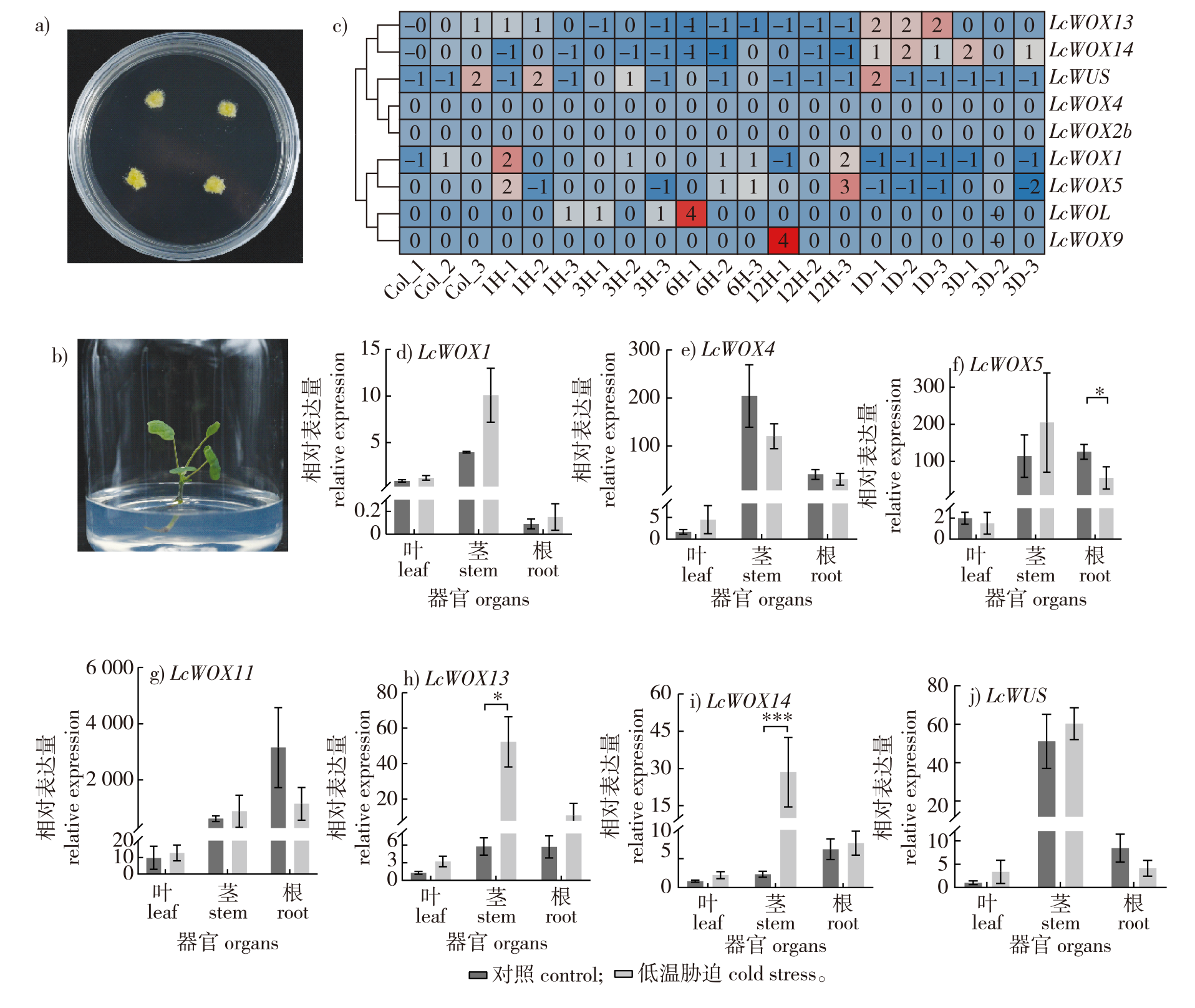
【目的】系统解析杂交鹅掌楸(Liriodendron sino-americanum)WOX转录因子家族在非生物胁迫下的功能特征及其潜在的调控机制。【方法】以杂交鹅掌楸为试验材料,首先对未成熟胚进行诱导脱分化处理获得愈伤组织,再通过体胚发生技术获得再生植株。利用胁迫转录组分析和实时荧光定量PCR技术,分析LcWOXs基因在杂交鹅掌楸响应非生物胁迫中的表达模式,鉴定出关键响应基因;随后进一步对杂交鹅掌楸植株进行表型观察并测定与分析其生理生化指标。【结果】①在低温胁迫下,仅茎组织中LcWOX13和LcWOX14的表达显著上调,其他LcWOXs基因基本不响应。②在干旱和盐胁迫诱导下,多数LcWOXs基因呈现逐渐增强的诱导表达趋势。其中LcWOX5在根中显著上调表达,LcWOX11在茎中显著上调表达,而LcWOX13和LcWOX14则在植株根、茎、叶中均显著上调表达。③在干旱和盐胁迫条件下,杂交鹅掌楸均表现为相对含水率(RWC)降低和膜脂过氧化水平[丙二醛(MDA)含量]升高。同时,其抗氧化酶系统被激活,尤其是过氧化物酶(POD)和过氧化氢酶(CAT)活性显著增强,超氧化物歧化酶(SOD)的活性也有所提高。干旱条件下脯氨酸含量变化不显著,而盐胁迫导致其显著降低。【结论】杂交鹅掌楸WOX家族可能在调控其抗氧化防御系统及渗透调节过程中扮演关键角色,有助于有效应对胁迫诱导的氧化损伤。

Abstract

【Objective】Against the backdrop of intensified global climate change and continued ecological deterioration, abiotic stresses, including low temperature, drought, and salinity, have become major environmental constraints limiting plant growth and development, productivity, and geographical distribution. As sessile organisms, plants are unable to escape unfavorable environmental conditions and have therefore evolved sophisticated and efficient mechanisms for stress perception, signal transduction, and regulatory responses to maintain normal growth and enhance environmental adaptability. WUSCHEL-related homeobox (WOX) transcription factors, a family of plant-specific transcriptional regulators, play essential roles in embryogenesis, meristem maintenance, organ formation, and stem cell fate determination. In addition, accumulating evidence indicates that WOX genes are extensively involved in plant responses to abiotic stresses by regulating stress-related signaling pathways and the expression of downstream stress-responsive genes, thereby enhancing stress tolerance. However, the biological functions and molecular regulatory mechanisms of the WOX gene family in woody plants, particularly in Liriodendron sino-americanum, remain poorly understood. Elucidating the functions of the LcWOX transcription factor family in the abiotic stress responses of L. sino-americanum will not only facilitate the identification of key genetic resources for stress-resistant breeding and clarify the molecular basis of stress adaptation but also provide a theoretical foundation and candidate genes for the molecular breeding and genetic improvement of forest trees. Therefore, this study aimed to systematically characterize the expression patterns, functional responses, and potential regulatory mechanisms of the WOX transcription factor family in L. sino-americanum under abiotic stress conditions.【Method】L. sino-americanum was used as the experimental material. Abiotic stress conditions were simulated by low-temperature (4 ℃), drought (15% PEG 6000, mass fraction), and salt treatments (200 mmol/L NaCl). Immature embryos were first induced to undergo dedifferentiation to obtain callus tissues, followed by plant regeneration through somatic embryogenesis. Stress-responsive transcriptome sequencing combined with quantitative real-time PCR (qRT-PCR) was employed to analyze the expression patterns of LcWOX genes in response to abiotic stresses and to identify key stress-responsive genes. Subsequently, regenerated plants of L. sino-americanum subjected to drought and salt stress were evaluated through phenotypic observation and physiological and biochemical analyses, including measurements of relative water content (RWC), malondialdehyde (MDA) content, proline content, peroxidase (POD) activity, superoxide dismutase (SOD) activity, and catalase (CAT) activity.【Result】Based on previously generated transcriptomic data and further validated by qRT-PCR, the expression patterns of LcWOX family members under low-temperature, drought, and salt stresses were systematically analyzed, revealing distinct dynamic expression profiles in response to different abiotic stresses. The results demonstrated that different LcWOX genes exhibited distinct stress-responsive expression patterns. (1) Under low-temperature stress, only LcWOX13 and LcWOX14 were significantly upregulated in stem tissues, whereas the remaining LcWOX genes showed little or no transcriptional response in roots, stems, or leaves. (2) Under drought and salt stress, most LcWOX genes exhibited progressively enhanced inducible expression. Among them, LcWOX5 was significantly upregulated in roots under both drought and salt stresses, with an increase approaching 100%; LcWOX11 was significantly induced in stem tissues; and LcWOX13 and LcWOX14 were significantly upregulated in roots, stems, and leaves under both stress conditions. Furthermore, regenerated plants were subjected to drought and salt treatments for stress tolerance evaluation. Compared with the control, both drought and salt stresses reduced relative water content (RWC) from approximately 90% to approximately 75% and increased malondialdehyde (MDA) content to approximately 1.5-fold that of the control, indicating varying degrees of oxidative damage to cellular membranes. In response to stress-induced oxidative damage, the antioxidant defense system was markedly activated, with particularly pronounced increases in peroxidase (POD) and catalase (CAT) activities, accompanied by an increase in superoxide dismutase (SOD) activity. Notably, the proline content remained relatively stable at approximately 450 μg/g under drought stress, showing no significant change, whereas salt stress caused a significant reduction in proline accumulation of approximately 35%. 【Conclusion】 The LcWOX gene family plays an important regulatory role in the response of L. sino-americanum to abiotic stresses, potentially enhancing reactive oxygen species scavenging capacity and maintaining cellular homeostasis through coordinated regulation of the antioxidant defense system and osmotic adjustment, thereby alleviating stress-induced oxidative damage and improving stress tolerance. This study provides preliminary insights into the functional characteristics of LcWOX genes in the abiotic stress response of L. sino-americanum and offers a theoretical basis for elucidating their biological functions and identifying candidate genes for stress-resistant breeding. Nevertheless, the molecular regulatory network mediated by LcWOX genes, together with their upstream and downstream regulatory mechanisms during abiotic stress responses, remains largely unknown. Their specific functions and regulatory modes in different stress-signaling pathways warrant further investigation through molecular genetic approaches and functional validation.

关键词

WOX基因家族 / 非生物胁迫 / 氧化应激 / 杂交鹅掌楸

Key words

WOX gene family / abiotic stress / oxidative stress / L. sino-americanum

引用本文

导出引用
曹俊, 郝兆东, 鲁路, 等. 杂交鹅掌楸WOX转录因子在非生物胁迫中的表达模式及生理响应[J]. 南京林业大学学报(自然科学版). 2026, 50(5): 61-69 https://doi.org/10.12302/j.issn.1000-2006.202507017
Cao Jun, Hao Zhaodong, Lu Lu, et al. Expression patterns and physiological function analyses of WOX transcription factors in Liriodendron sino-americanum under abiotic stress[J]. Journal of Nanjing Forestry University (Natural Sciences Edition). 2026, 50(5): 61-69 https://doi.org/10.12302/j.issn.1000-2006.202507017
中图分类号: S718;S68   

参考文献

[1]
郝兆东. 鹅掌楸属基因组演化及其花色变异遗传基础研究[D]. 南京: 南京林业大学, 2020.
Hao Z D. Liriodendron genome evolution and the genetic basis of flower color variation[D]. Nanjing: Nanjing Forestry University, 2020.
[2]
郝日明, 贺善安, 汤诗杰, 等. 鹅掌楸在中国的自然分布及其特点[J]. 植物资源与环境, 1995, 4(1):1-6.
Hao R M, He S A, Tang S J, et al. Natural distribution and characteristics of Liriodendron chinense in China[J]. Journal of Plant Resources and Environment, 1995, 4(1):1-6.
[3]
王章荣. 鹅掌楸属(Liriodendron)杂交育种回顾与展望[J]. 南京林业大学学报(自然科学版), 2003, 27(3):76-78.
Wang Z R. The review and outlook on hybridization in tulip tree breeding in China[J]. Journal of Nanjing Forestry University (Natural Sciences Edition), 2003, 27(3):76-78. DOI:10.3969/j.issn.1000-2006.2003.03.019.
[4]
Chen J H, Hao Z D, Guang X M, et al. Author Correction:Liriodendron genome sheds light on angiosperm phylogeny and species-pair differentiation[J]. Nature Plants, 2019, 5(3):328. DOI:10.1038/s41477-019-0368-1.
[5]
陈金慧, 施季森, 诸葛强, 等. 杂交鹅掌楸体细胞胚胎发生研究[J]. 林业科学, 2003, 39(4):49-53.
Chen J H, Shi J S, Zhuge Q, et al. Studies on the somatic embryogenesis of Liriodendron hybrids(L.chinense × L.tulipifera)[J]. Scientia Silvae Sinicae, 2003, 39(4):49-53.DOI:10.3321/j.issn:1001-7488.2003.04.008.
[6]
Li M P, Wang D, Long X F, et al. Agrobacterium-mediated genetic transformation of embryogenic callus in a Liriodendron Hybrid (L.chinense × L.Tulipifera)[J]. Frontiers in Plant Science, 2022, 13:802128. DOI:10.3389/fpls.2022.802128.
[7]
Li C R, Jiang P S, Zhang J J, et al. Highly efficient homozygous CRISPR/Cas9 gene editing based on single-cell-originated somatic embryogenesis in Liriodendron tulipifera[J]. Plants, 2025, 14(3):472. DOI:10.3390/plants14030472.
[8]
姚丹静, 曲弈, 陈金慧. 脯氨酸对杉木愈伤组织超低温冷冻保存的影响[J]. 湖北林业科技, 2014, 43(3):30-31,58.
Yao D J, Qu Y, Chen J H. The influence of prolin on cryopreservation of callus of Cunninghamia lanceolata[J]. Hubei Forestry Science and Technology, 2014, 43(3):30-31,58. DOI:10.3969/j.issn.1004-3020.2014.03.009.
[9]
Ellouzi H, Oueslati S, Hessini K, et al. Seed-priming with H2O2 alleviates subsequent salt stress by preventing ROS production and amplifying antioxidant defense in cauliflower seeds and seedlings[J]. Scientia Horticulturae, 2021, 288:110360. DOI:10.1016/j.scienta.2021.110360.
[10]
Wang P T, Liu W C, Han C, et al. Reactive oxygen species:multidimensional regulators of plant adaptation to abiotic stress and development[J]. Journal of Integrative Plant Biology, 2024, 66(3):330-367. DOI:10.1111/jipb.13601.
[11]
van der Graaff E, Laux T, Rensing S A. The WUS homeobox-containing (WOX) protein family[J]. Genome Biology, 2009, 10(12):248. DOI:10.1186/gb-2009-10-12-248.
[12]
Long X F, Zhang J J, Wang D D, et al. Expression dynamics of WOX homeodomain transcription factors during somatic embryogenesis in Liriodendron hybrids[J]. Forestry Research, 2023, 3:15. DOI:10.48130/FR-2023-0015.
[13]
王俞程, 何瑞萍, 彭献军, 等. WOX转录因子家族研究进展[J]. 草业科学, 2015, 32(5):760-769.
Wang Y C, He R P, Peng X J, et al. The research progress of WOX transcription factor family[J]. Pratacultural Science, 2015, 32(5):760-769. DOI:10.11829/j.issn.1001-0629.2014-0554.
[14]
Liao B J, Liang P X, Tong L, et al. The role of Liriodendron dof gene family in abiotic stress response[J]. Plants, 2024, 13(14):2009. DOI:10.3390/plants13142009.
[15]
Tong L, Lin M Y, Zhu L M, et al. Unraveling the role of the Liriodendron Thioredoxin (TRX) gene family in an abiotic stress response[J]. Plants, 2024, 13(12):1674. DOI:10.3390/plants13121674.
[16]
周艳威, 李美平, 鲁路, 等. 杂交鹅掌楸苗期NaCl胁迫响应研究[J]. 分子植物育种, 2017, 15(2):735-743.
Zhou Y W, Li M P, Lu L, et al. Effect of NaCl stress on Liriodendron hybrids during seedlings period[J]. Molecular Plant Breeding, 2017, 15(2):735-743. DOI:10.13271/j.mpb.015.000735.
[17]
李小方, 张志良. 植物生理学实验指导[M]. 5版. 北京: 高等教育出版社, 2016.
Li X F, Zhang Z L. Experimental instruction of plant physiology[M]. 5th ed. Beijing: Higher Education Press, 2016.
[18]
Li T T, Yuan W G, Qiu S, et al. Selection of reference genes for gene expression analysis in Liriodendron hybrids’ somatic embryogenesis and germinative tissues[J]. Scientific Reports, 2021, 11(1):4957. DOI:10.1038/s41598-021-84518-w.
[19]
Livak K J, Schmittgen T D. Analysis of relative gene expression data using real-time quantitative PCR and the $2^{-\Delta \Delta C_{t}}$ method[J]. Methods, 2001, 25(4):402-408. DOI:10.1006/meth.2001.1262.
[20]
Lu Y, Hu L F, Yu L, et al. Physiological and transcriptomic analysis revealed that the accumulation of reactive oxygen species caused the low temperature sensitivity of Liriodendron × sino-americanum[J]. Plant Science, 2024, 342:112020. DOI:10.1016/j.plantsci.2024.112020.
[21]
高俊凤. 植物生理学实验指导[M]. 北京: 高等教育出版社, 2006.
Gao J F. Experimental guidance for plant physiology[M]. Beijing: Higher Education Press, 2006.
[22]
赵薇, 王浩宇, 朱铭玮, 等. 娜塔栎种子失水过程中的生理响应[J]. 南京林业大学学报(自然科学版), 2025, 49(3):144-152.
Zhao W, Wang H Y, Zhu M W, et al. Physiological response of Quercus texana seeds during dehydration[J]. Journal of Nanjing Forestry University (Natural Sciences Edition), 2025, 49(3):144-152. DOI:10.12302/j.issn.1000-2006.202311009.
[23]
Wu W H, Zhu S, Xu L, et al. Genome-wide identification of the Liriodendron chinense WRKY gene family and its diverse roles in response to multiple abiotic stress[J]. BMC Plant Biology, 2022, 22(1):25. DOI:10.1186/s12870-021-03371-1.
[24]
Wu W H, Zhu S, Zhu L M, et al. Characterization of the Liriodendron chinense MYB gene family and its role in abiotic stress response[J]. Frontiers in Plant Science, 2021, 12:641280. DOI:10.3389/fpls.2021.641280.
[25]
Wang L Q, Li Z, Wen S S, et al. WUSCHEL-related homeobox gene PagWOX11/12a responds to drought stress by enhancing root elongation and biomass growth in poplar[J]. Journal of Experimental Botany, 2020, 71(4):1503-1513. DOI:10.1093/jxb/erz490.
[26]
Hao Q N, Zhang L, Yang Y Y, et al. Genome-wide analysis of the WOX gene family and function exploration of GmWOX18 in soybean[J]. Plants, 2019, 8(7):215. DOI:10.3390/plants8070215.
[27]
Li Y, Jin C H, Liu Y T, et al. Global analysis of the WOX transcription factor gene family in Populus × xiaohei T.S.Hwang et Liang reveals their stress-responsive patterns[J]. Forests, 2022, 13(1):122. DOI:10.3390/f13010122.
[28]
Song X X, Lu J Y, Wang H, et al. Identification and characterization of WOX gene family in flax (Linum usitatissimum L.) and its role under abiotic stress[J]. International Journal of Molecular Sciences, 2025, 26(8):3571. DOI:10.3390/ijms26083571.
[29]
Sun R B, Zhang X, Ma D, et al. Identification and evolutionary analysis of cotton (Gossypium hirsutum) WOX family genes and their potential function in somatic embryogenesis[J]. International Journal of Molecular Sciences, 2023, 24(13):11077. DOI:10.3390/ijms241311077.
[30]
Cheng S F, Huang Y L, Zhu N, et al. The rice WUSCHEL-related homeobox genes are involved in reproductive organ development,hormone signaling and abiotic stress response[J]. Gene, 2014, 549(2):266-274. DOI:10.1016/j.gene.2014.08.003.
[31]
Zhou Y P, Sommer M L, Hochholdinger F. Cold response and tolerance in cereal roots[J]. Journal of Experimental Botany, 2021:erab334. DOI:10.1093/jxb/erab334.
[32]
Wang D B, Qiu Z M, Xu T, et al. Identification and expression patterns of WOX transcription factors under abiotic stresses in Pinus massoniana[J]. International Journal of Molecular Sciences, 2024, 25(3):1627. DOI:10.3390/ijms25031627.
[33]
Zhu J H, Shi H Z, Lee B H, et al. An Arabidopsis homeodomain transcription factor gene,HOS9 mediates cold tolerance through a CBF-independent pathway[J]. Proceedings of the National Academy of Sciences of the United States of America, 2004, 101(26):9873-9878. DOI:10.1073/pnas.0403166101.
[34]
Lv J H, Feng Y, Jiang L Z, et al. Genome-wide identification of WOX family members in nine Rosaceae species and a functional analysis of MdWOX13-1 in drought resistance[J]. Plant Science, 2023, 328:111564. DOI:10.1016/j.plantsci.2022.111564.
[35]
Tang F, Chen N Z, Zhao M L, et al. Identification and functional divergence analysis of WOX gene family in paper mulberry[J]. International Journal of Molecular Sciences, 2017, 18(8):1782. DOI:10.3390/ijms18081782.
[36]
Li H, Ma W Y, Wang X, et al. A WUSCHEL-related homeobox transcription factor,SlWOX4,negatively regulates drought tolerance in tomato[J]. Plant Cell Reports, 2024, 43(11):253. DOI:10.1007/s00299-024-03333-5.
[37]
李晓旭, 刘成, 李伟, 等. 番茄WOX转录因子家族的鉴定及其进化、表达分析[J]. 遗传, 2016, 38(5):444-460.
Li X X, Liu C, Li W, et al. Genome-wide identification,phylogenetic analysis and expression profiling of the WOX family genes in Solanum lycopersicum[J]. Hereditas, 2016, 38(5):444-460. DOI:10.16288/j.yczz.15-499.

基金

福建省林业科技项目(2024FKJ05)

责任编辑: 吴祝华
PDF(3036 KB)

Accesses

Citation

Detail

段落导航
相关文章

/

〈 〉