尾叶桉×细叶桉无性系第二轮伐期生长的遗传分析和选择

徐家洪, 周明明, 翁启杰, 甘四明, 李梅

南京林业大学学报(自然科学版) ›› 2026, Vol. 50 ›› Issue (5) : 70-76.

PDF(1437 KB)
PDF(1437 KB)
南京林业大学学报(自然科学版) ›› 2026, Vol. 50 ›› Issue (5) : 70-76. DOI: 10.12302/j.issn.1000-2006.202507030
专题报道Ⅰ:第二十八届中国科协年会———全球气候变化下的林草智能设计育种专题Ⅱ(执行主编 曹福亮 范国强 尹佟明 张怀清)

尾叶桉×细叶桉无性系第二轮伐期生长的遗传分析和选择

作者信息 +

Genetic analysis and selection on the growth traits of sib clones of an Eucalyptus urophylla × E. tereticornis at second-rotation period

Author information +
文章历史 +

摘要

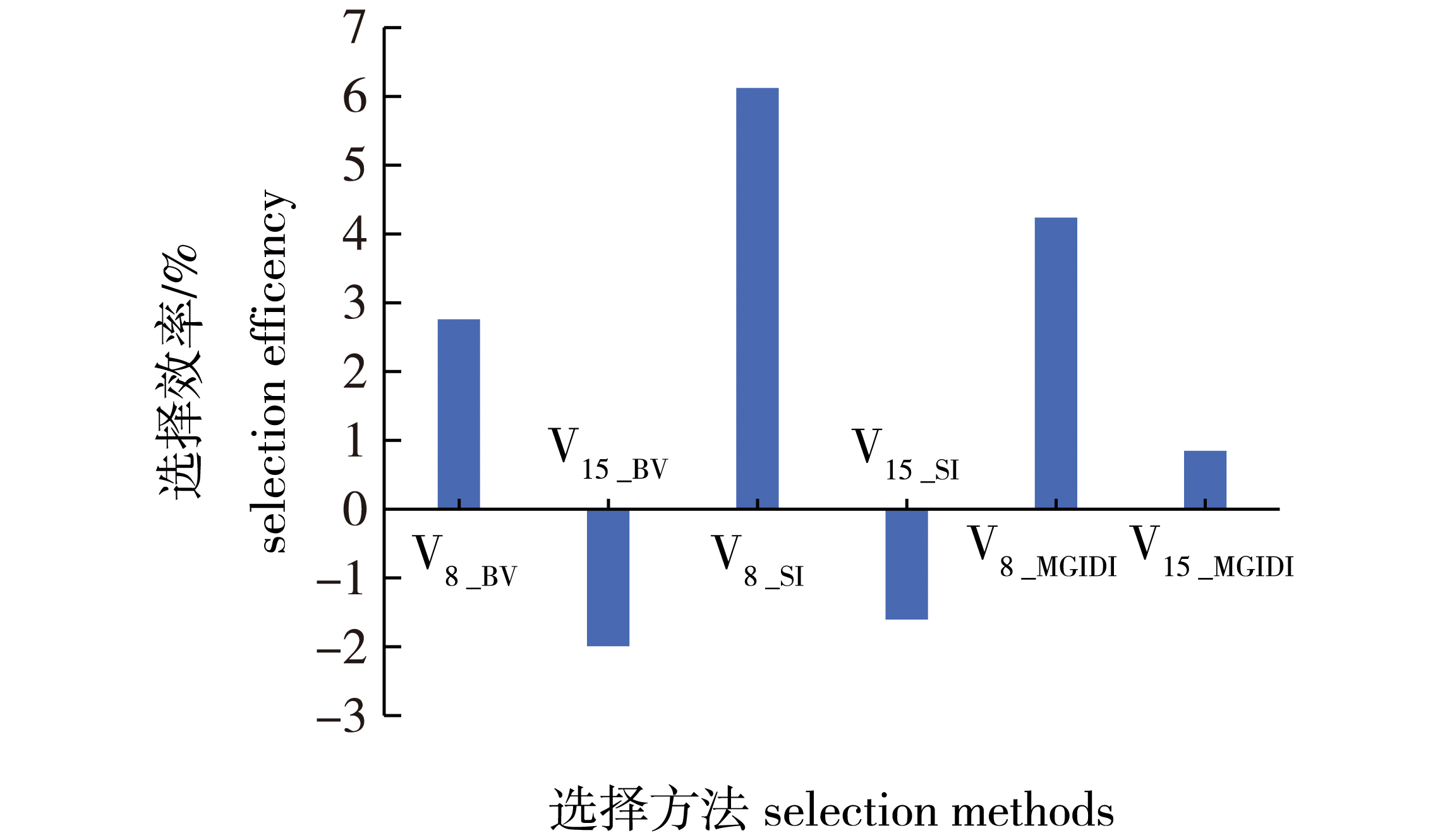
【目的】无性系测定对评估无性系的遗传变异和选择的遗传增益具有重要作用,但在桉树中较少开展无性系第2或更多轮伐期的测定研究。本研究旨在了解桉树无性系第2轮伐期生长性状的遗传变异,并探讨跨轮伐期选择优良无性系的有效性。【方法】以尾叶桉×细叶桉(Eucalyptus urophylla × E. tereticornis)1个杂交组合的全同胞子代扦插无性系为材料,评估第2轮伐期3.5年生生长性状的重复力(H2)以及这些生长性状间及与第1轮伐期重要性状间的表型相关(rp)和遗传相关(rg)。利用最佳线性无偏预测(BLUP)法估算第2轮伐期3.5年生单株材积(VS,3.5)的育种值(BV)并选择优良无性系,进一步评估相对遗传增益(RG)和第1轮伐期已有选择的效率(E)。【结果】第2轮伐期3.5年生7个生长性状的H2为0.29~0.48,属于低到中等程度。生长性状间rp和rg大多为显著正相关;第2轮伐期3.5年生与第1轮伐期8年生和15年生的生长性状间的rp普遍较低且多数不显著,而rg则普遍中等相关且多数达显著水平。基于第2轮伐期VS,3.5的BV,在15%的入选率下选择41个无性系,RG为39.1%;相较于VS,3.5的BV选择,第1轮伐期8年生单株材积(V8)和15年生单株材积(V15)BV选择的E分别为2.8%和-2.0%,而以上两个年份的多性状指数选择的E分别为6.1%和-1.6%,基因型-理想型距离指数(MGIDI)选择的E分别为4.2%和0.8%。【结论】尾叶桉×细叶桉无性系第2轮伐期3.5年生生长受低到中等程度的遗传控制。跨轮伐期的生长性状具有相似的遗传基础。但是,表型上第1轮伐期的生长对第2轮伐期的预测准确性不高,并且第1轮伐期已有选择相较于第2轮伐期VS,3.5的BV选择的E值极低,表明速生无性系的评估和选择需要综合不同轮伐期的生长。

Abstract

【Objective】 Clonal testing plays a pivotal role in forest tree breeding programs by enabling the evaluation of genetic variation among clones and facilitating accurate estimation of genetic gain from selection, while few studies have been conducted on the second or higher rotations of clonal test in eucalypts. This study aimed to quantify the genetic variation and clonal repeatability of growth traits at 3.5 years in the second rotation of eucalypt clones, and evaluate the effectiveness of across-rotation selection strategies for identifying superior clones. 【Method】 A set of cutting rooted full sib clones derived from a controlled cross between Eucalyptus urophylla and E. tereticornis were used for estimating clonal repeatability (H2) of 3.5-year-old growth traits of the second rotation as well as trait-trait phenotypic correlation (rp) and genetic correlation (rg) for these growth traits compared with these important traits of the first rotation. Clonal breeding values (BV) for 3.5-year-old volume (VS,3.5) of the second-rotation were calculated with best linear unbiased prediction (BLUP) method and then used for selection of superior clones. Relative genetic gain (RG) and selection efficiency (E) were assessed for the selected clones and the earlier first-rotation selections as compared to the VS3.5-based-BV selection, respectively. 【Result】 The H2 estimates for seven 3.5-year-old second rotation growth traits ranged from 0.29 to 0.48, indicating low to medium magnitude. The rp and rg among these second rotation growth traits were usually significant and positive. The rp values between second rotation growth traits with 8-and 15-year-old growth of the first rotation were generally low and mostly not significant, while their rg were generally moderate and statistically significant. A total of 41 clones were selected out from the VS,3.5-derived-BV rank at an intensity of 15%, yielding in an RG of 39.1%. As compared to the VS,3.5-based-BV selection, the E values of BV selection in 8- and 15-year-old volumes (V8 and V15, respectively) of the first rotation were 2.8% and -2.0%, respectively, while the E values of multi-trait selection index (SI) method at ages 8 and 15 years of the first rotation were 6.1% and -1.6%, respectively, and those of multi-trait genotype-ideotype distance index (MGIDI) selection of the two first-rotation ages were 4.2% and 0.8%, respectively. 【Conclusion】 Growth cultivars at 3.5 years in the second-rotation of E. urophylla × E. tereticornis clones was under low to medium genetic control. Across-rotation growth traits have similar genetic basis. However, growth of the first rotation shows low predictability for that of the second rotation, and selections of the first rotation exhibit very low E values as compared to the VS,3.5-based-BV selection, implying the necessity of across-rotation evaluation and selection at least in growth traits.
关键词

尾叶桉×细叶桉 / 第2轮伐期 / 生长性状 / 遗传参数 / 无性系选择

Key words

Eucalyptus urophylla × E. tereticornis / the second rotation / growth traits / genetic parameter / clonal selection

引用本文

导出引用
徐家洪, 周明明, 翁启杰, 等. 尾叶桉×细叶桉无性系第二轮伐期生长的遗传分析和选择[J]. 南京林业大学学报(自然科学版). 2026, 50(5): 70-76 https://doi.org/10.12302/j.issn.1000-2006.202507030
Xu Jiahong, Zhou Mingming, Weng Qijie, et al. Genetic analysis and selection on the growth traits of sib clones of an Eucalyptus urophylla × E. tereticornis at second-rotation period[J]. Journal of Nanjing Forestry University (Natural Sciences Edition). 2026, 50(5): 70-76 https://doi.org/10.12302/j.issn.1000-2006.202507030
中图分类号: S722   

参考文献

[1]
Brooker M. A new classification of the genus Eucalyptus L’Hér.(Myrtaceae)[J]. Australian Systematic Botany, 2000, 13(1):79-148. DOI:10.1071/sb98008.
[2]
Jacobs M R. Eucalypts for Planting[M]. Rome: Food and Agriculture Organization of the United Nations, 1979,1981.
[3]
Eldridge K, Davidson J, Harwood C, et al. Eucalypt Domestication and Breeding[M]. New York: Oxford University Press, 1993.
[4]
Weng Q, He X, Li F, et al. Hybridizing ability and heterosis between Eucalyptus urophylla and E.tereticornis for growth and wood density over two environments[J]. Silvae Genetica, 2014, 63(1-2):15-23. DOI:10.1515/sg-2014-0003.
[5]
彭仕尧, 徐建民, 李光友, 等. 尾细桉无性系在雷州半岛的生长与遗传分析[J]. 中南林业科技大学学报, 2013, 33(4):23-27.
Peng S Y, Xu J M, Li G Y, et al. Growth and genetic analysis of 42 Eucalyptus urophylla × E.tereticornis clones in Leizhou Peninsula of China[J]. Journal of Central South University of Forestry & Technology, 2013, 33(4):23-27. DOI:10.14067/j.cnki.1673-923x.2013.04.018.
[6]
何旭东, 李发根, 翁启杰, 等. 尾叶桉×细叶桉杂种生长与耐寒性的联合选择[J]. 中南林业科技大学学报, 2010, 30(8):68-71.
He X D, Li F G, Weng Q J, et al. Selection of Eucalyptus urophylla × E. tereticornis hybrids in growth and cold hardiness[J]. Journal of Central South University of Forestry & Technology, 2010, 30(8):68-71. DOI:10.14067/j.cnki.1673-923x.2010.08.022.
[7]
陈升侃, 周长品, 翁启杰, 等. 尾叶桉´细叶桉木材密度与生长的联合选择[J]. 林业科学研究, 2018, 31(2): 77-82.
Chen S K, Zhou C P, Weng Q J, et al. Combined selection of wood density and growth in Eucalyptus urophylla × E. tereticornis hybrids[J]. Forest Research, 2018, 31(2): 77-82. DOI:10.13275/j.cnki.lykxyj.2018.02.011.
[8]
Xu J, Zhou M, Weng Q, et al. Across-rotation genetic analysis and multitrait selection in a cloned cross of Eucalyptus urophylla × E. tereticornis[J]. Frontiers in Plant Science, 2025, 16: 1553819. DOI:10.3389/fpls.2025.1553819.
[9]
Arnold R J, Xie Y, Luo J, et al. A tale of two genera:exotic Eucalyptus and Acacia species in China.2. Plantation resource development[J]. International Forestry Review, 2020, 22(2):153-168. DOI:10.1505/146554820829403441.
[10]
祁述雄. 中国桉树[M]. 2版. 北京: 中国林业出版社, 2002:56-57.
Qi S X. Eucalyptus in China[M]. 2nd ed. Beijing: China Forestry Publishing House, 2002:56-57.
[11]
Braga R C, Paludeto J G Z, Souza B M, et al. Genetic parameters and genotype × environment interaction in Pinus taeda clonal tests[J]. Forest Ecology and Management, 2020, 474:118342. DOI:10.1016/j.foreco.2020.118342.
[12]
Osorio L F, White T L, Huber D A. Age-age and trait-trait correlations for Eucalyptus grandis Hill ex Maiden and their implications for optimal selection age and design of clonal trials[J]. Theoretical and Applied Genetics, 2003, 106(4):735-743. DOI:10.1007/s00122-002-1124-9.
[13]
Amâncio M R, Pereira F B, Paludeto J G Z, et al. Genetic control of coppice regrowth in Eucalyptus spp[J]. Silvae Genetica, 2020, 69(1):6-12. DOI:10.2478/sg-2020-0002.
[14]
王楚彪, 罗建中, 何文亮, 等. 桉树无性系多区域联合测试的G×E分析及选优[J]. 林业科学, 2022, 58(11):108-117.
Wang C B, Luo J Z, He W L, et al. G × E analysis and selection of Eucalyptus clones by multi-region combined test[J]. Scientia Silvae Sinicae, 2022, 58(11):108-117. DOI:10.11707/j.1001-7488.20221110.
[15]
Yang H, Weng Q, Li F, et al. Genotypic variation and genotype-by-environment interactions in growth and wood properties in a cloned Eucalyptus urophylla ´ E. tereticornis family in southern China[J]. Forest Science, 2018, 64(3): 225-232. DOI:10.1093/forsci/fxx011.
[16]
He X D, Li F G, Li M, et al. Quantitative genetics of cold hardiness and growth in Eucalyptus as estimated from E. urophylla × E.tereticornis hybrids[J]. New Forests, 2012, 43(3):383-394. DOI:10.1007/s11056-011-9287-3.
[17]
Rstudio T. RStudio: integrated development for R[EB/OL].(2024) [2026-09-06]. https://github.com/rstudio/rstudio.
[18]
R Core Team. R: a language and environment for statistical computing[R/OL]. (2017)[2026-09-06]. https://cran.r-project.org/doc/manuals/r-release/fullrefman.pdf.
[19]
Gilmour A R, Gogel B J, Cullis B R, et al. ASReml user guide release 3.0[R/OL]. (2009) [2026-09-06]. https://www.vsni.co.uk/downloads/asreml/release3/UserGuide.pdf.
[20]
LY/T 1775-2008 桉树速生丰产林生产技术规程[S].
LY/T 1775-2008. Technical code for production of eucalyptus fast-growing and high-yield plantation[S].
[21]
LY/T 2456-2015桉树丰产林经营技术规程[S].
LY/T 2456-2015. Technical regulation on management of eucalypt high-yielding plantation[S].
[22]
Wolak M E. Nadiv:an R package to create relatedness matrices for estimating non-additive genetic variances in animal models[J]. Methods in Ecology and Evolution, 2012, 3(5):792-796. DOI:10.1111/j.2041-210X.2012.00213.x.
[23]
林元震, 陈晓阳. R与ASReml-R统计分析教程[M]. 北京: 中国林业出版社, 2014.
Lin Y Z, Chen X Y. R & ASReml-R statistical analysis tutorial[M]. Beijing: China Forestry Publishing House, 2014.
[24]
White T L, Adams W T, Neale D B. Forest Genetics[M]. Oxfordshire: Oxford University Press, 2007:329-355.
[25]
Singh B D. Plant breeding: principles and methods[M]. New Delhi: Kalyani, 1990.
[26]
Crous J W, Burger L. A comparison of planting and coppice regeneration of Eucalyptus grandis × Eucalyptus urophylla clones in South Africa[J]. Southern Forests:a Journal of Forest Science, 2015, 77(4):277-285. DOI:10.2989/20702620.2015.1063031.
[27]
Hardiyanto E B, Inail M A, Mendham D S, et al. Eucalyptus pellita coppice vs.seedlings as a re-establishment method in south Sumatra,Indonesia[J]. Forests, 2022, 13(7):1017. DOI:10.3390/f13071017.
[28]
Zhou X G, Ye D, Zhu H G, et al. Effects of second rotation seedlings and coppice on understory vegetation and timber production of Eucalyptus plantations[J]. Journal of Tropical Forest Science, 2017, 29(1): 54-68.
[29]
Marron N, Ceulemans R. Genetic variation of leaf traits related to productivity in a Populus deltoides × Populus nigra family[J]. Canadian Journal of Forest Research, 2006, 36(2):390-400. DOI:10.1139/x05-245.
[30]
Whittock S P, Apiolaza L A, Kelly C M, et al. Genetic control of coppice and lignotuber development in Eucalyptus globulus[J]. Australian Journal of Botany, 2003, 51(1): 57-67. DOI:10.1071/BT02049.
[31]
Massaro R A M, Bonine C A V, Scarpinati E A, et al. Viabilidade de aplicação da seleção precoce em testes clonais de Eucalyptus spp[J]. Ciência Florestal, 2010, 20(4):597-609. DOI:10.5902/198050982418.
[32]
Kien N D, Jansson G, Harwood C, et al. Clonal variation and genotype by environment interactions in growth and wood density in Eucalyptus camaldulensis at three contrasting sites in Vietnam[J]. Silvae Genetica, 2010, 59(1):17-28. DOI:10.1515/sg-2010-0003.
[33]
解懿妮, 莫晓勇, 彭仕尧, 等. 粤西21个桉树无性系早期性状遗传变异分析和无性系综合选择[J]. 南京林业大学学报(自然科学版), 2018, 42(3):73-80.
Xie Y N, Mo X Y, Peng S Y, et al. Genetic variation analysis and early comprehensive selection of 21 Eucalyptus clones in western Guangdong Province,China[J]. Journal of Nanjing Forestry University (Natural Sciences Edition), 2018, 42(3):73-80. DOI:10.3969/j.issn.1000-2006.201708010.
[34]
陈升侃, 李昌荣, 许翠娟, 等. 桉树无性系生长遗传分析与选择[J]. 中南林业科技大学学报, 2020, 40(11):25-30,38.
Chen S K, Li C R, Xu C J, et al. Genetic analysis and selection of Eucalyptus clones growth[J]. Journal of Central South University of Forestry & Technology, 2020, 40(11):25-30,38. DOI:10.14067/j.cnki.1673-923x.2020.11.004.

基金

广东省林业科技创新项目(2022KJCX024)

责任编辑: 吴祝华
PDF(1437 KB)

Accesses

Citation

Detail

段落导航
相关文章

/

〈 〉