PDF(1712 KB)

湿地松×加勒比松F2代生长表现分析
王哲, 赵奋成, 龙永彬, 邓乐平, 谢威, 曾明, 吴启政, 刘阳, 薛蕾, 郭文冰
南京林业大学学报(自然科学版) ›› 2026, Vol. 50 ›› Issue (5) : 77-84.
PDF(1712 KB)
 PDF(1712 KB)
湿地松×加勒比松F2代生长表现分析
Growth performance analysis of the F2 generation of Pinus elliottii ×P. caribaea var. hondurensis
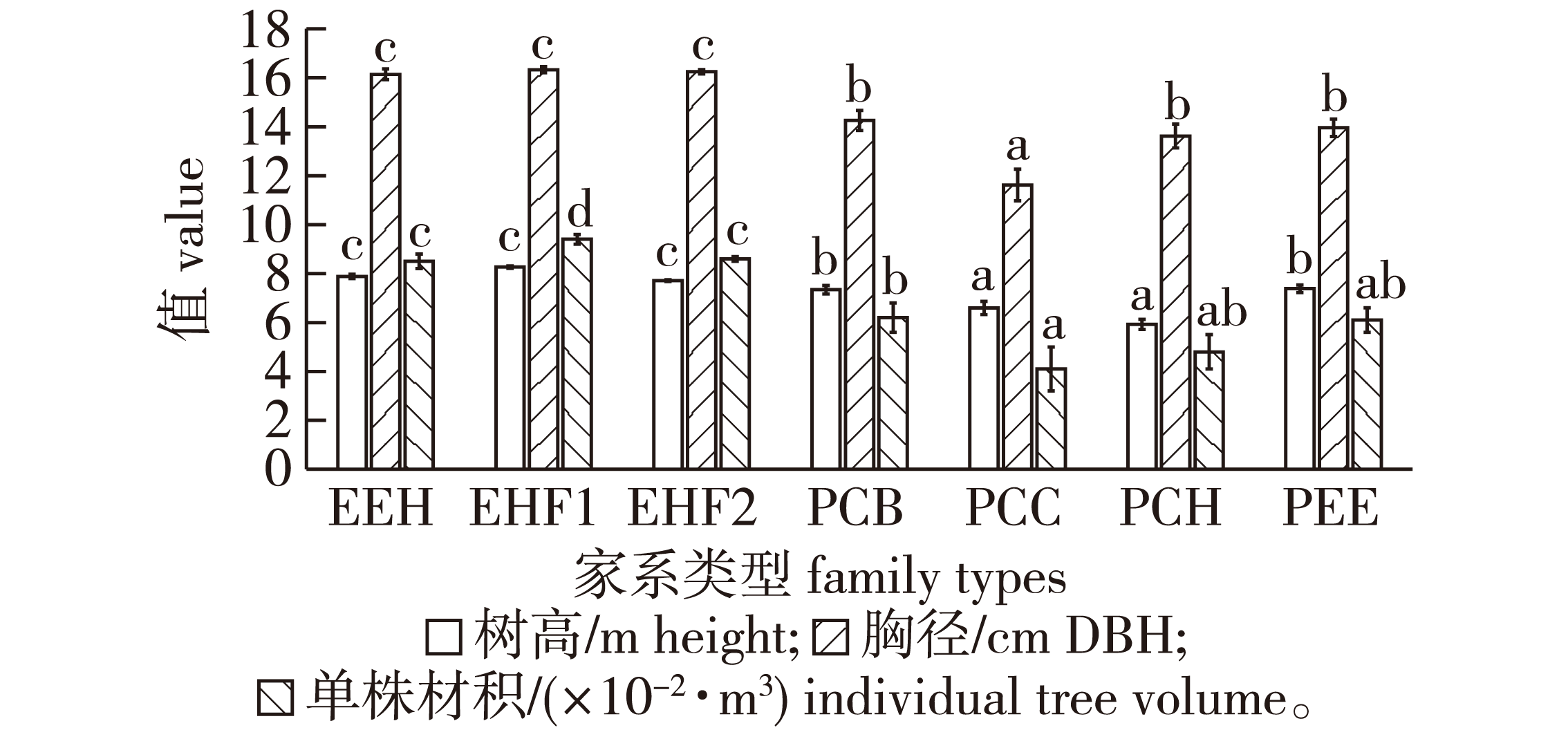
【目的】湿地松(Pinus elliottii)与洪都拉斯加勒比松(P. caribaea var. hondurensis)种间杂交获得的湿加松F1代,在树高、胸径等生长性状方面表现出显著的杂种优势。为了探究其F2代是否会出现性状分离及生长衰退现象,本研究通过多世代遗传测定,系统评估湿加松高世代育种潜力,旨在为杂种优势固定及种子园升级提供理论依据。【方法】选取广东省台山市红岭种子园内种植的28个湿加松全同胞F1代家系(EHF1),42个湿加松半同胞F2代家系(EHF2),3个湿地松×湿加松家系(EEH),以及6个湿地松、加勒比松对照(CK)家系,2015年采用随机不完全区组设计种植,1~4株单行小区,共28个重复,每个家系平均36株,在林龄7 a时,进行树高、胸径的测量,计算单株材积,通过线性模型进行生长量多重比较、家系遗传力、湿加松EHF2家系育种值等遗传参数的计算。【结果】试验林整体保存率为74.03%,湿加松EHF1、EHF2、EEH家系、CK的保存率分别为79.97%、70.53%、87.07%、68.98%。树高、胸径、单株材积最大的个体均来自EHF2家系,暗示F2代湿加松可能出现基因累加效应。3个家系的湿加松生长量显著高于湿地松、加勒比松对照(P<0.05),3个家系湿加松生长量对比结果显示,EHF1家系的树高、胸径高于EHF2和EEH家系但未达到显著水平(P>0.05),平均单株材积显著(P<0.05)高于EHF2和EEH家系,其中湿加松EHF1家系的平均单株材积比EHF2高9.28%。造成EHF2家系平均单株材积比EHF1小的主要因素是树高8.5 m以上的占比较低,拉低了整体水平。湿加松EHF2家系的树高、胸径、单株材积的家系遗传力为0.515~0.637,选择单株材积育种值前20的家系,遗传增益为9.81%。【结论】湿加松F1和F2代家系相较于亲本湿地松和加勒比松均表现出较强的杂种优势,湿加松F1代杂交家系的平均单株材积显著高于湿加松初级种子园生产的F2代,表明湿加松F2代相较F1代在生长上出现了一定的衰退,但可以通过筛选育种值高的无性系营建高增益的湿加松无性系精选种子园,其生产的子代可以达到甚至超过F1代的平均生长水平。生长量作为典型数量性状,通过高世代育种体系可实现有利基因聚合,有效提升遗传增益并固定杂种优势。建立经过多代遗传改良的湿加松高世代种子园,是同时实现遗传增益提升和固化杂种优势的科学策略。
【Objective】 The interspecific hybridization between the slash pine (Pinus elliottii) and the Honduras Caribbean pine (P. caribaea var. hondurensis) has resulted in the F1 generation of the hybrid known as P. elliottii × P. caribaea var. hondurensis which exhibits significant hybrid vigor in terms of growth traits such as tree height and diameter at breast height (DBH). To investigate whether the F2 generation exhibit trait segregation and growth decline, this study conducts multi-generational genetic assessments to systematically evaluate the breeding potential of the P. elliottii × P. caribaea var. hondurensis in higher generations. The ultimate goal is to provide a theoretical basis for the fixation of hybrid vigor and the upgrading of seed orchards. 【Method】 A total of 28 full-sibling F1 family lines of P. elliottii × P. caribaea var. hondurensis (EHF1), 42 half-sibling F2 family lines (EHF2), and three family lines resulting from the cross between P. elliottii and P. elliottii × P. caribaea var. hondurensis (EEH) were selected from the Hongling Seed Orchard in Taishan City, Guangdong Province. Additionally, three varieties of Caribbean pine were planted as controls: the Honduras Caribbean pine (P. caribaea var. hondurensis, PCH), the Bahamian Caribbean pine (P. caribaea var. bahamensis, PCB), and the Cuban Caribbean pine (P. caribaea var. caribaea, PCC), along with the slash pine (PEE). In 2015, a randomized incomplete block design was employed for planting, with one to four plants per single-row plot, resulting in a total of 28 replicates, with an average of 36 plants per family line. At the age of seven years, measurements of tree height and DBH were taken, and individual tree volume was calculated. A linear model was utilized for multiple comparisons of growth rates, as well as for calculating genetic parameters such as family heritability and breeding values for the EHF2 family groups. 【Result】 The overall survival rate of the experimental forest was 74.03%, with survival rates for EHF1, EHF2, EEH families, and the controls being 79.97%, 70.53%, 87.07% and 68.79%, respectively. The tallest tree, the largest DBH, and the highest individual tree volume were all found in the EHF2 family group, measuring 12.4 m, 27.4 cm, and 36.56 × 10⁻² m3, respectively. This suggests the potential for a genetic additive effect in the F2 generation of P. elliottii × P. caribaea var. hondurensis. The growth rates of the three types of P. elliottii × P. caribaea var. hondurensis were significantly higher than those of the control slash pine and caribbean pine (P < 0.05). A further comparison among the three types of P. elliottii × P. caribaea var. hondurensis revealed that EHF1 had greater tree height and DBH than EHF2 and EEH families, although the differences did not reach statistical significance (P > 0.05). However, the average individual tree volume of EHF1 families was significantly higher (P < 0.05) than that of EHF2 and EEH families, with EHF1’s family average individual tree volume exceeding that of EHF2 by 9.28%. The primary factor contributing to the smaller average individual tree volume of EHF2 family compared to EHF1 was the higher proportion of trees below 8.5 m in height, while the proportion of trees above 8.5 m was relatively low. The family heritability of tree height, DBH, and individual tree volume for EHF2 family ranged from 0.515 to 0.637. When selecting the top 20 family lines based on individual tree volume breeding values, a genetic gain of 9.81% was observed. 【Conclusion】 The F1 and F2 generations of P. elliottii × P. caribaea var. hondurensis exhibit stronger hybrid vigor compared to the parent species, slash pine and Caribbean pine. The average individual tree volume of the F1 hybrid is significantly greater than that of the F2 generation produced from the primary seed orchard of P. elliottii × P. caribaea var. hondurensis, indicating a certain degree of growth decline in the F2 generation compared to the F1 generation. However, by selecting high breeding value clones, it is possible to establish seed orchards of P. elliottii × P. caribaea var. hondurensis that can produce progeny with growth levels that meet or even exceed the average growth levels of the F1 generation. As growth rate is a typical quantitative trait, the establishment of a high-generation breeding system can facilitate the aggregation of favorable genes, effectively enhancing genetic gain and solidifying hybrid vigor. The establishment of high-generation seed orchards of P. elliottii × P. caribaea var. hondurensis, which have undergone multiple generations of genetic improvement, is a scientifically sound strategy for achieving both enhanced genetic gain and the fixation of hybrid vigor.
湿加松 / 杂种优势 / 高世代育种 / F2代 / 遗传分化
Pinus elliottii × P. caribaea / heterosis / advanced generation breeding / F2 generation / genetic differentiation
| [1] |
李宪政, 赵奋成, 张应中, 等. 湿地松与加勒比松杂种第一代生长研究初报[J]. 广东林业科技, 1999(1):1-7.
|
| [2] |
张应中, 赵奋成, 林军, 等. 湿加松在粤北山区早期生长表现初报[J]. 林业科学研究, 2007, 20(4):556-562.
|
| [3] |
赵奋成, 张应中, 黄永权, 等. 湿地松×加勒比松杂种在湛江地区的早期生长表现[J]. 广东林业科技, 2011, 27(3):1-7.
|
| [4] |
李福明, 彭冠明, 赵奋成, 等. 湿加松优良家系丰产林生长表现[J]. 广东林业科技, 2008, 24(1):37-41.
|
| [5] |
张应中, 赵奋成, 钟岁英, 等. 湿地松×加勒比松杂种松扦插繁殖技术研究[J]. 林业科学研究, 2002, 15(4):437-443.
|
| [6] |
张应中, 赵奋成, 钟岁英, 等. 湿加松扦插繁殖配套技术[J]. 广东林业科技, 2008, 24(2):25-30.
|
| [7] |
沈熙环, 黄永权. 广东省湿加松良种选育和推广进展[J]. 林业科技通讯, 2018(1):74-75.
|
| [8] |
|
| [9] |
何克军. 澳大利亚昆士兰州松树杂交育种和造林[J]. 广东林业科技, 1996, 12(3):34-38.
|
| [10] |
|
| [11] |
刘天颐, 薛晓峰, 刘纯鑫, 等. 澳大利亚湿加松F2代在广东早期生长表现[J]. 广东林业科技, 2008, 24(1):42-46.
|
| [12] |
王辉彬. 澳洲湿加松F2造林技术研究[J]. 现代农业科技, 2015(18):159-160.
|
| [13] |
王启和, 干少雄, 代仕高, 等. 湿地松×加勒比松F2子代苗高生长规律[J]. 西南林学院学报, 2003, 23(4):8-11.
|
| [14] |
蓝贺胜, 李树忠, 吴炜, 等. F2代湿加松和火炬松引种试验林早期生长分析[J]. 林业科技开发, 2008, 22(5):61-62.
|
| [15] |
林元震. R与ASReml-R统计学[M]. 北京: 中国林业出版社, 2017.
|
| [16] |
|
| [17] |
黄永权, 赵奋成. 广东湿加松良种选育现状及发展对策[J]. 福建林业科技, 2007, 34(1):158-162,193.
|
| [18] |
邓乐平, 黄婷, 赵奋成, 等. 加勒比松3个变种种源试验初报[J]. 广东农业科学, 2020, 47(8):56-64.
|
| [19] |
|
| [20] |
|
/
| 〈 |
|
〉 |