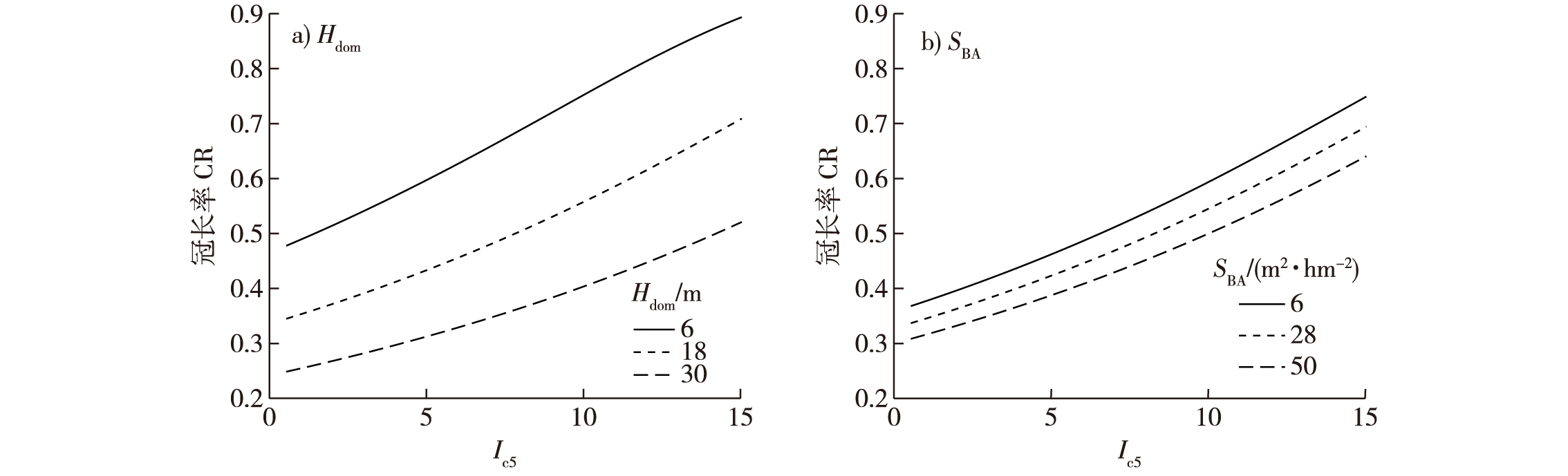
【目的】冠长率是反映林木活力、支撑林分生长预测的关键指标。然而,适用于长白落叶松(Larix olgensis )的高精度冠长率预测模型仍较为缺乏,其主要影响因子尚未明晰;且现有模型多依赖测量成本较高的树高与枝下高等变量。因此,本研究旨在采用易于获取的变量,构建长白落叶松人工林的非线性混合效应(NLME)冠长率模型,并确定高效的预测校正方案,以服务于精准森林经营。【方法】基于黑龙江省东京城林业局、林口林业局、孟家岗林场共463块长白落叶松标准地观测数据,以理查德(Richards)模型为基础,采用逐步回归法引入林分优势木平均高、林分公顷断面积以及与距离相关的竞争指数(Ic5)作为协变量,构建非线性混合效应模型。采用留一交叉检验和随机抽样校正方案,分析不同校正样本量(1~20株)对模型预测精度的影响。【结果】非线性混合效应模型调整决定系数(${\mathit{R}}_{\mathrm{a}}^{2}$)为0.705 4,均方根误差(RMSE)为0.086 9,赤池信息准则(AIC)为-17 147.76,表明模型拟合优度良好。参数估计显示,冠长率与林分优势木平均高、林分公顷断面积呈负相关,而与竞争指数(Ic5)呈正相关。抽样校正可显著提升预测精度,但当样本量超过5株时,精度提升效果显著减弱。【结论】本研究构建的非线性混合效应模型,在不依赖树高相关测量的前提下,有效量化了立地质量、林分密度与竞争对长白落叶松冠长率的多因素影响。推荐每个样地抽取5株样木作为最优校正方案,为黑龙江省长白落叶松人工林冠长率的低成本、高精度预测提供可靠方法与实践依据。
【Objective】Crown ratio (CR) is a vital indicator of tree vigor and a fundamental parameter for stand growth prediction. However, high-precision CR prediction models specifically for Larix olgensis plantations remain scarce, and the key driving factors are not yet fully understood. Furthermore, existing models often rely on variables such as total tree height and height to crown base, which are costly and difficult to measure. Therefore, this study aimed to develop a nonlinear mixed-effects (NLME) crown ratio model for L. olgensis plantations using easily obtainable variables and to determine an efficient calibration strategy for prediction to support precision forest management. 【Method】The study utilized observation data from 463 sample plots of L. olgensis in the Dongjingcheng Forestry Bureau, Linkou Forestry Bureau, and Mengjiagang Forest Farm in Heilongjiang Province. A Richards function was selected as the basic model. Stepwise regression was employed to incorporate stand mean dominant height, stand basal area per hectare, and a distance-dependent competition index (Ic5) as covariates to construct the NLME model. Leave-one-out cross-validation and random sampling calibration schemes were employed to analyze the effects of different calibration sample sizes (ranging from 1 to 20 trees) on model prediction accuracy. 【Result】The developed NLME model demonstrated good goodness-of-fit, with an adjusted coefficient of determination (${\mathit{R}}_{\mathrm{a}}^{2}$) of 0.705 4, a root mean square error (RMSE) of 0.086 9, and an Akaike information criterion (AIC) of -17 147.76. Parameter estimates indicated that CR was negatively correlated with stand mean dominant height and stand basal area per hectare, but positively correlated with competition index (Ic5). Sampling calibration significantly improved prediction accuracy; however, the marginal gain in accuracy diminished markedly when the sample size exceeded five trees. 【Conclusion】The NLME model developed in this study effectively quantifies the multifactorial effects of site quality, stand density, and competition on the CR of Larix olgensis without relying on height-related measurements. A calibration sample size of five trees per plot is recommended as the optimal strategy. These findings provide a reliable method and practical tool for achieving low-cost, high-accuracy CR predictions in L. olgensis plantations in Heilongjiang Province.
 PDF(1986 KB)