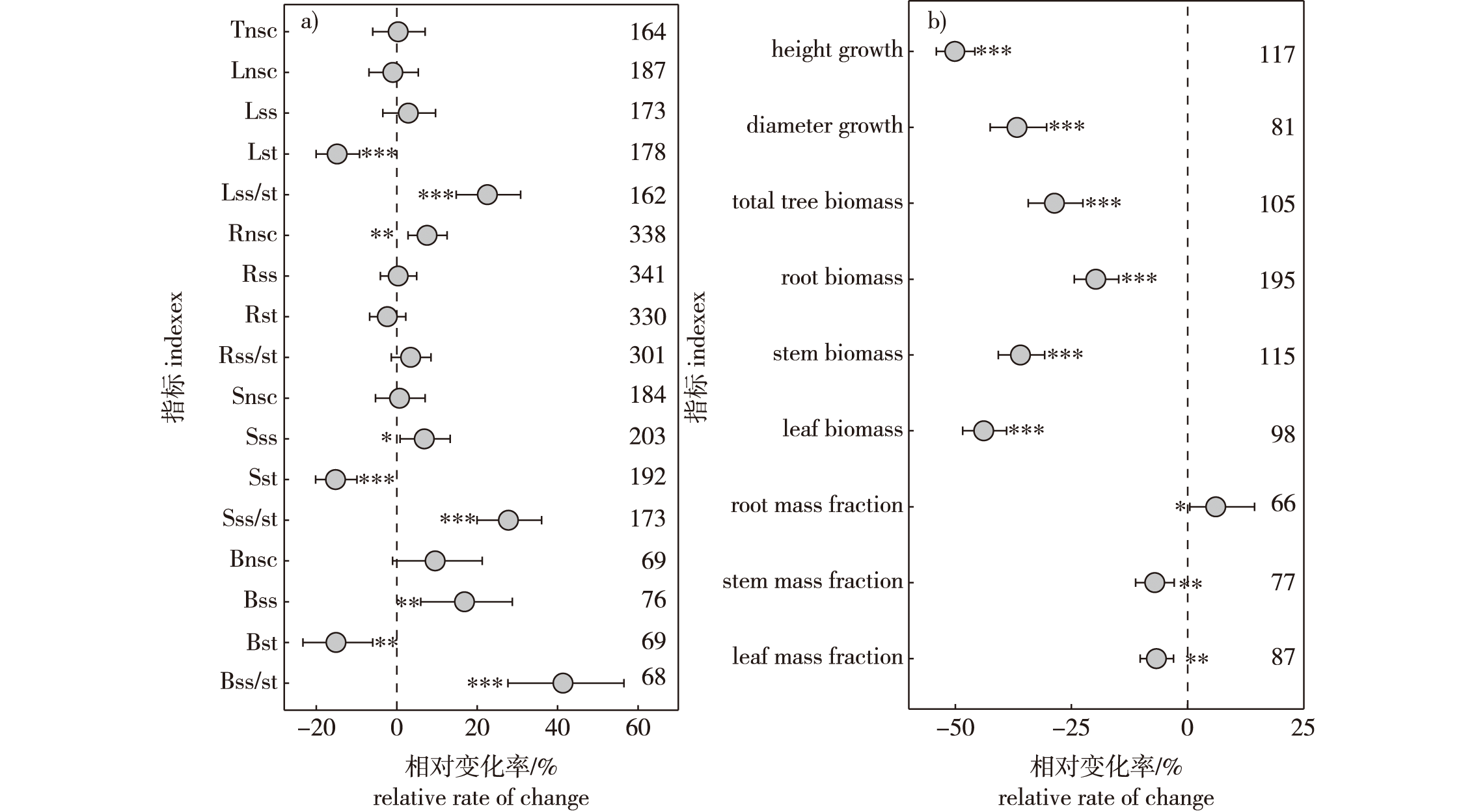
【目的】通过全面评估干旱胁迫对树木非结构性碳水化合物(NSC)动态和生长的影响,加深对树木应对环境胁迫响应规律及其潜在调节机制的理解。【方法】以温带和亚热带森林生态系统为对象,通过文献梳理,系统收集现有同时观测树木NSC与结构性生长的干旱胁迫实验结果,采用整合分析(Meta-analysis)方法,定量评估不同功能类型树种对干旱的响应规律,并探讨该响应与干旱强度及持续时间之间的关系。【结果】①树木在干旱胁迫下通常表现为维持NSC浓度并显著降低生长速率的响应规律。其中,地上部分NSC浓度基本稳定,淀粉向可溶性糖的转化趋势增强,而根系NSC显著上升;径向生长、树高增量和总生物量累积在干旱胁迫下分别降低36.68%、50.07%和28.64%;②不同叶习性树木呈现出响应差异:落叶树种主要表现出枝条和根系NSC增加,生物量分配向根系倾斜;常绿树种地上器官NSC维持稳定,根系中出现更加明显的淀粉向可溶性糖转化的趋势,生物量累积在不同器官的分配受干旱影响较落叶树种更小;③干旱强度与持续时间影响部分功能器官NSC与生长动态:干旱强度主要影响根系与树干淀粉浓度和生物量累积等指标,呈显著负相关关系;干旱持续时间与树干生物量累积呈显著负相关,与根系生物量累积呈正相关关系。【结论】树木在干旱胁迫下普遍采取限制生长、提升或维持NSC储备的保守策略,因此碳储存的优先级通常较结构性生长更高;碳分配则倾向于向根系转移,以维持水分获取能力和基本代谢过程,从而增强树木对水分胁迫的耐受性。本研究有助于深化对树木碳分配动态在干旱等不利环境条件下调节机制的认识,并为预测未来气候变化情景下森林碳汇能力提供依据和参考。
【Objective】This study aims to enhance the understanding of tree response patterns to environmental stresses and their underlying regulatory mechanisms by comprehensively assessing the effects of drought stress on non-structural carbohydrate (NSC) dynamics and growth in trees.【Method】Existing drought stress experiments that simultaneously observed tree NSC indicators and growth were systematically collected. Using meta-analysis, the response patterns of different functional tree types to drought were quantitatively evaluated, and the relationships between these responses and drought intensity as well as duration were explored.【Result】(1)Trees under drought stress generally maintained nonstructural carbohydrate (NSC) concentrations while significantly reducing growth rates. Specifically, aboveground NSC remained stable, and the conversion of starch to soluble sugar was promoted,whereas root NSC increased significantly. Radial growth, tree height increment, and total biomass accumulation decreased by 36.68%, 50.07%, and 28.64%, respectively; (2) Responses varied by different leaf habit tree species: deciduous trees showed increased NSC in branches and roots with biomass allocation shifting toward roots, while evergreen trees maintained stable above ground NSC but exhibited more pronounced starch to sugar conversion in roots, with less drought impact on biomass allocation among organs;(3) Drought intensity and duration affect the starch and growth dynamics of some functional organs: Drought intensity mainly affects the starch concentration and biomass accumulation of roots and stems, showing a significant negative correlation; while drought duration is significantly negatively correlated with stem biomass accumulation, but positively correlated with root biomass accumulation. 【Conclusion】Under drought stress, trees generally adopt a conservative strategy of restricting growth and enhancing or maintaining NSC reserves, so the priority of carbon storage is usually higher than that of structural growth; carbon allocation tends to shift to roots to maintain water acquisition ability and basic metabolic processes, thereby enhancing the tree’s tolerance to water stress. This study helps deepen the understanding of the dynamic regulation mechanism of carbon allocation in trees under drought, and provides a basis and reference for predicting the carbon sink capacity of forests under future climate change scenarios.
 PDF(2861 KB)