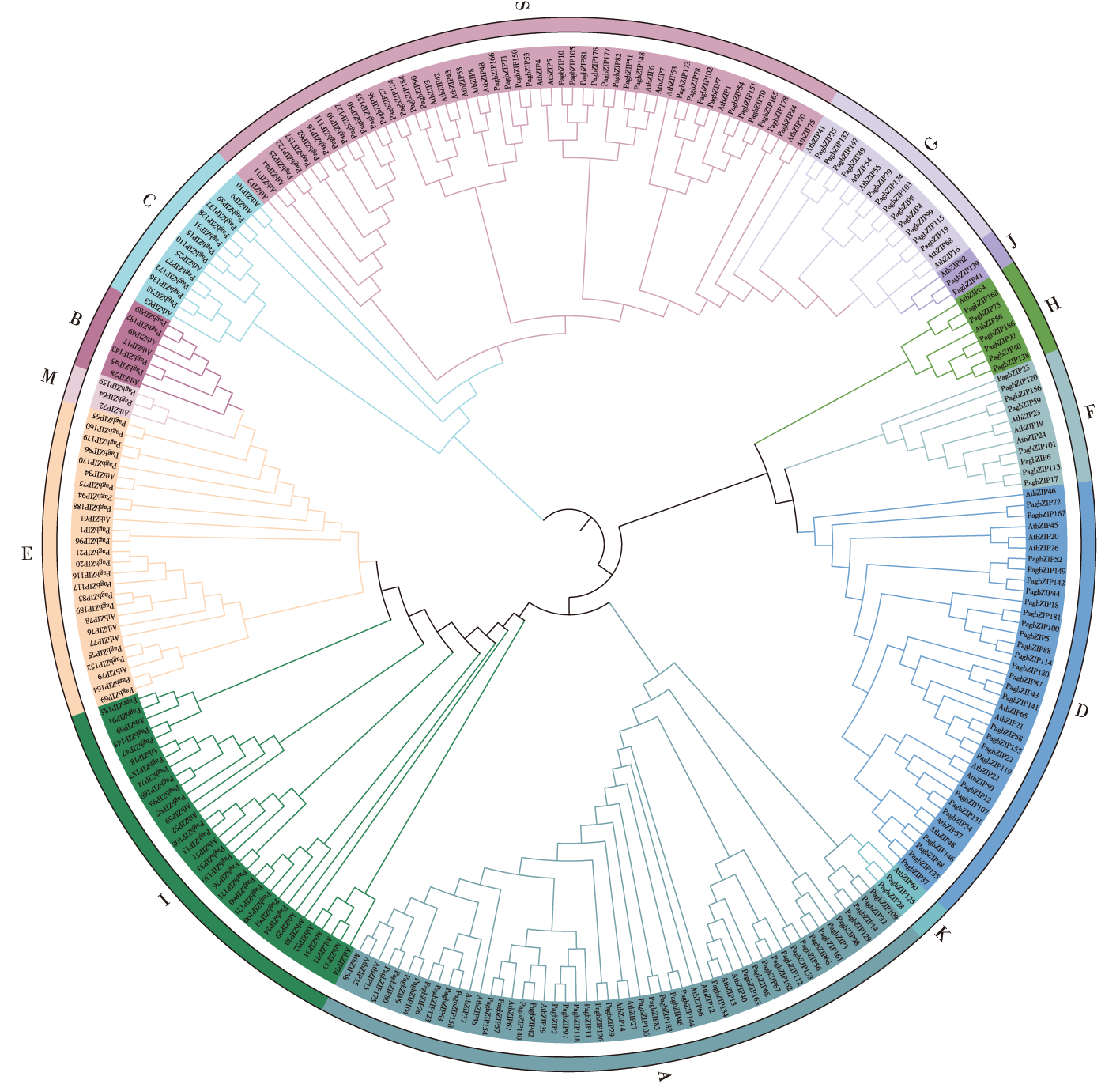
【目的】盐胁迫严重制约植物的生长发育。揭示植物盐胁迫应答机制对林木抗逆育种具有重要理论与实践意义。以银腺杨‘84K’(Populus alba×P. glandulosa ‘84K’)(‘84K’杨)为材料, 系统解析bZIP基因家族特征, 阐明PagbZIP36响应盐胁迫的分子机制, 为林木抗逆遗传改良提供理论依据与基因资源。【方法】采用生物信息学方法全面分析PagbZIPs基因家族结构、进化及顺式作用元件特征;通过表型观察与生理指标测定鉴定PagbZIP36的耐盐性;结合DAP-seq与分子生物学实验验证PagbZIP36通过调控PagGolS2参与盐胁迫应答的通路。【结果】在‘84K’杨基因组中鉴定出190个bZIP家族成员,可分为13个亚家族。S亚家族基因PagbZIP36的启动子区中盐胁迫相关顺式元件占比达70.1%,其表达受盐胁迫显著诱导。过表达PagbZIP36可显著提高‘84K’杨的耐盐性。机制分析表明, 该转录因子可直接调控下游PagGolS2的表达, 增强植株活性氧清除能力,维持细胞膜结构稳定性,从而有效缓解高盐造成的氧化损伤,提升杨树耐盐胁迫能力。【结论】S亚家族成员在盐胁迫响应中发挥关键作用,其中PagbZIP36通过调控PagGolS2增强活性氧清除效率与细胞膜稳定性, 进而提升耐盐能力。本研究为林木抗逆分子育种提供了关键候选基因与科学理论支撑。
【Objective】Soil salt stress is one of the major abiotic stresses that severely inhibits plant growth, development and productivity. Elucidating the molecular regulatory mechanisms of plant responses to salt stress is of great theoretical and practical significance for breeding stress-resistant forest trees and promoting their genetic improvement. In this study, ‘84K’ poplar (Populus alba × P. glandulosa ‘84K’), a widely used model tree in genetic research, was used as the experimental material. The structural and evolutionary characteristics of the bZIP transcription factor gene family were systematically identified and analyzed, and the biological function and molecular regulatory mechanism of PagbZIP36 in response to salt stress were further explored, aiming to provide reliable gene resources and theoretical support for molecular breeding of stress-resistant forest trees.【Method】A comprehensive bioinformatics analysis was performed to characterize the gene structure, phylogenetic relationships, conserved motifs and promoter cis-elements of the bZIP gene family. The expression pattern of PagbZIP36 under salt treatment was detected, and its salt tolerance function was identified through phenotypic observation and physiological index determination in transgenic poplar. In addition, DAP-seq combined with molecular biology experiments was used to verify the regulatory relationship between PagbZIP36 and its downstream target gene PagGolS2 during salt stress response.【Result】A total of 190 bZIP family members were identified from the ‘84K’ poplar genome and were divided into 13 distinct subfamilies. PagbZIP36, a member of the S subfamily, contained 70.1% salt stress-related cis-acting elements in its promoter region and was significantly induced by salt stress. Overexpression of PagbZIP36 significantly enhanced salt tolerance in transgenic ‘84K’ poplar. Further mechanistic analysis indicated that this transcription factor regulates the expression of the downstream functional gene PagGolS2, enhances reactive oxygen species scavenging efficiency, maintains cell membrane stability, effectively alleviates oxidative damage caused by high salt, and ultimately improves poplar salt tolerance.【Conclusion】Members of the bZIP S subfamily exert pivotal roles in plant salt stress response and tolerance. Among these regulators, PagbZIP36 enhances reactive oxygen species scavenging capacity and maintains cell membrane stability by targeting and modulating the expression of PagGolS2, thereby conferring significantly elevated salt tolerance in forest trees. This study provides critical candidate genes and a robust theoretical foundation for molecular breeding programs aimed at improving stress resistance in forest trees.
 PDF(4869 KB)