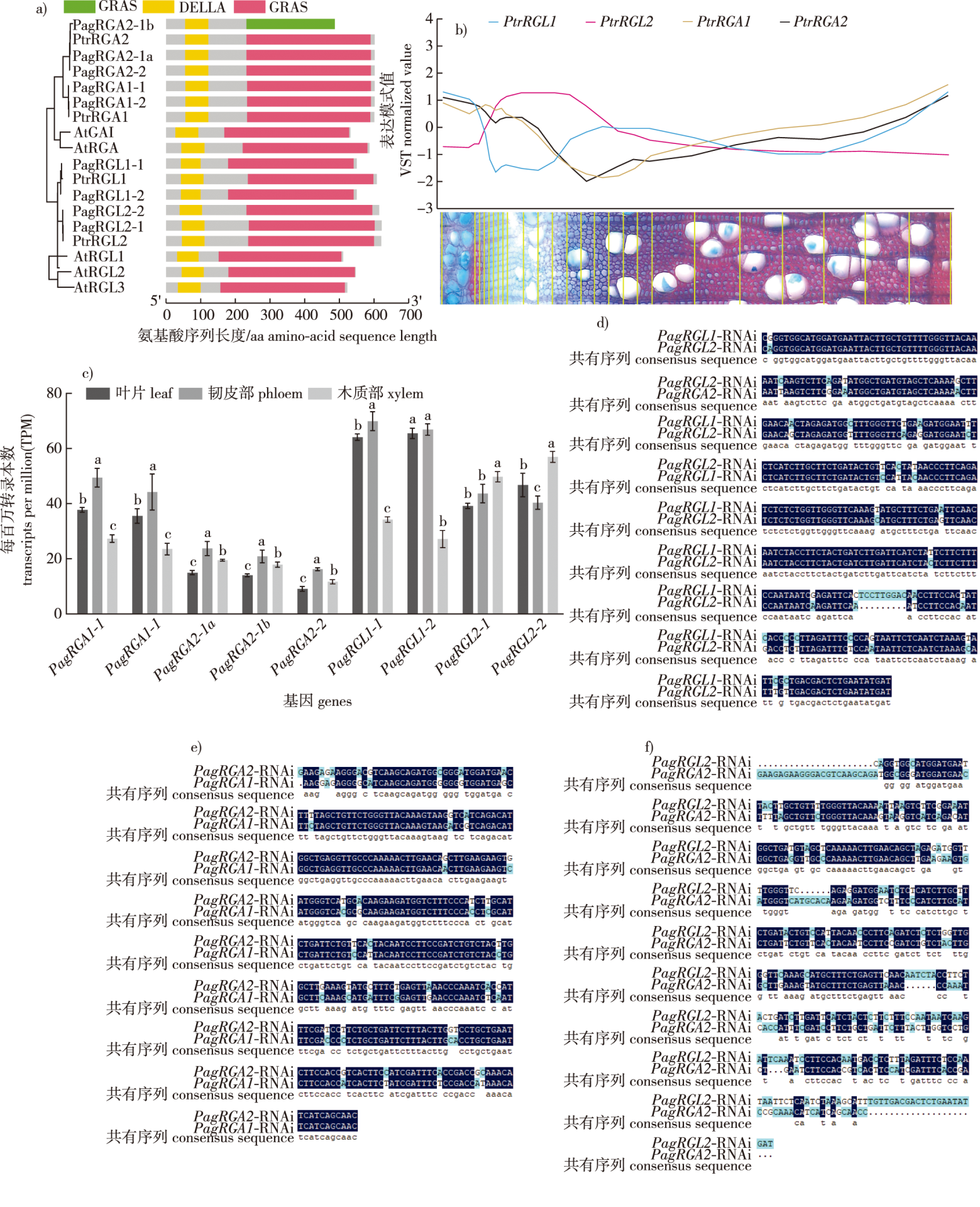
【目的】系统鉴定银腺杨DELLA蛋白家族成员,探究其在木材形成中的功能,揭示其调控次生生长的分子机制。【方法】利用HMM和Blastp工具,结合保守结构域分析,对银腺杨DELLA家族进行全基因组鉴定。通过系统发育分析和序列比对明确其分类与命名。基于组织表达筛选关键基因,利用基因工程技术创制组成型启动子(CaMV-35S)和木质部特异性表达启动子(PtrGT8D1 pro)驱动的PagRGA和PagRGL RNA干扰(RNAi)转基因植株。通过表型观察、震荡切片、扫描电镜、木材组分测定及转录组测序,分析干扰DELLA基因表达对植株生长、形成层活性、次生细胞壁加厚及木材组分的影响。【结果】①在银腺杨中鉴定到9个DELLA成员,分为PagRGA1、PagRGA2、PagRGL1和PagRGL2共4组,均含DELLA和GRAS结构域。②分别干扰PagRGA1/2和PagRGL1/2表达后,形成层细胞层数减少1~3层,木质部宽度变窄,木质素含量下降;RT-qPCR验证表明,木质素合成酶相关基因表达下调。其中,PagRGA RNAi植株的表型差异更显著。③转录组分析显示,干扰DELLA基因表达后差异表达基因富集于分生组织和细胞分裂相关GO条目。组成型表达启动子驱动植株富集更多生长素通路。【结论】DELLA蛋白是调控银腺杨次生生长的关键信号模块,不同成员存在功能冗余。DELLA蛋白通过调控相关基因的表达,并整合多种激素信号,协同调控形成层细胞分裂和次生细胞壁沉积。
【Objective】 The gibberellin (GA) signaling pathway plays a pivotal role in regulating plant growth and development, and DELLA protein is the core factor of this pathway. However, the systematic identification and functional dissection of DELLA family genes in woody plants, especially their roles in secondary growth and wood formation, remain poorly understood. The present study was conducted to systematically identify the DELLA protein family members in Populus alba × P. glandulosa, and to explore their biological functions and underlying molecular mechanisms in the regulation of secondary growth and wood formation.【Method】To identify all DELLA family genes at the whole-genome level, we combined HMM and Blastp tools for homology searches, followed by verification of the conserved N-terminal DELLA motif and C-terminal GRAS domain. Phylogenetic analysis and multiple sequence alignment were performed to clarify the classification, nomenclature and evolutionary relationships of these DELLA proteins. Tissue-specific expression patterns across various organs (leaves, xylem, and phloem) were analyzed to screen for key members potentially involved in vascular development. Subsequently, RNA interference (RNAi) transgenic plants targeting the representative PagRGA and PagRGL genes were generated using two distinct promoters: the constitutive CaMV-35S promoter and the xylem-specific PtrGT8D1 promoter. The effects of DELLA gene silencing on plant growth, cambial activity, secondary cell wall thickening, and wood chemical composition were comprehensively evaluated through phenotypic observation, vibratome sectioning, scanning electron microscopy (SEM), quantitative wood component analysis (lignin), and high-throughput transcriptome sequencing.【Result】(1)A total of nine DELLA family members were identified in P. alba × P. glandulosa, which were classified into four distinct clades corresponding to PagRGA1, PagRGA2, PagRGL1, and PagRGL2. This result is consistent with the presence of two homologous gene pairs in P. trichocarpa (PagRGA and PagRGL). All identified proteins harbored the canonical DELLA and GRAS domains, confirming their identity as functional DELLA regulators.(2)PagRGA2 and PagRGL2 were highly expressed in the xylem. RNAi-mediated silencing of PagRGL reduced ground diameter and internode number, decreased cambial cell layers by 1~2 layers, reduced xylem width, and decreased lignin content by 7.49%~7.59%, whereas RNAi silencing of PagRGA reduced cambial cell layers by 1~3 layers, reduced xylem width, and decreased lignin content by 16.87%~17.73%. RT-qPCR analysis further confirmed that the expression levels of key lignin biosynthetic genes (e.g., PagCAD2, PagCCR1/2, PagPAL1/2/3, PagC4H1/2, PagLAC2, PagCAld5H2 and PagCCoAOMT3)were substantially downregulated in the transgenic lines. Notably, the phenotypic changes in PagRGA RNAi plants were consistently more pronounced than those in PagRGL RNAi plants.(3)Transcriptome profiling revealed that differentially expressed genes (DEGs) following DELLA gene silencing were significantly enriched in gene ontology (GO) terms associated with meristem development, cell cycle regulation, cell wall organization, and xylem development. Moreover, auxin-related signaling pathways were predominantly enriched in plants driven by the constitutive CaMV-35S promoter.【Conclusion】These results demonstrate that DELLA proteins serve as a critical signaling module governing secondary growth in P. alba × P. glandulosa. Different DELLA family members exhibit functional redundancy. Mechanistically, DELLA proteins coordinate cambial cell proliferation and secondary cell wall deposition by modulating the expression of downstream regulatory and biosynthetic genes, as well as by integrating multiple hormonal signals, including GA and auxin. This study provides novel insights into the molecular basis of wood formation in poplar and identifies potential gene targets for future genetic improvement of wood quality and productivity in forest trees.
 PDF(52042 KB)