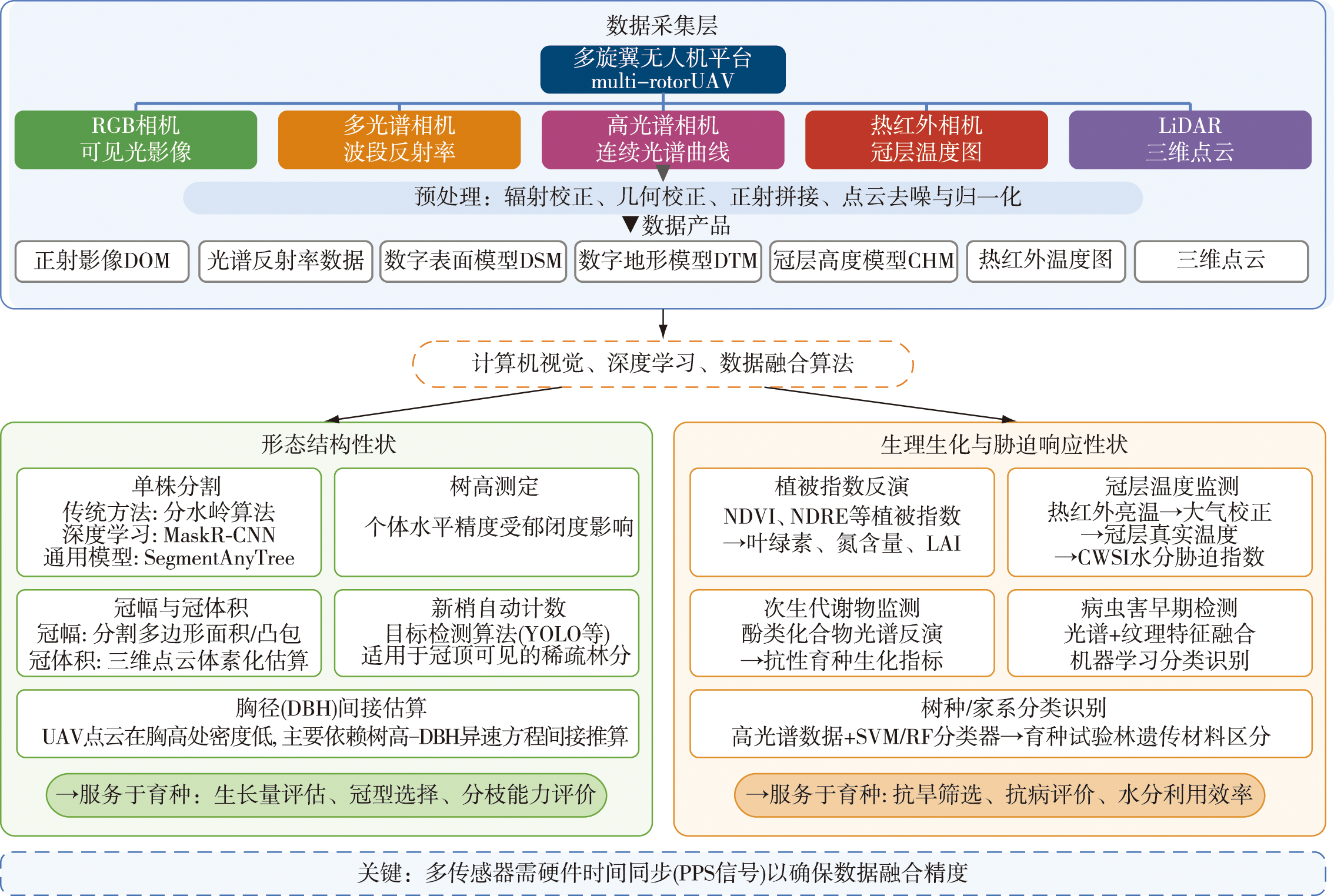
面对全球气候变化的严峻挑战,加速培育高产、优质且适应性强的林木新品种是保障森林生态系统可持续发展的迫切任务。然而,传统人工地面表型测定方法因效率低、成本高且具破坏性,已成为制约林木遗传改良进程的关键阻碍。近年来,无人机(unmanned aerial vehicle,UAV)低空遥感技术凭借其灵活高效、非破坏性和高时空分辨率的优势,正迅速发展为林木高通量表型(high-throughput phenotyping,HTP)获取的重要平台,为突破这一瓶颈提供了新途径。笔者围绕“无人机平台与传感器-表型性状提取方法-遗传育种应用”3个维度,系统综述该领域的研究进展。首先,概述多旋翼与固定翼无人机平台特性,以及搭载可见光(RGB)、多光谱、高光谱、热红外和激光雷达(LiDAR)等传感器的数据获取能力,并强调多传感器同步校准对数据融合精度的重要性。其次,重点阐述基于计算机视觉与深度学习算法从UAV数据中提取林木关键形态结构性状(如树高、冠幅)和生理生化性状(如叶绿素含量、冠层温度)的方法及其精度与适用条件。在此基础上,进一步探讨高通量表型数据如何有效支撑数量遗传分析与基因组育种模型构建,涵盖遗传参数估算、全基因组关联分析(GWAS)、新性状挖掘以及基因组选择(GS)预测精度的提升。最后,针对复杂林分环境下的数据获取瓶颈、多源数据标准化、深度学习模型泛化性不足以及“表型-基因组-环境”多组学融合等关键挑战进行深入分析,并指出面向未来气候适应性的动态遗传解析将是突破林木育种瓶颈的重要方向。
In the face of severe and escalating challenges posed by global climate change, accelerating the breeding of new forest tree varieties that are simultaneously high-yielding, high-quality, and broadly adaptive has become an urgent imperative for safe guarding the sustainable development and ecological resilience of forest ecosystems. Forest tree genetic improvement, however, has long been hampered by the protracted breeding cycles, extensive land requirements, and substantial labor demands intrinsic to perennial woody species. Among these constraints, the acquisition of accurate, large-scale phenotypic data has proven particularly limiting. Conventional manual, ground-based phenotyping approaches—being labor-intensive, time-consuming, costly, frequently subjective, and in many cases destructive—are incapable of matching the rapidly expanding capacity of genomic data generation, thereby giving rise to the widely recognized “phenotyping bottleneck” that now constitutes a critical obstacle to the efficiency of forest tree genetic improvement. In recent years, low-altitude remote sensing based on unmanned aerial vehicles (UAVs) has rapidly evolved into an important platform for the high-throughput phenotyping (HTP) of forest trees, owing to its operational flexibility, high efficiency, non-destructive nature, repeatable temporal sampling, and superior spatiotemporal resolution, offering a promising pathway to overcome this bottleneck. Structured around three interconnected dimensions-UAV platforms and sensors, phenotypic trait extraction methods, and applications in genetic breeding—this paper presents a systematic review of recent advances in this rapidly developing field, and seeks to clarify the technical pathways linking aerial data acquisition to genomic-assisted breeding decisions. Firstly, the distinctive operational characteristics of multi-rotor and fixed-wing UAV platforms are outlined and compared, with particular attention to their respective trade-offs among endurance, payload capacity, maneuverability, and the scale of areas amenable to survey. The data acquisition capabilities of mainstream onboard sensors—including RGB, multispectral, hyperspectral, thermal infrared, and light detection and ranging (LiDAR) sensors—are systematically examined in terms of their spectral coverage, spatial resolution, and suitability for capturing specific categories of tree traits. The review further underscores the critical role of synchronized multi-sensor calibration, geometric and radiometric correction, and precise spatiotemporal registration in ensuring the accuracy and reliability of subsequent multi-source data fusion, which collectively determine the quality of all downstream phenotypic estimates. Secondly, the review elaborates in detail on methods for extracting key phenotypic traits from UAV-derived data through computer vision and deep learning algorithms. Morphological and structural traits, such as tree height, crown width, crown projection area, stem volume, and canopy structural complexity, are typically derived from photogrammetric point clouds, canopy height models, and LiDAR returns. Physiological and biochemical traits, including leaf chlorophyll content, canopy temperature, water status, and various vegetation indices indicative of growth vigor and stress responses, are inferred from spectral and thermal information. The accuracy, robustness, and applicable conditions of these extraction methods are critically assessed, with emphasis on how stand density, canopy closure, illumination variability, and species-specific architecture influence estimation performance. Building upon these high-throughput phenotypic datasets, the paper further examines how such data can effectively underpin quantitative genetic analyses and the construction of genomic breeding models. Specifically, it addresses the estimation of genetic parameters such as heritability and genetic correlations from densely and repeatedly sampled aerial traits; the identification of novel, dynamically expressed traits through genome-wide association studies (GWAS) that would be difficult or impossible to capture manually; and the enhancement of genomic selection (GS) prediction accuracy through the integration of high-dimensional phenotypic information as auxiliary or secondary traits. The capacity of time-series UAV phenotyping to resolve the temporal dynamics of trait expression and growth trajectories is highlighted as a particularly valuable contribution to dissecting the genetic architecture of complex, longitudinally varying traits. Finally, an in-depth analysis is provided of the key challenges that remain to be resolved. These include the persistent difficulties of reliable data acquisition in complex, heterogeneous, and topographically variable stand environments; the standardization and interoperability of multi-source, multi-temporal data; the insufficient generalization capacity and limited transferability of deep learning models across species, sites, and growth stages; and the methodological and computational obstacles to the deep integration of “phenotype-genome-environment” multi-omics data. It is further argued that dynamic genetic dissection oriented toward future climate adaptability—achieved through the longitudinal, multi-scale monitoring of how forest trees respond to environmental stressors—will constitute a vital direction for breaking the persistent bottleneck in forest tree breeding. Continued advances in UAV platforms, sensor miniaturization, robust and interpretable algorithms, and standardized analytical frameworks are expected to transform forest tree phenomics into a foundational pillar of precision, climate-resilient genetic improvement.
 PDF(2297 KB)