面向智慧育种的表型解析与互作算法研究

张怀清, 焦俊博, 成媛, 范国强, 唐雪飞, 崔泽宇, 杨杰, 鲁南博

南京林业大学学报(自然科学版) ›› 2026, Vol. 50 ›› Issue (4) : 3-14.

PDF(3762 KB)
PDF(3762 KB)
南京林业大学学报(自然科学版) ›› 2026, Vol. 50 ›› Issue (4) : 3-14. DOI: 10.12302/j.issn.1000-2006.202605023
第二十八届中国科协年会———全球气候变化下的林草智能设计育种专题(执行主编 曹福亮 范国强 尹佟明 张怀清)
特邀专论

面向智慧育种的表型解析与互作算法研究

作者信息 +

Phenotypic analysis and interaction algorithms for smart breeding

Author information +
文章历史 +

摘要

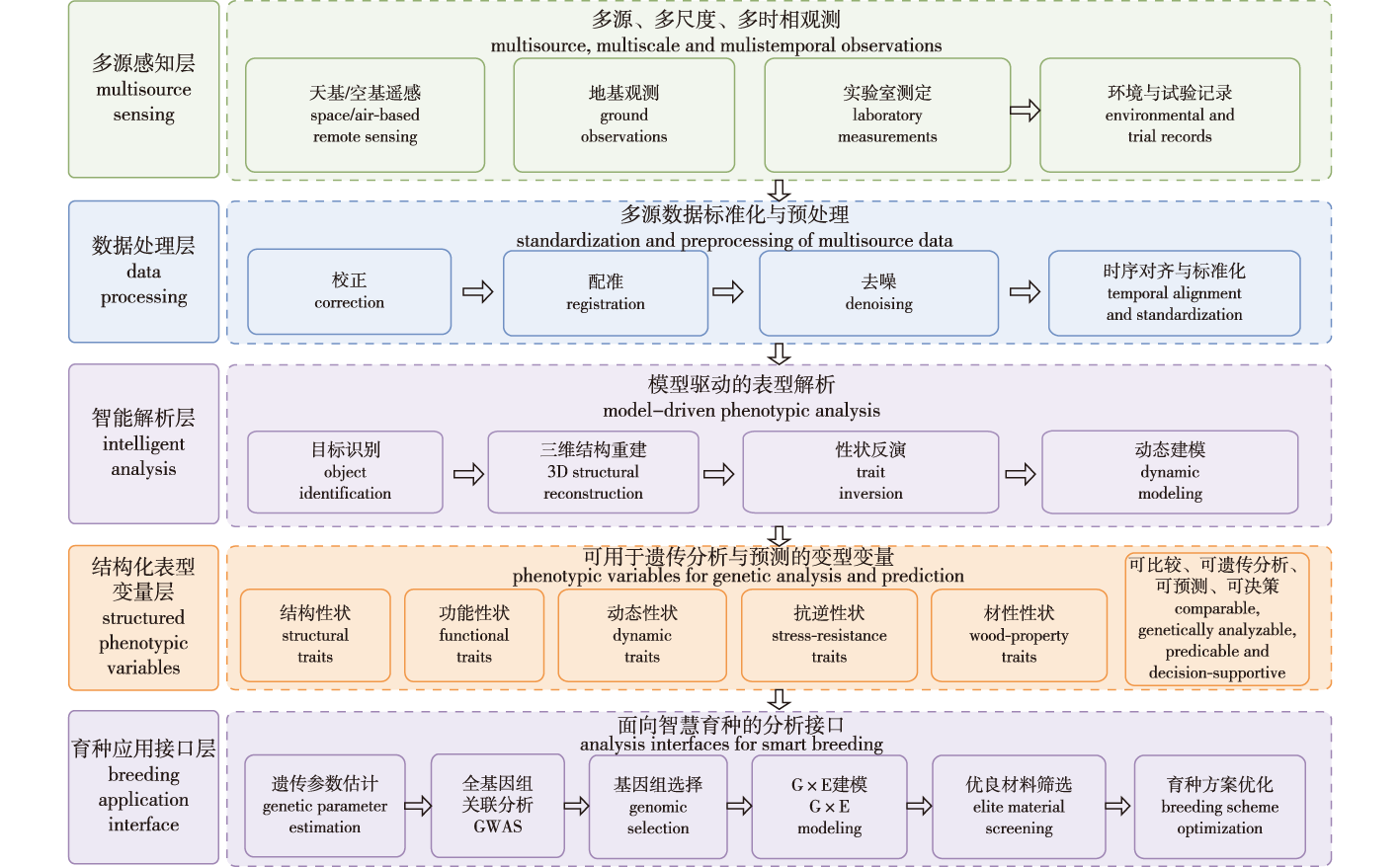
【目的】林木育种研究正由经验驱动向数据与模型驱动转变,亟需构建表型解析、多组学互作建模和育种决策支撑相衔接的方法体系。围绕林木智慧育种中表型变量构建与复杂性状互作解析问题,梳理表型解析和多组学互作算法的技术路径,分析其在智慧育种体系中的作用及发展方向。【方法】从多源感知、数据处理、智能解析、结构性表型变量等角度出发,论述林木表型解析的一般过程,以及它与遗传分析、基因组选择、育种决策的关系;其次,就遗传因素、环境因素、分子调控、发育过程中共同影响林木复杂表型形成的机理进行总结,归纳出多组学数据整合、统一表示学习、基因型-环境互作(G×E)建模、复杂性状预测、机制解析等关键技术手段,并讨论多组学大模型、科研智能体、数字孪生对知识管理、任务安排和育种计划制定的作用。【结果】林木智慧育种的重点不是单一的模型预测准确度高低,而是多源数据采集、表型变量提取、相互作用建模、最终解释反馈整个过程。目前林木智慧育种还存在数据标准化程度低、小样本差异高、难以适应新环境,缺少良好可解释性及有效闭环验证等问题。【结论】未来应加快建设长期、多地点、多尺度的表型-基因型-环境协同数据底座,发展适合林木长周期和强环境异质场景的多模态基础模型、因果推断方法和人机协同智能体系统。在此基础上,形成贯通数据获取、性状解析、互作建模、方案生成和育种验证的林木智慧育种新体系。

Abstract

【Objective】Forest tree breeding is shifting from experience-driven selection to data- and model-driven improvement, creating a need for an integrated framework that links phenotypic analysis, multi-omics interaction modeling, and breeding decision support. This paper focuses on phenotypic variable construction and complex-trait interaction analysis in smart forest tree breeding, reviews the technical pathways of phenotypic analysis and multi-omics interaction algorithms, and discusses their roles and future directions in intelligent breeding systems.【Method】We first discuss the general workflow of forest tree phenotypic analysis—covering multi-source sensing, data processing, intelligent analysis, and the construction of structural phenotypic variables—and elucidate its interrelationships with genetic analysis, genomic selection, and breeding decision-making. Subsequently, addressing the mechanisms by which genetic factors, environmental factors, molecular regulation, and developmental processes collectively shape complex forest tree phenotypes, we summarize key technical approaches such as multi-omics data integration, unified representation learning, genotype-environment interaction (G×E) modeling, and the prediction and mechanistic analysis of complex traits. Furthermore, we explore the roles that large multi-omics models, scientific research agents, and digital twins play in knowledge management, task scheduling, and the formulation of breeding plans.【Result】Based on the aforementioned findings, we conclude that the primary focus of smart forest tree breeding lies not merely in the predictive accuracy of isolated models, but rather in the comprehensive end-to-end process encompassing multi-source data acquisition, phenotypic variable extraction, interaction modeling, and ultimately interpretive feedback. Currently, smart forest tree breeding faces several challenges, including low levels of data standardization, issues related to small sample sizes coupled with high variability, difficulties in adapting to novel environments, a lack of robust interpretability, and an absence of effective closed-loop validation mechanisms.【Conclusion】In the future, it is necessary to accelerate the construction of a long-term, multi-site, and multi-scale collaborative phenotypic-genotypic-environmental data infrastructure, and to develop multimodal foundation models, causal inference methods, and human-machine collaborative agent systems suited to the long life cycle and strong environmental heterogeneity of forest trees. On this basis, a smart forest tree breeding system can be established that integrates data acquisition, trait analysis, interaction modeling, strategy generation, and breeding validation.

关键词

林木智慧育种 / 表型解析 / 多组学互作 / 大模型 / 林木育种智能体

Key words

forest tree smart breeding / phenotypic analysis / multi-omics interaction / large model / scientific agent for forest tree breeding

引用本文

导出引用
张怀清, 焦俊博, 成媛, . 面向智慧育种的表型解析与互作算法研究[J]. 南京林业大学学报(自然科学版). 2026, 50(4): 3-14 https://doi.org/10.12302/j.issn.1000-2006.202605023
Zhang Huaiqing, Jiao Junbo, Cheng Yuan, et al. Phenotypic analysis and interaction algorithms for smart breeding[J]. Journal of Nanjing Forestry University (Natural Sciences Edition). 2026, 50(4): 3-14 https://doi.org/10.12302/j.issn.1000-2006.202605023
中图分类号: S72;TP3.0   

参考文献

[1]
Xu Y B, Zhang X P, Li H H, et al. Smart breeding driven by big data,artificial intelligence,and integrated genomic-enviromic prediction[J]. Molecular Plant, 2022, 15(11):1664-1695. DOI:10.1016/j.molp.2022.09.001.
[2]
Yan J, Wang X F. Machine learning bridges omics sciences and plant breeding[J]. Trends in Plant Science, 2023, 28(2):199-210. DOI:10.1016/j.tplants.2022.08.018.
[3]
Fu J Y, Zheng S Z, Fan L J, et al. Breeding 5.0:artificial intelligence (AI)-decoded germplasm for accelerated crop innovation[J]. Journal of Integrative Plant Biology, 2025:jipb. 70008. DOI:10.1111/jipb.70008.
[4]
边黎明, 张慧春. 表型技术在林木育种和精确林业上的应用[J]. 林业科学, 2020, 56(6):113-126.
Bian L M, Zhang H C. Application of phenotyping techniques in forest tree breeding and precision forestry[J]. Scientia Silvae Sinicae, 2020, 56(6):113-126. DOI:10.11707/j.1001-7488.20200612.
[5]
Ding X Y, Pelser P B, Xu C, et al. Leveraging close-range UAV phenotyping and GWAS for enhanced understanding of slash pine growth dynamics[J]. Information Processing in Agriculture, 2025, 12(4):550-564. DOI:10.1016/j.inpa.2025.07.002.
[6]
葛晓宁, 许新桥, 张怀清, 等. 林木基因型-环境互作算法研究进展与思考[J]. 林业科学, 2025, 61(3):1-15.
Ge X N, Xu X Q, Zhang H Q, et al. Progress and reflection on genotype-environment interaction algorithms in forest tree breeding[J]. Scientia Silvae Sinicae, 2025, 61(3):1-15. DOI:10.11707/j.1001-7488.LYKX20240800.
[7]
Ting T C, MacKay D S, Jung J, et al. Beyond high-throughput:leveraging plant phenotyping to improve understanding and prediction of plant growth through process-based models[J]. The New Phytologist, 2026, 250(3):1468-1482. DOI:10.1111/nph.71039.
[8]
Murphy K M, Ludwig E, Gutierrez J, et al. Deep learning in image-based plant phenotyping[J]. Annual Review of Plant Biology, 2024, 75:771-795. DOI:10.1146/annurev-arplant-070523-042828.
[9]
Wang W X, Guo W J, Le L, et al. Integration of high-throughput phenotyping,GWAS,and predictive models reveals the genetic architecture of plant height in maize[J]. Molecular Plant, 2023, 16(2):354-373. DOI:10.1016/j.molp.2022.11.016.
[10]
Wang K L, Abid M A, Rasheed A, et al. DNNGP,a deep neural network-based method for genomic prediction using multi-omics data in plants[J]. Molecular Plant, 2023, 16(1):279-293. DOI:10.1016/j.molp.2022.11.004.
[11]
Lam H Y I, Ong X E, Mutwil M. Large language models in plant biology[J]. Trends in Plant Science, 2024, 29(10):1145-1155. DOI:10.1016/j.tplants.2024.04.013.
[12]
Xu R, Li C Y. A review of high-throughput field phenotyping systems:focusing on ground robots[J]. Plant Phenomics, 2022, 2022:9760269. DOI:10.34133/2022/9760269.
[13]
郭新宇, 吴升, 苟文博, 等. 农作物表型组大数据工厂成套技术装备研究综述[J]. 农业机械学报, 2026, 57(1):1-18,61.
Guo X Y, Wu S, Gou W B, et al. Review of integrated technology and equipment system for crop phenomics big data factory[J]. Transactions of the Chinese Society for Agricultural Machinery, 2026, 57(1):1-18,61. DOI:10.6041/j.issn.1000-1298.2026.01.001.
[14]
李英伦, 蔡诗辰, 张延宇, 等. 基于环绕式无人车表型平台和同源传感阵列的田间原位表型数据融合解析方法[J]. 农业机械学报, 2026, 57(1):19-29.
Li Y L, Cai S C, Zhang Y Y, et al. Method for fusion analysis of in-situ field phenotyping data based on surrounding unmanned vehicle phenotyping platform and homologous sensor arrays[J]. Transactions of the Chinese Society for Agricultural Machinery, 2026, 57(1):19-29. DOI:10.6041/j.issn.1000-1298.2026.01.002.
[15]
Yang J, Zhang H Q, Li J Y, et al. SmartQSM:a novel quantitative structure model using sparse-convolution-based point cloud contraction for reconstruction and analysis of individual tree architecture[J]. ISPRS Journal of Photogrammetry and Remote Sensing, 2026, 232:712-739. DOI:10.1016/j.isprsjprs.2026.01.011.
[16]
Jiang L Z, Li C Y, Fu L S. Apple tree architectural trait phenotyping with organ-level instance segmentation from point cloud[J]. Computers and Electronics in Agriculture, 2025, 229:109708. DOI:10.1016/j.compag.2024.109708.
[17]
Wang L L, Zhang H Q, Fu R R, et al. MTSCFNet:a novel framework for improving tree species classification in a subtropical forest using RGB,LiDAR-derived,and GF-2 data[J]. Journal of Forestry Research, 2025, 37(1):22. DOI:10.1007/s11676-025-01964-2.
[18]
Lim-Hing S, Conrad A O, Montes C R, et al. Near-infrared spectroscopy as a high-throughput phenotyping method for fusiform rust resistance in loblolly pine[J]. Plant Phenomics, 2025, 7(3):100066. DOI:10.1016/j.plaphe.2025.100066.
[19]
Li Y L, Wen W L, Fan J C, et al. Multi-source data fusion improves time-series phenotype accuracy in maize under a field high-throughput phenotyping platform[J]. Plant Phenomics, 2023, 5:43. DOI:10.34133/plantphenomics.0043.
[20]
Sapkota R, Qureshi R, Usman Hadi M, et al. Multi-modal LLMs in agriculture:a comprehensive review[J]. IEEE Transactions on Automation Science and Engineering, 2025, 22:22510-22540. DOI:10.1109/TASE.2025.3612154.
[21]
Fu R, Zhang H, Wang G, et al. Improving the accuracy of DBH estimation in Chinese fir using multi-source data fusion and interpretable machine learning algorithms[J]. Smart Forestry, 2026, 1: e007. DOI:10.48130/smartfor-0026-0004.
[22]
Li X, Guo T T, Mu Q, et al. Genomic and environmental determinants and their interplay underlying phenotypic plasticity[J]. Proceedings of the National Academy of Sciences of the United States of America, 2018, 115(26):6679-6684. DOI:10.1073/pnas.1718326115.
[23]
Wang P P, Lehti-Shiu M D, Lotreck S, et al. Prediction of plant complex traits via integration of multi-omics data[J]. Nature Communications, 2024, 15(1):6856. DOI:10.1038/s41467-024-50701-6.
[24]
Ma Z G, Zhang J Z, Pei H C, et al. DeepWheat:predicting the effects of genomic variants on gene expression and regulatory activities across tissues and varieties in wheat using deep learning[J]. Genome Biology, 2025, 26(1):321. DOI:10.1186/s13059-025-03809-x.
[25]
Crossa J, Martini J W R, Vitale P, et al. Expanding genomic prediction in plant breeding:harnessing big data,machine learning,and advanced software[J]. Trends in Plant Science, 2025, 30(7):756-774. DOI:10.1016/j.tplants.2024.12.009.
[26]
Zou Q X, Tai S S, Yuan Q G, et al. Large-scale crop dataset and deep learning-based multi-modal fusion framework for more accurate G × E genomic prediction[J]. Computers and Electronics in Agriculture, 2025, 230:109833. DOI:10.1016/j.compag.2024.109833.
[27]
Opgenoorth L, Dauphin B, Benavides R, et al. The GenTree Platform:growth traits and tree-level environmental data in 12 European forest tree species[J]. GigaScience, 2021, 10(3):giab010. DOI:10.1093/gigascience/giab010.
[28]
Zhou X L, Zhang L, Zhang M, et al. Genomic selection for growth and wood properties in multi-generation hybrid populations of Populus deltoides[J]. Horticulture Research, 2025, 12(9):uhaf165. DOI:10.1093/hr/uhaf165.
[29]
Sang Y P, Long Z Q, Dan X M, et al. Genomic insights into local adaptation and future climate-induced vulnerability of a keystone forest tree in East Asia[J]. Nature Communications, 2022, 13(1):6541. DOI:10.1038/s41467-022-34206-8.
[30]
Whetten R W, Jayawickrama K J S, Cumbie W P, et al. Genomic tools in applied tree breeding programs:factors to consider[J]. Forests, 2023, 14(2):169. DOI:10.3390/f14020169.
[31]
Kusmec A, Yeh C, Genomes to Fields Initiative, et al. Data-driven identification of environmental variables influencing phenotypic plasticity to facilitate breeding for future climates[J]. The New Phytologist, 2024, 244(2):618-634. DOI:10.1111/nph.19937.
[32]
Cao G S, Chao H Y, Zheng W Q, et al. ScPlantLLM:a foundation model for exploring single-cell expression atlases in plants[J]. Genomics,Proteomics & Bioinformatics, 2025, 23(3):qzaf024. DOI:10.1093/gpbjnl/qzaf024.
[33]
Xu F, Wu T H, Cheng Q, et al. Foundation models in plant molecular biology:advances,challenges,and future directions[J]. Frontiers in Plant Science, 2025, 16:1611992. DOI:10.3389/fpls.2025.1611992.
[34]
Grattapaglia D. Twelve years into genomic selection in forest trees:climbing the slope of enlightenment of marker assisted tree breeding[J]. Forests, 2022, 13(10):1554. DOI:10.3390/f13101554.
[35]
Crossa J, Pérez-Rodríguez P, Cuevas J, et al. Genomic selection in plant breeding:methods,models,and perspectives[J]. Trends in Plant Science, 2017, 22(11):961-975. DOI:10.1016/j.tplants.2017.08.011.
[36]
Wang H, Yan S, Wang W X, et al. Cropformer:an interpretable deep learning framework for crop genomic prediction[J]. Plant Communications, 2025, 6(3):101223. DOI:10.1016/j.xplc.2024.101223.
[37]
Montesinos-López A, Montesinos-López O A, Ramos-Pulido S, et al. Artificial intelligence meets genomic selection:comparing deep learning and GBLUP across diverse plant datasets[J]. Frontiers in Genetics, 2025, 16:1568705. DOI:10.3389/fgene.2025.1568705.
[38]
LUO L, LI L. Molecular understanding of wood formation in trees[J]. Forestry Research, 2022, 2: 5. DOI:10.48130/FR-2022-0005.
[39]
Wu H, Han R, Zhao L, et al. AutoGP:an intelligent breeding platform for enhancing maize genomic selection[J]. Plant Communications, 2025, 6(4):101240. DOI:10.1016/j.xplc.2025.101240.

基金

国家自然科学基金项目(32271877)
中央级公益性科研院所基本科研业务费专项资金项目(CAFYBB2023PA003)
科技创新2030-重大项目(2023ZD0406103)

责任编辑: 吴祝华
PDF(3762 KB)

Accesses

Citation

Detail

段落导航
相关文章

/