PDF(3898 KB)
Arbuscular mycorrhizal fungi induce excavate of Eucalyptus grandis phosphorus starvation response genes
WEI Wei, TANG Ming, CHEN Hui, XIE Xian'an, HUANG Xinru, WEI Hongjian
Journal of Nanjing Forestry University (Natural Sciences Edition) ›› 2025, Vol. 49 ›› Issue (6) : 261-269.
PDF(3898 KB)
PDF(3898 KB)
Arbuscular mycorrhizal fungi induce excavate of Eucalyptus grandis phosphorus starvation response genes
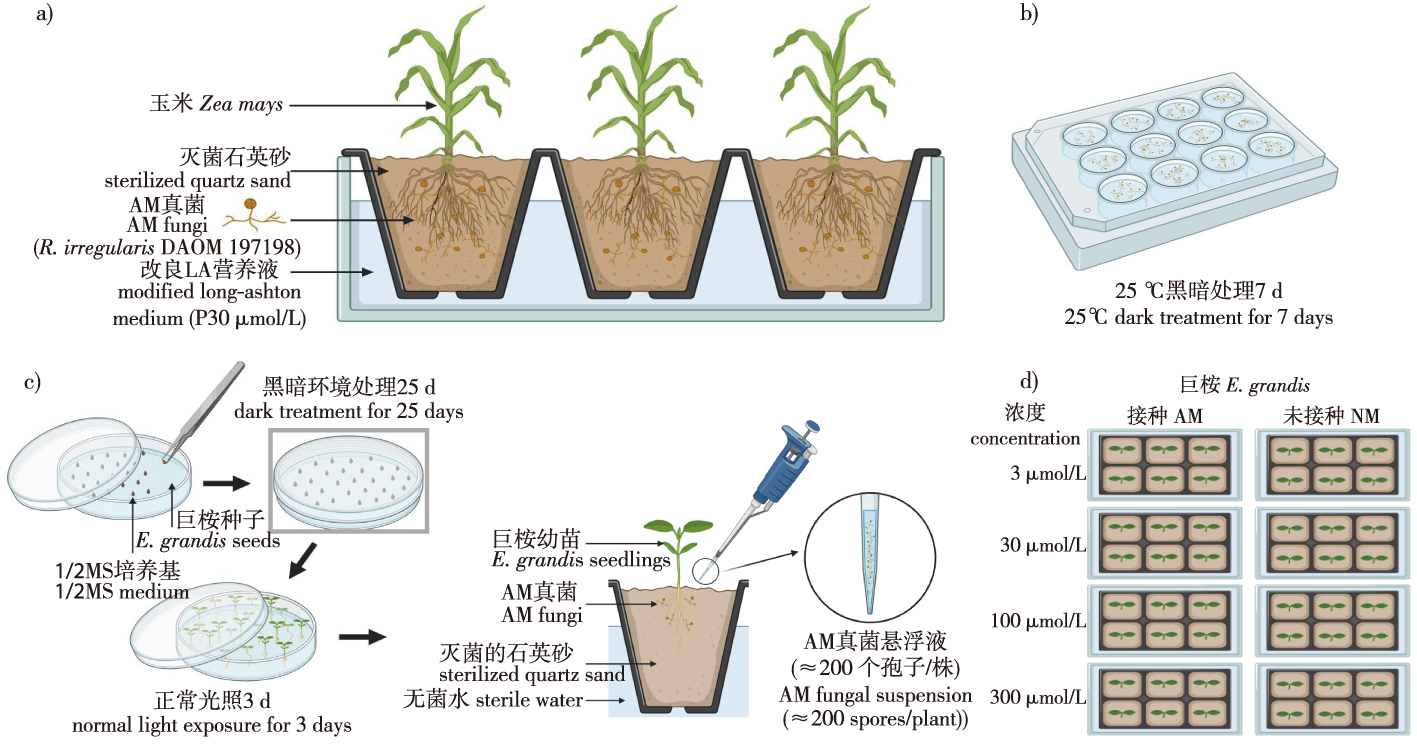
【Objective】Low phosphorus stress is one of the primary factors limiting the growth and development of eucalyptus (Eucalyptus grandis). Arbuscular mycorrhiza (AM) fungi, through their symbiotic relationship with plants, are known to enhance phosphorus absorption, particularly under low phosphorus conditions. This mutualistic association plays a crucial role in alleviating phosphorus limitation in plants by increasing the surface area for nutrient uptake and facilitating the transport of phosphorus from soil to plant. To investigate the effect of AM fungi on the expression of phosphorus (P) starvation response genes in E. grandis under low-P conditions, this study analyzed the expression levels of SPX and PHR genes, which are involved in P starvation response, in E. grandis seedlings inoculated with AM fungi across different phosphorus concentrations. Specifically, the study focused on the role of AM fungi in modulating the expression of key genes involved in the phosphate starvation response, namely, PHR and SPX genes. 【Method】 E. grandis seedlings were inoculated with the AM fungus Rhizophagus irregularis under varying phosphorus supply levels. Four phosphorus treatments were applied: extremely low (3 μmol/L NaH2PO4), low (30 μmol/L), medium (100 μmol/L) and high (300 μmol/L). The seedlings were grown under controlled conditions, and various plant physiological parameters, including plant height, root length and biomass, were measured to assess the impact of the phosphorus supply and AM fungi inoculation on growth. The gene expression levels of phosphate starvation response genes, particularly EgPHR2 and EgSPX2, were analyzed through quantitative PCR to identify key genes involved in the phosphorus acquisition pathway and their regulation under different phosphorus conditions.【Result】Mycorrhizal inoculation had a significant impact on the colonization rates of E. grandis roots, especially under low phosphorus conditions. The mycorrhizal colonization rates for seedlings treated with extremely low (3 μmol/L NaH2PO4) and low (30 μmol/L NaH2PO4) phosphorus were 82.61% and 67.53%, respectively, those were significantly higher than the colonization rates under medium (100 μmol/L NaH2PO4, 38.60%) and high phosphorus (300 μmol/L NaH2PO4, 38.64%) treatments. In addition to improved colonization, AM fungi inoculation also led to significant increases in plant height, root length, and biomass, particularly under phosphorus-limited conditions. Bioinformatics analysis of the E. grandis genome identified two PHR genes and six SPX genes that are likely involved in the phosphate starvation response. The expression of EgPHR2 and EgSPX2 in AM-inoculated seedlings was significantly higher compared to non-inoculated controls. Specifically, the expression of EgPHR2 increased by 273.64%, 294.67%, and 698.15% at 30 μmol/L, 100 μmol/L and 300 μmol/L phosphorus, respectively. Similarly, EgSPX2 expression showed substantial increases of 2 517.15%, 606.40% and 923.13% under the same phosphorus conditions, indicating a strong upregulation of these genes in response to phosphorus limitation.【Conclusion】The findings of this study suggest that EgPHR2 and EgSPX2 are specifically involved in the expression is closely linked to the colonization of E. grandis roots by AM fungi. The expression of EgPHR2 was particularly elevated under high phosphorus conditions, while EgSPX2 showed higher expression under low phosphorus conditions, highlighting their distinct roles in phosphorus homeostasis. The results also demonstrate that AM fungi play a crucial role in E. grandis, particularly under phosphorus-deficient conditions, by modulating the expression of key genes involved in phosphorus acquisition and signaling pathways.
arbuscular mycorrhiza / Rhizophagus irregularis / Eucalyptus grandis / phosphate starvation response genes
| [1] |
胡天宇, 李臣坤. 巨桉种源引种选择研究[J]. 四川农业大学学报, 1999, 17(1):44-49.
|
| [2] |
郑威, 李晨曦, 谭玲, 等. 南亚热带桉树人工林与典型乡土树种人工林土壤磷组分及磷吸附特性比较[J]. 土壤, 2020, 52(5):1017-1024.
|
| [3] |
任忠秀, 包雪梅, 于家伊, 等. 我国桉树人工林施肥现状、存在问题及对策[J]. 桉树科技, 2013, 30(4):52-59.
|
| [4] |
|
| [5] |
|
| [6] |
|
| [7] |
宗建伟, 李柽, 张静, 等. 接种丛枝菌根真菌对盐胁迫下文冠果生长及生理特性的影响[J]. 南京林业大学学报(自然科学版), 2024, 48(4):168-176.
【目的】探究接种丛枝菌根(arbuscular mycorrhizal,AM)真菌对盐胁迫下文冠果(Xanthoceras sorbifolium)生长、生理代谢及耐盐能力的影响。【方法】以摩西斗管囊霉(Funneliformis mosseae)为供试菌种,选用1年生文冠果实生苗进行盆栽试验,进行接种与不接种处理,分别设置5种不同浓度(0、80、160、240、320 mmol/L)的NaCl胁迫,胁迫结束后测定文冠果幼苗生物量、侵染特性及生理指标。【结果】①盐胁迫下,接种AM真菌提高了文冠果地上、地下生物量;随着盐浓度的增加,其根系菌根侵染率显著降低。②接种AM真菌增加了文冠果叶片可溶性蛋白、脯氨酸、还原型谷胱甘肽(GSH)和还原型抗坏血酸(AsA)含量,增强了超氧化物歧化酶(SOD)和过氧化物酶(POD)活性,而相对电导率和丙二醛(MDA)含量明显降低。③双因素方差分析显示时间和浓度对接种与未接种AM真菌处理下的文冠果叶片MDA、脯氨酸、可溶性蛋白和AsA含量有极显著交互效应(P <0.01);文冠果接种组对320 mmol/L盐胁迫的抗性最好。【结论】AM真菌可提高盐胁迫下文冠果渗透调节能力,增强抗氧化酶活性,增加抗氧化物含量,表明AM真菌能够提升文冠果耐盐能力,促进植物生长。
|
| [8] |
方静, 张书曼, 严善春, 等. 两种丛枝菌根真菌复合接种对青山杨叶片抗美国白蛾的影响[J]. 南京林业大学学报(自然科学版), 2024, 48(2):144-154.
【目的】 为研究青山杨叶部害虫生物防控新途径,探索丛枝菌根(arbuscular mycorrhiza,AM)真菌复合接种对青山杨(Populus pseudo-cathayana × P. deltoides)叶片抗美国白蛾的影响。【方法】 于温室盆栽条件下对1年生青山杨扦插苗进行根内根孢囊霉(Rhizophagus intraradices, RI)和摩西斗管囊霉(Funneliformis mosseae,FM)单一及复合接种(M)处理,以不接种处理为对照(CK),测定对青山杨叶片次生代谢物质、防御酶和蛋白酶抑制剂方面等化学防御能力的影响,并以美国白蛾(Hyphantria cunea)幼虫为生物测定对象判断青山杨的抗虫效果。【结果】 在120 d内M组的菌根侵染率、丛枝着生率和根内泡囊数均高于FM和RI组,同时,M组能在一定程度上提高青山杨叶片的化学防御能力,其中叶片总生物碱、纤维素含量和过氧化物酶(POD)、过氧化氢酶(CAT)、脂氧合酶(LOX)、多酚氧化酶(PPO)、胰凝乳蛋白酶抑制剂(CI)、胰蛋白酶抑制剂(TI)活性显著高于RI、FM和CK组(P<0.05)。取食M组叶片的3龄美国白蛾幼虫取食量、排粪量、纤维素酶活性、乙酰胆碱酯酶(AchE)活性和多功能氧化酶(MFO)活性显著低于取食FM、RI和CK组的(P<0.05),3龄幼虫体长、食物利用率、胰蛋白酶活性、羧酸酯酶(CarE)活性、谷胱甘肽S-转移酶(GSTs)活性显著高于取食RI和FM组的(P<0.05),3龄幼虫食物消耗率和α-淀粉酶活性与RI组差异不显著,其体质量与取食FM组的差异不显著;取食M组叶片的4龄幼虫体质量、取食量、食物消耗率、纤维素酶活性、GSTs活性、CarE活性、AchE活性、MFO活性显著低于取食FM、RI和CK组的(P<0.05),4龄幼虫排粪量显著低于取食RI和CK组的(P<0.05),4龄幼虫胰蛋白酶活性显著高于其余3组(P<0.05),4龄幼虫的体长和食物利用率与取食RI组的差异不显著,4龄幼虫α-淀粉酶活性与取食FM和RI组的差异均不显著;取食M组叶片的5龄幼虫体长、体质量、取食量、排粪量、食物利用率、α-淀粉酶活性、纤维素酶活性、GSTs活性、CarE活性和MFO活性显著低于取食FM、RI和CK组的(P<0.05),5龄幼虫食物消耗率显著低于取食FM和RI组的(P<0.05),5龄幼虫AchE活性显著低于取食FM组的(P<0.05),5龄幼虫胰蛋白酶活性显著高于其余3组(P<0.05)。【结论】 将RI与FM复合接种能够诱导青山杨叶片在次生代谢物质、防御酶和蛋白酶抑制剂方面的化学防御性能,RI和FM复合接种对青山杨的抗虫性表现优于RI、FM单一接种和无AM真菌接种,并且对美国白蛾幼虫具有一定的抑制效果,在实际应用时可优先考虑RI和FM复合接种。
|
| [9] |
王炜, 母洪娜, 杨慧敏, 等. 接种丛枝菌根真菌(AMF)对夏雪片莲生长状况和光合特性的影响[J]. 南京林业大学学报(自然科学版), 2025, 49(3):205-212.
【目的】探究丛枝菌根真菌(arbuscular mycorrhizal fungi, AMF)定殖对夏雪片莲(Leucojum aestivum)生长和光合特性的影响,为培育高质量观赏及药用花卉提供相关依据。【方法】选择大小一致的夏雪片莲2年生球茎于温室中种植并接种AMF,试验组分别接种根内根孢囊霉(Rhizophagus intraradices, Ri)、摩西斗管囊霉(Funneliformis mosseae, Fm)和扭形多样孢囊霉(Diversispora tortuosa, Dt),以及混合接种3种AMF(以质量比1∶1∶1混合,Mi),对照组(CK)接种3类AMF混合(质量比1∶1∶1)的灭活菌剂;测定接种AMF后夏雪片莲的株高、干鲜质量及光合特性,并进行光合特性的相关性分析,同时采用隶属函数分析法综合评估所有指标。【结果】Fm组侵染率最高,为69.38%;Ri组最低,为36.93%,其中Ri组侵染率显著低于Fm、Dt和Mi组。在各处理组中,Fm组的株高最高(43.46 cm),且干质量也达到最大(39.94 g)。光合参数显示,Ri组表现出最高的气孔导度均值[Gs=0.30 mol/(m<sup>2</sup>·s)]、胞间CO<sub>2</sub>浓度均值(Ci=331 μmol/mol)和蒸腾速率均值[Tr=3.45 mmol/(m<sup>2</sup>·s)],其中Tr显著高于CK组。相关性分析揭示,净光合速率(Pn)与Gs在所有处理组中普遍呈显著正相关,气孔限制值(Ls)与Ci在菌根处理组中呈显著负相关;其余光合指标也存在一定的相关性,但不同处理间并未呈现规律性变化。隶属函数结果表明,Mi和Dt对夏雪片莲的光合能力和生物量综合影响较优。【结论】AMF的定殖能够有效促进夏雪片莲的生长,而且不同的AMF定殖对光合作用的影响效果不一;其中Dt和Mi对夏雪片莲的光合能力和生物量综合促进作用较好,Fm对夏雪片莲的株高具有促进作用,对光合能力影响不显著。
|
| [10] |
Arbuscular mycorrhizal (AM) fungi can form beneficial associations with the most terrestrial vascular plant species. AM fungi not only facilitate plant nutrient acquisition but also enhance plant tolerance to various environmental stresses such as drought stress. However, the molecular mechanisms by which AM fungal mitogen‐activated protein kinase (MAPK) cascades mediate the host adaptation to drought stimulus remains to be investigated. Recently, many studies have shown that virus‐induced gene silencing (VIGS) and host‐induced gene silencing (HIGS) strategies are used for functional studies of AM fungi. Here, we identify the three HOG1 (High Osmolarity Glycerol 1)‐MAPK cascade genes RiSte11, RiPbs2 and RiHog1 from Rhizophagus irregularis. The expression levels of the three HOG1‐MAPK genes are significantly increased in mycorrhizal roots of the plant Astragalus sinicus under severe drought stress. RiHog1 protein was predominantly localized in the nucleus of yeast in response to 1 M sorbitol treatment, and RiPbs2 interacts with RiSte11 or RiHog1 directly by pull‐down assay. Importantly, VIGS or HIGS of RiSte11, RiPbs2 or RiHog1 hampers arbuscule development and decreases relative water content in plants during AM symbiosis. Moreover, silencing of HOG1‐MAPK cascade genes led to the decreased expression of drought‐resistant genes (RiAQPs, RiTPSs, RiNTH1 and Ri14‐3‐3) in the AM fungal symbiont in response to drought stress. Taken together, this study demonstrates that VIGS or HIGS of AM fungal HOG1‐MAPK cascade inhibits arbuscule development and expression of AM fungal drought‐resistant genes under drought stress.
|
| [11] |
韩丽娜, 谢贤安, 陈辉, 等. 巨桉金属耐受蛋白EgMTP6的分子特征及功能[J]. 林业科学, 2022, 58(5):93-101.
|
| [12] |
\n\n\nReciprocal symbiosis of > 70% of terrestrial vascular plants with arbuscular mycorrhizal (AM) fungi provides the fungi with fatty acids and sugars. In return, AM fungi facilitate plant phosphate (Pi) uptake from soil. However, how AM fungi handle Pi transport and homeostasis at the symbiotic interface of AM symbiosis is poorly understood.
|
| [13] |
|
| [14] |
|
| [15] |
|
| [16] |
|
| [17] |
|
| [18] |
|
| [19] |
Eucalyptus are of tremendous economic importance being the most planted hardwoods worldwide for pulp and paper, timber and bioenergy. The recent release of the Eucalyptus grandis genome sequence pointed out many new candidate genes potentially involved in secondary growth, wood formation or lineage‐specific biosynthetic pathways. Their functional characterization is, however, hindered by the tedious, time‐consuming and inefficient transformation systems available hitherto for eucalypts. To overcome this limitation, we developed a fast, reliable and efficient protocol to obtain and easily detect co‐transformed E. grandis hairy roots using fluorescent markers, with an average efficiency of 62%. We set up conditions both to cultivate excised roots in vitro and to harden composite plants and verified that hairy root morphology and vascular system anatomy were similar to wild‐type ones. We further demonstrated that co‐transformed hairy roots are suitable for medium‐throughput functional studies enabling, for instance, protein subcellular localization, gene expression patterns through RT‐qPCR and promoter expression, as well as the modulation of endogenous gene expression. Down‐regulation of the Eucalyptus cinnamoyl‐CoA reductase1 (EgCCR1) gene, encoding a key enzyme in lignin biosynthesis, led to transgenic roots with reduced lignin levels and thinner cell walls. This gene was used as a proof of concept to demonstrate that the function of genes involved in secondary cell wall biosynthesis and wood formation can be elucidated in transgenic hairy roots using histochemical, transcriptomic and biochemical approaches. The method described here is timely because it will accelerate gene mining of the genome for both basic research and industry purposes.
|
| [20] |
Phosphorus is a macronutrient that is essential for plant survival. Most land plants have evolved the ability to form a mutualistic symbiosis with arbuscular mycorrhizal (AM) fungi, which enhances phosphate (Pi) acquisition. Modulation of Pi transporter systems is the master strategy used by mycorrhizal plants to adapt to ambient Pi concentrations. However, the specific functions of PHOSPHATE TRANSPORTER 1 (PHT1) genes, which are Pi transporters that are responsive to high Pi availability, are largely unknown. Here, we report that AsPT5, an Astragalus sinicus (Chinese milk vetch) member of the PHT1 gene family, is conserved across dicotyledons and is constitutively expressed in a broad range of tissues independently of Pi supply, but is remarkably induced by indole-3-acetic acid (auxin) treatment under moderately high Pi conditions. Subcellular localization experiments indicated that AsPT5 localizes to the plasma membrane of plant cells. Using reverse genetics, we showed that AsPT5 not only mediates Pi transport and remodels root system architecture but is also essential for arbuscule formation in A. sinicus under moderately high Pi concentrations. Overall, our study provides insight into the function of AsPT5 in Pi transport, AM development and the cross-talk between Pi nutrition and auxin signalling in mycorrhizal plants.© 2020 Society for Applied Microbiology and John Wiley & Sons Ltd.
|
| [21] |
Changes in cellular or subcellular Ca2+ concentrations play essential roles in plant development and in the responses of plants to their environment. However, the mechanisms through which Ca2+ acts, the downstream signaling components, as well as the relationships among the various Ca2+-dependent processes remain largely unknown. Using an RNA interference–based screen for gene function in Medicago truncatula, we identified a gene that is involved in root development. Silencing Ca2+-dependent protein kinase1 (CDPK1), which is predicted to encode a Ca2+-dependent protein kinase, resulted in significantly reduced root hair and root cell lengths. Inactivation of CDPK1 is also associated with significant diminution of both rhizobial and mycorrhizal symbiotic colonization. Additionally, microarray analysis revealed that silencing CDPK1 alters cell wall and defense-related gene expression. We propose that M. truncatula CDPK1 is a key component of one or more signaling pathways that directly or indirectly modulates cell expansion or cell wall synthesis, possibly altering defense gene expression and symbiotic interactions.
|
| [22] |
|
| [23] |
|
| [24] |
吴柳杰. 桉树幼苗对磷铝胁迫的适应性反应机制[D]. 南宁: 广西大学, 2015.
|
| [25] |
王文启, 马凤鸣, 戴建军, 等. 磷复肥对大豆养分积累和产量影响的研究[J]. 现代化农业, 2003(7):12-13.
|
| [26] |
陈少雄. 桉树人工林土壤养分现状与施肥研究[J]. 桉树科技, 2009, 26(1):52-63.
|
| [27] |
In plants, sensing the levels of external and internal nutrients is essential for reprogramming the transcriptome and adapting to the fluctuating environment. Phosphate (Pi) is a key plant nutrient, and a large proportion of Pi starvation-responsive genes are under the control of Phosphate Starvation Response Regulator 1 (PHR1) in Arabidopsis (AtPHR1) and its homologs, such as Oryza sativa (Os)PHR2 in rice. AtPHR1 and OsPHR2 expression is not very responsive to Pi starvation, raising the question as to how plants sense changes in cellular Pi levels to activate the central regulator. SPX [named after SYG1 (suppressor of yeast gpa1), Pho81 (CDK inhibitor in yeast PHO pathway), and XPR1 (xenotropic and polytropic retrovirus receptor)] proteins that harbor only the SPX domain are reported to be involved in the negative regulation of Pi starvation responses. Here, we show that the nuclear localized SPX proteins SPX1 and SPX2 are Pi-dependent inhibitors of the activity of OsPHR2 in rice. Indeed, SPX1 and SPX2 proteins interact with PHR2 through their SPX domain, inhibiting its binding to P1BS (the PHR1-binding sequence: GNATATNC). In vivo data, as well as results from in vitro experiments using purified SPX1, SPX2, and OsPHR2 proteins, showed that SPX1 and SPX2 inhibition of OsPHR2 activity is Pi-dependent. These data provide evidence to support the involvement of SPX1 and SPX2 in the Pi-sensing mechanism in plants.
|
| [28] |
PHR2, a central regulator of phosphate signaling in rice, enhanced the expression of phosphate starvation-induced (PSI) genes and resulted in the enhancement of Pi acquisition under Pi deficiency stress. This occurred via PHR2 binding to a cis-element named the PHR1 binding sequences. However, the transcription level of PHR2 was not responsive to Pi starvation. So how is activity of transcription factor PHR2 adjusted to adapt diverse Pi status? Here, we identify an SPX family protein, Os-SPX4 (SPX4 hereafter), involving in Pi starvation signaling and acting as a negative regulator of PHR2. SPX4 is shown to be a fast turnover protein. When Pi is sufficient, through its interaction with PHR2, SPX4 inhibits the binding of PHR2 to its cis-element and reduces the targeting of PHR2 to the nucleus. However, when plants grow under Pi deficiency, the degradation of SPX4 is accelerated through the 26S proteasome pathway, thereby releasing PHR2 into the nucleus and activating the expression of PSI genes. Because the level of SPX4 is responsive to Pi concentration and SPX4 interacts with PHR2 and regulates its activity, this suggests that SPX4 senses the internal Pi concentration under diverse Pi conditions and regulates appropriate responses to maintain Pi homeostasis in plants.© 2014 American Society of Plant Biologists. All rights reserved.
|
| [29] |
Previous research has demonstrated that AtPHR1 plays a central role in phosphate (Pi)-starvation signaling in Arabidopsis thaliana. In this work, two OsPHR genes from rice (Oryza sativa) were isolated and designated as OsPHR1 and OsPHR2 based on amino acid sequence homology to AtPHR1. Their functions in Pi signaling in rice were investigated using transgenic plants. Our results showed that both OsPHR1 and OsPHR2 are involved in Pi-starvation signaling pathway by regulation of the expression of Pi-starvation-induced genes, whereas only OsPHR2 overexpression results in the excessive accumulation of Pi in shoots under Pi-sufficient conditions. Under Pi-sufficient conditions, overexpression of OsPHR2 mimics Pi-starvation stress in rice with enhanced root elongation and proliferated root hair growth, suggesting the involvement of OsPHR2 in Pi-dependent root architecture alteration by both systematic and local pathways. In OsPHR2-overexpression plants, some Pi transporters were up-regulated under Pi-sufficient conditions, which correlates with the strongly increased content of Pi. The mechanism behind the OsPHR2 regulated Pi accumulation will provide useful approaches to develop smart plants with high Pi efficiency.
|
/
| 〈 |
|
〉 |