PDF(2345 KB)

Analysis of the efficacy of efficient combined formulations against Bursaphelenchus xylophilus
ZHANG Jiao, YE Jianren, CHEN Tingting, CHENG Hao
Journal of Nanjing Forestry University (Natural Sciences Edition) ›› 2025, Vol. 49 ›› Issue (6) : 73-80.
PDF(2345 KB)
 PDF(2345 KB)
Analysis of the efficacy of efficient combined formulations against Bursaphelenchus xylophilus
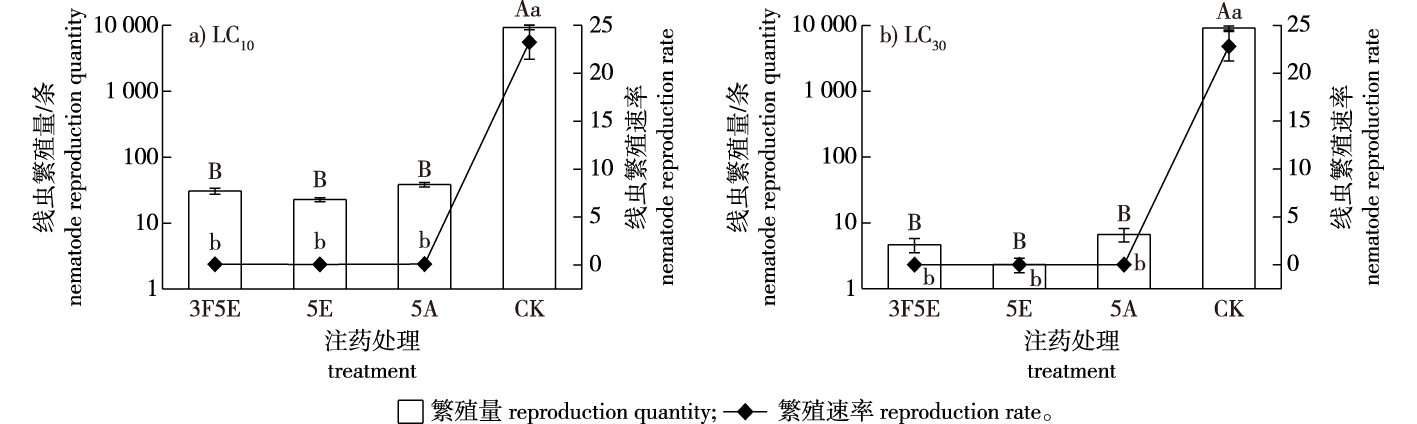
【Objective】Injecting agents into pine trees to prevent pine wilt disease is an effective control measure. This study aimed to develop more efficient and fast-delivery agents by combining two different drugs to create a novel microemulsion. The virulence activity of this combined (3% fluopyram-5% emamectin benzoate) microemulsion against Bursaphelenchus xylophilus and its potential for controlling pine wilt disease were explored.【Method】The nematocidal effects of the newly developed combined microemulsion, along with two commonly used agents for pine wilt disease-5% emamectin benzoate microemulsion and 5% avermectin emulsifiable concentrate-were assessed using the insect immersion method. B. xylophilus was treated with lethal concentrations (LC10 and LC30) of each agent to determine their impact on nematode reproduction. Three agents were injected into the trunks of Pinus massoniana trees in the forest to observe agent absorption and tree sensitivity to successfully absorbed agents. After 90 days of injection, samples of the treated trees were collected to analyze the dynamic distribution of drug transport within the tree body. Additionally, 100 days after inoculation, the treated trees were artificially inoculated with B. xylophilus to observe and statistically analyze the control effects of each agent on pine wilt disease.【Result】The LC50 values after 24 hours of treatment with the 3% fluopyram-5% emamectin benzoate microemulsion, 5% emamectin benzoate microemulsion, and 5% avermectin emulsifiable concentrate on pine wood nematodes were 2.644 0, 27.678 4, and 42.891 1 mg/L, respectively. Among the tested agents, the 3% fluopyram-5% emamectin benzoate microemulsion exhibited the strongest nematocidal activity. The population reproduction of nematodes treated with low concentrations of the agents was significantly lower than the control group. Seven days after injection, both the self-made combined microemulsion and 5% avermectin emulsifiable concentrate were fully absorbed by the tree, whereas absorption of the 5% emamectin benzoate microemulsion was more limited. After 180 days, the self-made combined microemulsion showed minimal sensitivity to the tree, with slight discoloration at the injection point, while the 5% avermectin emulsifiable concentrate caused significant discoloration of the xylem at the injection site. After 90 days, residual concentrations of all agents were detected at the top of the tree. The highest residual concentration of fluopyram (0.13 mg/kg) was found 0.5 m below the injection point in the combined 3% fluopyram-5% emamectin benzoate microemulsion, while emamectin benzoate had a residual concentration of 0.07 mg/kg, and 5% avermectin's residual concent ration had 0.1 mg/kg. The highest residual concentrations of all agents were observed 0.5 m above the injection point, with fluopyram in the combined microemulsion reaching 55.65 mg/kg, significantly higher than the other agents. Overall, the residual concentration of fluopyram was higher than that of emamectin benzoate in the combined microemulsion and higher than 5% avermectin emulsifiable concentrate. Inoculation with pine wood nematodes in mid-July showed that, 270 days after inoculation, the trees treated with the agents remained healthy, while untreated trees exhibited signs of infection 100 days post-inoculation. All agents effectively prevented the onset of pine wilt disease.【Conclusion】The toxicity analysis of the new self-made combined agent demonstrates its strong nematocidal effect, good absorbability after injection into P. massoniana, and mild sensitivity to the tree. It also exhibits excellent transport ability within the tree and provides effective prevention against pine wood nematode infection. Further optimization of the formula and large-scale application in forest management is recommended.
pine wilt disease / combined agents / toxicity analysis / trunk injection / fluopyram-emamectin benzoate / nematicide
| [1] |
|
| [2] |
|
| [3] |
|
| [4] |
|
| [5] |
叶建仁. 松材线虫病在中国的流行现状、防治技术与对策分析[J]. 林业科学, 2019, 55(9):1-10.
|
| [6] |
李卫斌, 安炳贞, 孔玉辉, 等. 基于无人机遥感影像的松材线虫病监测方法概述[J]. 林业工程学报, 2023, 8(2):21-29.
|
| [7] |
|
| [8] |
|
| [9] |
甘绍泽, 王晓飞, 陈旭华, 等. 注干施用“松线静”(5%阿维菌素乳油)防控松材线虫病研究[J]. 温带林业研究, 2023, 6(3):42-47.
|
| [10] |
|
| [11] |
|
| [12] |
尹福强, 宋珍, 徐琴, 等. 多花黄精灰霉病病原菌Botrytis deweyae生物学特性及防治药剂筛选[J]. 江苏农业学报, 2024, 40(10):1818-1825.
|
| [13] |
|
| [14] |
凌文政, 曹海潮, 余佳敏, 等. 氟吡菌酰胺纳米纤维剂的研制及其对南方根结线虫的生物活性[J]. 中国农业科学, 2024, 57(15):2997-3009.
|
| [15] |
|
| [16] |
|
| [17] |
|
| [18] |
龙鼎新, 伍一军, 李薇, 等. 8种化学药剂单独及两两联合染毒对松材线虫杀灭作用试验[J]. 浙江林业科技, 2006, 26(5):39-42.
|
| [19] |
谈家金, 杨荣铮, 吴慧平. 不同地理种群的松材线虫对马尾松的致病力差异[J]. 植物检疫, 2000, 14(6):324-325.
|
| [20] |
曹娜, 赵小云, 宋鲜梅, 等. 阿维菌素与常用杀虫剂复配对Q型烟粉虱的增效作用及田间防效[J]. 农药, 2019, 58(11):849-855,858.
|
| [21] |
|
| [22] |
|
| [23] |
朱丽华, 林丽, 蒋鹏, 等. 不同致病力松材线虫的繁殖能力和移动能力比较[J]. 东北林业大学学报, 2017, 45(12):76-79.
|
| [24] |
|
| [25] |
谭瑞娜, 郝昕, 邓振, 等. 松材线虫谷胱甘肽S转移酶基因响应阿维菌素胁迫功能研究[J]. 中南林业科技大学学报, 2023, 43(8):159-168.
|
| [26] |
|
| [27] |
申继忠. 影响农药产品使用价值和寿命的因素分析[J]. 世界农药, 2021, 43(1):10-22,33.
|
| [28] |
莫启进, 卓梅芳, 王健, 等. 松脂掺杂物中氯化钠的快速检测[J]. 广西林业科学, 2014, 43(1):105-107.
|
| [29] |
李长强, 叶建仁, 张婉君, 等. 注干施用甲维盐防治松材线虫病的研究[J]. 中国植保导刊, 2022, 42(3):16-19.
|
| [30] |
孙太凡. 绿色农药剂型:微乳剂的研究进展[J]. 黑龙江八一农垦大学学报, 2007, 19(6):86-88.
|
| [31] |
张扬, 杨鼎超, 李正昀, 等. 高效新型杀松材线虫剂的筛选及其林间防效[J]. 植物保护学报, 2017, 44(5):856-862.
|
| [32] |
向帆, 叶建仁, 张婉君. 注干施用 3 种药剂防治松材线虫病研究[J]. 南京林业大学学报(自然科学版), 2025, 49(3):95-101.
|
| [33] |
|
| [34] |
|
| [35] |
|
/
| 〈 |
|
〉 |