Evaluation and renewal of parks in high-density urban districts based on human-scale vitality measurement

Chen Shuolei, Zou Jiahui, Huang Yuanfan, Wang Hao

Journal of Nanjing Forestry University (Natural Sciences Edition) ›› 2026, Vol. 50 ›› Issue (4) : 270-277.

PDF(19963 KB)
PDF(19963 KB)
Journal of Nanjing Forestry University (Natural Sciences Edition) ›› 2026, Vol. 50 ›› Issue (4) : 270-277. DOI: 10.12302/j.issn.1000-2006.202405003

Evaluation and renewal of parks in high-density urban districts based on human-scale vitality measurement

Author information +
History +

Abstract

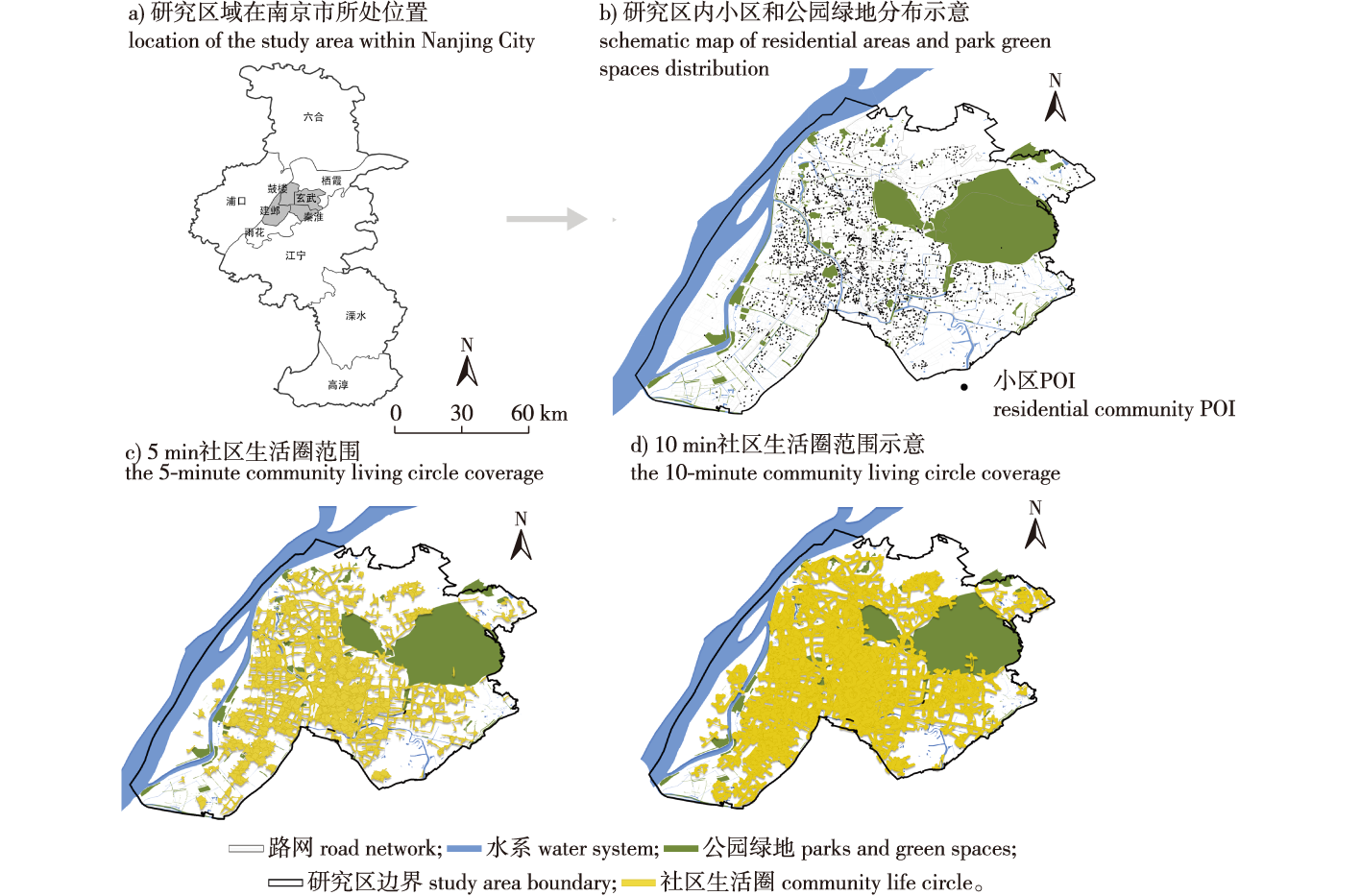
【Objective】To address the urgent need for people-centered optimization of park green spaces in high-density urban areas under the stock-based development paradigm, this study evaluates the supply-demand dynamics of urban parks in Nanjing and proposes targeted renewal strategies for community life circle units exhibiting mismatches. The research aims to identify specific locations where park provision fails to meet actual activity demand, thereby providing a scientific basis for refined park renewal.【Method】The study focusing on 2 717 community life circle units in Nanjing.An integrated analytical framework was developed. On the demand side, high-precision, multi-source heterogeneous big data were synthesized to construct a comprehensive measure of spatial vitality, capturing large-scale dynamic population demand from a human-scale perspective. This approach addresses the limitations of conventional methods reliant on static residential population data. On the supply side, the multidimensional characteristics of park provision were quantitatively evaluated using the Critic weighting method. By coupling dynamic demand measurement with multidimensional supply assessment, units characterized by “provision lagging behind demand” were precisely identified, and the spatial patterns of mismatch were revealed.【Result】The results indicate that approximately 20% of community life circle units suffer from park undersupply relative to dynamic activity demand. Fine-grained assessment revealed marked intra-urban disparities: compared with newly developed districts, older urban cores (e.g., Gulou and Xuanwu Districts) exhibit significantly higher levels of park deficiency. Park distribution displayed strong spatial heterogeneity, intensifying the mismatch at the neighborhood scale. This issue is particularly acute within the 5-minute walkable life circle, where residents’ immediate demand for convenient park access remains largely unmet.【Conclusion】Based on these findings, prioritized renewal strategies are proposed for severely undersupplied units. Rather than advocating incremental land expansion, this study emphasizes the refined optimization of existing park resources under high-density, land-constrained conditions. By integrating dynamic demand analysis with multidimensional supply assessment, this research offers a distinctive, compact, and human-centered perspective for aligning park provision with actual resident needs, contributing methodological support and practical guidance for equitable and efficient green-space planning.
Key words

high-density community parks / stock-based renewal / spatial correlation analysis / dynamic demand / vitality measurement / Nanjing City

Cite this article

Download Citations
Chen Shuolei , Zou Jiahui , Huang Yuanfan , et al. Evaluation and renewal of parks in high-density urban districts based on human-scale vitality measurement[J]. Journal of Nanjing Forestry University (Natural Sciences Edition). 2026, 50(4): 270-277 https://doi.org/10.12302/j.issn.1000-2006.202405003

References

[1]
李欣, 刘馨, 刘张旭, 等. 城市网络活力与建成环境的非线性关系:以武汉地铁站域为例[J]. 建筑学报, 2024(S2):92-99.
Li X, Liu X, Liu Z X, et al. Nonlinear relationship between urban online vitality and built environment a case study of metro vicinity area in Wuhan[J]. Architectural Journal, 2024(S2):92-99.
[2]
凡来, 张大玉. 北京街区活力影响机制及空间分异特征研究:基于多尺度地理加权回归[J]. 城市规划, 2022, 46(5):27-37.
Fan L, Zhang D Y. Research on the influence mechanism and spatial heterogeneity characteristics of block vitality in Beijing:based on multi-scale geographically weighted regression[J]. City Planning Review, 2022, 46(5):27-37. DOI:10.11819/cpr20220502a.
[3]
王敏, 朱安娜, 汪洁琼, 等. 基于社会公平正义的城市公园绿地空间配置供需关系:以上海徐汇区为例[J]. 生态学报, 2019, 39(19):7035-7046.
Wang M, Zhu A N, Wang J Q, et al. Supply and demand analysis of urban park distribution based on social equity and justice:a case study of Xuhui District,Shanghai[J]. Acta Ecologica Sinica, 2019, 39(19):7035-7046. DOI:10.5846/stxb201808021645.
[4]
Wang C L, Li C, Wang M, et al. Environmental justice and park accessibility in urban China:evidence from Shanghai[J]. Asia Pacific Viewpoint, 2022, 63(2):236-249. DOI:10.1111/apv.12314.
[5]
江炜, 邵大伟, 吴殿鸣. 生活圈视阈下公园绿地圈层分布及其协同区位演变特征:以南京为例[J]. 中国园林, 2024, 40(8):91-96.
Jiang W, Shao D W, Wu D M. The evolution characteristics of park green space circle distribution and colocation quotient from the perspective of life circle:a case study of Nanjing[J]. Chinese Landscape Architecture, 2024, 40(8):91-96. DOI:10.19775/j.cla.2024.08.0091.
[6]
时珍, 邢露华, 郑琳琳, 等. 城市公园绿地游憩供需协同度评价及优化策略[J]. 南京林业大学学报(自然科学版), 2021, 45(2):197-204.
Shi Z, Xing L H, Zheng L L, et al. Evaluations and optimization strategies of synergy degree of park green space based on balance of supply and demand for recreation[J]. Journal of Nanjing Forestry University (Natural Sciences Edition), 2021, 45(2):197-204. DOI:10.12302/j.issn.1000-2006.202004036.
[7]
杜伊, 金云峰. 社区生活圈的公共开放空间绩效研究:以上海市中心城区为例[J]. 现代城市研究, 2018(5):101-108.
Du Y, Jin Y F. Performance evaluation of public open spacein community life circle level:a case study of downtown of Shanghai[J]. Modern Urban Research, 2018(5):101-108. DOI:10.3969/j.issn.1009-6000.2018.05.014.
[8]
江海燕, 梁挚呈, 肖希, 等. 三维视角下高密度街区开放空间供需匹配研究:以广州珠江新城为例[J]. 城市规划, 2022, 46(11):42-51.
Jiang H Y, Liang Z C, Xiao X, et al. Research on supply-demand match of open space in high-density block from a three-dimensional perspective:taking Guangzhou Zhujiang new town as an example[J]. City Planning Review, 2022, 46(11):42-51. DOI:10.11819/cpr20221104a.
[9]
Zhou C H, An Y H, Zhao J, et al. How do mini-parks serve in groups A visit analysis of mini-park groups in the neighbourhoods of Nanjing[J]. Cities, 2022, 129:103804. DOI:10.1016/j.cities.2022.103804.
[10]
徐振, 李鸣珂, 陈妍, 等. 基于在线地图的南京市主城区大型公园绿地骑行可达范围评估[J]. 南京林业大学学报(自然科学版), 2023, 47(6):219-226.
Xu Z, Li M K, Chen Y, et al. Assessing the cycling catchment of large parks with online maps:a case study of Nanjing City[J]. Journal of Nanjing Forestry University (Natural Sciences Edition), 2023, 47(6):219-226. DOI:10.12302/j.issn.1000-2006.202206023.
[11]
牛爽, 汤晓敏. 高密度城区公园绿地配置公平性测度研究:以上海黄浦区为例[J]. 中国园林, 2021, 37(10):100-105.
Niu S, Tang X M. Research on the equity measurement of park green space distribution in high-density urban areas:a case study of Huangpu District,Shanghai[J]. Chinese Landscape Architecture, 2021, 37(10):100-105. DOI:10.19775/j.cla.2021.10.0100.
[12]
徐磊青, 刘念, 卢济威. 公共空间密度、系数与微观品质对城市活力的影响:上海轨交站域的显微观察[J]. 新建筑, 2015(4):21-26.
Xu L Q, Liu N, Lu J W. The impact of density,ratio and microcosmic quality of public space on urban vitality:microscopic observation of Shanghai rail transit station areas[J]. New Architecture, 2015(4):21-26. DOI:10.3969/j.issn.1000-3959.2015.04.005.
[13]
Cai J, Li R, Liu Z H, et al. Quantifying spatial interaction centrality in urban population mobility:a mobility feature- and network topology-based locational measure[J]. Sustainable Cities and Society, 2024, 114:105769. DOI:10.1016/j.scs.2024.105769.
[14]
汤爽爽, 周婧, 邓颖慧, 等. 江苏省流动人口城—镇—乡分布的时空分异与影响因素[J]. 地理学报, 2022, 77(12):3055-3071.
Tang S S, Zhou J, Deng Y H, et al. Spatiotemporal differentiation and influencing factors on floating population distribution in city-town-rural areas of Jiangsu Province[J]. Acta Geographica Sinica, 2022, 77(12):3055-3071. DOI:10.11821/dlxb202212008.
[15]
方家, 刘颂, 王德, 等. 基于手机信令数据的上海城市公园供需服务分析[J]. 风景园林, 2017, 24(11):35-40.
Fang J, Liu S, Wang D, et al. Supply-demand service analysis of park in Shanghai by mobile phone signaling data[J]. Landscape Architecture, 2017, 24(11):35-40. DOI:10.14085/j.fjyl.2017.11.0035.06.
[16]
盛强, 武静芬, 荣毅龙. 社区商业活力的空间韧性:北京胡同区空间治理对比研究[J]. 城市问题, 2021(8):83-92.
Sheng Q, Wu J F, Rong Y L. The spatial resilience of the community’s commercial vitality:comparative study on spatial governance of Beijing Hutong[J]. Urban Problems, 2021(8):83-92. DOI:10.13239/j.bjsshkxy.cswt.210809.
[17]
叶宇, 黄鎔, 张灵珠. 多源数据与深度学习支持下的人本城市设计:以上海苏州河两岸城市绿道规划研究为例[J]. 风景园林, 2021, 28(1):39-45.
Ye Y, Huang R, Zhang L Z. Human-oriented urban design with support of multi-source data and deep learning:a case study on urban greenway planning of Suzhou creek,Shanghai[J]. Landscape Architecture, 2021, 28(1):39-45. DOI:10.14085/j.fjyl.2021.01.0039.07.
[18]
刘影, 张小勇, 徐铭嘉, 等. 供需协同视角下公园绿地空间分异特征研究:以北京市朝阳区为例[J]. 城市发展研究, 2022, 29(2):12-19.
Liu Y, Zhang X Y, Xu M J, et al. Spatial differentiation characteristics of park from perspective of supply-demand synergy:take Chaoyang District of Beijing as an example[J]. Urban Development Studies, 2022, 29(2):12-19. DOI:10.3969/j.issn.1006-3862.2022.02.012.
[19]
匡纬, 李莎. 基于多源数据的社区生活圈内公园使用热度影响机制:以北京市海淀区为例[J]. 城市问题, 2021(11):36-44.
Kuang W, Li S. Factors affecting park vitality in community walking Circle based on multi-source data:a case study of Haidian District in Beijing[J]. Urban Problems, 2021(11):36-44. DOI:10.13239/j.bjsshkxy.cswt.211104.
[20]
张婧远, 陈培育. 面向城市公园的感知可达性研究进展述评与人本规划思潮下的应用启示[J]. 国际城市规划, 2021, 36(5):96-103.
Zhang J Y, Chen P Y. Reviewing the research development of perceived accessibility to urban parks and its application inspirations in the trend of human-oriented planning[J]. Urban Planning International, 2021, 36(5):96-103. DOI:10.19830/j.upi.2020.425.
[21]
马立强, 王良羽, 王丞. 城市工业废弃地再利用项目的溢出效应评价—基于改进的CRITIC-熵权赋权法[J]. 南京林业大学学报(人文社会科学版), 2022, 22(4):68-79.
Ma L Q, Wang L Y, Wang C. Evaluation of spillover effects of urban industrial wasteland reuse projects based on improved CRITIC-entropy weighting approach[J]. Journal of Nanjing Forestry University (Humanities and Social Sciences), 2022, 22(4):68-79. DOI:10.16397/j.cnki.1671-1165.202204068.
PDF(19963 KB)

Accesses

Citation

Detail

Sections
Recommended
The full text is translated into English by AI, aiming to facilitate reading and comprehension. The core content is subject to the explanation in Chinese.

/