Effects of blue light on reproduction and embryonic development of Bursaphelenchus xylophilus

SUN Xi, SHAO Hudie, CAI Renyue, DING Kai, YOU Yujie, ZOU Yiqiao, LI Quan, HU Jiafu

Journal of Nanjing Forestry University (Natural Sciences Edition) ›› 2026, Vol. 50 ›› Issue (2) : 245-250.

PDF(2203 KB)
PDF(2203 KB)
Journal of Nanjing Forestry University (Natural Sciences Edition) ›› 2026, Vol. 50 ›› Issue (2) : 245-250. DOI: 10.12302/j.issn.1000-2006.202406005

Effects of blue light on reproduction and embryonic development of Bursaphelenchus xylophilus

Author information +
History +

Abstract

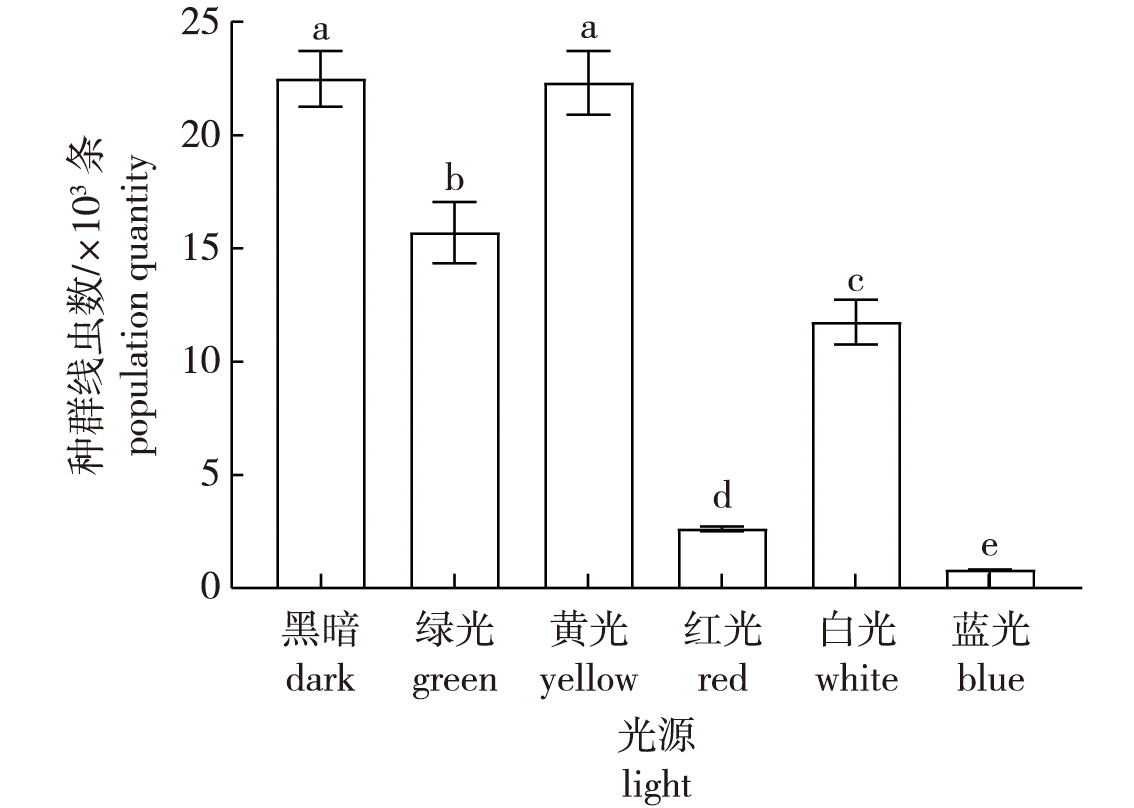
【Objective】Pine wood nematode (Bursaphelenchus xylophilus) typically live in dark environments and are extremely sensitive to light, exhibiting a strong avoidance response. By studying the inhibitory effects under different light conditions on their population growth, key mechanisms of how light affects the growth of B. xylophilus populations can be revealed. This research also aims to elucidate the underlying mechanisms that inhibit population growth, laying a solid foundation for future optical and basic biological studies on pine wood nematodes and providing new perspectives for their control.【Method】Five light wavelengths (clours)—green, yellow, red, white and blue—were employed to investigate the effects of various light conditions on the nematode population. Additionally, the effects of different blue light intensities on egg hatching rate, sex ratio, body length, and embryonic development were further explored.【Result】Blue light exhibited the strongest inhibitory effect on B. xylophilus, significantly suppressing population growth. Further research on the effects of different blue light intensities on reproductive behavior showed that when the light intensity is below 1 000 lx, blue light has no significant effect on reproduction. However, when the intensity increased to 1 250 lx, compared to the control group, the number of offspring, egg hatching rate, developmental speed, and individual size of the nematodes significantly decreased. Additionally, there are notable changes in the male-to-female sex ratio.【Conclusion】In summary, blue light at intensities above 1 000 lx significantly inhibits the egg hatching rate, developmental progress, and adult body size of B. xylophilus. As an important environmental and physical factor, blue light can influence microbial life cycles, morphological changes, and gene expression, thereby regulating its physiological and metabolic processes.

Key words

Bursaphelenchus xylophilus / light stress / blue light / embryonic development

Cite this article

Download Citations
SUN Xi , SHAO Hudie , CAI Renyue , et al . Effects of blue light on reproduction and embryonic development of Bursaphelenchus xylophilus[J]. Journal of Nanjing Forestry University (Natural Sciences Edition). 2026, 50(2): 245-250 https://doi.org/10.12302/j.issn.1000-2006.202406005

References

[1]
ZHAO L L, ZHANG X X, WEI Y N, et al. Ascarosides coordinate the dispersal of a plant-parasitic nematode with the metamorphosis of its vector beetle[J]. Nature Communications, 2016, 7:12341. DOI: 10.1038/ncomms12341.
[2]
YI C K, BYUN B H, PARK J D, et al. First finding of the pinewood nematode,Bursaphelenchus xylophilus (Steiner & Buhrer) Nickle and its insect vector in Korea[R]. Research Reports of The Forestry Research Institute, 1989, 2:17-40. DOI: 10.1067/api.semanticscholar2314.
[3]
MOTA M M, BRAASCH H, BRAVO M A, et al. First report of Bursaphelenchus xylophilus in Portugal and in Europe[J]. Nematology, 1999, 1(7):727-734. DOI: 10.1163/156854199508757.
[4]
SHI J, LUO Y Q, SONG J Y, et al. Traits of masson pine affecting attack of pine wood nematode[J]. Journal of Integrative Plant Biology, 2007, 49(12):1763-1771. DOI: 10.1111/j.1744-7909.2007.00613.x.
[5]
ROBINET C, CASTAGNONE-SERENO P, MOTA M, et al. Effectiveness of clear-cuttings in non-fragmented pine forests in relation to EU regulations for the eradication of the pine wood nematode[J]. Journal of Applied Ecology, 2020, 57(3):460-466. DOI: 10.1111/1365-2664.13564.
[6]
FILHO D M, Daniel C, HENRIQUEZ B, et al. Visible light reduces C. elegans longevity[J]. Nature Communications, 2018, 9(1):927. DOI: 10.1038/s41467-018-02934-5.
[7]
NOMA K, JIN Y S. Optogenetic mutagenesis in Caenorhabditis elegans[J]. Nature Communications, 2015, 6:8868. DOI: 10.1038/ncomms9868.
[8]
ISHIII N, SUZUKI K. The killing effects of ultraviolet light and X-rays on free-living nematode, Rhabditidae tokai[J]. Journal of Radiation Research, 1980. 21(1):137-147. DOI: 10.1269/jrr.21.137.
[9]
ZHOU L F, SHENG B C, ZHANG T Y, et al. Madd-4 plays a critical role in light against Bursaphelenchus xylophilus[J]. Scientific Reports, 2022, 12(1):14796. DOI: 10.1038/s41598-022-19263-9.
[10]
SUN S M, WANG J H, LIU W Y, et al. Regulatory roles of Bxy-laf1 in reproductive behaviour of Bursaphelenchus xylophilus[J]. Frontiers in Physiology, 2022, 13:1024409. DOI: 10.3389/fphys.2022.1024409.
[11]
王钊贵, 徐鹏, 曹蓉, 等. 负载甲维盐介孔二氧化硅纳米球的制备及其对松材线虫的毒力性能[J]. 林业工程学报, 2023, 8(6):131-136.
WANG Z G, XU P, CAO R, et al. Preparation of emamectin benzoate-loaded mesoporous silica nanospheresand their toxicity to Bursaphelenchus xylophilus[J]. Journal of Forestry Engineering, 2023, 8(6):131-136. DOI: 10.13360/j.issn.2096-1359.202305026.
[12]
王兴松, 李恩星, 杨诗瀚, 等. 根结线虫病对烟草植株根际土壤微生物群落及其功能的影响[J]. 江苏农业学报, 2024, 40(6):993-1003.
WANG X S, LI E X, YANG S H, et al. Effects of root-knot nematode disease on microbial community and func.tion in rhizosphere soil of tobacco plants[J]. Jiangsu Agricultural Journal, 2024, 40(6):993-1003. DOI: 10.3969/i.issn.1000-4440.2024.06.005.
[13]
WARD A, LIU J, FENG Z Y, et al. Light-sensitive neurons and channels mediate phototaxis in C.elegans[J]. Nature Neuroscience, 2008, 11(8):916-922. DOI: 10.1038/nn.2155.
[14]
KANEKO S. Effect of light intensity on the development of pine wilt disease[J]. Canadian Journal of Botany, 1989, 67(6):1861-1864. DOI: 10.1139/b89-235.
[15]
叶为民, 冯志新. 松材线虫个体发育研究[J]. 华南农业大学学报, 1993, 14(2):78-83.
YE W M, FENG Z X. Embryology and life history studies on pine wood nematode[J]. Journal of South China Agricultural University, 1993, 14(2):78-83. DOI: CNKI:SUN:HNNB.0.1993-02-013.
[16]
MAMIYA Y J. The life history of the B. xylophilus, Bursaphelenchus lignicolus[J]. Japanese Journal of Nematology, 1975, 5:16-25. DOI: 10.14855/jjn1972.5.16
[17]
FLEMMING A J, SHEN Z Z, CUNHA A, et al. Somatic polyploidization and cellular proliferation drive body size evolution in nematodes[J]. Proceedings of the National Academy of Sciences of the United States of America, 2000, 97(10):5285-5290. DOI: 10.1073/pnas.97.10.5285.
[18]
MORITA K, CHOW K L, UENO N. Regulation of body length and male tail ray pattern formation of Caenorhabditis elegans by a member of TGF-beta family[J]. Development, 1999, 126(6):1337-1347. DOI: 10.1242/dev.126.6.1337.
PDF(2203 KB)

Accesses

Citation

Detail

Sections
Recommended
The full text is translated into English by AI, aiming to facilitate reading and comprehension. The core content is subject to the explanation in Chinese.

/