The vertical distribution patterns of soil exchangeable cations in typical southern subtropical forests of China

LIU Rongzhen, LIU Peiling, LU Xiankai

Journal of Nanjing Forestry University (Natural Sciences Edition) ›› 2026, Vol. 50 ›› Issue (1) : 104-111.

PDF(1893 KB)
PDF(1893 KB)
Journal of Nanjing Forestry University (Natural Sciences Edition) ›› 2026, Vol. 50 ›› Issue (1) : 104-111. DOI: 10.12302/j.issn.1000-2006.202406014

The vertical distribution patterns of soil exchangeable cations in typical southern subtropical forests of China

Author information +
History +

Abstract

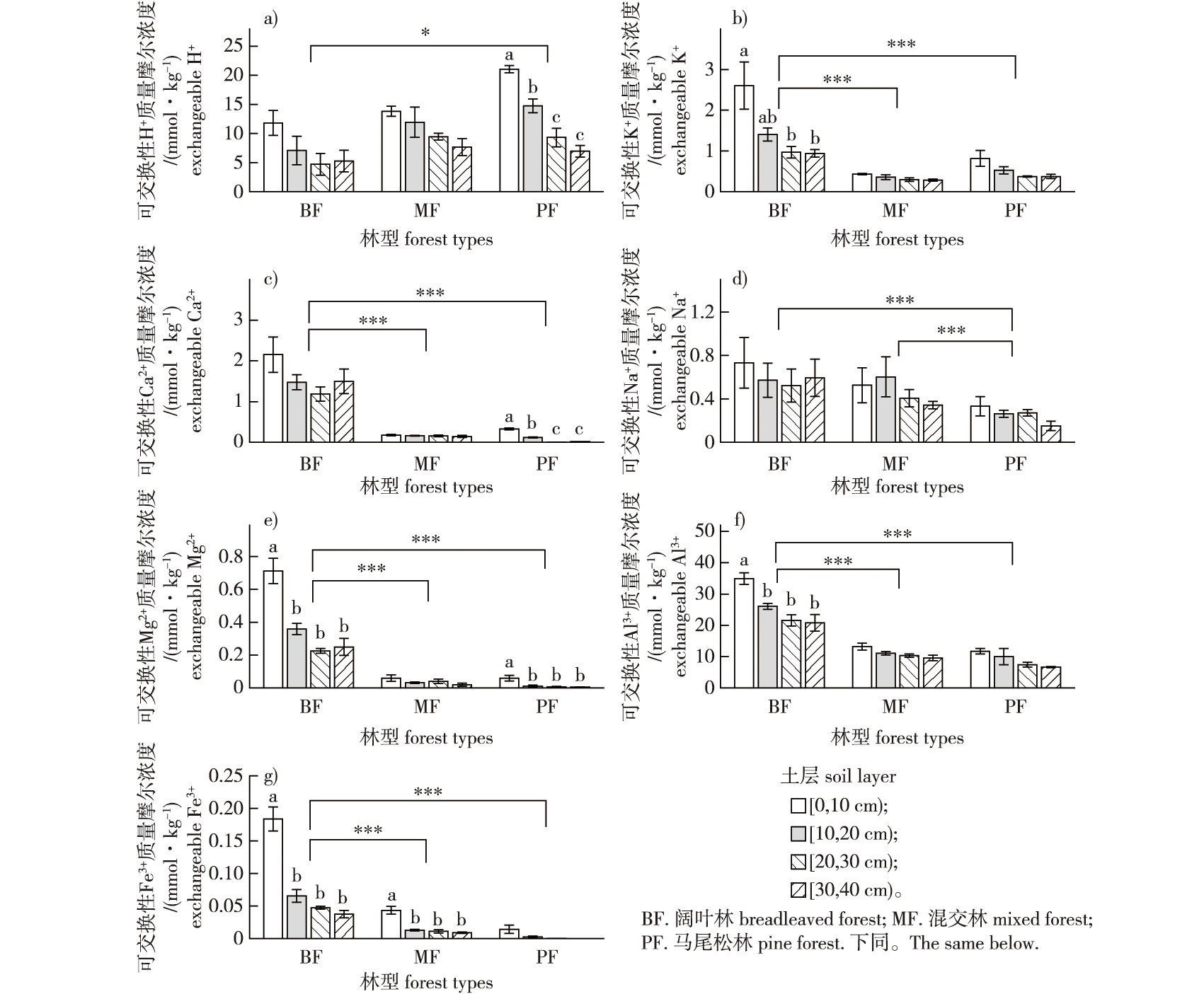
【Objective】 This study aims to explore the vertical distribution patterns of exchangeable cations in southern subtropical forest soils and identify their potential influencing factors, so as to provide theoretical support for the conservation and sustainable development of southern subtropical forest ecosystems.【Method】Three representative southern subtropical forests in the Dinghushan National Nature Reserve, Guangdong Province were selected for this study. These forests include the monsoon evergreen broadleaved forest (broadleaved forest/primary forest), mixed Pinus massoniana/broadleaved forest (mixed forest/secondary forest), and P. massoniana forest (pine forest/planted forest). The exchangeable cations (H+, Al3+, K+, Na+, Ca2+, Mg2+ and Fe3+), cation exchange capacity (CEC), aluminum saturation (Al-S), base saturation (BS), and pH in different soil layers [0, 10), [10, 20), [20, 30), and [30, 40) cm of three forests were analyzed.【Result】The results indicated that pH was generally lower than 4.2, BS was below 8%, and Al-S was typically higher than 60% across the three forests. Along the soil profile, the concentrations of exchangeable cations, CEC, BS, and exchangeable acidity generally decreased with increasing soil depth, while soil pH and Al-S showed an increasing trend. Overall, the broadleaved forest had significantly higher CEC, BS, Al-S, and exchangeable cation contents (except for H+) than the other two forests, but had lower soil pH. The mixed and coniferous forests exhibited similar patterns in exchangeable cation distribution. 【Conclusion】In conclusion, the southern subtropical forests of China are acid-sensitive ecosystems characterized by nutrient-poor soils within an aluminum buffering system. Exchangeable cations are predominantly concentrated in the upper soil layers. Land-use history and its legacy effects contribute to the varying soil acidification status among these three forests. Given the global change, it is essential to prioritize the replenishment of key cations like calcium and magnesium, rather than focusing solely on aluminum toxicity, in forest restoration and management efforts.
Key words

southern subtropical forest / soil acidification / cation exchange capacity (CEC) / base saturation (BS) / land use / Dinghushan, Guangdong Province

Cite this article

Download Citations
LIU Rongzhen , LIU Peiling , LU Xiankai. The vertical distribution patterns of soil exchangeable cations in typical southern subtropical forests of China[J]. Journal of Nanjing Forestry University (Natural Sciences Edition). 2026, 50(1): 104-111 https://doi.org/10.12302/j.issn.1000-2006.202406014

References

[1]
JOBBÁGY E G, JACKSON R B. Patterns and mechanisms of soil acidification in the conversion of grasslands to forests[J]. Biogeochemistry, 2003, 64(2)1: 205-229.DOI: 10.1023/A:1024985629259.
[2]
LU X K, MAO Q G, MO J M, et al. Divergent responses of soil buffering capacity to long-term N deposition in three typical tropical forests with different land-use history[J]. Environmental Science & Technology, 2015, 49(7): 4072-4080.DOI: 10.1021/es5047233.
[3]
YU Z P, CHEN H Y H, SEARLE E B, et al. Whole soil acidification and base cation reduction across subtropical China[J]. Geoderma, 2020, 361: 114107.DOI: 10.1016/j.geoderma.2019.114107.
[4]
JAMES J, LITTKE K, BONASSI T, et al. Exchangeable cations in deep forest soils: separating climate and chemical controls on spatial and vertical distribution and cycling[J]. Geoderma, 2016, 279:109-121.DOI: 10.1016/j.geoderma.2016.05.022.
[5]
MO J M, BROWN S, LENART M, et al. Nutrient dynamics of a human-impacted pine forest in a MAB reserve of subtropical China[J]. Biotropica, 1995, 27(3):290.DOI: 10.2307/2388915.
[6]
MO J M, BROWN S, PENG S L, et al. Nitrogen availability in disturbed,rehabilitated and mature forests of tropical China[J]. Forest Ecology and Management, 2003, 175(1/2/3):573-583.DOI: 10.1016/S0378-1127(02)00220-7.
[7]
MO J M, BROWN S, XUE J H, et al. Response of litter decomposition to simulated N deposition in disturbed, rehabilitated and mature forests in subtropical China[J]. Plant Soil, 2006, 282(1):135-151.DOI: 10.1007/s11104-005-5446-7.
[8]
LU X K, MO J M, GUNDERSERN P, et al. Effect of simulated N deposition on soil exchangeable cations in three forest types of subtropical China[J]. Pedosphere, 2009, 19(2):189-198.DOI: 10.1016/s1002-0160(09)60108-9.
[9]
MAO Q G, LU X K, ZHOU K J, et al. Effects of long-term nitrogen and phosphorus additions on soil acidification in an N-rich tropical forest[J]. Geoderma, 2017, 285:57-63.DOI: 10.1016/j.geoderma.2016.09.017.
[10]
鲁显楷, 莫江明, 张炜, 等. 模拟大气氮沉降对中国森林生态系统影响的研究进展[J]. 热带亚热带植物学报, 2019, 27(5): 500-522.
LU X K, MO J M, ZHANG W, et al. Effects of simulated atmospheric nitrogen deposition on forest ecosystems in China: an overview[J]. Journal of Tropical and Subtropical Botany, 2019, 27(5): 500-522.DOI: 10.11926/jtsb.4113.
[11]
LU X K, MO J M, GILLIAM F S, et al. Effects of experimental nitrogen additions on plant diversity in an old-growth tropical forest[J]. Global Change Biology, 2010, 16(10): 2688-2700.DOI: 10.1111/j.1365-2486.2010.02174.x.
[12]
FANG Y T, GUNDERSEN P, MO J M, et al. Nitrogen leaching in response to increased nitrogen inputs in subtropical monsoon forests in southern China[J]. Forest Ecology and Management, 2009, 257(1): 332-342.DOI: 10.1016/j.foreco.2008.09.004.
[13]
LU X K, VITOUSEK P M, MAO Q G, et al. Plant acclimation to long-term high nitrogen deposition in an N-rich tropical forest[J]. Proceedings of the National Academy of Sciences of the United States of America, 2018, 115(20): 5187-5192.DOI: 10.1073/pnas.1720777115.
[14]
刘菊秀, 周国逸, 温达志, 等. 酸沉降影响下广东陆地生态系统表层土壤特征[J]. 农业环境保护, 2001, 20(4): 231-234.
LIU J X, ZHOU G Y, WEN D Z, et al. Properties of surface soil on selected forest ecosystem affected by acid deposition in Guangdong[J]. Agro-environmental Protection, 2001, 20(4): 231-234.DOI: 10.3321/j.issn:1672-2043.2001.04.012.
[15]
LU X K, MAO Q G, GILLIAM F S, et al. Nitrogen deposition contributes to soil acidification in tropical ecosystems[J]. Global Change Biology, 2014, 20(12): 3790-3801.DOI: 10.1111/gcb.12665.
[16]
VON UEXKÜLL H R, MUTERT E. Global extent,development and economic impact of acid soils[J]. Plant Soil, 1995, 171(1): 1-15.DOI: 10.1007/BF00009558.
[17]
LARSSEN T, CARMICHAEL G R. Acid rain and acidification in China: the importance of base cation deposition[J]. Environmental Pollution, 2000, 110(1): 89-102.DOI: 10.1016/s0269-7491(99)00279-1.
[18]
TIAN D S, NIU S L. A global analysis of soil acidification caused by nitrogen addition[J]. Environmental Research Letters, 2015, 10(2): 024019.DOI: 10.1088/1748-9326/10/2/024019.
[19]
BOWMAN W D, CLEVELAND C C, HALADAL, et al. Negative impact of nitrogen deposition on soil buffering capacity[J]. Nature Geoscience, 2008, 1:767-770.DOI: 10.1038/ngeo339.
[20]
ZHANG L M, HU H W, SHEN J P, et al. Ammonia-oxidizing archaea have more important role than ammonia-oxidizing bacteria in ammonia oxidation of strongly acidic soils[J]. The ISME Journal, 2012, 6(5): 1032-1045.DOI: 10.1038/ismej.2011.168.
[21]
PING C L, MICHAELSON G J, STILES C A, et al. Soil characteristics, carbon stores, and nutrient distribution in eight forest types along an elevation gradient, eastern Puerto Rico[J]. Ecological Bulletins, 2013, 54, 67-86.
[22]
LAURANCE W F, FEARNSIDE P M, LAURANCE S G, et al. Relationship between soils and Amazon forest biomass: a landscape-scale study[J]. Forest Ecology and Management, 1999, 118(1/2/3): 127-138.DOI: 10.1016/S0378-1127(98)00494-0.
[23]
HIUEL D. Encyclopedia of soils in the environment[M]. Oxford: Elsevier, 2005: 10-19. DOI:10.1016/C2019-1-04073-9.
[24]
PORDER S, JOHNSON A H, XING H X, et al. Linking geomorphology, weathering and cation availability in the Luquillo Mountains of Puerto Rico[J]. Geoderma, 2015, 249: 100-110.DOI: 10.1016/j.geoderma.2015.03.002.
[25]
BERTHRONG S T, JOBBÁGY E G, JACKSON R B. A global meta-analysis of soil exchangeable cations, pH, carbon and nitrogen with afforestation[J]. Ecological Applications, 2009, 19(8):2228-2241.DOI: 10.1890/08-1730.1.
[26]
CAVELIER J. Fine-root biomass and soil properties in a semideciduous and a lower montane rain forest in Panama[J]. Plant Soil, 1992, 142(2):187-201.DOI: 10.1007/BF00010965.
[27]
FÖLSTER H, DEZZEO N, PRIESS J A. Soil-vegetation relationship in base-deficient premontane moist forest-savanna mosaics of the Venezuelan Guayana[J]. Geoderma, 2001, 104(1/2):95-113.DOI: 10.1016/S0016-7061(01)00058-1.
[28]
NELSON P N, SU N H. Soil pH buffering capacity: a descriptive function and its application to some acidic tropical soils[J]. Soil Research, 2010, 48(3): 201.DOI: 10.1071/sr09150.
[29]
ZHOU J, XIA F, LIU X M, et al. Effects of nitrogen fertilizer on the acidification of two typical acid soils in south China[J]. Journal of Soils and Sediments, 2014, 14(2): 415-422.DOI: 10.1007/s11368-013-0695-1.
[30]
PINCUS L N, RYAN P C, HUERTAS F J, et al. The influence of soil age and regional climate on clay mineralogy and cation exchange capacity of moist tropical soils: a case study from Late Quaternary chronosequences in Costa Rica[J]. Geoderma, 2017, 308: 130-148.DOI: 10.1016/j.geoderma.2017.08.033.
[31]
CHEN C, XIAO W Y, CHEN H Y H. Mapping global soil acidification under N deposition[J]. Global Change Biology, 2023, 29(16): 4652-4661.DOI: 10.1111/gcb.16813.
[32]
JOBBÁGY E G, JACKSON R B. The distribution of soil nutrients with depth: global patterns and the imprint of plants[J]. Biogeochemistry, 2001, 53(1): 51-77.DOI: 10.1023/A:1010760720215.
[33]
GIRONA-GARCÍA A, BADÍA-VILLAS D, MARTÍ C. Changes in topsoil properties after centennial Scots pine afforestation in a European beech forest (NE Spain)[J]. Forests, 2018, 9(6): 343.DOI: 10.3390/f9060343.
[34]
YAMASHITA N, OHTA S, SASE H, et al. Seasonal changes in multi-scale spatial structure of soil pH and related parameters along a tropical dry evergreen forest slope[J]. Geoderma, 2011, 165(1): 31-39.DOI: 10.1016/j.geoderma.2011.06.020.
[35]
李沁宇, 刘鑫, 张金池. 长三角区域酸雨类型转变趋势研究[J]. 南京林业大学学报(自然科学版), 2021, 45(1): 168-174.
LI Q Y, LIU X, ZHANG J C. Changing trends of acid rain types in the Yangtze River Delta region[J]. Journal of Nanjing Forestry University (Natural Science Edition), 2021, 45(1): 168-174.DOI: 10.12302/j.issn.1000-2006.201908029.
[36]
张智扬, 尹海魁, 李新旺, 等. 河北省县域土地利用碳排放空间格局及协调分区[J]. 江苏农业学报, 2024, 40(2):281-292.
ZHANG Z Y, YIN H K, LI X W, et al. Spatial pattern and coordination division of carbon emissions of county land use in Hebei Province[J]. Jiangsu Journal of Agricultural Sciences, 2024, 40(2): 281-292.DOI:10.3969/j.issn.1000-4440.2024.02.010.
[37]
ZHOU G Y, LIU S G, LI Z A, et al. Old-growth forests can accumulate carbon in soils[J]. Science, 2006, 314, 1417-1417.DOI: 10.1126/science.1130168.
PDF(1893 KB)

Accesses

Citation

Detail

Sections
Recommended
The full text is translated into English by AI, aiming to facilitate reading and comprehension. The core content is subject to the explanation in Chinese.

/