Research progress on efficient genetic transformation systems in plants

ZHOU Fangwei, XU Liang, SHI Congguang, YANG Shaozong

Journal of Nanjing Forestry University (Natural Sciences Edition) ›› 2026, Vol. 50 ›› Issue (3) : 1-13.

PDF(4511 KB)
PDF(4511 KB)
Journal of Nanjing Forestry University (Natural Sciences Edition) ›› 2026, Vol. 50 ›› Issue (3) : 1-13. DOI: 10.12302/j.issn.1000-2006.202406033

Research progress on efficient genetic transformation systems in plants

Author information +
History +

Abstract

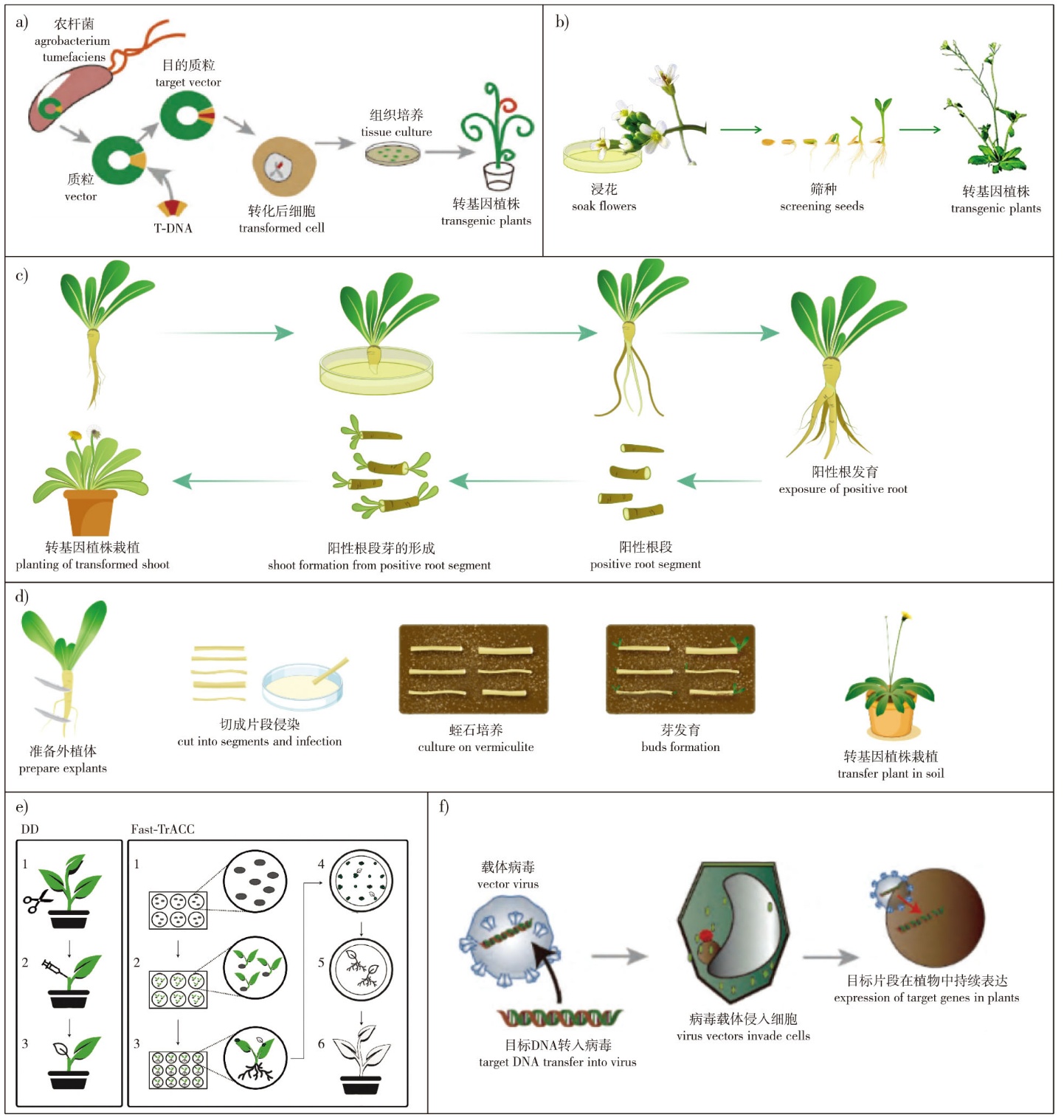
Plant genetic transformation is a pivotal technology in modern plant biotechnology, which not only deepens our understanding of plant biological mechanisms but also drives the improvement of desirable traits and precision breeding. The establishment of efficient genetic transformation and regeneration systems is the cornerstone for implementing genome editing technologies in plants. In recent years, researchers have continuously developed novel transformation methods to overcome traditional technical bottlenecks, enabling efficient delivery of exogenous genes and regeneration of transgenic plants. Current plant genetic transformation technologies fall into two major categories: direct transformation methods(e.g., particle bombardment, nanoparticle-mediated transformation, electroporation, microinjection, liposome-mediated transformation, and pollen tube pathway-mediated delivery) and indirect transformation approaches (e.g., Agrobacterium-mediated leaf disk method, cut-dip-budding (CDB) delivery system, direct delivery (DD), and fast-treated Agrobacterium co-culture (Fast-TrACC) method). These techniques have been widely applied for trait-specific improvement and precision breeding across diverse plant species, ranging from model plants to economically important crops and forest trees. This review systematically elucidates the operational principles, molecular mechanisms, and recent advances of various genetic transformation technologies, aiming to provide a comprehensive theoretical framework and practical guidance for plant molecular breeding programs in the context of sustainable forestry and agricultural development.
Key words

plant genetic transformation / tissue culture / gene editing / transgenic

Cite this article

Download Citations
ZHOU Fangwei , XU Liang , SHI Congguang , et al. Research progress on efficient genetic transformation systems in plants[J]. Journal of Nanjing Forestry University (Natural Sciences Edition). 2026, 50(3): 1-13 https://doi.org/10.12302/j.issn.1000-2006.202406033

References

[1]
YAN Y, ZHU X J, YU Y, et al. Nanotechnology strategies for plant genetic engineering[J]. Advanced Materials, 2022, 34(7):2106945. DOI: 10.1002/adma.202106945.
[2]
ZAMBRYSKI P, JOOS H, GENETELLO C, et al. Ti plasmid vector for the introduction of DNA into plant cells without alteration of their normal regeneration capacity[J]. The EMBO Journal, 1983, 2(12):2143-2150. DOI: 10.1002/j.1460-2075.1983.tb01715.x.
[3]
MEYER P, HEIDMANN I, FORKMANN G, et al. A new Petunia flower colour generated by transformation of a mutant with a maize gene[J]. Nature, 1987, 330(6149):677-678. DOI: 10.1038/330677a0.
[4]
OSTLIE K, HUTCHISON W, HELLMICH R. Bt corn and european corn borer:long-term success through resistance management[C]. University of Minnesota, 1997.
[5]
SU W B, XU M Y, RADANI Y, et al. Technological development and application of plant genetic transformation[J]. International Journal of Molecular Sciences, 2023, 24(13):10646. DOI: 10.3390/ijms241310646.
[6]
ZHANG Y, ZHANG F, LI X H, et al. Transcription activator-like effector nucleases enable efficient plant genome engineering[J]. Plant Physiology, 2012, 161(1):20-27. DOI: 10.1104/pp.112.205179.
[7]
WEINTHAL D, TOVKACH A, ZEEVI V, et al. Genome editing in plant cells by zinc finger nucleases[J]. Trends in Plant Science, 2010, 15(6):308-321. DOI: 10.1016/j.tplants.2010.03.001.
[8]
YIN K Q, GAO C X, QIU J L. Progress and prospects in plant genome editing[J]. Nature Plants, 2017, 3:17107. DOI: 10.1038/nplants.2017.107.
[9]
XU N Y, KANG M, ZOBRIST J D, et al. Genetic transformation of recalcitrant upland switchgrass using morphogenic genes[J]. Frontiers in Plant Science, 2021, 12:781565. DOI: 10.3389/fpls.2021.781565.
[10]
DAI S H, ZHENG P, MARMEY P, et al. Comparative analysis of transgenic rice plants obtained by Agrobacterium-mediated transformation and particle bombardment[J]. Molecular Breeding, 2001, 7(1):25-33. DOI: 10.1023/A:1009687511633.
[11]
SONG X G, MENG X B, GUO H Y, et al. Targeting a gene regulatory element enhances rice grain yield by decoupling panicle number and size[J]. Nature Biotechnology, 2022, 40(9):1403-1411. DOI: 10.1038/s41587-022-01281-7.
[12]
ZHANG Y, BOZOROV T A, LI D X, et al. An efficient in vitro regeneration system from different wild apple (Malus sieversii) explants[J]. Plant Methods, 2020, 16:56. DOI: 10.1186/s13007-020-00599-0.
[13]
JIA H G, ZHANG Y Z, ORBOVIC V, et al. Genome editing of the disease susceptibility gene CsLOB1 in Citrus confers resistance to Citrus canker[J]. Plant Biotechnology Journal, 2017, 15(7):817-823. DOI: 10.1111/pbi.12677.
[14]
ZHANG T Q, ZHANG W X, DING C J, et al. A breeding strategy for improving drought and salt tolerance of poplar based on CRISPR/Cas9[J]. Plant Biotechnology Journal, 2023, 21(11):2160-2162. DOI: 10.1111/pbi.14147.
[15]
RAMKUMAR T R, LENKA S K, ARYA S S, et al. A short history and perspectives on plant genetic transformation[J]. Methods in Molecular Biology, 2020, 2124:39-68. DOI: 10.1007/978-1-0716-0356-7_3.
[16]
ANAMI S, NJUGUNA E, COUSSENS G, et al. Higher plant transformation:principles and molecular tools[J]. The International Journal of Developmental Biology, 2013, 57(6/7/8):483-494. DOI: 10.1387/ijdb.130232mv.
[17]
DEMIRER G S, ZHANG H, MATOS J L, et al. High aspect ratio nanomaterials enable delivery of functional genetic material without DNA integration in mature plants[J]. Nature Nanotechnology, 2019, 14(5):456-464. DOI: 10.1038/s41565-019-0382-5.
[18]
LOWE K, LA ROTA M, HOERSTER G, et al. Rapid genotype “independent” Zea mays L.(maize) transformation via direct somatic embryogenesis[J]. In Vitro Cellular & Developmental Biology-Plant, 2018, 54(3):240-252. DOI: 10.1007/s11627-018-9905-2.
[19]
MOOKKAN M, NELSON-VASILCHIK K, HAGUE J, et al. Selectable marker independent transformation of recalcitrant maize inbred B73 and sorghum P898012 mediated by morphogenic regulators BABY BOOM and WUSCHEL2[J]. Plant Cell Reports, 2017, 36(9):1477-1491. DOI: 10.1007/s00299-017-2169-1.
[20]
WANG K, SHI L, LIANG X N, et al. The gene TaWOX5 overcomes genotype dependency in wheat genetic transformation[J]. Nature Plants, 2022, 8(2):110-117. DOI: 10.1038/s41477-021-01085-8.
[21]
DEBERNARDI J M, TRICOLI D M, ERCOLI M F, et al. A GRF-GIF chimeric protein improves the regeneration efficiency of transgenic plants[J]. Nature Biotechnology, 2020, 38(11):1274-1279. DOI: 10.1038/s41587-020-0703-0.
[22]
CODY J P, MAHER M F, NASTI R A, et al. Direct delivery and fast-treated Agrobacterium co-culture (Fast-TrACC) plant transformation methods for Nicotiana benthamiana[J]. Nature Protocols, 2023, 18(1):81-107. DOI: 10.1038/s41596-022-00749-9.
[23]
LIAN Z Y, NGUYEN C D, LIU L, et al. Application of developmental regulators to improve in planta or in vitro transformation in plants[J]. Plant Biotechnology Journal, 2022, 20(8):1622-1635. DOI: 10.1111/pbi.13837.
[24]
CAO X S, XIE H T, SONG M L, et al. Cut-dip-budding delivery system enables genetic modifications in plants without tissue culture[J]. The Innovation, 2023, 4(1):100345. DOI: 10.1016/j.xinn.2022.100345.
[25]
CUNNINGHAM F J, GOH N S, DEMIRER G S, et al. Nanoparticle-mediated delivery towards advancing plant genetic engineering[J]. Trends in Biotechnology, 2018, 36(9):882-897. DOI: 10.1016/j.tibtech.2018.03.009.
[26]
GORDON-KAMM B, SARDESAI N, ARLING M, et al. Using morphogenic genes to improve recovery and regeneration of transgenic plants[J]. Plants, 2019, 8(2):38. DOI: 10.3390/plants8020038.
[27]
KESHAVAREDDY G, KUMAR A R V, RAMU V S. Methods of plant transformation-a review[J]. International Journal of Current Microbiology and Applied Sciences, 2018, 7(7):2656-2668. DOI: 10.20546/ijcmas.2018.707.312.
[28]
KLEIN T M. Particle bombardment: an established weapon in the arsenal of plant biotechnologists[M]// STEWART C N, TOURAEVA, CITOVSKYV, et al. Technologies Plant Transformation. Oxford,UK: Blackwell Publishing Ltd., 2011:53-71.
[29]
RAO A Q, BAKHSH A, KIANI S, et al. The myth of plant transformation[J]. Biotechnology Advances, 2009, 27(6):753-763. DOI: 10.1016/j.biotechadv.2009.04.028.
[30]
MOHAMMED S, SAMAD A A, RAHMAT Z. Agrobacterium -mediated transformation of rice:constraints and possible solutions[J]. Rice Science, 2019, 26(3):133-146. DOI: 10.1016/j.rsci.2019.04.001.
[31]
KAUSCH A P, NELSON-VASILCHIK K, HAGUE J, et al. Edit at will:genotype independent plant transformation in the era of advanced genomics and genome editing[J]. Plant Science, 2019, 281:186-205. DOI: 10.1016/j.plantsci.2019.01.006.
[32]
SHAHZAD A, SHARMA S, SIDDIQUI S A. Biotechnological strategies for the conservation of medicinal and ornamental climbers[M]. Cham: Springer International Publishing, 2016 DOI: 10.1007/978-3-319-19288-8.
[33]
KOTNIK T, FREY W, SACK M, et al. Electroporation-based applications in biotechnology[J]. Trends in Biotechnology, 2015, 33(8):480-488. DOI: 10.1016/j.tibtech.2015.06.002.
[34]
WEN S S, GE X L, WANG R, et al. An efficient Agrobacterium-mediated transformation method for hybrid poplar 84K (Populus alba × P.glandulosa) using calli as explants[J]. International Journal of Molecular Sciences, 2022, 23(4):2216. DOI: 10.3390/ijms23042216.
[35]
BECHTOLD N, PELLETIER G. In planta Agrobacterium-mediated transformation of adult Arabidopsis thaliana plants by vacuum infiltration[J]. Methods in Molecular Biology, 1998, 82:259-266. DOI: 10.1385/0-89603-391-0:259.
[36]
LU J H, LI S S, DENG S, et al. A method of genetic transformation and gene editing of succulents without tissue culture[J]. Plant Biotechnology Journal, 2024, 22(7):1981-1988. DOI: 10.1111/pbi.14318.
[37]
TUO D C, YAN P, ZHAO G Y, et al. An efficient Papaya leaf distortion mosaic potyvirus vector for virus-induced gene silencing in Papaya[J]. Horticulture Research, 2021, 8:144. DOI: 10.1038/s41438-021-00579-y.
[38]
LIU Y J, ZHANG S J, ZHANG S F, et al. Efficient transformation of the isolated microspores of Chinese cabbage (Brassica rapa L.ssp. pekinensis) by particle bombardment[J]. Plant Methods, 2024, 20(1):17. DOI: 10.1186/s13007-024-01134-1.
[39]
ZHAO X, MENG Z G, WANG Y, et al. Pollen magnetofection for genetic modification with magnetic nanoparticles as gene carriers[J]. Nature Plants, 2017, 3(12):956-964. DOI: 10.1038/s41477-017-0063-z.
[40]
MORI K, TANASE K, SASAKI K. Novel electroporation-based genome editing of carnation plant tissues using RNPs targeting the anthocyanidin synthase gene[J]. Planta, 2024, 259(4):84. DOI: 10.1007/s00425-024-04358-6.
[41]
KARNY A, ZINGER A, KAJAL A, et al. Therapeutic nanoparticles penetrate leaves and deliver nutrients to agricultural crops[J]. Scientific Reports, 2018, 8:7589. DOI: 10.1038/s41598-018-25197-y.
[42]
MASANI M Y A, NOLL G A, AHMAD PARVEEZ G K, et al. Efficient transformation of oil palm protoplasts by PEG-mediated transfection and DNA microinjection[J]. PLoS One, 2014, 9(5):e96831. DOI: 10.1371/journal.pone.0096831.
[43]
ZHOU M, LUO J, XIAO D, et al. An efficient method for the production of transgenic peanut plants by pollen tube transformation mediated by Agrobacterium tumefaciens[J].Plant Cell,Tissue and Organ Culture (PCTOC), 2023, 152(1):207-214. DOI: 10.1007/s11240-022-02388-0.
[44]
PASZKOWSKI J, SHILLITO R D, SAUL M, et al. Direct gene transfer to plants[J]. The EMBO Journal, 1984, 3(12):2717-2722. DOI: 10.1002/j.1460-2075.1984.tb02201.x.
[45]
SANFORD J C. The development of the biolistic process[J]. In vitro Cellular & Developmental Biology-Plant, 2000, 36(5):303-308. DOI: 10.1007/s11627-000-0056-9.
[46]
SANFORD J C, KLEIN T M, WOLF E D, et al. Delivery of substances into cells and tissues using a particle bombardment process[J]. Particulate Science and Technology, 1987, 5(1):27-37. DOI: 10.1080/02726358708904533.
[47]
ALTPETER F, BAISAKH N, BEACHY R, et al. Particle bombardment and the genetic enhancement of crops:myths and realities[J]. Molecular Breeding, 2005, 15(3):305-327. DOI: 10.1007/s11032-004-8001-y.
[48]
DONG O X, RONALD P C. Targeted DNA insertion in plants[J]. Proceedings of the National Academy of Sciences of the United States of America, 2021, 118(22):e2004834117. DOI: 10.1073/pnas.2004834117.
[49]
BEGEMANN M B, GRAY B N, JANUARY E, et al. Precise insertion and guided editing of higher plant genomes using Cpf1 CRISPR nucleases[J]. Scientific Reports, 2017, 7:11606. DOI: 10.1038/s41598-017-11760-6.
[50]
BONAWITZ N D, AINLEY W M, ITAYA A, et al. Zinc finger nuclease-mediated targeting of multiple transgenes to an endogenous soybean genomic locus via non-homologous end joining[J]. Plant Biotechnology Journal, 2019, 17(4):750-761. DOI: 10.1111/pbi.13012.
[51]
RUF S, BOCK R. Loopholes for smuggling DNA into pollen[J]. Nature Plants, 2017, 3(12):918-919. DOI: 10.1038/s41477-017-0072-y.
[52]
KWAK S Y, LEW T T S, SWEENEY C J, et al. Chloroplast-selective gene delivery and expression in planta using chitosan-complexed single-walled carbon nanotube carriers[J]. Nature Nanotechnology, 2019, 14(5):447-455. DOI: 10.1038/s41565-019-0375-4.
[53]
HENDLER-NEUMARK A, BISKER G. Fluorescent single-walled carbon nanotubes for protein detection[J]. Sensors, 2019, 19(24):5403. DOI: 10.3390/s19245403.
[54]
MOHANTA D, PATNAIK S, SOOD S, et al. Carbon nanotubes:evaluation of toxicity at biointerfaces[J]. Journal of Pharmaceutical Analysis, 2019, 9(5):293-300. DOI: 10.1016/j.jpha.2019.04.003.
[55]
LI M, LIU J B, DENG M Y, et al. Rapid transmembrane transport of DNA nanostructures by chemically anchoring artificial receptors on cell membranes[J]. ChemPlusChem, 2019, 84(4):323-327. DOI: 10.1002/cplu.201900025.
[56]
ZHAN Y X, MA W J, ZHANG Y X, et al. Diversity of DNA nanostructures and applications in oncotherapy[J]. Biotechnology Journal, 2020, 15(1):1900094. DOI: 10.1002/biot.201900094.
[57]
AHMED M. Peptides, polypeptides and peptide-polymer hybrids as nucleic acid carriers[J]. Biomaterials Science, 2017, 5(11):2188-2211. DOI: 10.1039/C7BM00584A.
[58]
BOLHASSANI A, JAFARZADE B S, MARDANI G. In vitro and in vivo delivery of therapeutic proteins using cell penetrating peptides[J]. Peptides, 2017, 87:50-63. DOI: 10.1016/j.peptides.2016.11.011.
[59]
CHUAH J A, NUMATA K. Stimulus-responsive peptide for effective delivery and release of DNA in plants[J]. Biomacromolecules, 2018, 19(4):1154-1163. DOI: 10.1021/acs.biomac.8b00016.
[60]
KALDIS A, BERBATI M, MELITA O, et al. Exogenously applied dsRNA molecules deriving from the Zucchini yellow mosaic virus (ZYMV) genome move systemically and protect cucurbits against ZYMV[J]. Molecular Plant Pathology, 2018, 19(4):883-895. DOI: 10.1111/mpp.12572.
[61]
DUBROVINA A S, KISELEV K V. Exogenous RNAs for gene regulation and plant resistance[J]. International Journal of Molecular Sciences, 2019, 20(9):2282. DOI: 10.3390/ijms20092282.
[62]
GOGOI A, SARMAH N, KALDIS A, et al. Plant insects and mites uptake double-stranded RNA upon its exogenous application on tomato leaves[J]. Planta, 2017, 246(6):1233-1241. DOI: 10.1007/s00425-017-2776-7.
[63]
SAEED T, SHAHZAD A. Basic principles behind genetic transformation in plants[M]// Biotechnological strategies for the conservation of medicinal and ornamental climbers. Cham: Springer International Publishing,2015:327-350. DOI: 10.1007/978-3-319-19288-8_13.
[64]
OZYIGIT I I. Gene transfer to plants by electroporation:methods and applications[J]. Molecular Biology Reports, 2020, 47(4):3195-3210. DOI: 10.1007/s11033-020-05343-4.
[65]
MORIKAWA H, YAMADA Y. Capillary microinjection into protoplasts and intranuclear localization of injected materials[J]. Plant and Cell Physiology, 1985, 26:229-236. DOI: 10.1093/OXFORDJOURNALS.PCP.A076901.
[66]
VAN WORDRAGEN M, SHAKYA R, VERKERK R, et al. Liposome-mediated transfer of YAC DNA to tobacco cells[J]. Plant Molecular Biology Reporter, 1997, 15(2):170-178. DOI: 10.1007/BF02812268.
[67]
ALI A, BANG S W, CHUNG S M, et al. Plant transformation via pollen tube-mediated gene transfer[J]. Plant Molecular Biology Reporter, 2015, 33(3):742-747. DOI: 10.1007/s11105-014-0839-5.
[68]
GELVIN S B. Integration of Agrobacterium T-DNA into the plant genome[J]. Annual Review of Genetics, 2017, 51:195-217. DOI: 10.1146/annurev-genet-120215-035320.
[69]
HORSCH R B, ROGERS S G, FRALEY R T. Transgenic plants[J]. Cold Spring Harbor Symposia on Quantitative Biology, 1985, 50:433-437. DOI: 10.1101/sqb.1985.050.01.054.
[70]
GRIMSLEY N, HOHN T, DAVIES J W, et al. Agrobacterium-mediated delivery of infectious maize streak virus into maize plants[J]. Nature, 1987, 325(6100):177-179. DOI: 10.1038/325177a0.
[71]
CAO X S, XIE H T, SONG M L, et al. Extremely simplified cut-dip-budding method for genetic transformation and gene editing in Taraxacum kok-saghyz[J]. The Innovation Life, 2023, 1(3):100040. DOI: 10.59717/j.xinn-life.2023.100040.
[72]
GLEBA Y, KLIMYUK V, MARILLONNET S. Viral vectors for the expression of proteins in plants[J]. Current Opinion in Biotechnology, 2007, 18(2):134-141. DOI: 10.1016/j.copbio.2007.03.002.
[73]
SEO J K, CHOI H S, KIM K H. Engineering of soybean mosaic virus as a versatile tool for studying protein-protein interactions in soybean[J]. Scientific Reports, 2016, 6:22436. DOI: 10.1038/srep22436.
[74]
SZETO W W, HAMER D H, CARLSON P S, et al. Cloning of cauliflower mosaic virus (CLMV) DNA in Escherichia coli[J].Science, 1977, 196(4286):210-212. DOI: 10.1126/science.322284.
[75]
HOWELL S H, WALKER L L, DUDLEY R K. Cloned cauliflower mosaic virus DNA infects turnips (Brassica rapa)[J]. Science, 1980, 208(4449):1265-1267. DOI: 10.1126/science.208.4449.1265.
[76]
GRIMSLEY N, HOHN B, HOHN T, et al. “Agroinfection,” an alternative route for viral infection of plants by using the Ti plasmid[J]. Proceedings of the National Academy of Sciences of the United States of America, 1986, 83(10):3282-3286. DOI: 10.1073/pnas.83.10.3282.
[77]
LEISER R M, ZIEGLER-GRAFF V, REUTENAUER A, et al. Agroinfection as an alternative to insects for infecting plants with beet western yellows luteovirus[J]. Proceedings of the National Academy of Sciences, 1992, 89(19):9136-9140. DOI: 10.1073/pnas.89.19.9136.
[78]
ROBERTSON D. VIGS vectors for gene silencing:many targets,many tools[J]. Annual Review of Plant Biology, 2004, 55:495-519. DOI: 10.1146/annurev.arplant.55.031903.141803.
[79]
BECKER A, LANGE M. VIGS-genomics goes functional[J]. Trends in Plant Science, 2010, 15(1):1-4. DOI: 10.1016/j.tplants.2009.09.002.
[80]
WANG K, GONG Q, YE X G. Recent developments and applications of genetic transformation and genome editing technologies in wheat[J]. Theoretical and Applied Genetics, 2020, 133(5):1603-1622. DOI: 10.1007/s00122-019-03464-4.
[81]
YU Y, YU H X, PENG J, et al. Enhancing wheat regeneration and genetic transformation through overexpression of TaLAX1[J]. Plant Communications, 2024, 5(5):100738. DOI: 10.1016/j.xplc.2023.100738.
[82]
WANG N, RYAN L, SARDESAI N, et al. Leaf transformation for efficient random integration and targeted genome modification in maize and sorghum[J]. Nature Plants, 2023, 9(2):255-270. DOI: 10.1038/s41477-022-01338-0.
[83]
JIN Y D, WANG B J, BAO M C, et al. Development of an efficient expression system with large cargo capacity for interrogation of gene function in bamboo based on bamboo mosaic virus[J]. Journal of Integrative Plant Biology, 2023, 65(6):1369-1382. DOI: 10.1111/jipb.13468.
[84]
HE Y B, ZHANG T, SUN H, et al. A reporter for noninvasively monitoring gene expression and plant transformation[J]. Horticulture Research, 2020, 7:152. DOI: 10.1038/s41438-020-00390-1.
[85]
TUO D C, ZHOU P, YAN P, et al. A cassava common mosaic virus vector for virus-induced gene silencing in cassava[J]. Plant Methods, 2021, 17(1):74. DOI: 10.1186/s13007-021-00775-w.
[86]
YUE J J, VANBUREN R, LIU J, et al. SunUp and Sunset genomes revealed impact of particle bombardment mediated transformation and domestication history in Papaya[J].Nature Genetics, 2022, 54(5):715-724. DOI: 10.1038/s41588-022-01068-1.
[87]
WANGZP ZHANGZB, ZHENGDY, et al. Efficient and genotype independent maize transformation using pollen transfected by DNA-coated magnetic nanoparticles[J]. Journal of Integrative Plant Biology, 2022, 64(6): 1145-1156.
[88]
BAI J Y, LUO Y, WANG X, et al. A protein-independent fluorescent RNA aptamer reporter system for plant genetic engineering[J]. Nature Communications, 2020, 11:3847. DOI: 10.1038/s41467-020-17497-7.
[89]
LI J, SCARANO A, GONZALEZ N M, et al. Biofortified tomatoes provide a new route to vitamin D sufficiency[J]. Nature Plants, 2022, 8(6):611-616. DOI: 10.1038/s41477-022-01154-6.
[90]
LIU L, GALLAGHER J, AREVALO E D, et al. Enhancing grain-yield-related traits by CRISPR-Cas9 promoter editing of maize CLE genes[J]. Nature Plants, 2021, 7(3):287-294. DOI: 10.1038/s41477-021-00858-5.
[91]
SULIS D B, JIANG X, YANG C M, et al. Multiplex CRISPR editing of wood for sustainable fiber production[J]. Science, 2023, 381(6654):216-221. DOI: 10.1126/science.add4514.
[92]
WANG P, LOMBI E, ZHAO F J, et al. Nanotechnology:a new opportunity in plant sciences[J]. Trends in Plant Science, 2016, 21(8):699-712. DOI: 10.1016/j.tplants.2016.04.005.
[93]
MARTIN-ORTIGOSA S, PETERSON D J, VALENSTEIN J S, et al. Mesoporous silica nanoparticle-mediated intracellular cre protein delivery for maize genome editing via loxP site excision[J]. Plant Physiology, 2014, 164(2):537-547. DOI: 10.1104/pp.113.233650.
[94]
FAROOQ N, ATHER L, SHAFIQ M, et al. Magnetofection approach for the transformation of okra using green iron nanoparticles[J]. Scientific Reports, 2022, 12:16568. DOI: 10.1038/s41598-022-20569-x.
PDF(4511 KB)

Accesses

Citation

Detail

Sections
Recommended
The full text is translated into English by AI, aiming to facilitate reading and comprehension. The core content is subject to the explanation in Chinese.

/