PDF(2532 KB)

Regional variation characteristics and influencing factors in leaf functional traits of a pioneer tree species Pyracantha fortuneana,in Guizhou Karst areas
DU Jiaoyan, LI Anding, ZHANG Hongyu, CAI Guojun, CAO Yang
Journal of Nanjing Forestry University (Natural Sciences Edition) ›› 2026, Vol. 50 ›› Issue (3) : 169-179.
PDF(2532 KB)
 PDF(2532 KB)
Regional variation characteristics and influencing factors in leaf functional traits of a pioneer tree species Pyracantha fortuneana,in Guizhou Karst areas
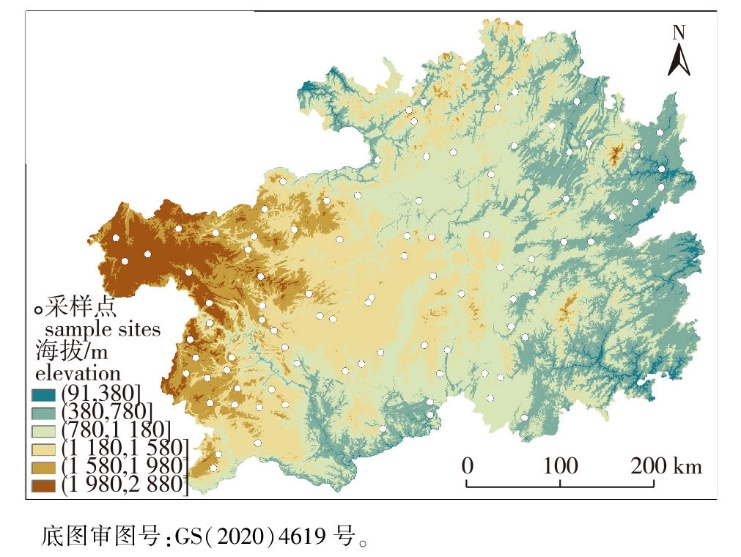
【Objective】Leaves are the fundamental biological organs for photosynthesis,serving as the central hub for plant energy acquisition and material exchange. Their functional traits provide key,measurable indicators of a plant’s ecological strategy and its inherent capability to adapt to various environmental constraints. This is particularly true for pioneer tree species in the Karst region,whose leaf traits provide critical insights into their response and adaptation to regional environmental changes. To thrive in the unique Karst environment,characterized by drought-prone,thin soils,pioneer species have developed distinct leaf functional traits. These include variations in leaf size,thickness,stomatal density,and biochemical composition,which directly influence photosynthetic efficiency,water regulation,and stress tolerance. Systematically analyzing the variation and patterning of these functional traits of pioneer species across various environmental conditions in the Karst region can reveal their specific ecological strategies for survival and growth under severe environmental stress. Furthermore,studying these leaf functional traits provides a valuable tool for monitoring ongoing environmental changes within the Karst area.【Method】In this study,we focused on Pyracantha fortuneana,a crucial pioneer tree species widely distributed throughout the Karst region of Guizhou Province. A comprehensive dataset of 8 120 leaves was collected from 406 P. fortuneana individuals across 93 representative field sample sites. Six specific morphological functional traits were measured and calculated for each: leaf dry weight(LDW),leaf length-to-width ratio(LLW),thickness(LT),leaf area(LA),specific leaf area(SLA)and leaf dry matter content(LDMC). Concurrently with plant sampling,environmental data were collected. Soil samples from the 93 sites were analyzed to measure soil organic carbon(SOC),total nitrogen(TN),and total phosphorus(TP)contents. Meteorological factors collated included annual mean temperature(MAT),annual average precipitation(MAP),and annual average sunshine hours(ANS). To explore the characteristics of trait variation and their specific environmental regional,the gathered data were subjected to advanced statistical analysis,including Pearson correlation analysis,linear regression modeling along environmental gradients,and variance partitioning(VP)analysis(hierarchical segmentation analysis).【Result】The results of this study revealed four main findings regarding the leaf functional traits of P. fortuneana on a regional scale:(1)The coefficient of variation(CV)for the six morphological leaf functional traits ranged from 10.04% to 30.16%. Specifically,leaf dry weight(LDW)showed the largest variation(30.16%),while leaf dry matter content(LDMC)showed the smallest(10.04%). This overall small degree of variation indicates the high stability and strong inherent adaptability of P. fortuneana to the Karst environment.(2)Significant and often inverse correlations were found among the functional traits. Specifically,LDW was found to be highly positively correlated with LT,LA and LDMC(P < 0.001),but highly negatively correlated with leaf length-to-width ratio(LLW)and SLA(P < 0.001). Similarly,LT exhibited a significant positive correlation with LA and LDMC(P < 0.001),and a negative correlation with LLW and SLA(P < 0.001). Indicating that there are different correlations and trade-offs between functional traits of P. fortuneana leaves.(3)Clear trends were identified in response to the major geographic variable,altitude. As altitude increased and annual mean temperature decreased,P. fortuneana adapted by increasing its leaf aspect ratio(LLW)and specific leaf area(SLA),while concurrently reducing its leaf dry weight(LDW),leaf thickness(LT),and leaf dry matter content(LDMC).(4)Variance partitioning analysis determined that altitude was the primary influencing factor driving the regional variation in leaf functional traits,with the explanation rate for the observed trait variation rate for the observed trait variation being consistently higher than 35%.【Conclusion】The evolution of a sophisticated suite of leaf functional traits in P. fortuneana represents a key survival strategy against the typical intermittent drought of Karst areas,with these coordinated morphological and physiological adjustments significantly improving water-use efficiency and resource conservation. Furthermore,the strong influence of altitude on these trait patterns demonstrates the critical role of environmental gradients in shaping the phenotypic plasticity and evolutionary adaptation of this pioneer species within the complex Karst ecosystem. Our results reveal the adaptive characteristics of the functional traits of the leaves of the pioneer species P. fortuneana to Karst habitats at a relatively large scale,which is helpful for understanding the impact of regional scale environmental changes on plant variation and providing a reference for plant selection in karst vegetation restoration.
Pyacantha fortuneana / pioneer tree / Karst / leaf functional trait / adaptation strategy / vegetation restoration / regional environment
| [1] |
赵夏纬, 王一峰, 马文梅. 高寒草地不同坡向披针叶黄华蒸腾速率与叶性状的关系[J]. 生态学报, 2019, 39(7):2494-2500.
|
| [2] |
|
| [3] |
靳莎, 闫淑君, 黄柳菁, 等. 植物叶功能性状间的权衡研究进展[J]. 四川林业科技, 2019, 40(5):96-103.
|
| [4] |
|
| [5] |
朱济友, 于强, 刘亚培, 等. 植物功能性状及其叶经济谱对城市热环境的响应[J]. 北京林业大学学报, 2018, 40(9):72-81.
|
| [6] |
张奇平. 天目山主要树种叶性状在海拔梯度和微地形上的分异格局[D]. 上海: 华东师范大学, 2011.
|
| [7] |
唐青青, 黄永涛, 丁易, 等. 亚热带常绿落叶阔叶混交林植物功能性状的种间和种内变异[J]. 生物多样性, 2016, 24(3):262-270.
|
| [8] |
刘润红, 白金连, 包含, 等. 桂林岩溶石山青冈群落主要木本植物功能性状变异与关联[J]. 植物生态学报, 2020, 44(8):828-841.
|
| [9] |
陈文, 王桔红, 马瑞君, 等. 粤东89种常见植物叶功能性状变异特征[J]. 生态学杂志, 2016, 35(8):2101-2109.
|
| [10] |
熊玲, 龙翠玲, 廖全兰, 等. 茂兰喀斯特森林木本植物叶的功能性状及其相互关系[J]. 应用与环境生物学报, 2022, 28(1):152-159.
|
| [11] |
李艳鹏, 贺同鑫, 王清奎. 施肥对杉木林土壤酶和活性有机碳的影响[J]. 生态学杂志, 2016, 35(10):2722-2731.
|
| [12] |
冯秋红, 史作民, 董莉莉, 等. 南北样带落叶乔木功能性状及其与气象因子的关系[J]. 中国农业气象, 2009, 30(1):79-83.
|
| [13] |
吴陶红, 龙翠玲, 熊玲, 等. 茂兰喀斯特森林不同演替阶段植物叶片功能性状与土壤因子的关系[J]. 广西植物, 2023, 43(3):463-472.
|
| [14] |
|
| [15] |
|
| [16] |
|
| [17] |
李仙兰, 刘江华, 陈淑芸. 红花檵木Loropetalum chinense var. rubrum植物功能性状对光照强度的响应[J]. 陕西林业科技, 2013, 41(3):1-5.
|
| [18] |
杜娇艳, 蔡国俊, 张红玉, 等. 贵州喀斯特地区植物叶片C、N、P化学计量特征对气候环境和土壤养分的响应[J]. 生态环境学报, 2023, 32(12):2154-2165.
|
| [19] |
肖显静, 王雯. 群落演替“个体论” 的发展历程及启发[J]. 自然辩证法研究, 2020, 36(2):66-72.
|
| [20] |
李兰平, 张慧敏, 李宏林, 等. 不同功能群及先锋种在高寒人工草地建植初期的作用[J]. 草地学报, 2021, 29(7):1513-1521.
|
| [21] |
刘长成, 王斌, 郭柯, 等. 中国喀斯特植被分类系统[J]. 广西植物, 2021, 41(10):1618-1631.
|
| [22] |
李婷婷, 容丽, 王梦洁, 等. 黔中喀斯特次生林群落结构动态[J]. 广西植物, 2021, 41(5):684-694.
|
| [23] |
王进, 朱江, 艾训儒, 等. 湖北星斗山地形变化对不同生活型植物叶功能性状的影响[J]. 植物生态学报, 2019, 43(5):447-457.
|
| [24] |
吴凤婵, 蔡国俊, 李安定, 等. 喀斯特峰丛洼地3个建群树种“植物-凋落物-土壤” 系统氮同位素特征[J]. 贵州师范大学学报(自然科学版), 2024, 42(1):12-18.
|
| [25] |
李乐, 钟迪, 贾宝军, 等. 蒙古栎叶面积的数字图像法测定[J]. 西北林学院学报, 2016, 31(6):96-103.
|
| [26] |
税伟, 郭平平, 朱粟锋, 等. 云南喀斯特退化天坑木本植物功能性状变异特征及适应策略[J]. 地理科学, 2022, 42(7):1295-1306.
|
| [27] |
文春玉, 徐明, 聂坤, 等. 亚热带山地马尾松-甜槠针阔混交林土壤养分空间分布特征与合理取样[J]. 土壤, 2023, 55(6):1244-1250.
|
| [28] |
鲍士旦. 土壤农化分析[M]. 第3版:北京: 中国农业出版社, 2000.
|
| [29] |
|
| [30] |
|
| [31] |
|
| [32] |
|
| [33] |
隆庆之, 杜虎, 苏樑, 等. 喀斯特常绿落叶阔叶林木本植物功能性状变异及其适应策略[J]. 生态学报, 2023, 43(21):8875-8883.
|
| [34] |
|
| [35] |
任昱, 卢琦, 吴波, 等. 不同模拟增雨下白刺比叶面积和叶干物质含量的比较[J]. 生态学报, 2015, 35(14):4707-4715.
|
| [36] |
|
| [37] |
|
| [38] |
|
| [39] |
|
| [40] |
徐睿, 刘静, 王利艳, 等. 不同地理种源杉木根叶功能性状与碳氮磷化学计量分析[J]. 生态学报, 2022, 42(15):6298-6310.
|
| [41] |
陈少明, 陈辉煌. 气候条件对德化梨生长发育的影响分析[J]. 农业灾害研究, 2018, 8(6):29-30.
|
| [42] |
张凯, 侯继华, 何念鹏. 油松叶功能性状分布特征及其控制因素[J]. 生态学报, 2017, 37(3):736-749.
|
| [43] |
|
| [44] |
|
/
| 〈 |
|
〉 |