PDF(2893 KB)

Genetic analysis of growth traits in the reciprocal hybrids of Camellia oleifera ‘Deyou No.2’ and C. yunsienensis‘Youza 2’
YUAN Yingchun, YUAN Deyi, GONG Wenfang, GUO Xinmiao, LI Nanxin, JIANG Yi, HU Guanxing
Journal of Nanjing Forestry University (Natural Sciences Edition) ›› 2026, Vol. 50 ›› Issue (1) : 196-204.
PDF(2893 KB)
 PDF(2893 KB)
Genetic analysis of growth traits in the reciprocal hybrids of Camellia oleifera ‘Deyou No.2’ and C. yunsienensis‘Youza 2’
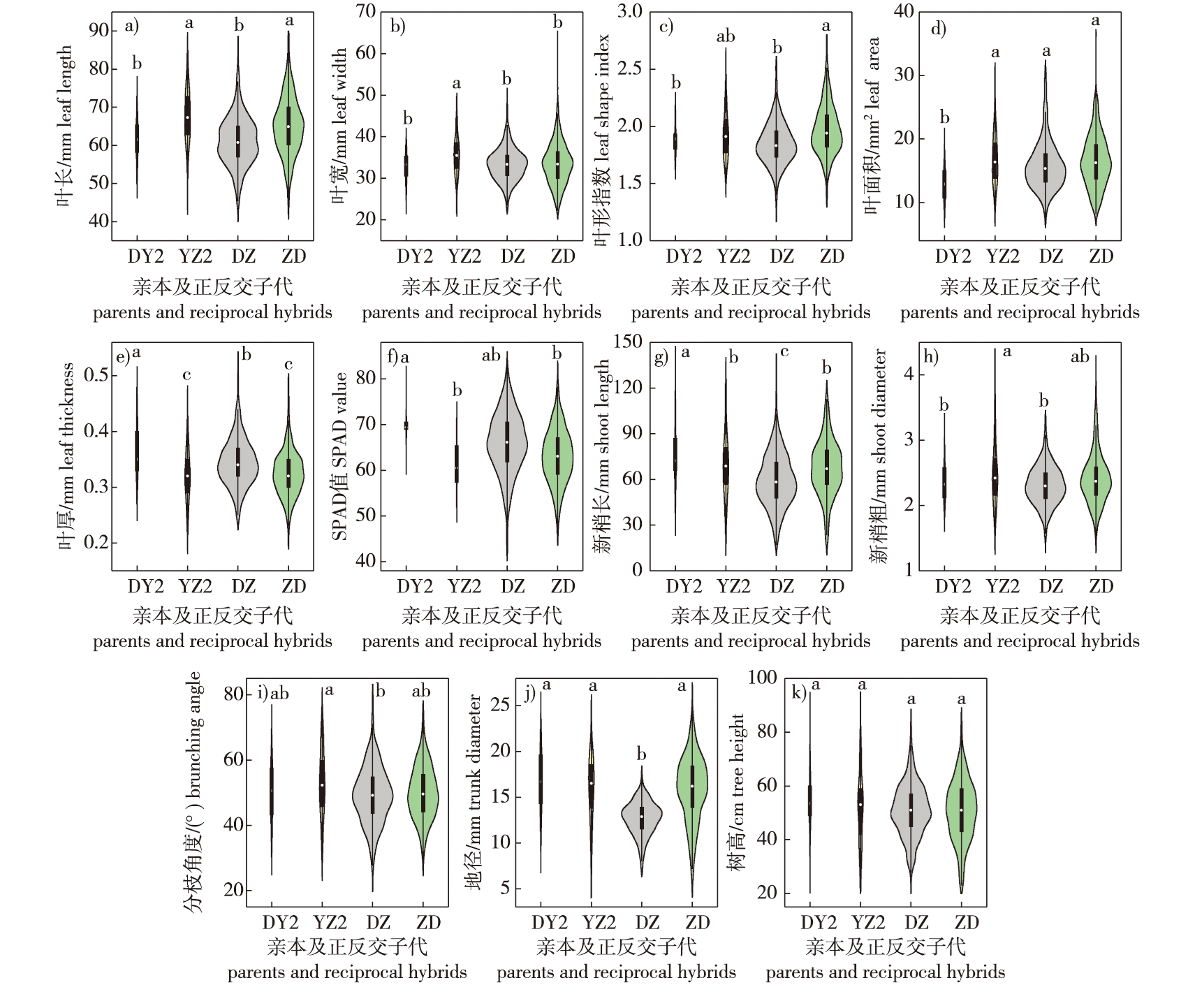
【Objective】Camellia oleifera is a distinctive woody oilseed species native to China, valued for its exceptional nutritional and economic significance. Nevertheless, its hybrid breeding efficiency is constrained by factors such as complex genetic backgrounds, prolonged juvenile phases, and poorly understood inheritance patterns. This study systematically investigated the genetic variation and inheritance patterns of growth-related traits in reciprocal hybrids derived from C. oleifera cultivars ‘Deyou No.2’ (DY2) and C. yunsienensis ‘Youza 2’ (YZ2), with the aim of establishing a theoretical basis for optimizing parental selection strategies and facilitating early phenotypic prediction in hybrid offspring.【Method】Reciprocal crosses were performed using DY2 (a high-yielding cultivar characterized by large fruit and thin pericarp) and YZ2 (a wild superior genotype exhibiting spring flowering and anthracnose resistance) as parental lines. Two crossing combinations were established: the orthogonal group (DZ, DY2♀ × YZ2♂) and the reciprocal group (ZD, YZ2♀ × DY2♂), consisting of 749 and 569 progeny individuals, respectively. All plant materials were planted in 2019 at the C. oleifera Seedling Experimental Base of Central South University of Forestry and Technology(113.42°E, 28.38°N) under standardized cultivation management practices. Eleven quantitative traits—namely leaf length (LL), leaf width (LW), leaf thickness (LT), leaf area (LA), leaf shape index (LSI), SPAD value (SV), shoot length (SL), shoot diameter (SD), branching angle (BA), trunk diameter (TD) and tree height (TH)—were measured during July-August 2022 in accordance with the Technical Specification for Investigation and Determination of Major Traits in C. oleifera (LY/T 2955-2018). Data were processed using Excel 16 and SPSS 26.0. Key genetic parameters, including coefficients of variation (CV), mid-parent heterosis (MPH), and relative genetic contribution of parents, were calculated. Cluster analysis (K-means) and normality tests (Kolmogorov-Smirnov) were conducted to assess trait distribution and genetic divergence.【Result】(1) Trait variation and distribution: significant genetic variation was observed across all measured traits, with CV values ranging from 9.46% (SV in ZD) to 29.33% (SL in DZ). The average CV followed the order of SL > LA > TH > TD > BA > LW > SD > LT > LL > LSI > SV.Most traits exhibited continuous distribution patterns, consistent with polygenic inheritance. However, only SL (DZ, P = 0.024; ZD, P = 0.174), SD (DZ, P = 0.200), and SV (DZ, P = 0.200) showed approximately normal distributions; the remaining traits displayed significant skewness, likely due to directional selection or parental genetic dominance. (2) Reciprocal effects and genetic tendency: maternal influence was predominant for traits including LL, LSI, LT and SV. For instance, LT in DZ (0.34 mm) and ZD (0.32 mm) reflected mid-parent values (MPV 0.34 mm), with DZ exhibiting positive mid-parent heterosis (MPH 0.09%).Traits such as LW, SD and BA showed a paternal bias toward DY2;for example, LW in DZ (33.35 mm) was lower than that in the MPV (34.12 mm), with a CV of 11.75%. Conversely, LA, SL, TD and TH exhibited a directional trend toward YZ2, with LA in ZD displaying the highest MPH (10.41%).Tree-related traits (SL, TD, TH) showed negative MPH (e.g., SL in DZ, -18.05%), indicating hybrid depression, whereas leaf-related traits demonstrated moderate heterosis (e.g., LA in ZD, 16.52 mm2 vs. MPV 14.96 mm2). (3) Correlation analysis: strong correlations were observed among leaf and tree traits. For instance, LL was positively correlated with LW (R = 0.674, P < 0.01) and LA (R = 0.765, P < 0.01). The SPAD value showed a significant positive correlation with LT (R = 0.172, P < 0.01), suggesting that LT may serve as a potential proxy for photosynthetic efficiency. A significant negative correlation was found between LSI and LW (R = -0.603, P < 0.01), indicating morphological trade-offs in leaf structure. (4) Cluster analysis: the orthogonal progeny (DZ) were classified into three distinct clusters: Cluster 1, comprising 321 individuals, exhibited phenotypic characteristics similar to those of YZ2; Cluster 2,consisting of 182 individuals, aligned closely with DY2; Cluster 3, with 248 individuals, demonstrated inferior growth performance.In contrast, the reciprocal progeny (ZD) segregated into four clusters. Notably, Cluster 3 (140 individuals) surpassed both parental lines in key tree traits, exhibiting greater TH (60.02 cm vs. 54.97 cm in DY2) and TD (18.33 mm vs. 15.86 mm in YZ2). 【Conclusion】Reciprocal hybrids between C. oleifera DY2 and YZ2 display substantial genetic diversity. Maternal effects are predominant in determining leaf morphology, whereas paternal inheritance plays a more significant role in shaping tree architecture. The reciprocal cross (ZD) demonstrates superior performance in critical growth traits, particularly with Cluster 3, which showed enhanced TD and TH. These results highlight the potential for simultaneous selection of genetically correlated traits and provide valuable guidance for early-stage screening in hybrid breeding programs. Future research should incorporate fruit-related traits to assess the predictive validity of growth trait selection.
Camellia oleifera / C. yunsienensis / cross-breeding / reciprocal hybrids / growth traits / genetic variation
| [1] |
王瑞, 陈永忠. 我国油茶产业的发展现状及提升思路[J]. 林业科技开发, 2015(4):6-10.
|
| [2] |
彭邵锋, 陆佳, 马力, 等. 油茶果实生长发育期氮磷钾含量变化研究[J]. 西南林业大学学报, 2015, 35(6):26-30.
|
| [3] |
|
| [4] |
肖凯英, 刘娟. 普通油茶育种研究进展[J]. 生物灾害科学, 2021, 44(2):114-118.
|
| [5] |
江泽鹏, 吴道念, 王东雪, 等. 普通油茶优良家系杂交试验[J]. 广西林业科学, 2014, 43(4):409-413.
|
| [6] |
林萍, 姚小华, 滕建华, 等. 油茶杂交子代幼林生长性状的遗传分析[J]. 经济林研究, 2016, 34(1):6-11.
|
| [7] |
吕欢欢, 伍岳峰, 李煜, 等. 普通油茶杂交子代重要经济性状的遗传分析与选择[J]. 经济林研究, 2022, 40(3):14-26.
|
| [8] |
陈雅, 袁德义, 邹锋, 等. 油茶种间杂交叶表型的遗传变异分析[J]. 中南林业科技大学学报, 2020, 40(5):47-56.
|
| [9] |
张荣, 冯丽, 武蕾, 等. 油橄榄杂交F1代表型遗传变异及童期选择研究[J]. 甘肃农业大学学报, 2023, 58(4):226-236.
|
| [10] |
李颖, 张树航, 郭燕, 等. 211份板栗种质资源花序表型多样性和聚类分析[J]. 中国农业科学, 2020, 53(22):4667-4682.
|
| [11] |
于秋香, 李扬, 李颖, 等. 基于果实表型的核桃种质资源遗传多样性分析[J]. 华北农学报, 2021, 36(S1): 53-61.
|
| [12] |
傅志强, 袁汕, 申春晖, 等. 基于花器官特征的油茶遗传多样性分析[J]. 经济林研究, 2022, 40(4):12-18,28.
|
| [13] |
王金星, 潘刚, 王滑, 等. 西藏核桃叶片和坚果表型多样性及其相关关系研究[J]. 林业科学研究, 2012, 25(2):236-240.
|
| [14] |
张绪萍, 张琦, 张金兰, 等. 香梨杂种后代叶片与果实性状的相关性研究[J]. 江西农业学报, 2009, 21(4):53-54.
|
| [15] |
朱振家, 姜成英, 史艳虎, 等. 库源比改变对油橄榄产量及源叶光合作用的调节[J]. 中国农业科学, 2015, 48(3):546-554.
|
| [16] |
刁松锋, 李芳东, 段伟, 等. 柿杂交F1代叶表型遗传多样性研究[J]. 中国农业大学学报, 2017, 22(2):32-44.
|
| [17] |
党伟锋, 张军科, 王拓, 等. 秦冠与富士苹果杂交F1代生物学性状遗传分析[J]. 河南农业科学, 2012, 41(10):122-126.
|
| [18] |
王东雪, 曾雯珺, 江泽鹏, 等. 油茶F1代苗期叶表型性状遗传多样性研究[J]. 西北林学院学报, 2019, 34(1):113-118.
|
| [19] |
国家林业局. 油茶主要性状调查与测定规范:LY/T 2955-2018[S]. 北京: 中国标准出版社, 2018.
National Forestry Administration. Regulation of investigation and determination for the main traits of oil-tea camellia:LY/T 2955-2018[S]. Beijing: China Standards Press, 2018.
|
| [20] |
谢军, 王荣, 徐美隆, 等. 酿酒葡萄香宝馨与赤霞珠正反交后代果实性状遗传变异分析[J]. 果树学报, 40(8): 1509-1522.
|
| [21] |
刘庆昌. 遗传学[M]. 北京: 科学出版社, 2007.
|
| [22] |
郭鑫淼, 袁迎春, 胡观兴, 等. 油茶杂交子代花器官性状的遗传分析[J]. 植物遗传资源学报, 2023, 24(6):1649-1658.
|
| [23] |
张飞, 陈发棣, 房伟民, 等. 菊花营养性状杂种优势表现与主基因+多基因混合遗传分析[J]. 林业科学, 2011, 47(2):46-52.
|
| [24] |
|
| [25] |
刘孟军. 枣树数量性状的概率分级研究[J]. 园艺学报, 1996, 23(2):105-109.
|
| [26] |
刘孟军. 桃树部分经济性状的种内变异及其分级标准研究[J]. 北京农学院学报, 1992, 7(2):98-104.
|
| [27] |
|
| [28] |
陈学森, 王楠, 张宗营, 等. 关于果树种质资源与遗传育种若干问题的理解与思考[J]. 中国农业科学, 2022, 55(17):3395-3410.
|
| [29] |
|
/
| 〈 |
|
〉 |