PDF(1891 KB)

Multi-objective management models for Pinus koraiensis plantations
LI Shuang, JIANG Bo, JIN Xingji, PUKKALA Timo
Journal of Nanjing Forestry University (Natural Sciences Edition) ›› 2025, Vol. 49 ›› Issue (6) : 55-63.
PDF(1891 KB)
 PDF(1891 KB)
Multi-objective management models for Pinus koraiensis plantations
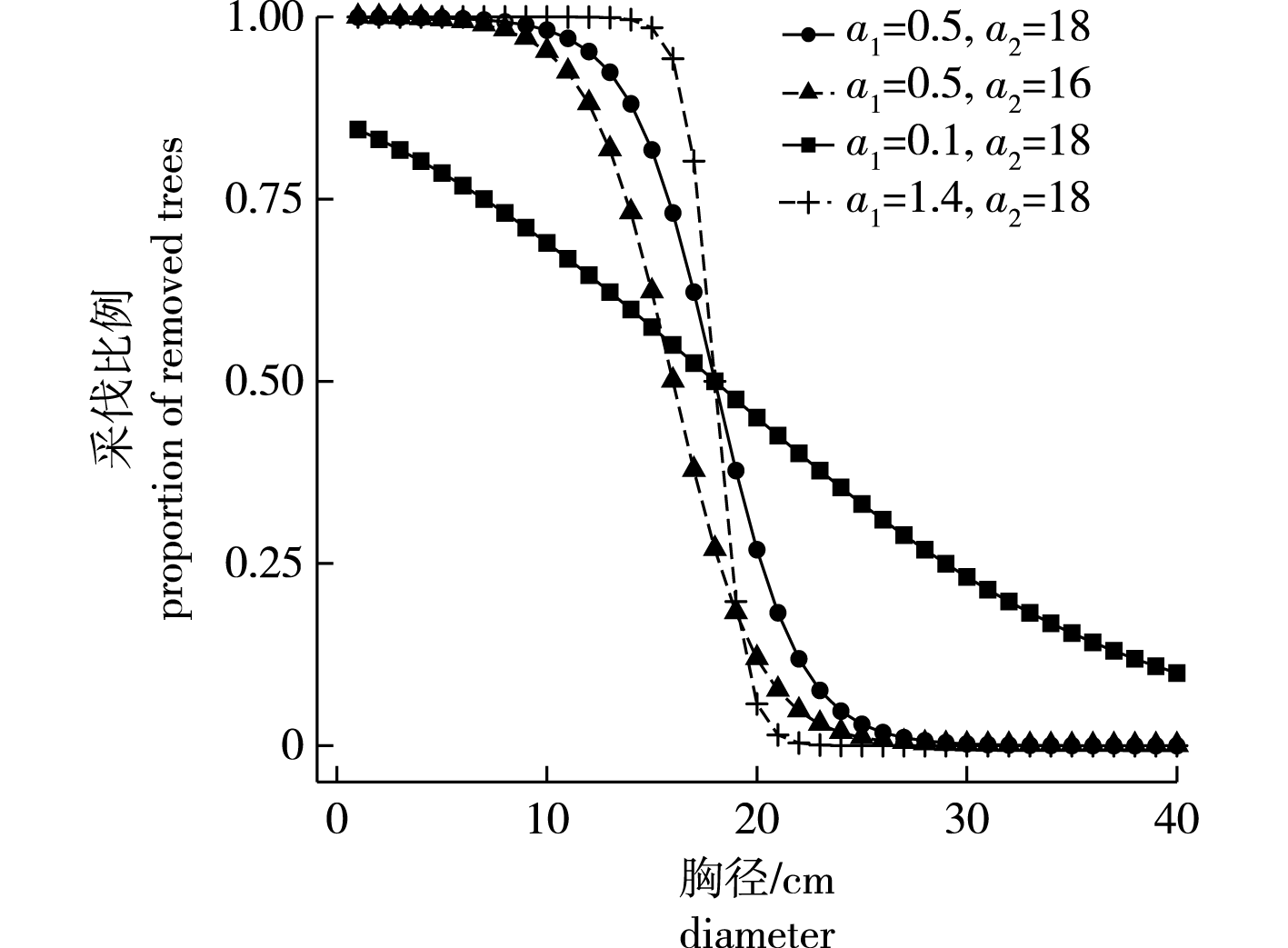
【Objective】Management measurement of Pinus koraiensis plantations of different site indexes were optimized and the management models were constructed with a constraint that thinning from below, to guide the multi-objective management and formulate the multi-objective management plans of Pinus koraiensis plantations in Heilongjiang Province, so as to improve the multi-objective management level of plantations in China.【Method】Multi-attribute utility functions including wood production (WP), large log production (LLP) and cone yield (CY) were maximized using the following weights for the three management objectives: 0.25, 0.25 and 0.50 respectively. The management schedule was optimized for 41 plots of young Pinus koraiensis plantations in Heilongjiang Province, using a stand growth simulator and a differential evolution optimization algorithm. Three models were developed using stand variables as predictors: the number of trees per hectare at thinning, thinning intensity in different diameter classes (described by a parameter of the logistic function, indicating the diameter when the thinning intensity is 50%), and the average diameter at breast height (DBH) at clear-cutting.【Result】The optimal number of trees at thinning was significantly negatively correlated with the average diameter at breast height and positively correlated with the site index. The parameter of the logistic function showed a positive correlation with the average diameter at breast height and the site index. The average diameter at clear-cutting was positively correlated with the site index and negatively correlated with the number of trees. The of the three models of number of trees per hectare during thinning, thinning intensity and average diameter at breast height during clear-cutting were at 0.930, 0.798 and 0.965, respectively. The mean error of the three models was at 2.000 trees/hm2, -0.015 and 0.128 cm, and the mean of absolute errors was at 91.000 trees/hm2, 1.238 and 0.165 cm, respectively.【Conclusion】The average number of trees in the forest at thinning is positively correlated with the site index and negatively correlated with average stand DBH. The average stand DBH increases with the increase of the site index at thinning. The average stand DBH of forests with poor stand during clear-cutting is smaller than that of those with good stand.
Pinus koraiensis plantation / multi-objective management model / management guideline / Logistic function / differential evolution
| [1] |
魏晓慧, 孙玉军, 梅光义, 等. 基于多功能经营的森林资源评价[J]. 中南林业科技大学学报, 2013, 33(11):103-108.
|
| [2] |
曾伟生, 杨学云. 我国用材林资源状况及木材安全分析[J]. 林业资源管理, 2023(1):17-24.
|
| [3] |
董诗涛, 郎晓雪, 施凯泽, 等. 基于森林资源二类调查数据的思茅松人工林经验收获表的编制[J]. 林业调查规划, 2019, 44(2):7-11.
|
| [4] |
|
| [5] |
姜兴艳, 曾思齐, 石振威, 等. 湖南省楠木次生林收获表的研制[J]. 中南林业科技大学学报, 2020, 40(11):55-64.
|
| [6] |
|
| [7] |
戚维江, 高绪汤, 肖思友. 编制辽宁省刺槐人工林林分密度管理图[J]. 东北林业大学学报, 1991, 19(3):96-102.
|
| [8] |
|
| [9] |
|
| [10] |
王成德. 人工林树冠生长模拟及密度控制决策技术研究:以杉木和桉树为例[D]. 北京: 北京林业大学, 2019.
|
| [11] |
|
| [12] |
|
| [13] |
|
| [14] |
|
| [15] |
|
| [16] |
|
| [17] |
|
| [18] |
|
| [19] |
|
| [20] |
|
| [21] |
|
| [22] |
|
| [23] |
宋磊, 金星姬,
|
| [24] |
国家林业局. 森林采伐作业规程:LY/T 1646—2005[S]. 北京: 中国标准出版社, 2005.
State Forestry Administration of the People's Republic of China. Code of forest harvesting:LY/T 1646—2005[S]. Beijing: Standards Press of China, 2005.
|
| [25] |
|
| [26] |
|
| [27] |
|
| [28] |
孙海丽. 差分进化算法改进及其应用研究[D]. 哈尔滨: 哈尔滨工业大学, 2020.
|
| [29] |
王祖玲. 面向全局和多模态优化问题的差分进化算法改善研究[D]. 杭州: 杭州师范大学, 2022.
|
| [30] |
宋磊. 黑龙江省长白落叶松人工林多目标经营模型[D]. 哈尔滨: 东北林业大学, 2023.
|
| [31] |
|
| [32] |
|
| [33] |
|
| [34] |
赵俊卉, 亢新刚, 刘燕. 长白山主要针叶树种最优树高曲线研究[J]. 北京林业大学学报, 2009, 31(4):13-18.
|
| [35] |
黄宏超, 谢栋博, 段光爽, 等. 华北落叶松和白桦半参数树高曲线模型[J]. 林业科学, 2022, 58(10):101-110.
|
| [36] |
张树森, 王蒙, 董利虎. 黑龙江省小黑杨人工林分生长收获模型研究[J]. 防护林科技, 2017(8):39-41.
|
| [37] |
|
| [38] |
|
| [39] |
|
| [40] |
|
| [41] |
|
| [42] |
|
/
| 〈 |
|
〉 |