PDF(2191 KB)

Prediction model of fire spread rate of dead coniferous layer in Pinus koraiensis plantation based on IWOA-BP
HUANG Tianqi, XIN Ying, ZHANG Min
Journal of Nanjing Forestry University (Natural Sciences Edition) ›› 2026, Vol. 50 ›› Issue (2) : 29-36.
PDF(2191 KB)
 PDF(2191 KB)
Prediction model of fire spread rate of dead coniferous layer in Pinus koraiensis plantation based on IWOA-BP
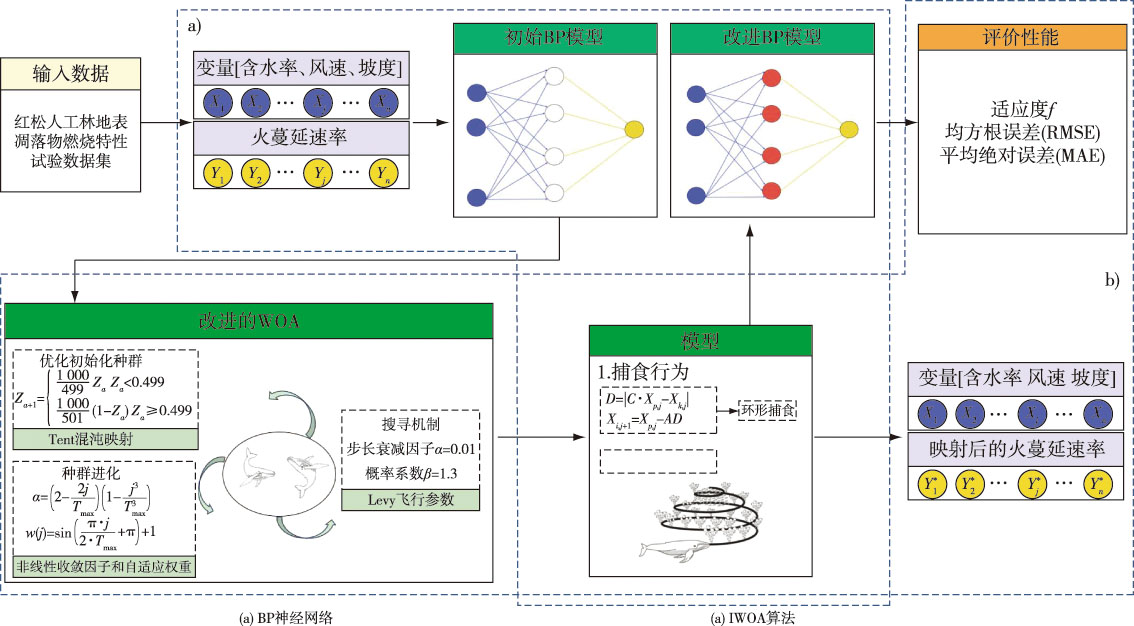
【Objective】Pinus koraiensis needles exhibit a significant forest fire risk due to their high oil content, and surface fire spread is the main fire spread mode. Developing a predictive model for surface fire spread rates can provide scientific basis and valuable insights for fire prevention and control in Pinus koraiensis plantations.【Method】The dead coniferous layer of Pinus koraiensis plantation in Liangshui area of Heilongjiang province was used as the material, 360 sets of indoor point burning tests were conducted with water content of 0, 5%, 10%, 15%, 20%, slope of 0°, 5°, 10°, 15° and wind speed of 0, 1, 2, 3, 4 and 5 m/s. Based on the fire spread rate measured by thermocouple method, an improved WOA(IWOA)-BP neural network model was constructed to predict the fire spread rate, and the prediction results were compared with those of three models (WOA-BP neural network, GA-BP neural network and PSO-BP neural network).【Result】Slope, wind speed and fire spread rate were significantly positively correlated (P<0.01), while water content exhibited a negative correlation with fire spread rate (P<0.05). The fire spread rate decreased with an increase in fuel water content, and increased with the increase of wind speed and slope. When the wind speed was 4 m/s, the fire spread growth rate reached the maximum. The improved whale optimization algorithm (IWOA) included Tent chaotic mapping, improved nonlinear convergence factor, adaptive weighting and Levy flight motion. These enhancements increased the algorithm’s randomness and diversity, thereby improving its convergence speed and reducing the likelihood of becoming trapped in local optima, with high prediction accuracy and robustness. The accuracy and stability of the BP neural network model optimized by the IWOA demonstrated significant improvements compared to three other models, exhibiting the highest model fitness to the measured data.【Conclusion】The IWOA-BP neural network model can effectively predict the fire spread rate of the dead coniferous layer of the Pinus koraiensis plantation, and providing scientific guidance for forest fire prevention and control and forest litter fire spread rate prediction model.
Pinus koraiensis plantation / fire spread rate / point fire test / improved whale optimization algorithm (IWOA) / BP neural network
| [1] |
王秋华, 王劲, 李晓娜, 等. 森林-城镇交界域火灾研究进展[J]. 南京林业大学学报(自然科学版), 2024, 48(5):1-10.
|
| [2] |
张晓迪, 李明泽, 王斌, 等. 基于红外序列图像的火线实时提取及蔓延模拟火线优化[J]. 南京林业大学学报(自然科学版), 2023, 47(6):192-202.
|
| [3] |
王俊玲, 范习健, 杨绪兵, 等. 基于自注意力机制的航空林火图像识别方法[J]. 南京林业大学学报(自然科学版), 2025, 49(2):194-202.
|
| [4] |
巨文珍, 韩斐扬, 彭泊林, 等. 广西林火发生动态及气象影响因素研究[J]. 森林工程, 2024, 40(2):77-84.
|
| [5] |
王敏, 孙启发, 李希进, 等. 滇南异龙湖流域近150年森林火灾史及其驱动因素[J]. 生态学杂志, 2025, 44(2):441-450.
|
| [6] |
|
| [7] |
范迎新, 贾炜玮, 李凤日, 等. 帽儿山不同种源人工红松的生长差异性[J]. 应用生态学报, 2024, 35(7):1735-1743.
|
| [8] |
宁吉彬. 红松人工林地表火行为对其排放特征影响的室内模拟研究[D]. 哈尔滨: 东北林业大学, 2023.
|
| [9] |
任孟林. 红松人工林地表可燃物火蔓延速率预测模型研究[D]. 哈尔滨: 东北林业大学, 2023.
|
| [10] |
赵璠, 舒立福, 周汝良, 等. 林火行为蔓延模型研究进展[J]. 世界林业研究, 2017, 30(2):46-50.
|
| [11] |
王宇虹, 杨晓丹, 任俐文, 等. 林火蔓延模型及其适用性研究进展[J]. 科技导报, 2023, 41(21):49-57.
|
| [12] |
|
| [13] |
|
| [14] |
|
| [15] |
|
| [16] |
|
| [17] |
|
| [18] |
|
| [19] |
|
| [20] |
冯俊伟. 华南地区森林地表可燃物火蔓延速度特性的实验研究[J]. 消防科学与技术, 2022, 41(6):832-835.
|
| [21] |
孙园. 基于WRF与元胞自动机的林火蔓延模拟方法[D]. 哈尔滨: 东北林业大学, 2023.
|
| [22] |
张运林. 烟头点燃蒙古栎和红松落叶床层的概率[D]. 哈尔滨: 东北林业大学, 2016.
|
| [23] |
戴春雨, 马廉洁, 蒋涵存, 等. 基于多种策略改进的鲸鱼优化算法[J]. 计算机工程与科学, 2024, 46(9):1635-1647.
|
| [24] |
杜晔, 田晓清, 李昂, 等. 基于改进鲸鱼算法优化SVM的软件缺陷检测方法[J]. 信息网络安全, 2024, 24(8):1152-1162.
|
| [25] |
赵丙秀, 董宁. 基于WOA-BP神经网络下马铃薯产量预测分析模型[J]. 农机化研究, 2024, 46(3):47-51.
|
| [26] |
金森, 张运林, 朱凯月, 等. 烟头点燃蒙古栎落叶床层的概率[J]. 东北林业大学学报, 2014, 42(8):75-78.
|
| [27] |
|
/
| 〈 |
|
〉 |