PDF(1962 KB)

Responses of water-carbon physiology and soil water-carbon distribution characteristics to thinning in Populus tomentosa
WANG Yafei, ZHU Wei, QU Guanbo, TANG Zehao, JIA Liming
Journal of Nanjing Forestry University (Natural Sciences Edition) ›› 2026, Vol. 50 ›› Issue (3) : 112-120.
PDF(1962 KB)
 PDF(1962 KB)
Responses of water-carbon physiology and soil water-carbon distribution characteristics to thinning in Populus tomentosa
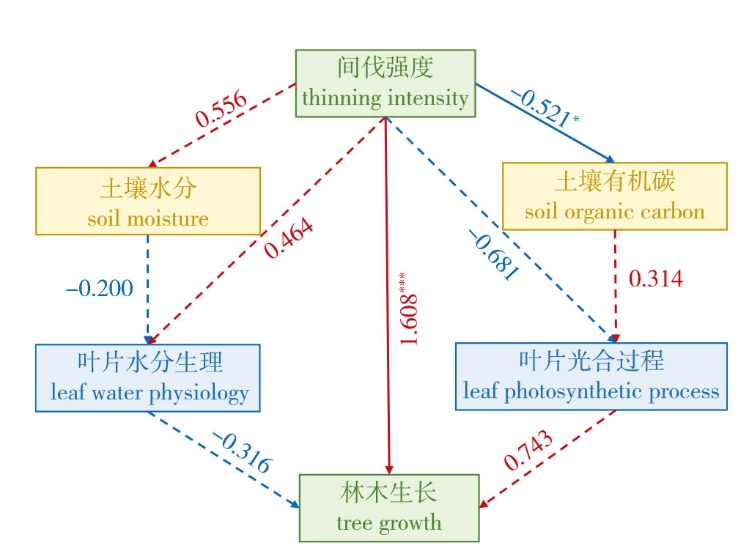
【Objective】This research aims to clarify the response mechanism of soil moisture and carbon characteristics and forest water-carbon physiological processes to thinning, and provide a theoretical reference for the optimization of efficient structural control technology of fast-growing tree species.【Method】Taking 8-year-old triploid P. tomentosa S86 ((Populus tomentosa×P. alba var. pyramidalis)×(P. alba×Populus × canadensis)) plantations in the North China Plain as the research object, three thinning intensities were set: no thinning (NT), alternate row thinning (50% thinning, T50), and alternate row and alternate tree thinning (75% thinning, T75). We analyzed the changes in leaf water traits, gas exchange parameters, and non-structural carbohydrates of P. tomentosa after thinning, as well as the distribution characteristics of soil moisture and carbon, to explore the relationship between soil moisture and carbon characteristics and the physiological processes of water and carbon in trees under different thinning intensities.【Result】(1) A significant negative correlation was found between soil moisture content and soil organic carbon content(P<0.05). Overall, both soil moisture content and organic carbon content were regulated by thinning. As the soil depth increased, the soil moisture content increased layer by layer, while the organic carbon content decreased layer by layer. (2) In the short period after thinning, the transpiration rate of P. tomentosa changed. As the thinning intensity increased, the transpiration rate first increased and then decreased. Among them, the leaf transpiration rate of the T50 treatment was significantly increased by 40.94% compared with the T75 treatment, but other gas exchange parameters were not affected by the short-term effects of thinning. (3) There was no significant difference in the carbon, nitrogen content and non-structural carbohydrate content of leaves in the short period after thinning. Their mass fractions were 470.01-511.85, 21.30-22.53, and 102.31-113.65 g/kg, respectively. (4) Thinning could regulate forest trees to form a larger canopy and significantly promoted the growth of tree diameter at breast height (P<0.05). As the thinning intensity increased, this promoting effect became more obvious. (5) There was a significant positive correlation between leaf photosynthetic rate and soil organic carbon (P<0.01). Soil organic carbon content positively affected the photosynthetic process of leaves and thereby promoted forest growth, while soil moisture negatively regulated leaf water physiological processes and inhibited forest growth.【Conclusion】Tending thinning had different effects on soil moisture and carbon content, and there were differences in soil water and carbon content at different soil depths. In the short time after thinning, changes in soil water and carbon content did not affect in the net photosynthetic rate, water status, nutrient content and non-structural carbohydrates of P. tomentosa leaves. Forest trees transferred nutrients and photosynthetic products to storage organs such as tree branches and trunks, thereby increasing the growth and development of tree diameter at breast height and crown width.
Populus tomentosa / thinning effect / tree water-carbon physiology / soil water and carbon / non-structural carbohydrates(NSC)
| [1] |
|
| [2] |
|
| [3] |
|
| [4] |
段洪浪, 吴建平, 刘文飞, 等. 干旱胁迫下树木的碳水过程以及干旱死亡机理[J]. 林业科学, 2015, 51(11):113-120.
|
| [5] |
|
| [6] |
|
| [7] |
|
| [8] |
|
| [9] |
|
| [10] |
|
| [11] |
刘锦春, 钟章成, 何跃军. 水分胁迫对重庆石灰岩地区不同龄级柏木(Cupressus funebris endl.) 幼苗气体交换的影响[J]. 生态学报, 2007, 27(9):3601-3608.
|
| [12] |
李彦彬, 边泽鹏, 李道西, 等. 花前干旱复水对冬小麦光合特性、产量和水分利用效率的影响[J]. 中国农村水利水电, 2020(6):130-134,138.
|
| [13] |
杨佳鹤, 何进宇, 刘飞杨, 等. 不同土壤水分对植物光合作用的影响研究进展[J]. 节水灌溉, 2023(11):39-46.
|
| [14] |
王海珍, 韩路, 徐雅丽, 等. 土壤水分梯度对灰胡杨光合作用与抗逆性的影响[J]. 生态学报, 2017, 37(2):432-442.
|
| [15] |
|
| [16] |
|
| [17] |
|
| [18] |
|
| [19] |
|
| [20] |
|
| [21] |
林达,
|
| [22] |
|
| [23] |
|
| [24] |
|
| [25] |
|
| [26] |
|
| [27] |
王亚飞, 杨红青, 周欧, 等. 水氮耦合下高密度毛白杨纸浆林树木各器官化学计量特征[J]. 北京林业大学学报, 2023, 45(12):68-79.
|
| [28] |
徐军亮, 竹磊, 师志强, 等. 栓皮栎粗根和茎干中非结构性碳水化合物含量的调配关系[J]. 林业科学, 2021, 57(1):200-206.
|
| [29] |
|
| [30] |
|
| [31] |
|
| [32] |
|
| [33] |
朱喜, 何志斌, 杜军, 等. 间伐对祁连山青海云杉人工林土壤水分的影响[J]. 林业科学研究, 2015, 28(1):55-60.
|
| [34] |
席本野, 邸楠, 曹治国, 等. 树木吸收利用深层土壤水的特征与机制:对人工林培育的启示[J]. 植物生态学报, 2018, 42(9):885-905.
|
| [35] |
|
| [36] |
李敏, 赵熙州, 丁波, 等. 不同间伐处理对马尾松人工林土壤特性季节动态变化的影响[J]. 东北林业大学学报, 2023, 51(5):84-90.
|
| [37] |
|
| [38] |
|
| [39] |
|
| [40] |
|
| [41] |
|
| [42] |
|
| [43] |
赵连春, 赵成章, 陈静, 等. 秦王川湿地不同密度柽柳枝-叶性状及其光合特性[J]. 生态学报, 2018, 38(5):1722-1730.
|
| [44] |
|
| [45] |
牛鉴祺, 吕彦飞, 王树力. 抚育间伐对杨桦次生林非结构性碳水化合物质量分数和碳氮磷生态化学计量特征的影响[J]. 东北林业大学学报, 2024, 52(6):51-57.
|
| [46] |
|
| [47] |
|
| [48] |
|
| [49] |
|
| [50] |
|
| [51] |
邢鸿林, 赵彩鸿, 沈忱, 等. 红皮云杉人工林树冠特征与生长形质的关系及间伐与修枝对其影响[J]. 西北林学院学报, 2024, 39(2):91-96,202.
|
| [52] |
郑鸣鸣, 任正标, 王友良, 等. 间伐强度对杉木中龄林生长和结构的影响[J]. 森林与环境学报, 2020, 40(4):369-376.
|
/
| 〈 |
|
〉 |