PDF(1755 KB)

Effects of different poplar varieties and plantation densities on stand growth and leaf drought resistance in semi-arid region
WANG Zihao, ZHANG Weixi, DING Changjun, YU Jinjin, WEI Hang, MIAO Lulan, SU Xiaohua, BAI Lidong, YAN Maolin, LI Aiping, HUANG Qinjun
Journal of Nanjing Forestry University (Natural Sciences Edition) ›› 2026, Vol. 50 ›› Issue (2) : 205-214.
PDF(1755 KB)
 PDF(1755 KB)
Effects of different poplar varieties and plantation densities on stand growth and leaf drought resistance in semi-arid region
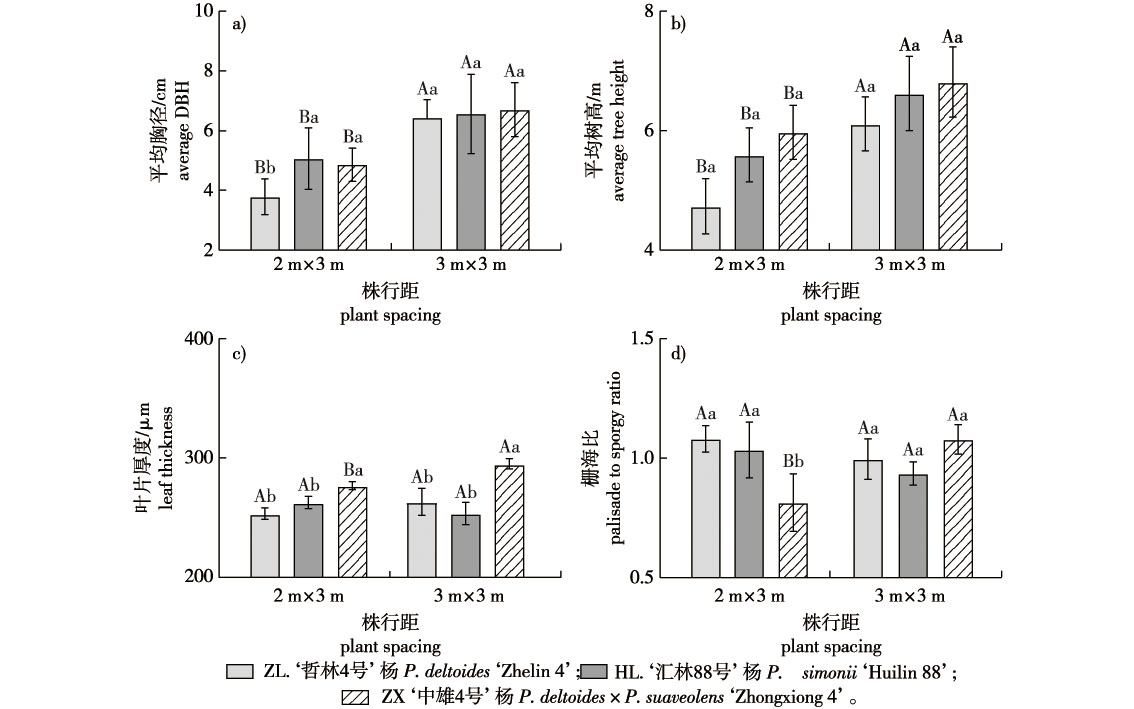
【Objective】This study explored the growth and leaf drought resistance-related traits of poplar under natural semi-arid conditions in response to different plantation densities, thereby offering valuable insights for the precise matching of poplar varieties to site conditions in semi-arid regions.【Method】At the Meng’e Shasheng Plant Park in Dalate Banner, Inner Mongolia, three poplar varieties, Populus deltoides ‘Zhelin 4’, P. × simonii ‘Huilin 88’and P. deltoides × P. suaveolens ‘Zhongxiong 4’, planted in high plantation density (2 m×3 m) and low plantation density (3 m×3 m), at their five years old, were selected as the research objects, the characteristics of growth, leaf anatomical structure, photosynthetic parameters, proline and other physiological and biochemical indexes were observed and analyzed. Principal component analysis and membership function synthesis method were used to evaluate the differences.【Result】(1)The average DBH and average tree height of the three poplar varieties under low plantation density were significantly higher than those under high plantation density, with an average increase of 45.73% and 20.52%, respectively. The growth performance of ‘Zhongxiong 4’ under the two plantation densities was better, and the leaf thickness was significantly higher than that of other varieties. Under low plantation density, the leaf thickness and palisade to spongy ratio of ‘Zhongxiong 4’ were significantly increased compared with high plantation density, indicating that the leaf structure of ‘Zhongxiong 4’ was more suitable for low plantation density. (2)From low plantation density to high plantation density, the net photosynthetic rate (Pn) of the three poplar varieties decreased significantly. The Pn of ‘Zhongxiong 4’ and ‘Huilin 88’ decreased by 12.02% and 16.05%, respectively, while the Pn of ‘Zhelin 4’ decreased by 48.26%. The transpiration rate (Tr), instantaneous water use efficiency (WUEi) and stomatal conductance (Gs) of ‘Zhongxiong 4’ and ‘Huilin 88’ were not significantly different between the two plantation densities. Tr and Gs of ‘Zhelin 4’ decreased significantly under high plantation density and were lower than those of other varieties, indicating that the photosynthetic capacity of poplar was stronger under low plantation density. (3)At high plantation density, there was no significant difference in the contents of proline and soluble sugar among the three poplar varieties, the soluble protein content of ‘Zhongxiong 4’ was significantly higher than that of other varieties. However, at low density, ‘Zhelin 4’, ‘Huilin 88’, and ‘Zhongxiong 4’ exhibited the highest concentrations of soluble sugar, proline, and soluble protein. This suggests that different poplar varieties may adapt to drought environment with different osmotic regulatory substances.【Conclusion】Under natural semi-arid conditions, low plantation density is more conducive to poplar growth, and different poplar varieties respond to plantation density through differenttrait indicators to adjust the drought adaptability of trees. The growth and drought resistance of the leaves of ‘Zhongxiong 4’ were better under the two plantation densities, which could adapt to the construction of plantations with more plantation densities under the natural conditions of semi-arid region.
poplar / semi-arid region / plantation densities / growth trait / leaf anatomical structure / photosynthetic parameter / osmotic regulator
| [1] |
丁昌俊, 黄秦军, 张冰玉, 等. 北方型美洲黑杨不同无性系重要性状评价[J]. 林业科学研究, 2016, 29(3):331-339.
|
| [2] |
胡彦波, 张鹏, 张政, 等. 松嫩平原西部3种杨树生长、木材属性及形态生理学特征比较[J]. 生态学杂志, 2024, 43(10):2945-2952.
|
| [3] |
国家林业和草原局. 中国森林资源报告(2014—2018)[M]. 北京: 中国林业出版社, 2019.
National Forestry and Grassland Administration. Forest resources report of China(2014—2018)[M]. Beijing: China Foresty Publishing House, 2019.
|
| [4] |
赵子夜. 中国“三北” 防护林工程建设现状及思考[J]. 南京林业大学学报(人文社会科学版), 2018, 18(3):67-76,89.
|
| [5] |
李政宏, 丁昌俊, 张伟溪, 等. 美洲黑杨无性系苗木对不同光周期处理的生长与生理响应[J]. 林业科学, 2023, 59(3):127-144.
|
| [6] |
苗婷婷, 吴中能, 刘俊龙, 等. 7个杨树品种苗期叶片解剖结构和叶绿素荧光特性研究[J]. 中国农学通报, 2024, 40(24):51-59.
|
| [7] |
刘宁, 丁昌俊, 李波, 等. 造林密度对欧美杨3品种在东北地区生长及材性的影响[J]. 林业科学研究, 2020, 33(4):9-18.
|
| [8] |
贾亚运, 何宗明, 周丽丽, 等. 造林密度对杉木幼林生长及空间利用的影响[J]. 生态学杂志, 2016, 35(5):1177-1181.
|
| [9] |
|
| [10] |
|
| [11] |
黄绢, 李丹, 王宁宁, 等. 不同配置方式杨树超短轮伐人工林光合特性及生长差异[J]. 林业科学, 2016, 52(8):131-137.
|
| [12] |
潘存娥, 田丽萍, 李贞贞, 等. 5种杨树无性系叶片解剖结构的抗旱性研究[J]. 中国农学通报, 2011, 27(2):21-25.
|
| [13] |
尹春英, 李春阳. 杨树抗旱性研究进展[J]. 应用与环境生物学报, 2003, 9(6):662-668.
|
| [14] |
苏晓华, 丁昌俊, 马常耕. 我国杨树育种的研究进展及对策[J]. 林业科学研究, 2010, 23(1):31-37.
|
| [15] |
马小芬, 王兴芳, 李强, 等. 不同种源地文冠果叶片解剖结构比较及抗旱性分析[J]. 干旱区资源与环境, 2013, 27(6):92-96.
|
| [16] |
张莉, 续九如. 水分胁迫下刺槐不同无性系生理生化反应的研究[J]. 林业科学, 2003, 39(4):162-167.
|
| [17] |
孔祥生, 张妙霞, 王学永, 等. 水分胁迫下2个牡丹品种生理生化差异比较[J]. 林业科学, 2011, 47(9):162-167.
|
| [18] |
郑旭, 赵文静, 刘兴满, 等. 苏北滨海盐渍土土壤基本性质及其对中山杉生长的影响[J]. 江苏农业学报, 2023, 39(9):1854-1861.
|
| [19] |
刘夏岚, 宋子琪, 胡凤荣, 等. 青钱柳二倍体和四倍体叶特征比较研究[J]. 南京林业大学学报(自然科学版), 2024, 48(4):76-84.
|
| [20] |
张江涛, 杨亚峰, 刘艳, 等. 杨树品种2025及其2个芽变彩叶品种对土壤持续干旱胁迫的生理响应[J]. 东北林业大学学报, 2014, 42(11):1-6.
|
| [21] |
|
| [22] |
张赞培, 谷月营, 尚旭岚, 等. 自然低温下23个青钱柳家系耐寒性评价[J]. 南京林业大学学报(自然科学版), 2024, 48(4):85-92.
|
| [23] |
邹琦. 植物生理生化实验指导[M]. 北京: 中国农业出版社, 2003.
|
| [24] |
陈存, 丁昌俊, 黄秦军, 等. 美洲黑杨表型和生理性状多样性及群体结构分析[J]. 北京林业大学学报, 2021, 43(6):1-12.
|
| [25] |
董雪婷, 张静, 张志东, 等. 树种相互作用、林分密度和树木大小对华北落叶松生产力的影响[J]. 应用生态学报, 2021, 32(8):2722-2728.
|
| [26] |
徐慧兰, 颜培栋, 杨章旗. 造林密度对15年生马尾松生长和材性的影响[J]. 森林与环境学报, 2020, 40(5):505-511.
|
| [27] |
张喜年, 张长耀, 李紫帅, 等. 干旱胁迫对西藏半干旱河谷区典型灌木生理特性和解剖结构的影响[J]. 东北林业大学学报, 2023, 51(12):81-88.
|
| [28] |
苏东凯, 周永斌, 唐庆华, 等. 不同杨树品种光合生理生态特性的研究[J]. 西北林学院学报, 2006, 21(2):39-41.
|
| [29] |
高苗琴, 赵瑜琦, 宗毓铮, 等. 2025杨及其3种芽变红叶杨光合生理和生态适应性研究[J]. 西北林学院学报, 2020, 35(2):102-107.
|
| [30] |
巴合提牙尔·克热木, 郭靖, 徐业勇, 等. 南疆地区2个引种大樱桃品种光合特性对比研究[J]. 西北林学院学报, 2016, 31(2):86-91.
|
| [31] |
黄彩霞, 张明, 巴玉春, 等. 造林密度对新疆杨人工林生长发育和光合特性的影响[J]. 甘肃农业大学学报, 2017, 52(2):61-64,70.
|
| [32] |
邓松录, 狄晓艳, 王孟本, 等. 杨树无性系光合特征的研究[J]. 植物研究, 2006, 26(5):600-608.
|
| [33] |
张小全, 徐德应, 赵茂盛. 林冠结构、辐射传输与冠层光合作用研究综述[J]. 林业科学研究, 1999, 12(4):411-421.
|
| [34] |
于均屹, 徐立清, 张勇, 等. 光照和地下竞争对林冠下人工更新紫椴苗木形态和生物量分配的影响[J]. 森林工程, 2023, 39(4):38-47.
|
| [35] |
何凤, 杜红岩, 刘攀峰, 等. 干旱胁迫对杜仲叶片结构特征的影响[J]. 植物研究, 2021, 41(6):947-956.
|
| [36] |
梁青兰, 韩友吉, 乔艳辉, 等. 干旱胁迫对黑杨派无性系生长及生理特性的影响[J]. 北京林业大学学报, 2023, 45(10):81-89.
|
| [37] |
易嘉欣, 马晓雨, 孙国语, 等. 铅锌复合胁迫对小黑杨、黑青杨生长及生理的影响[J]. 东北林业大学学报, 2022, 50(4):15-20.
|
| [38] |
|
/
| 〈 |
|
〉 |