Capacities of six common bamboo species to regulate temperature and humidity of micro-environment in the garden

WANG Ruihan, ZHANG Qingping

Journal of Nanjing Forestry University (Natural Sciences Edition) ›› 2026, Vol. 50 ›› Issue (3) : 275-284.

PDF(8364 KB)
PDF(8364 KB)
Journal of Nanjing Forestry University (Natural Sciences Edition) ›› 2026, Vol. 50 ›› Issue (3) : 275-284. DOI: 10.12302/j.issn.1000-2006.202409024

Capacities of six common bamboo species to regulate temperature and humidity of micro-environment in the garden

Author information +
History +

Abstract

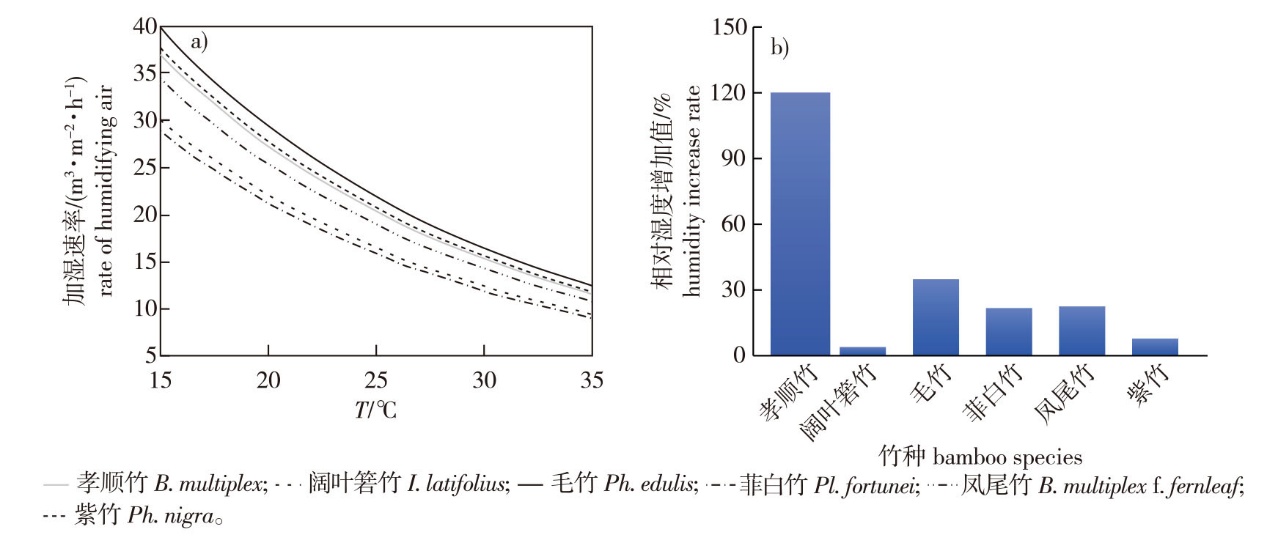
【Objective】Urban green spaces play a crucial role in creating a favorable living environment. This study compared the temperature and humidity regulation ability of six common bamboo species in urban parks to offer insights for optimizing their health benefits in garden design.【Method】Four urban parks with diverse environmental settings were chosen for the study. The radiation cooling effects of six common bamboo species were assessed using a thermal imager, while the transpiration rates were measured with a photosynthesis meter.【Result】The results indicated that these bamboos could reduce ambient temperatures by 2-3 ℃ in urban parks with various environmental settings, with localized reductions reaching as high as 7-15 ℃. These areas were mainly planted with Bambusa multiplex, Phyllostachys edulis, and Indocalamus latifolius. Variations in transpiration rates were observed across different seasons and times of the day, with higher rates in August compared to March and peak transpiration occurring at 10:00 and 14:00 during summer. The average transpiration rates ranged from 37 to 52 g/(m2·h) for six bamboos species and the rank of corresponding humidification efficiency was Bambusa multiplex > Phyllostachys edulis > B. multiplex f. fernleaf > Pleioblastus fortunei > Phyllostachys nigra > Indocalamus latifolius.【Conclusion】B. multiplex and Phyllostachys edulis demonstrated superior microclimate regulation abilities, effectively managing both temperature and humidity levels. However, Indocalamus latifolius primarily excelled in reducing ambient temperatures. The study suggests that the temperature and humidity regulation capabilities of bamboo can be enhanced through careful selection of bamboo species, control of leaf are scale, and appropriate environmental water management.
Key words

bamboo forests therapy / ornamental bamboo / irradiation cooling / humidity regulation / urban park

Cite this article

Download Citations
WANG Ruihan , ZHANG Qingping. Capacities of six common bamboo species to regulate temperature and humidity of micro-environment in the garden[J]. Journal of Nanjing Forestry University (Natural Sciences Edition). 2026, 50(3): 275-284 https://doi.org/10.12302/j.issn.1000-2006.202409024

References

[1]
李瑨婧. 健康景观的衍变及其发展研究[D]. 西安: 西安建筑科技大学, 2018.
LI J J. Study on the evolution and development of health landscape[D]. Xi’an: Xi’an University of Architecture and Technology, 2018.
[2]
邹杰, 石鹤峰, 蔡永敏, 等. 亚健康评价及治疗研究进展[J]. 中医研究, 2009, 22(2):62-64.
ZOU J, SHI H F, CAI Y M, et al. Advance in research on the comment and treatment of subhealthy state[J]. Traditional Chinese Medicinal Research, 2009, 22(2):62-64. DOI:10.3969/j.issn.1001-6910.2009.02.035.
[3]
郭诗宇, 汪远洋, 陈兴国, 等. 森林康养与康养森林建设研究进展[J]. 世界林业研究, 2022, 35(2):28-33.
GUO S Y, WANG Y Y, CHEN X G, et al. Research progress in forest therapy and forest established for healthcare[J]. World Forestry Research, 2022, 35(2):28-33. DOI:10.13348/j.cnki.sjlyyj.2021.0103.y.
[4]
邓三龙. 森林康养的理论研究与实践[J]. 世界林业研究, 2016, 29(6):1-6.
DENG S L. Theoretic research and practices of forest health[J]. World Forestry Research, 2016, 29(6):1-6. DOI:10.13348/j.cnki.sjlyyj.2016.06.001.
[5]
PAN Y, LONG Y Y, HUI J, et al. Microplastics can affect the trophic cascade strength and stability of plankton ecosystems via behavior-mediated indirect interactions[J]. Journal of Hazardous Materials, 2022, 430:128415. DOI:10.1016/j.jhazmat.2022.128415.
[6]
冯云, 范少辉, 刘广路, 等. 中原竹类植物研究进展[J]. 世界竹藤通讯, 2018, 16(6):53-57.
FENG Y, FAN S H, LIU G L, et al. Research progress in bamboo plants from the central plain region of China[J]. World Bamboo and Rattan, 2018, 16(6):53-57. DOI:10.13640/j.cnki.wbr.2018.06.014.
[7]
刘娇妹, 李树华, 杨志峰. 北京公园绿地夏季温湿效应[J]. 生态学杂志, 2008, 27(11):1972-1978.
LIU J M, LI S H, YANG Z F. Temperature and humidity effect of urban green spaces in Beijing in summer[J]. Chinese Journal of Ecology, 2008, 27(11):1972-1978.
[8]
万娟, 王舒, 罗睿, 等. 簕竹属10个竹种净光合速率和固碳释氧能力分析[J]. 江苏农业科学, 2017, 45(8):104-107.
WAN J, WANG S, LUO R, et al. Analysis of net photosynthetic rate and carbon fixation and oxygen release ability of 10 bamboo species in Bambusa[J].Jiangsu Agricultural Sciences, 2017, 45(8):104-107. DOI:10.15889/j.issn.1002-1302.2017.08.029.
[9]
殷亦佳, 陈启航, 赵芮, 等. 北京市常见绿化树种蒸腾特性与温湿效益研究[J]. 西北林学院学报, 2021, 36(1):31-36,76.
YIN Y J, CHEN Q H, ZHAO R, et al. Transpiration characteristics and temperature & humidity benefits of common greening tree species in Beijing[J]. Journal of Northwest Forestry University, 2021, 36(1):31-36,76. DOI:10.3969/j.issn.1001-7461.2021.01.05.
[10]
邵永昌, 张金池, 孙永涛, 等. 上海主要绿化树种夏季蒸腾特性与降温增湿功能比较[J]. 中国水土保持科学, 2015, 13(6): 83-90. DOI: 10.16843/j.sswc.2015.06.013.
SHAO Y C, ZHANG J C, SUN Y T, et al. Comparison of transpiration characteristics and cooling and humidifying functions of the main greening tree species in summer in Shanghai[J]. Science of Soil and Water Conservation, 2015, 13(6): 83-90. DOI: 10.16843/j.sswc.2015.06.013.
[11]
王锐涵, 张青萍. 城市公园中6个常见竹种的滞尘效应评价[J]. 南京林业大学学报(自然科学版), 2025, 49(6):231-237.
WANG R H, ZHANG Q P. Evaluation of dust retention effect of six common ornarnental bamboo species in urban parks[J]. Journal of Nanjing Forestry University (Natural Sciences Edition), 2025, 49(6):231-237. DOI:10.12302/j.issn.1000-2006.202402023.
[12]
许卫东, 刘君, 张拴勤, 等. 绿色植被蒸腾作用机制及红外辐射特性[J]. 陆军工程大学学报, 2022, 1(1):38-43.
XU W D, LIU J, ZHANG S Q, et al. Transpiration and infrared radiation characteristics of green plants[J]. Journal of Army Engineering University of PLA, 2022, 1(1):38-43. DOI:10.12018/j.issn.2097-0730.20211104001.
[13]
邵永昌, 庄家尧, 王柏昌, 等. 上海地区主要绿化树种夏季光合特性和固碳释氧能力研究[J]. 安徽农业大学学报, 2016, 43(1):94-101.
SHAO Y C, ZHUANG J Y, WANG B C, et al. Photosynthetic characteristics and carbon sequestration and oxygen release capacity of the main urban landscape tree species during summer in Shanghai[J]. Journal of Anhui Agricultural University, 2016, 43(1):94-101. DOI:10.13610/j.cnki.1672-352x.20151224.012.
[14]
武小钢, 蔺银鼎, 闫海冰, 等. 城市绿地降温增湿效应与其结构特征相关性研究[J]. 中国生态农业学报, 2008, 16(6):1469-1473.
WU X G, LIN Y D, YAN H B, et al. Correlation between ecological effect and structure characteristics of urban green areas[J]. Chinese Journal of Eco-Agriculture, 2008, 16(6):1469-1473. DOI:10.3724/SP.J.1011.2008.01469.
[15]
吴仁武, 晏海, 舒也, 等. 竹类植物夏季微气候特征及其对人体舒适度的影响[J]. 中国园林, 2019, 35(7):112-117.
WU R W, YAN H, SHU Y, et al. Microclimatic characteristics and human comfort conditions of bamboo plant communities in summer[J]. Chinese Landscape Architecture, 2019, 35(7):112-117. DOI:10.19775/j.cla.2019.07.0112.
[16]
王茜. 福州旗山森林公园毛竹游憩林生态保健功能研究[D]. 北京: 中国林业科学研究院, 2015.
WANG Q. Study on ecological health functions of Phyllostachys pubescens forest in Qishan Mountain of Fuzhou[D]. Beijing: Chinese Academy of Forestry, 2015.
[17]
王茜, 王成, 杜万光, 等. 福州旗山夏季毛竹林生态保健功能研究[J]. 南京林业大学学报(自然科学版), 2018, 42(2):120-126.
WANG Q, WANG C, DU W G, et al. Exploring the ecological healthy function of Phyllostachys pubescens forest in Qishan Park of Fuzhou in summer[J]. Journal of Nanjing Forestry University (Natural Sciences Edition), 2018, 42(2):120-126. DOI:10.3969/j.issn.1000-2006.201703003.
[18]
SMITH D L, JOHNSON L. Vegetation-mediated changes in microclimate reduce soil respiration as woodlands expand into grasslands[J]. Ecology, 2004, 85(12):3348-3361. DOI:10.1890/03-0576.
[19]
TANAKA K, HASHIMOTO S. Plant canopy effects on soil thermal and hydrological properties and soil respiration[J]. Ecological Modelling, 2006, 196(1/2):32-44. DOI:10.1016/j.ecolmodel.2006.01.004.
[20]
谭娟, 王敏, 郭晋川, 等. 喀斯特峰丛洼地4种典型植物蒸腾作用及其影响因素[J]. 水土保持通报, 2017, 37(6):16-21,27.
TAN J, WANG M, GUO J C, et al. Transpiration of 4 typical plants and its affecting factors in Karst peak cluster depression area[J]. Bulletin of Soil and Water Conservation, 2017, 37(6):16-21,27. DOI:10.13961/j.cnki.stbctb.2017.06.003.
PDF(8364 KB)

Accesses

Citation

Detail

Sections
Recommended
The full text is translated into English by AI, aiming to facilitate reading and comprehension. The core content is subject to the explanation in Chinese.

/