Changes of supply-demand relationship pattern of carbon sequestration services and its driving factors in the Shan-Shui Initiative in the source of Qiantang River in China

XU Caiyao, CUI Mingye, XU Wenjing, REN Yan, KONG Fanbin

Journal of Nanjing Forestry University (Natural Sciences Edition) ›› 2026, Vol. 50 ›› Issue (3) : 90-100.

PDF(8056 KB)
PDF(8056 KB)
Journal of Nanjing Forestry University (Natural Sciences Edition) ›› 2026, Vol. 50 ›› Issue (3) : 90-100. DOI: 10.12302/j.issn.1000-2006.202409026

Changes of supply-demand relationship pattern of carbon sequestration services and its driving factors in the Shan-Shui Initiative in the source of Qiantang River in China

Author information +
History +

Abstract

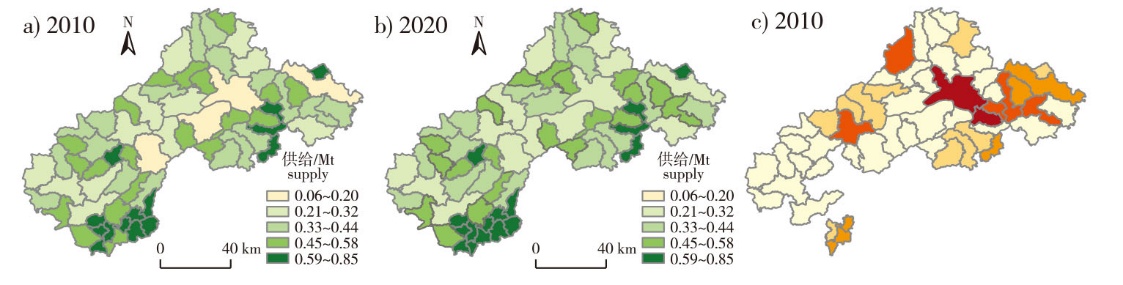
【Objective】Enhancing carbon sequestration and sink capacity is a critical pathway for ecosystems to mitigate global warming. Quantifying the supply and demand of ecosystem carbon sequestration services (ECSS) and their spatial relationships, along with identifying the drivers of their dynamics, provides an essential foundation for formulating and optimizing region-specific carbon-neutral solutions based on ecological protection and restoration projects.【Method】This study targeted the Qiantang River source region integrated protection and restoration project of mountains, rivers, forests, farmlands, lakes and grasslands (referred to as the Qiantang River source “Shan-Shui Initiative”) in Zhejiang Province. Using quantitative analytical models, we systematically assessed the spatiotemporal patterns, spatial heterogeneity, and driving factors of ECSS supply-demand relationships in the project area.【Result】(1) The ECSS supply in the Qiantang River “Shan-Shui Initiative” area exceeded demand. In 2020, the ECSS supply reached 13.72 Mt, reflecting a 9.1% increase compared to 2010, with a spatial distribution characterized by “higher values in central-western regions and lower values in the east”. Conversely, the ECSS demand in 2020 was 2.87 Mt, marking a 24.2% rise from 2010. The supply-demand ratio (SDR) of ECSS consistently exhibited a surplus state across most of the study area. (2) The drivers of ECSS supply-demand dynamics displayed significant spatial heterogeneity. GDP per capita, population density, annual mean air temperature, the proportion of secondary industry, and the coverage of urban construction land exerted statistically significant negative effects on the ECSS supply-demand relationship. In contrast, the proportion of forest area demonstrated a pronounced positive effect.【Conclusion】This study elucidates the spatiotemporal evolution and driving mechanisms of ECSS supply-demand patterns in national key ecological function zones under engineered interventions. The findings offer a scientific basis for optimizing the planning and sustainable management of ecosystem carbon sequestration services through the implementation of the “Shan-Shui Initiative.”
Key words

ecosystem carbon sequestration services / supply-demand relationship pattern / driving factors / Qiantang River source region / geographically weighted regression model

Cite this article

Download Citations
XU Caiyao , CUI Mingye , XU Wenjing , et al . Changes of supply-demand relationship pattern of carbon sequestration services and its driving factors in the Shan-Shui Initiative in the source of Qiantang River in China[J]. Journal of Nanjing Forestry University (Natural Sciences Edition). 2026, 50(3): 90-100 https://doi.org/10.12302/j.issn.1000-2006.202409026

References

[1]
徐彩瑶, 任燕, 孔凡斌. 浙江省土地利用变化对生态系统固碳服务的影响及其预测[J]. 应用生态学报, 2023, 34(6):1610-1620.
XU C Y, REN Y, KONG F B. Impacts and prediction of land use change on ecosystem carbon sequestration in Zhejiang Province,China[J].Chinese Journal of Applied Ecology, 2023, 34(6):1610-1620.DOI: 10.13287/j.1001-9332.202306.024.
[2]
HU Y B, ZHANG Q, HU S J, et al. Research progress and prospects of ecosystem carbon sequestration under climate change (1992-2022)[J]. Ecological Indicators, 2022, 145:109656.DOI: 10.1016/j.ecolind.2022.109656.
[3]
梁华秋, 沈梦晗, 邵明, 等. 基于生态系统服务供需的临沂市固碳生态网络构建[J]. 应用生态学报, 2024, 35(3):759-768.
LIANG H Q, SHEN M H, SHAO M, et al. Construction of carbon sequestration ecological network in Linyi City based on supply and demand of ecosystem service[J]. Chinese Journal of Applied Ecology, 2024, 35(3):759-768.DOI: 10.13287/j.1001-9332.202403.027.
[4]
马琳, 刘浩, 彭建, 等. 生态系统服务供给和需求研究进展[J]. 地理学报, 2017, 72(7):1277-1289.
MA L, LIU H, PENG J, et al. A review of ecosystem services supply and demand[J]. Acta Geographica Sinica, 2017, 72(7):1277-1289.DOI: 10.11821/dlxb201707012.
[5]
戴洪霞, 谢慧黎, 陈凌秀, 等. 面向供需协同的闽江流域固碳服务流评价[J]. 环境科学, 2025, 46(9):5930-5940.
DAI H X, XIE H L, CHEN L X, et al. Evaluation of carbon fixation service flow in Minjiang River basin for supply and demand synergy[J]. Environmental Science, 2025, 46(9):5930-5940. DOI:10.13227/j.hjkx.202408154.
[6]
杨丽雯, 董丽青, 张立伟, 等. 固碳服务供需平衡和服务流量化评估:以引黄入晋南干线为例[J]. 资源科学, 2019, 41(3):557-571.
YANG L W, DONG L Q, ZHANG L W, et al. Quantitative assessment of carbon sequestration service supply and demand and service flows:a case study of the Yellow River Diversion Project South Line[J]. Resources Science, 2019, 41(3):557-571.DOI: 10.18402/resci.2019.03.13.
[7]
陶芹, 陶宇, 欧维新. 不同碳减排目标下长三角地区碳固持服务供需演变分析[J]. 长江流域资源与环境, 2022, 31(1):191-201.
TAO Q, TAO Y, OU W X. Mapping the changes in supply and demand of carbon sequestration service in the Yangtze River delta under different carbon emission reduction targets[J]. Resources and Environment in the Yangtze basin, 2022, 31(1):191-201.DOI: 10.11870/cjlyzyyhj202201018.
[8]
徐彩瑶, 崔铭烨, 王宁, 等. 浙江省生态保护修复优先区识别[J]. 生态学报, 2024, 44(8):3223-3240.
XU C Y, CUI M Y, WANG N, et al. Identification of priority areas for ecological protection and restoration in Zhejiang Province based on ecosystem service bundles[J]. Acta Ecologica Sinica, 2024, 44(8):3223-3240.DOI: 10.20103/j.stxb.202305181053.
[9]
赵雪雁, 马平易, 李文青, 等. 黄土高原生态系统服务供需关系的时空变化[J]. 地理学报, 2021, 76(11):2780-2796.
ZHAO X Y, MA P Y, LI W Q, et al. Spatiotemporal changes of supply and demand relationships of ecosystem services in the Loess Plateau[J]. Acta Geographica Sinica, 2021, 76(11):2780-2796.DOI: 10.11821/dlxb202111013.
[10]
余玉洋, 李晶. 秦巴山区生态系统服务供需与人类活动强度的时空变化及其耦合关系[J]. 生态学报, 2024, 44(19):8764-8773.
YU Y Y, LI J. Spatio-temporal changes of ecosystem service supply and demand and human activity intensity in Qinling-Daba Mountains and its coupling relationship[J]. Acta Ecologica Sinica, 2024, 44(19):8764-8773.DOI: 10.20103/j.stxb.202206211756.
[11]
刘海, 武靖, 陈晓玲. 丹江口水源区生态系统服务时空变化及权衡协同关系[J]. 生态学报, 2018, 38(13):4609-4624.
LIU H, WU J, CHEN X L. Study on spatial-temporal change andtrade-off/synergy relationships of ecosystem services in the Danjiangkou water source area[J]. Acta Ecologica Sinica, 2018, 38(13):4609-4624.DOI: 10.5846/stxb201706281169.
[12]
BURKHARD B, KROLL F, MÜLLER F, et al. Landscapes’ capacities to provide ecosystem services: a concept for land-cover based assessments[J]. Landscape Online, 2009, 15:1-22.DOI: 10.3097/lo.200915.
[13]
WU X, LIU S L, ZHAO S, et al. Quantification and driving force analysis of ecosystem services supply,demand and balance in China[J].Science of The Total Environment, 2019, 652:1375-1386.DOI: 10.1016/j.scitotenv.2018.10.329.
[14]
SAUTER I, KIENAST F, BOLLIGER J, et al. Changes in demand and supply of ecosystem services under scenarios of future land use in Vorarlberg,Austria[J].Journal of Mountain Science, 2019, 16(12):2793-2809.DOI: 10.1007/s11629-018-5124-x.
[15]
陈瑶, 张长春, 胡丰, 等. 基于MSPA-InVEST模型分析太行山生态网络演变[J]. 环境科学, 2025, 46(10):6443-6454.
CHEN Y, ZHANG C C, HU F, et al. Analysis of ecological network evolution in Taihang mountains based on MSPA-InVEST model[J]. Environmental Science, 2025, 46(10):6443-6454. DOI:10.13227/j.hgkx.202410020.
[16]
魏雷晗冰, 时鹏, 魏勇, 等. 窟野河流域生态系统服务功能变化及其驱动因素分析[J]. 水土保持学报, 2024, 38(4):222-235.
WEI L H B, SHI P, WEI Y, et al. Analysis of ecosystem service function changes and their driving factors in the Kuye River basin[J]. Journal of Soil and Water Conservation, 2024, 38(4):222-235.DOI: 10.13870/j.cnki.stbcxb.2024.04.037.
[17]
孔凡斌, 曹露丹, 徐彩瑶. 县域碳收支核算与碳综合补偿类型分区:以钱塘江流域为例[J]. 经济地理, 2023, 43(3):150-161.
KONG F B, CAO L D, XU C Y. Measurement of carbon budget and type partition of carbon comprehensive compensation in the Qiantang River basin[J]. Economic Geography, 2023, 43(3):150-161.DOI: 10.15957/j.cnki.jjdl.2023.03.016.
[18]
IPCC. Climate Change 2007: Synthesis Report[R]. 2007.
[19]
刘竹, 耿涌, 薛冰, 等. 城市能源消费碳排放核算方法[J]. 资源科学, 2011, 33(7):1325-1330.
LIU Z, GENG Y, XUE B, et al. A calculation method of CO2 emission from urban energy consumption[J]. Resources Science, 2011, 33(7):1325-1330.
[20]
李波, 张俊飚, 李海鹏. 中国农业碳排放时空特征及影响因素分解[J]. 中国人口·资源与环境, 2011, 21(8):80-86.
LI B, ZHANG J B, LI H P. Research on spatial-temporal characteristics and affecting factors decomposition of agricultural carbon emission in China[J]. China Population,Resources and Environment, 2011, 21(8):80-86.DOI: 10.3969/j.issn.1002-2104.2011.08.013.
[21]
FOTHERINGHAM A S, CHARLTON M E, BRUNSDON C. Geographically weighted regression:a natural evolution of the expansion method for spatial data analysis[J]. Environment and Planning A:Economy and Space, 1998, 30(11):1905-1927.DOI: 10.1068/a301905.
[22]
严莉, 曹广超, 康利刚, 等. 基于InVEST模型的共和县生境质量时空变化及驱动因素[J]. 干旱区研究, 2024, 41(2):314-325.
YAN L, CAO G C, KANG L G, et al. Analysis of spatial and temporal changes in habitat quality and driving factors in Gonghe County using the InVEST model[J]. Arid Zone Research, 2024, 41(2):314-325.DOI: 10.13866/j.azr.2024.02.14.
[23]
乔旭宁, 张婷, 杨永菊, 等. 渭干河流域生态系统服务的空间溢出及对居民福祉的影响[J]. 资源科学, 2017, 39(3):533-544.
QIAO X N, ZHANG T, YANG Y J, et al. Spatial flow of ecosystem services and impacts on human well-being in the Weigan River basin[J]. Resources Science, 2017, 39(3):533-544.DOI: 10.18402/resci.2017.03.15.
[24]
叶艳妹, 林耀奔, 刘书畅, 等. 山水林田湖草生态修复工程的社会-生态系统(SES)分析框架及应用:以浙江省钱塘江源头区域为例[J]. 生态学报, 2019, 39(23):8846-8856.
YE Y M, LIN Y B, LIU S C, et al. Social-ecological system (SES) analysis framework for application in ecological restoration engineering of mountains-rivers-forests-farmlands-lakes-grasslands:utilizing the source area of Qiantang River in Zhejiang Province as an example[J]. Acta Ecologica Sinica, 2019, 39(23):8846-8856.DOI: 10.5846/stxb201905301139.
[25]
苏敏, 虞方伯, 方晓波. 浙江省钱塘江源区域山水林田湖草生命共同体健康评价[J]. 水土保持通报, 2024, 44(1):97-108.
SU M, YU F B, FANG X B. Health evaluation of life communities of mountains-rivers-forests-farmlands-lakes-grasslands in source area of Qiantang River in Zhejiang Province[J]. Bulletin of Soil and Water Conservation, 2024, 44(1):97-108.DOI: 10.13961/j.cnki.stbctb.2024.01.011.
[26]
邹文涛, 何友均, 叶兵, 等. 基于InVEST模型的钱江源国家公园生态系统碳储量研究[J]. 中南林业科技大学学报, 2021, 41(3):120-128.
ZOU W T, HE Y J, YE B, et al. Study on carbon storage of ecosystem in Qianjiangyuan National Park based on InVEST model[J]. Journal of Central South University of Forestry & Technology, 2021, 41(3):120-128.DOI: 10.14067/j.cnki.1673-923x.2021.03.013.
[27]
段艺璇, 赵晓迪, 邹文涛, 等. 钱江源国家公园体制试点区湿地生态系统服务价值评估[J]. 林业经济, 2019, 41(4):50-57.
DUAN Y X, ZHAO X D, ZOU W T, et al. Evaluation on wetland ecosystem service value in Qianjiangyuan National Park pilot area[J]. Forestry Economics, 2019, 41(4):50-57.DOI: 10.13843/j.cnki.lyjj.2019.04.008.
[28]
李婷, 李晶, 王彦泽, 等. 关中-天水经济区生态系统固碳服务空间流动及格局优化[J]. 中国农业科学, 2017, 50(20):3953-3969.
LI T, LI J, WANG Y Z, et al. The spatial flow and pattern optimization of carbon sequestration ecosystem service in Guanzhong-Tianshui economical region[J]. Scientia Agricultura Sinica, 2017, 50(20):3953-3969.DOI: 10.3864/j.issn.0578-1752.2017.20.011.
[29]
朱文泉, 潘耀忠, 阳小琼, 等. 气候变化对中国陆地植被净初级生产力的影响分析[J]. 科学通报, 2007, 52(21):2535-2541.
ZHU W Q, PAN Y Z, YANG X Q, et al. Impact of climate change on net primary productivity of terrestrial vegetation in China[J]. Chinese Science Bulletin, 2007, 52(21):2535-2541.DOI: 10.3321/j.issn:0023-074x.2007.21.012.
[30]
孟士婷, 黄庆旭, 何春阳, 等. 区域碳固持服务供需关系动态分析:以北京为例[J]. 自然资源学报, 2018, 33(7):1191-1203.
MENG S T, HUANG Q X, HE C Y, et al. Mapping the changes in supply and demand of carbon sequestration service:a case study in Beijing[J]. Journal of Natural Resources, 2018, 33(7):1191-1203.DOI: 10.31497/zrzyxb.20171155.
[31]
YAN Z, XIA L L, XIANG W N. Analyzing spatial patterns of urban carbon metabolism:a case study in Beijing,China[J].Landscape and Urban Planning, 2014, 130:184-200.DOI: 10.1016/j.landurbplan.2014.05.006.
[32]
刘文华, 国家统计局能源统计司. 中国能源统计年鉴. 2020[M]. 北京: 中国统计出版社, 2021.
LIU W H.China energy statistical yearbook. 2020[M]. Beijing: China Statistics Press, 2021.
[33]
魏楚, 沈满洪. 能源效率及其影响因素:基于DEA的实证分析[J]. 管理世界, 2007, 23(8):66-76.
WEI C, SHEN M H. Energy efficiency and its influencing factors:an empirical analysis based on DEA[J]. Management World, 2007, 23(8):66-76.DOI: 10.19744/j.cnki.11-1235/f.2007.08.009.
[33]
魏楚, 沈满洪. 能源效率及其影响因素:基于DEA的实证分析[J]. 管理世界, 2007(8):66-76.
WEI C, SHEN M H. Energy efficiency and its influencing factors:an empirical analysis based on DEA[J]. Journal of Management World, 2007(8):66-76.
[34]
刘立程, 刘春芳, 王川, 等. 黄土丘陵区生态系统服务供需匹配研究:以兰州市为例[J]. 地理学报, 2019, 74(9):1921-1937.
LIU L C, LIU C F, WANG C, et al. Supply and demand matching of ecosystem services in Loess Hilly region:a case study of Lanzhou[J]. Acta Geographica Sinica, 2019, 74(9):1921-1937.DOI: 10.11821/dlxb201909016.
[35]
张蓬涛, 刘双嘉, 周智, 等. 京津冀地区生态系统服务供需测度及时空演变[J]. 生态学报, 2021, 41(9):3354-3367.
ZHANG P T, LIU S J, ZHOU Z, et al. Supply and demand measurement and spatio-temporal evolution of ecosystem services in Beijing-Tianjin-Hebei region[J]. Acta Ecologica Sinica, 2021, 41(9):3354-3367.DOI: 10.5846/stxb202006101511.
[36]
杨冕, 张艺千, 王春晓. 湖北省关键生态系统服务供需状况的时空变化研究[J]. 长江流域资源与环境, 2019, 28(9):2080-2091.
YANG M, ZHANG Y Q, WANG C X. Spatial-temporal variations in the supply-demand balance of key ecosystem services in Hubei Province[J]. Resources and Environment in the Yangtze Basin, 2019, 28(9):2080-2091.
[37]
姚成胜, 朱鹤健, 吕晞, 等. 土地利用变化的社会经济驱动因子对福建生态系统服务价值的影响[J]. 自然资源学报, 2009, 24(2):225-233.
YAO C S, ZHU H J, LYU X, et al. Study on the impact of socio-economic driving factors of land use change on the ecosystem service values in Fujian Province[J]. Journal of Natural Resources, 2009, 24(2):225-233.DOI: 10.11849/zrzyxb.2009.02.006.
[38]
YIN S W, GONG Z W, GU L, et al. Driving forces of the efficiency of forest carbon sequestration production:spatial panel data from the national forest inventory in China[J]. Journal of Cleaner Production, 2022, 330:129776.DOI: 10.1016/j.jclepro.2021.129776.
[39]
张优. 基于LUCC的成都平原地区碳排放效应研究[D]. 成都: 四川师范大学, 2018.
ZHANG Y. Study on carbon emission effect in Chengdu plain area based on LUCC[D]. Chengdu: Sichuan Normal University, 2018.
[40]
刘洋, 张军, 周冬梅, 等. 基于InVEST模型的疏勒河流域碳储量时空变化研究[J]. 生态学报, 2021, 41(10):4052-4065.
LIU Y, ZHANG J, ZHOU D M, et al. Temporal and spatial variation of carbon storage in the Shule River Basin based on InVEST model[J]. Acta Ecologica Sinica, 2021, 41(10):4052-4065.DOI: 10.5846/stxb201911152452.
[41]
李博, 林文鹏, 李鲁冰. 面向SDG15的钱江源国家公园生态系统服务时空分析[J]. 自然资源遥感, 2022, 34(4):243-253.
LI B, LIN W P, LI L B. SDG15-oriented analysis on the spatiotemporal dynamics of ecosystem services in Qianjiangyuan National Park[J]. Remote Sensing for Natural Resources, 2022, 34(4):243-253.DOI: 10.6046/zrzyyg.2021409.
[42]
段宝玲, 冯强, 原燕燕, 等. 钱江源国家公园体制试点区生态系统服务权衡与协同分析[J]. 旅游科学, 2021, 35(5):11-31.
DUAN B L, FENG Q, YUAN Y Y, et al. Ecosystem services trade-offs and synergies in Qianjiangyuan National Park system pilot[J]. Tourism Science, 2021, 35(5):11-31.DOI: 10.16323/j.cnki.lykx.2021.05.002.
[43]
韩增林, 刘澄浩, 闫晓露, 等. 基于生态系统服务供需匹配与耦合协调的生态管理分区:以大连市为例[J]. 生态学报, 2021, 41(22):9064-9075.
HAN Z L, LIU C H, YAN X L, et al. Coupling coordination and matches in ecosystem services supply-demand for ecological zoning management:a case study of Dalian[J]. Acta Ecologica Sinica, 2021, 41(22):9064-9075.DOI: 10.5846/stxb202103220757.
[44]
彭建, 吕丹娜, 张甜, 等. 山水林田湖草生态保护修复的系统性认知[J]. 生态学报, 2019, 39(23):8755-8762.
PENG J, LYU D N, ZHANG T, et al. Systematic cognition of ecological protection and restoration of mountains-rivers-forests-farmlands-lakes-grasslands[J]. Acta Ecologica Sinica, 2019, 39(23):8755-8762.DOI: 10.5846/stxb201905311152.
PDF(8056 KB)

Accesses

Citation

Detail

Sections
Recommended
The full text is translated into English by AI, aiming to facilitate reading and comprehension. The core content is subject to the explanation in Chinese.

/