PDF(6528 KB)

Spatiotemporal evolution and driving factors of water yield in the Ulansuhai Nur basin
LI Qing, RAO Liangyi, LIU Pengkai
Journal of Nanjing Forestry University (Natural Sciences Edition) ›› 2026, Vol. 50 ›› Issue (2) : 251-260.
PDF(6528 KB)
 PDF(6528 KB)
Spatiotemporal evolution and driving factors of water yield in the Ulansuhai Nur basin
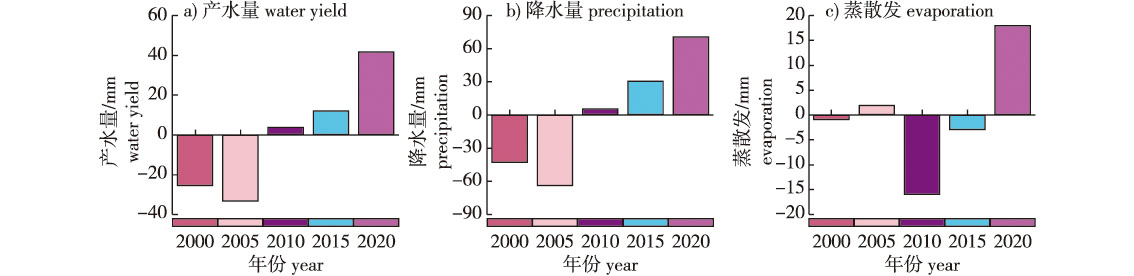
【Objective】Based on precipitation, climate, land use/cover change (LUCC), soil and other data from 2000 to 2020 in the Ulansuhai Nur basin, this study analyzed the spatiotemporal evolution characteristics of water yield and revealed their driving factors, aiming to provide a scientific basis for formulating rational water resource protection and utilization policies.【Method】The water yield module of the InVEST model was employed to simulate water yield during five periods (from 2000 to 2020) in the Ulansuhai Nur basin. The geographical detector model (GDM) was used to analyze the explanatory power of various factors on the spatial differentiation of water yield changes, while multiscale geographically weighted regression (MGWR) was applied to examine the localized influence of driving factors across different geographical locations.【Result】During the study period, the water yield in the Ulansuhai Nur basin showed an increasing trend, with a spatial distribution pattern of “lower in the west and higher in the east”, which was consistent with the temporal trend and spatial distribution of precipitation. Evapotranspiration levels exhibited minor fluctuations overall. LUCC trends were characterized by a reduction in the proportion of grassland and unused land. GDM results indicated significant differences in the explanatory power of various factors on water yield spatial differentiation, with elevation, soil, and the normalized difference vegetation index (NDVI) identified as the dominant factors. MGWR simulations revealed that climatic factors and soil showed negative effects on water yield, while other factors showed positive effects. Precipitation, elevation, and NDVI had stronger influences, with significant spatial heterogeneity observed across all factors.【Conclusion】Changes in water yield resulted from the combined effects of multiple factors. For future ecological conservation efforts in the Ulansuhai Nur basin, comprehensive consideration of the impacts of topography, climate, and changes in human activities on water yield services is essential.
InVEST model / geographical detector / multiscale geographically weighted regression / water yield / spatial differentiation / Ulansuhai Nur basin
| [1] |
程宪波, 陶宇, 欧维新. 生态系统服务与人类福祉关系研究进展[J]. 生态与农村环境学报, 2021, 37(7):885-893.
|
| [2] |
|
| [3] |
傅伯杰, 吕一河, 高光耀. 中国主要陆地生态系统服务与生态安全研究的重要进展[J]. 自然杂志, 2012, 34(5):261-272.
|
| [4] |
伍堂银, 周忠发, 张露, 等. 基于InVEST模型的南北盘江流域产水量时空变化研究[J]. 水土保持通报, 2023, 43(3):129-138.
|
| [5] |
贾雨凡, 王国庆. 基于InVEST模型的伊洛河流域水源涵养能力评估[J]. 水土保持学报, 2023, 37(3):101-108.
|
| [6] |
林峰, 陈兴伟, 姚文艺, 等. 基于SWAT模型的森林分布不连续流域水源涵养量多时间尺度分析[J]. 地理学报, 2020, 75(5):1065-1078.
|
| [7] |
崔越, 张利华, 吴宗钒, 等. 基于BEPS-Terrainlab v2.0模型鄂西犟河流域1999年—2016年蒸散发模拟分析[J]. 华中师范大学学报(自然科学版), 2020, 54(1):140-148.
|
| [8] |
刘娅, 朱文博, 韩雅, 等. 基于SOFM神经网络的京津冀地区水源涵养功能分区[J]. 环境科学研究, 2015, 28(3):369-376.
|
| [9] |
孙小银, 郭洪伟, 廉丽姝, 等. 南四湖流域产水量空间格局与驱动因素分析[J]. 自然资源学报, 2017, 32(4):669-679.
|
| [10] |
刘美娟, 仲俊涛, 王蓓, 等. 基于InVEST模型的青海湖流域产水功能时空变化及驱动因素分析[J]. 地理科学, 2023, 43(3):411-422.
|
| [11] |
彭赤彬, 钱湛, 姜恒, 等. 沅江流域产水服务功能的时空变化及驱动力分析[J]. 人民长江, 2023, 54(6):95-102,125.
|
| [12] |
|
| [13] |
顾晋饴, 李一平, 杜薇. 基于InVEST模型的太湖流域水源涵养能力评价及其变化特征分析[J]. 水资源保护, 2018, 34(3):62-67,84.
|
| [14] |
韩念龙, 张伟璇, 张亦清. 基于InVEST模型的海南岛产水量的时空变化研究[J]. 海南大学学报(自然科学版), 2021, 39(3):280-287.
|
| [15] |
周雪彤, 孙文义, 穆兴民, 等. 1990—2020年三江源水源涵养能力时空变化及影响因素[J]. 生态学报, 2023, 43(23):9844-9855.
|
| [16] |
|
| [17] |
高雅玉, 宋玉, 赵廷红, 等. 马莲河下游产水量时空演变特征[J]. 干旱区研究, 2024, 41(5):776-787.
|
| [18] |
朱志洪, 周本智, 王懿祥, 等. 近30年千岛湖流域产水量时空变化及其影响因子分析[J]. 南京林业大学学报(自然科学版), 2023, 47(3):111-119.
|
| [19] |
林世伟, 武瑞东. “三江并流” 区生态系统供水服务的空间分布特征[J]. 西部林业科学, 2015, 44(3):8-15.
|
| [20] |
郑续, 魏乐民, 郭建军, 等. 基于地理探测器的干旱区内陆河流域产水量驱动力分析:以疏勒河流域为例[J]. 干旱区地理, 2020, 43(6):1477-1485.
|
| [21] |
刘永婷, 杨钊, 徐光来, 等. 基于MGWR模型的皖江城市带生境质量对城镇化的响应研究[J]. 地理科学, 2023, 43(2):280-290.
|
| [22] |
梁晓瑶, 袁丽华, 宁立新, 等. 基于InVEST模型的黑龙江省生境质量空间格局及其影响因素[J]. 北京师范大学学报(自然科学版), 2020, 56(6):864-872.
|
| [23] |
包逸涛, 吴朝明, 朱骊, 等. 耦合InVEST与FLUS模型的无锡市产水量时空变化与预测[J]. 南京林业大学学报(自然科学版), 2025, 49(3):119-128.
|
| [24] |
周姣娣, 鲁栋梁, 许玉萍, 等. 基于InVEST和GIS模型的广西北部湾沿海地区碳储量时空演变研究[J]. 海洋环境科学, 2024, 43(5):715-722,732.
|
| [25] |
段鹏, 陈文波, 杨欢, 等. 生境破碎化过程对流域生境质量的影响[J]. 生态学报, 2024, 44(14):6053-6066.
|
| [26] |
王劲峰, 徐成东. 地理探测器:原理与展望[J]. 地理学报, 2017, 72(1):116-134.
|
| [27] |
周晓艳, 王海军, 黄欣, 等. 广佛都市圈生态系统服务权衡协同对城镇空间多维扩张的响应[J]. 应用生态学报, 2024, 35(7):1935-1943.
|
| [28] |
张旖琳, 吴相利, 王丽敏. 国家重点森林生态功能区产业生态化水平测度与产业-生态的协调发展[J]. 生态学报, 2024, 44(14):5985-6002.
|
| [29] |
邵全琴, 刘树超, 宁佳, 等. 2000—2019年中国重大生态工程生态效益遥感评估[J]. 地理学报, 2022, 77(9):2133-2153.
|
| [30] |
高秉丽. 土地利用和气候变化对黄河流域产水服务时空变化的影响[D]. 兰州: 兰州大学, 2022.
|
| [31] |
荔童, 梁小英, 张杰, 等. 基于贝叶斯网络的生态系统服务权衡协同关系及其驱动因子分析:以陕北黄土高原为例[J]. 生态学报, 2023, 43(16):6758-6771.
|
| [32] |
王晓峰, 符鑫鑫, 楚冰洋, 等. 秦岭生态屏障产水服务时空演变特征及驱动要素[J]. 自然资源学报, 2021, 36(10):2507-2521.
|
| [33] |
刘旭华, 张佳慧, 刘华民, 等. 基于种植结构改进的SWAT模型模拟乌梁素海流域面源污染负荷[J]. 环境工程学报, 2023, 17(8):2505-2514.
|
| [34] |
王懋源, 齐实, 郭衍瑞, 等. 藏东-川西生态维护水源涵养区产水量驱动机制[J]. 生态学报, 2024, 44(21):9520-9534.
|
| [35] |
薛曾辉, 高驭洋, 卢枰达, 等. 基于土地利用和地形的生态系统服务空间分布及权衡-协同-独立关系:以安塞区为例[J]. 水土保持研究, 2024, 31(2):240-251,263.
|
| [36] |
|
| [37] |
|
/
| 〈 |
|
〉 |