PDF(3385 KB)

Analysis of the occurrence regularity of adult Hyphantria cunea in Nanjing
YOU Linlin, DENG Yadi, XI Yueming, DAI Wei, LIU Hejia
Journal of Nanjing Forestry University (Natural Sciences Edition) ›› 2026, Vol. 50 ›› Issue (3) : 239-246.
PDF(3385 KB)
 PDF(3385 KB)
Analysis of the occurrence regularity of adult Hyphantria cunea in Nanjing
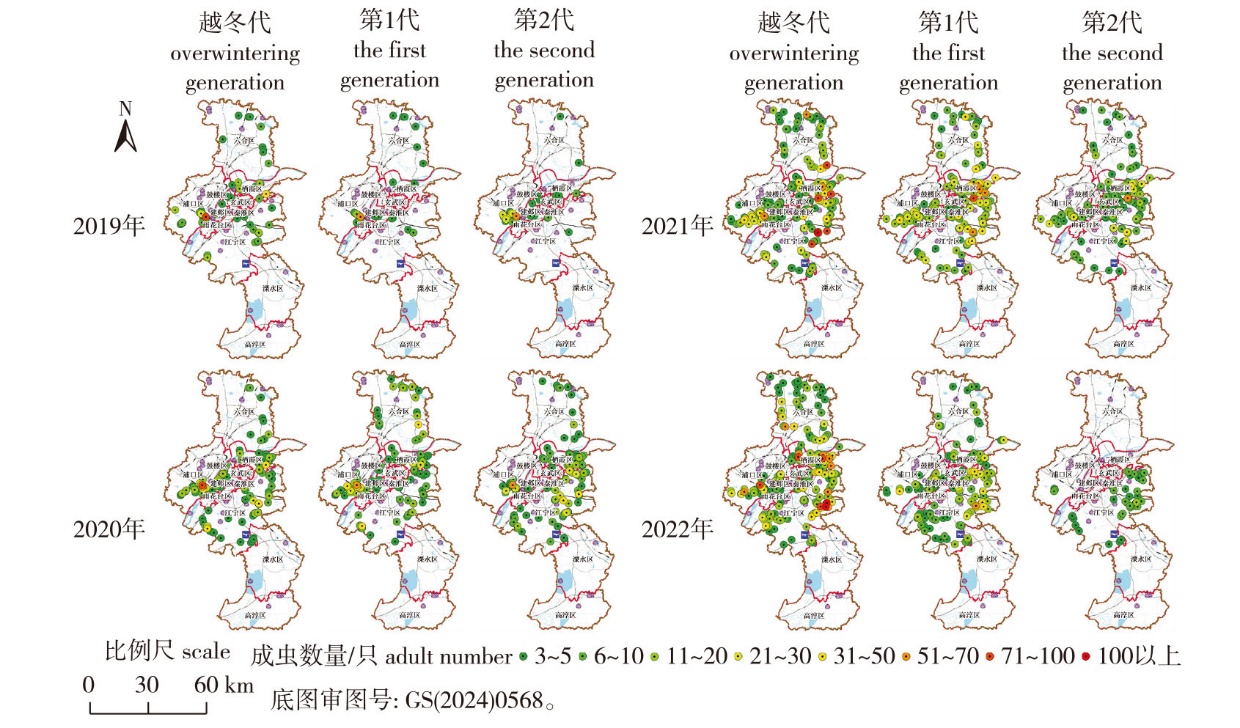
【Objective】This study aims to elucidate the occurrence regularity and spatial population distribution of adult Hyphantria cunea in Nanjing,in order to provide a scientific basis for its prevention and control.【Method】From 2019 to 2022,adult H. cunea were monitored annually using sex pheromone traps between April 1st and September 15th each year. The number of adults captured at each monitoring site was recorded to analyze interannual occurrence trends. The geostatistical method was applied to characterize the spatial distribution patterns of H. cunea across the study area. Semivariogram model parameters were calculated with the Autocorrelation tool in GS+ 9.0 software. Based on trap counts,monitoring sites were classified into eight density grades: 3-5,6-10,11-20,21-30,31-50,51-70,71-100,and >100 adults. Spatial distribution maps were generated using ArcGIS software. For each generation,the initial emergence,peak-start,peak,peak-end,and termination periods were determined. The STDEV function was used to compute theoretical interval values between the occurrence phases of adult H. cunea.【Result】From 2019 to 2021,adult catches showed a year-on-year increasing trend,followed by a decline in 2022. In Nanjing,H. cunea completes three generations per year. The overwintering generation exhibited the highest population abundance,with two developmental peaks,followed by the first generation; the second generation had the smallest population size. Adults of H. cunea were widely distributed across most parts of Nanjing,displaying an aggregated spatial distribution pattern. High-suitability areas for H. cunea included central urban zones,regions along major transportation corridors,areas adjacent to scenic spots,and neighborhoods surrounding water bodies. The average interval values between successive occurrence phases—from the initial emergence of the overwintering generation to the termination of the second generation—were 12.75,7.00,8.50,7.75,28.75,11.25,6.00,6.25,11.75,17.00,5.00,4.75,7.00 and 14.25 days,respectively.【Conclusion】H. cunea in Nanjing reproduces three generations annually. However,as the occurrence periods continue to advance,the potential for the emergence of a partial fourth generation is increasing. The spatial distribution of H. cunea is clustered,with high-suitability areas concentrated in central urban districts,transportation corridors,scenic spots,and riparian zones.
Hyphantria cunea / occurrence regularity / geostatistics / population distribution / Nanjing
| [1] |
|
| [2] |
陶萌萌, 马庆辉, 孟昭军, 等. 美国白蛾绿色防控研究进展[J]. 应用昆虫学报, 2023, 60 (1):13-22.
|
| [3] |
彭萌萌, 吴红渠, 张佳雯, 等. 基于 RNAi 技术解析美国白蛾HcAnk1和HcAnk2基因功能及对HcNPV 的敏感性[J]. 南京林业大学学报(自然科学版), 2024, 48 (3):181-190.
|
| [4] |
才琪, 朱宁波, 潘佳亮, 等. 四类重大林业有害生物的防控有效性分析[J]. 中国森林病虫, 2024, 43 (1):9-16.
|
| [5] |
赵旭东, 耿薏舒, 郝德君, 等. 美国白蛾防控技术的研究进展及展望[J]. 中国森林病虫, 2022, 41 (5):44-52.
|
| [6] |
国家林业和草原局公告 (2024年第6号)(2024年美国白蛾疫区)[EB/OL]. (2024-02-27)[2024-10-28]. https://www.forestry.gov.cn/lyj/1/gsgg/20240227/547471.html.
National Forestry and Grassland Administration Announcement[2024]No.6:The affected areas of Hyphantria cunea in 2024[EB/OL]. (2024-02-27) [2024-10-28]. https://www.forestry.gov.cn/lyj/1/gsgg/20240227/547471.html.
|
| [7] |
邓竣丹, 王海超, 许维康, 等. 不同寄主植物对美国白蛾肠道细菌群落的影响[J]. 植物保护学报, 2022, 49 (4):1201-1209.
|
| [8] |
赫传杰, 李加正, 王越, 等. 美国白蛾发生情况及2022年趋势预测[J]. 中国森林病虫, 2022, 41 (1):46-48.
|
| [9] |
纪烨琳, 苏喜友, 于治军. 基于随机森林模型的美国白蛾在中国的潜在生境预测[J]. 南京林业大学学报(自然科学版), 2019, 43 (6):121-128.
|
| [10] |
刘枫, 公超群, 李硕, 等. 基于不同气候情景的美国白蛾适生区预测[J]. 应用昆虫学报, 2023, 60 (1):76-86.
|
| [11] |
胡天义, 赵旭东, 耿薏舒, 等. 自主合成美国白蛾性信息素诱芯林间诱捕活性及应用[J]. 中国森林病虫, 2022, 41 (6):48-52.
|
| [12] |
国家林业局. 美国白蛾防治技术规程:LY/T2111—2013[S]. 北京: 中国标准出版社, 2013.
State Forestry Administration of the People’s Republic of China.Technical regulation for controlling Hyphantria cunea (Drury):LY/T 2111—2013[S]. Beijing: Standards Press of China, 2013.
|
| [13] |
刘永华, 郑羽墨, 阎雄飞, 等. 栎黄枯叶蛾低龄幼虫空间分布的地统计学分析[J]. 生态学报, 2018, 38 (15):5595-5601.
|
| [14] |
马志芳, 张大治, 贺泽帅, 等. 沙冬青豆荚螟-天敌空间分布的地统计学分析[J]. 植物保护, 2020, 46 (5):128-132.
|
| [15] |
孙鹏举, 骆有庆, 姚东华, 等. 柳毒蛾幼虫和蛹的空间分布的地统计学分析[J]. 植物保护学报, 2015, 42 (4):604-611.
|
| [16] |
李少华, 王云鹏, 王荣成, 等. 玉米田桃蛀螟幼虫的空间分布型与抽样技术[J]. 中国农业科学, 2022, 55 (10):1961-1970.
|
| [17] |
陈绘画, 郑玉成, 徐志宏. 用期距法预测松墨天牛成虫发生期[J]. 中国森林病虫, 2013, 32 (2):29-31.
|
| [18] |
周书永, 陈绘画, 徐卫民, 等. 松墨天牛成虫发生期预测[J]. 东北林业大学学报, 2013, 41 (7):100-103.
|
| [19] |
孙博, 王会军, 黄艳艳, 等. 2022年夏季中国高温干旱气候特征及成因探讨[J]. 大气科学学报, 2023, 46 (1):1-8.
|
| [20] |
李慧, 郝德君, 徐天, 等. 高温胁迫对植食性昆虫影响研究进展[J]. 南京林业大学学报(自然科学版), 2022, 46(6):215-224.
|
| [21] |
|
| [22] |
薛明宇, 郝德君, 赵旭东, 等. 极端气候对美国白蛾在我国潜在适生区分布的影响预测[J]. 南京林业大学学报(自然科学版), 2024, 48(5):197-203.
|
| [23] |
杜晶晶, 张越, 潘彦平, 等. 北京地区美国白蛾时空分布变化及其影响因素[J]. 生态学报, 2023, 43 (13):5480-5490.
|
| [24] |
|
| [25] |
|
| [26] |
戴伟, 奚月明, 游琳琳, 等. 南京城区美国白蛾发生规律探析[J]. 江苏林业科技, 2024, 51 (2):14-20,52.
|
| [27] |
卢修亮, 谢天, 程相称, 等. 美国白蛾在我国发生的世代变化分析[J]. 生物安全学报, 2023, 32 (1):1-7.
|
| [28] |
邱莹, 王玮, 赵吕权. 美国白蛾在我国由北向南扩散过程中体型与繁殖能力的地理变异[J]. 中南林业科技大学学报, 2020, 40 (11):65-72.
|
| [29] |
杨明琪. 不同气候情景下美国白蛾在我国的适生区预测[D]. 北京: 中国林业科学研究院, 2013.
|
| [30] |
王昶远. 美国白蛾在辽宁发生三代的调查及原因[J]. 森林病虫通讯, 2000, 19 (3):27-29.
|
| [31] |
黄广育. 上海金山区美国白蛾发生规律初探[J]. 中国森林病虫, 2022, 41 (2):27-31.
|
| [32] |
邱立新, 卢修亮, 林晓, 等. 我国美国白蛾防控历程与新时期策略探讨[J]. 中国森林病虫, 2022, 41 (6):1-7.
|
| [33] |
|
| [34] |
李德斌, 卢修亮, 何姍, 等. 东北地区美国白蛾灾害扩散过程和趋势分析[J]. 中国森林病虫, 2023, 42 (2):9-15.
|
/
| 〈 |
|
〉 |