Seasonal dynamic on biomass and morphological structure of absorptive root between female and male Fraxinus mandshurica

JIA Hongtao, WEI Xing, LI Wei, WU Chunze, WEI Qingyu, HAN Chunli

Journal of Nanjing Forestry University (Natural Sciences Edition) ›› 2026, Vol. 50 ›› Issue (2) : 149-157.

PDF(2377 KB)
PDF(2377 KB)
Journal of Nanjing Forestry University (Natural Sciences Edition) ›› 2026, Vol. 50 ›› Issue (2) : 149-157. DOI: 10.12302/j.issn.1000-2006.202410037

Seasonal dynamic on biomass and morphological structure of absorptive root between female and male Fraxinus mandshurica

Author information +
History +

Abstract

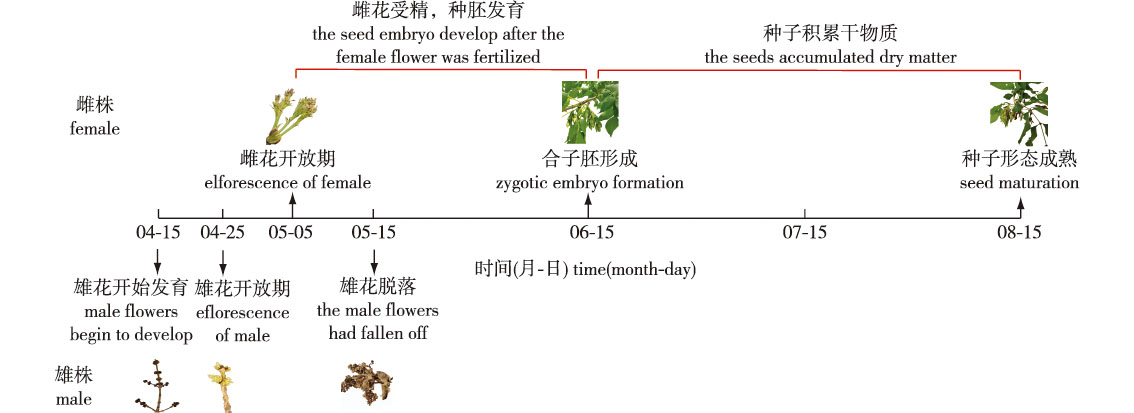
【Objective】This study aims to clarify the relationship between absorptive root development and reproductive processes in dioecious Fraxinus mandshurica, investigate gender dimorphism in root traits, and provide insights for sex-specific nutrient management strategies.【Method】Using mature female and male F. mandshurica trees, fine root samples (orders 1-3) were collected across the growing season (April-August) via soil coring. Root biomass, morphology, anatomical structure, and mycorrhizal infection rate were analyzed using root scanning and paraffin sectioning techniques.【Result】Absorptive root biomass increased seasonally in both sexes. Before male flowering, root biomass was similar between genders. From male flowering to female flowering, male root biomass increased by 33.14%, while female biomass remained unchanged. During seed development, both sexes exhibited marked increases in root biomass-females by 481.63% and males by 393.90% (P<0.05).Root length density was consistently higher in males, with the 1st-order root length density being 2.27 times greater in males at seed maturity. Gender-specific seasonal patterns were observed in root diameter, with male 1st-order roots being 21.80% (June) and 15.52% (August) thicker than females (P<0.05). Anatomical analysis revealed that this was due to greater cortical thickness in males (11.57% and 7.73% higher in June and August, respectively; P<0.05), while vascular bundle diameter did not differ. Mycorrhizal infection rate was also higher in males (by 4.45% in June and 3.84% in August).【Conclusion】Seasonal dynamics of absorptive root biomass in F. mandshurica are closely linked to reproductive phenology. Males exhibited earlier root development and maintained higher absorptive root biomass throughout the growing season. The observed gender differences in root morphology, anatomy and mycorrhizal association highlight distinct belowground strategies between female and male trees.
Key words

Fraxinus mandshurica / dioecy / absorptive root / root biomass / root morphology / root anatomy / seasonal dynamics

Cite this article

Download Citations
JIA Hongtao , WEI Xing , LI Wei , et al . Seasonal dynamic on biomass and morphological structure of absorptive root between female and male Fraxinus mandshurica[J]. Journal of Nanjing Forestry University (Natural Sciences Edition). 2026, 50(2): 149-157 https://doi.org/10.12302/j.issn.1000-2006.202410037

References

[1]
YU Q, BARRETT S C H, WANG X J, et al. Sexual dimorphism,temporal niche differentiation,and evidence for the Jack Sprat effect in an annual dioecious plant[J]. Journal of Systematics and Evolution, 2022, 60(5):1078-1091. DOI: 10.1111/jse.12753.
[2]
XIA Z C, HE Y, YU L, et al. Sex-specific strategies of phosphorus (P) acquisition in Populus cathayana as affected by soil P availability and distribution[J]. New Phytologist, 2020, 225(2):782-792. DOI: 10.1111/nph.16170.
[3]
ESPÍRITO-SANTO M M, MADEIRA B G, NEVES F S, et al. Sexual differences in reproductive phenology and their consequences for the demography of Baccharis dracunculifolia (Asteraceae),a dioecious tropical shrub[J]. Annals of Botany, 2003, 91(1):13-19. DOI: 10.1093/aob/mcg001.
[4]
SÁNCHEZ VILAS J, PANNELL J R. Sexual dimorphism in resource acquisition and deployment:both size and timing matter[J]. Annals of Botany, 2011, 107(1):119-126. DOI: 10.1093/aob/mcq209.
[5]
LEROY C, CARRIAS J F, CÉRÉGHINO R, et al. The contribution of microorganisms and metazoans to mineral nutrition in bromeliads[J]. Journal of Plant Ecology, 2016, 9(3):241-255. DOI: 10.1093/jpe/rtv052.
[6]
谷加存, 王东男, 夏秀雪, 等. 功能划分方法在树木细根生物量研究中的应用:进展与评述[J]. 植物生态学报, 2016, 40(12):1344-1351.
GU J C, WANG D N, XIA X X, et al. Applications of functional classification methods for tree fine root biomass estimation:advancements and synthesis[J]. Chinese Journal of Plant Ecology, 2016, 40(12):1344-1351. DOI: 10.17521/cjpe.2016.0167.
[7]
IVERSEN C M. Using root form to improve our understanding of root function[J]. New Phytologist, 2014, 203(3):707-709. DOI: 10.1111/nph.12902.
[8]
MCCORMACK M L, DICKIE I A, EISSENSTAT D M, et al. Redefining fine roots improves understanding of below-ground contributions to terrestrial biosphere processes[J]. New Phytologist, 2015, 207(3):505-518. DOI: 10.1111/nph.13363.
[9]
FRESCHET G T, PAGÈS L, IVERSEN C M, et al. A starting guide to root ecology:strengthening ecological concepts and standardising root classification,sampling,processing and trait measurements[J]. New Phytologist, 2021, 232(3):973-1122. DOI: 10.1111/nph.17572.
[10]
GUO D L, XIA M X, WEI X, et al. Anatomical traits associated with absorption and mycorrhizal colonization are linked to root branch order in twenty-three Chinese temperate tree species[J]. New Phytologist, 2008, 180(3):673-683. DOI: 10.1111/j.1469-8137.2008.02573.x.
[11]
PREGITZER K S, DEFOREST J L, BURTON A J, et al. Fine root architecture of nine North American trees[J]. Ecological Monographs, 2002, 72(2):293-309. DOI: 10.1890/0012-9615(2002)072[0293:FRAONN]2.0.CO;2.
[12]
DU X Z, WEI X. Definition of fine roots on the basis of the root anatomy,diameter,and branch orders of one-year old Fraxinus mandshurica seedlings[J]. Journal of Forestry Research, 2018, 29(5):1321-1327. DOI: 10.1007/s11676-017-0561-x.
[13]
WANG Z Q, GUO D L, WANG X R, et al. Fine root architecture,morphology,and biomass of different branch orders of two Chinese temperate tree species[J]. Plant and Soil, 2006, 288(1):155-171. DOI: 10.1007/s11104-006-9101-8.
[14]
GU J C, XU Y, DONG X Y, et al. Root diameter variations explained by anatomy and phylogeny of 50 tropical and temperate tree species[J]. Tree Physiology, 2014, 34(4):415-425. DOI: 10.1093/treephys/tpu019.
[15]
ZHU Z, QI F H, YAN C F, et al. Sexually different morphological,physiological and molecular responses of Fraxinus mandshurica flowers to floral development and chilling stress[J]. Plant Physiology and Biochemistry, 2016, 99:97-107. DOI: 10.1016/j.plaphy.2015.12.006.
[16]
ZHANG C Y, ZHAO X H, GAO L S, et al. Gender,neighboring competition and habitat effects on the stem growth in dioecious Fraxinus mandshurica trees in a northern temperate forest[J]. Annals of Forest Science, 2009, 66(8):812. DOI: 10.1051/forest/2009068.
[17]
HARRIS M S, PANNELL J R. Roots,shoots and reproduction:sexual dimorphism in size and costs of reproductive allocation in an annual herb[J]. Proceedings.Biological Sciences, 2008, 275(1651):2595-2602. DOI: 10.1098/rspb.2008.0585.
[18]
杜欣竹. 不同发育阶段水曲柳菌根和根毛的时空异质性[D]. 哈尔滨: 东北林业大学, 2018.
DU X Z. Spatial and temporal heterogeneity in the mycorrhiza fungi and root hair of Fraxinus mandshurica trees with different developmental stages[D]. Harbin: Northeast Forestry University, 2018.
[19]
盛萍萍, 刘润进, 李敏. 丛枝菌根观察与侵染率测定方法的比较[J]. 菌物学报, 2011, 30(4):519-525.
SHENG P P, LIU R J, LI M. Methodological comparison of observation and colonization measurement of arbuscular mycorrhizal fungi[J]. Mycosystema, 2011, 30(4):519-525. DOI: 10.13346/j.mycosystema.2011.04.002.
[20]
TEITEL Z, PICKUP M, FIELD D L, et al. The dynamics of resource allocation and costs of reproduction in a sexually dimorphic,wind-pollinated dioecious plant[J]. Plant Biology, 2016, 18(1):98-103. DOI: 10.1111/plb.12336.
[21]
ABRAMOFF R Z, FINZI A C. Are above-and below-ground phenology in sync?[J]. New Phytologist, 2015, 205(3):1054-1061. DOI: 10.1111/nph.13111.
[22]
JOSLIN J D, WOLFE M H, HANSON P J. Factors controlling the timing of root elongation intensity in a mature upland oak stand[J]. Plant and Soil, 2001, 228(2):201-212. DOI: 10.1023/A:1004866705021.
[23]
STEINAKER D F, WILSON S D. Phenology of fine roots and leaves in forest and grassland[J]. Journal of Ecology, 2008, 96(6):1222-1229. DOI: 10.1111/j.1365-2745.2008.01439.x.
[24]
SCHWIEGER S, BLUME-WERRY G, PETERS B, et al. Patterns and drivers in spring and autumn phenology differ above-and belowground in four ecosystems under the same macroclimatic conditions[J]. Plant and Soil, 2019, 445(1):217-229. DOI: 10.1007/s11104-019-04300-w.
[25]
ALVAREZ-URIA P, KÖRNER C. Low temperature limits of root growth in deciduous and evergreen temperate tree species[J]. Functional Ecology, 2007, 21(2):211-218. DOI: 10.1111/j.1365-2435.2007.01231.x.
[26]
DRUEGE U, KADNER R. Response of post-storage carbohydrate levels in Pelargonium cuttings to reduced air temperature during rooting and the relationship with leaf senescence and adventitious root formation[J]. Postharvest Biology and Technology, 2008, 47(1):126-135. DOI: 10.1016/j.postharvbio.2007.06.008.
[27]
MEI L, XIONG Y M, GU J C, et al. Whole-tree dynamics of non-structural carbohydrate and nitrogen pools across different seasons and in response to girdling in two temperate trees[J]. Oecologia, 2015, 177(2):333-344. DOI: 10.1007/s00442-014-3186-1.
[28]
LIU M, KORPELAINEN H, LI C Y. Sexual differences and sex ratios of dioecious plants under stressful environments[J]. Journal of Plant Ecology, 2021, 14(5):920-933. DOI: 10.1093/jpe/rtab038.
[29]
ZHANG S, JIANG H, PENG S M, et al. Sex-related differences in morphological,physiological,and ultrastructural responses of Populus cathayana to chilling[J]. Journal of Experimental Botany, 2011, 62(2):675-686.
[30]
OBESO J R. The costs of reproduction in plants[J]. New Phytologist, 2002, 155(3):321-348. DOI: 10.1046/j.1469-8137.2002.00477.x.
[31]
DESOTO L, OLANO J M, ROZAS V. Secondary growth and carbohydrate storage patterns differ between sexes in Juniperus thurifera[J]. Frontiers in Plant Science, 2016, 7:723. DOI: 10.3389/fpls.2016.00723.
[32]
ARIEL H M, ALEJANDRO R J F. Sex-related climate sensitivity of Araucaria araucana Patagonian forest-steppe ecotone[J]. Forest Ecology and Management, 2016, 362:130-141. DOI: 10.1016/j.foreco.2015.11.049.
[33]
ZHANG C Y, ZHAO X H, GAO L S, et al. Gender-related distributions of Fraxinus mandshurica in secondary and old-growth forests[J]. Acta Oecologica, 2010, 36(1):55-62. DOI: 10.1016/j.actao.2009.10.001.
[34]
CHEN W L, KOIDE R T, ADAMS T S, et al. Root morphology and mycorrhizal symbioses together shape nutrient foraging strategies of temperate trees[J]. PNAS, 2016, 113(31):8741-8746. DOI: 10.1073/pnas.1601006113.
[35]
FRESCHET G T, ROUMET C, COMAS L H, et al. Root traits as drivers of plant and ecosystem functioning:current understanding,pitfalls and future research needs[J]. New Phytologist, 2021, 232(3):1123-1158. DOI: 10.1111/nph.17072.
[36]
NOWAK K, GIERTYCH M J, PERS-KAMCZYC E, et al. Rich but not poor conditions determine sex-specific differences in growth rate of juvenile dioecious plants[J]. Journal of Plant Research, 2021, 134(5):947-962. DOI: 10.1007/s10265-021-01296-2.
[37]
WANG Y H, ZHANG N L, WANG M Q, et al. Sex-specific differences in the physiological and biochemical performance of arbuscular mycorrhizal fungi-inoculated mulberry clones under salinity stress[J]. Frontiers in Plant Science, 2021, 12:614162. DOI: 10.3389/fpls.2021.614162.
[38]
NICOTRA A B, CHAZDON R L, MONTGOMERY R A. Sexes show contrasting patterns of leaf and crown carbon gain in a dioecious rainforest shrub[J]. American Journal of Botany, 2003, 90(3):347-355. DOI: 10.3732/ajb.90.3.347.
[39]
NOWAK-DYJETA K, GIERTYCH M J, THOMAS P, et al. Males and females of Juniperus communis L.and Taxus baccata L.show different seasonal patterns of nitrogen and carbon content in needles[J]. Acta Physiologiae Plantarum, 2017, 39(8):191. DOI: 10.1007/s11738-017-2489-3.
[40]
NICOTRA A B. Reproductive allocation and the long-term costs of reproduction in Siparuna grandiflora,a dioecious neo-tropical shrub[J]. Journal of Ecology, 1999, 87(1):138-149. DOI: 10.1046/j.1365-2745.1999.00337.x.
[41]
MATSUYAMA S, SAKIMOTO M. Sexual dimorphism of reproductive allocation at shoot and tree levels in Zanthoxylum ailanthoides,a pioneer dioecious tree[J]. Botany, 2010, 88(10):867-874. DOI: 10.1139/b10-058.
[42]
TORIMARU T, TOMARU N. Reproductive investment at stem and genet levels in male and female plants of the clonal dioecious shrub Ilex leucoclada (A quifoliaceae)[J]. Botany, 2012, 90(4):301-310. DOI: 10.1139/b2012-004.
[43]
卫星, 刘颖, 陈海波. 黄波罗不同根序的解剖结构及其功能异质性[J]. 植物生态学报, 2008, 32(6):1238-1247.
WEI X, LIU Y, CHEN H B. Anatomical and functional heterogeneity among different root orders of Phellodendron amurense[J]. Journal of Plant Ecology (Chinese Version), 2008, 32(6):1238-1247. DOI: 10.3773/j.issn.1005-264x.2008.06.004.
[44]
MA Z Q, GUO D L, XU X L, et al. Evolutionary history resolves global organization of root functional traits[J]. Nature, 2018, 555(7694):94-97. DOI: 10.1038/nature25783.
[45]
王文娜, 王燕, 王韶仲, 等. 氮有效性增加对细根解剖、形态特征和菌根侵染的影响[J]. 应用生态学报, 2016, 27(4):1294-1302.
WANG W N, WANG Y, WANG S Z, et al. Effects of elevated N availability on anatomy,morphology and mycorrhizal colonization of fine roots:a review[J]. Chinese Journal of Applied Ecology, 2016, 27(4):1294-1302. DOI: 10.13287/j.1001-9332.201604.032.
PDF(2377 KB)

Accesses

Citation

Detail

Sections
Recommended
The full text is translated into English by AI, aiming to facilitate reading and comprehension. The core content is subject to the explanation in Chinese.

/