Research on canopy water content of different forest stands based on hyperspectral analysis

ZHANG Shuifeng, ZHANG Jinchi, ZHANG Yang, ZHENG Huaibing, GU Zheyan, LIU Xin

Journal of Nanjing Forestry University (Natural Sciences Edition) ›› 2025, Vol. 49 ›› Issue (6) : 238-246.

PDF(2268 KB)
PDF(2268 KB)
Journal of Nanjing Forestry University (Natural Sciences Edition) ›› 2025, Vol. 49 ›› Issue (6) : 238-246. DOI: 10.12302/j.issn.1000-2006.202411004

Research on canopy water content of different forest stands based on hyperspectral analysis

Author information +
History +

Abstract

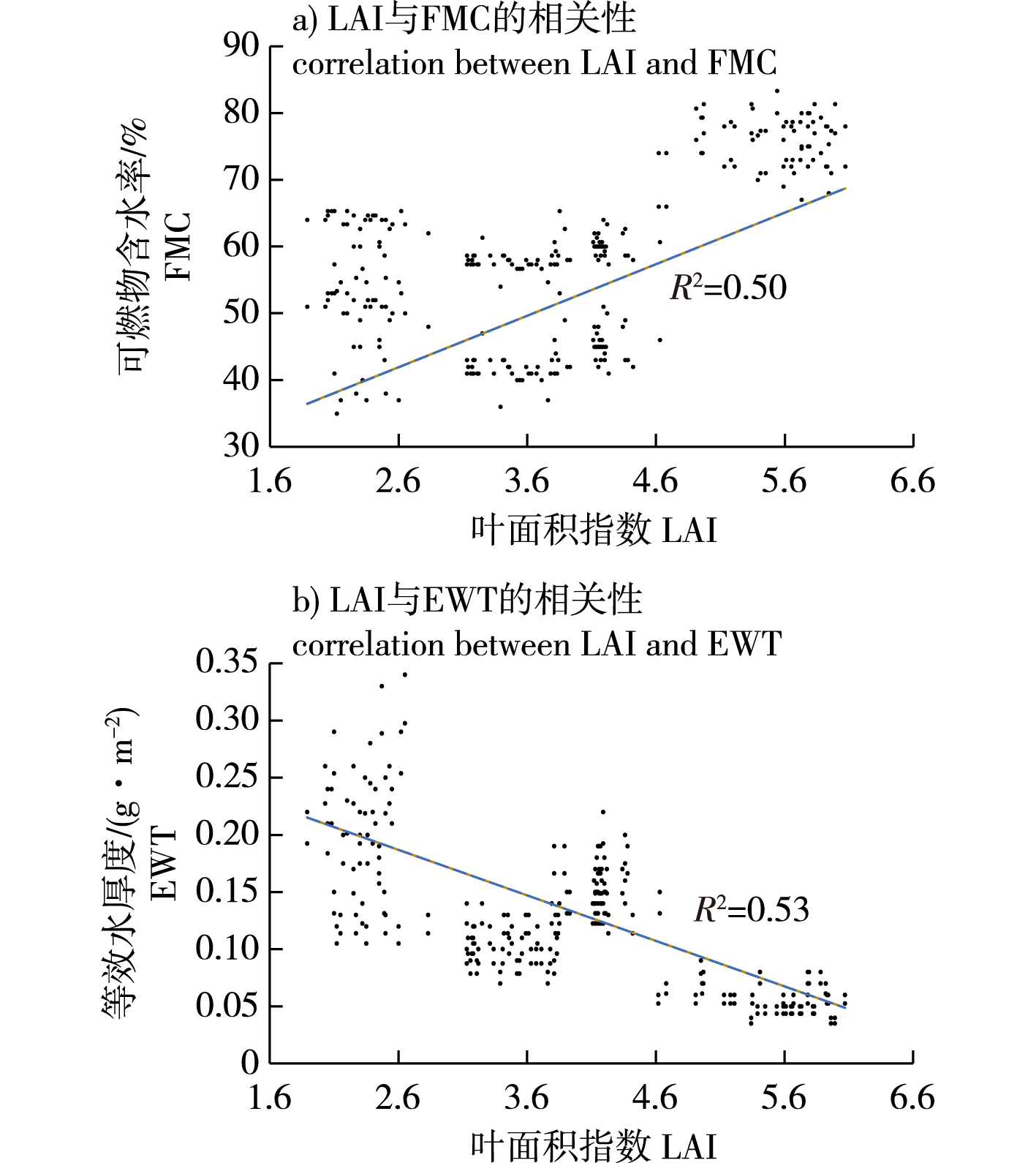
【Objective】Canopy fuel moisture parameters play a crucial role in assessing the physiological status of forest plants and fire risk. This study primarily explores methods for estimating vegetation canopy fuel moisture characteristic parameters using field hyperspectral data, providing a new approach for rapidly and non-destructively acquiring vegetation canopy moisture characteristic information to assess forest fuel fire risk.【Method】For canopy samples from four forest types, including Pinus massoniana, P. taeda, Camphora officinarum and Photinia serratifolia, spectral reflectance data, leaf area, fresh weight, dry weight, and leaf area index (LAI) were obtained through field sampling and laboratory experiments. Correlations between LAI and moisture characteristic variables (FMC, EWT, FMCC and EWTC) were analyzed. Partial least squares regression (PLSR) and artificial neural networks (ANN) were used to predict and estimate the moisture characteristic parameters FMCC and EWTC.【Result】The correlation between LAI and FMCC (R2=0.86) was significantly higher than that between LAI and EWTC(R2=0.04), while the correlation between LAI and EWT (R2=0.52) was slightly higher than that between LAI and FMC (R2=0.50). The estimation and validation processes for the aggregated samples of FMCC and EWTC across the four forest stand types showed that the coefficient of determination for the PLSR method was higher than that for the ANN, while the root mean square error was lower. In the estimation of EWTC and FMCC values for canopy fuel moisture characteristic variables in the four different forest types, the mean R2 value was 0.73 and the mean RMSEcv was 0.22 when using the PLSR method. P. massoniana showed the best performance (FMCC: R2=0.80, RMSECV=0.02; EWTC: R2=0.74, RMSECV=0.19). When using the ANN method, the mean R2 value was 0.76 and the mean RMSEcv was 0.20. The best performance was observed for the estimation of FMCC in P. massoniana ( R C V 2=0.91, RMSECV=0.12) and EWTC in P. taeda ( R C V 2=0.90, RMSECV=0.01) using ANN-2 as input.【Conclusion】Both EWTC and FMCC can be accurately predicted from reflectance spectra. As a mass-based variable, FMCC can achieve higher estimation accuracy than the area-based variable EWTC through both PLSR and ANN methods. Plant mass may play a more significant role than plant area in determining spectral emissivity, indicating that fuel mass factors have a greater impact on the inversion of spectral reflectance moisture characteristics, while leaf area has a relatively smaller influence. Overall, the hyperspectral data of forest stand canopy obtained through field measurements are effective in estimating fuel moisture characteristic parameters, and can provide valuable support for forest fuel fire risk prediction, forecasting, and level assessment.
Key words

canopy / hyperspectral / fuel moisture content / equivalent water thickness / north subtropical zone

Cite this article

Download Citations
ZHANG Shuifeng , ZHANG Jinchi , ZHANG Yang , et al . Research on canopy water content of different forest stands based on hyperspectral analysis[J]. Journal of Nanjing Forestry University (Natural Sciences Edition). 2025, 49(6): 238-246 https://doi.org/10.12302/j.issn.1000-2006.202411004

References

[1]
ANDREW S, ELAINE B, TIINA K. A UNEP rapid response assessment: spreading like wildfire-the rising threat of extraordinary landscape fires[R]. Nairobi: United Nations Environment Programme, 2022.
[2]
BOWMAN D M J S, BALCH J K, ARTAXO P. Fire in the earth system[J]. Science, 2009, 324(5926):481-484. DOI:10.1126/science.116388.
[3]
赵志霞, 李正才, 周君刚, 等. 火烧对北亚热带杉木林土壤有机碳的影响[J]. 林业科学研究, 2016, 29(2):301-305.
ZHAO Z X, LI Z C, ZHOU J G, et al. Effects of fire on soil organic carbon of Cunninghamia lanceolata stands in north subtropical area[J]. Forest Research, 2016, 29(2):301-305. DOI:10.13275/j.cnki.lykxyj.2016.02.024.
[4]
李史欣, 张福全, 林海峰. 基于机器学习算法的森林火灾风险评估研究[J]. 南京林业大学学报(自然科学版), 2023, 47(5):49-56.
LI S X, ZHANG F Q, LIN H F. Research on forest fire risk evaluation based on machine learning algorithm[J]. Journal of Nanjing Forestry University (Natural Sciences Edition), 2023, 47(5):49-56. DOI:10.12302/j.issn.1000-2006.202202004.
[5]
MILTON J E, SCHAEPMAN E M, ANDERSON K, et al. Progress in field spectroscopy[J]. Remote Sensing of Environment, 2009, 113: S92-S109. DOI:10.1016/j.rse.2007.08.001
[6]
MEINGAST M K, FALKOWSKI J M, KANE S E, et al. Spectral detection of near-surface moisture content and water-table position in northern peatland ecosystems[J]. Remote Sensing of Environment, 2014, 152: 536-546. DOI:10.1016/j.rse.2014.07.014
[7]
HE C M, SUN J, CHEN Y W, et al. PROSPECT-GPR: exploring spectral associations among vegetation traits in wavelength selection for leaf mass per area and water contents[J]. Science of Remote Sensing, 2023, 8: 100100. DOI: 10.1016/j.srs.2023.100100.
[8]
FENG S J, QIU J X, CROW T W, et al. Improved estimation of vegetation water content and its impact on L-band soil moisture retrieval over cropland[J]. Journal of Hydrology, 2023, 617: 129015. DOI:10.1016/j.jhydrol.2022.129015
[9]
MIRZAIE M, DARVISHZADEH R, SHAKIBA A, et al. Comparative analysis of different uni-and multi-variate methods for estimation of vegetation water content using hyper-spectral measurements[J]. International Journal of Applied Earth Observation and Geoinformation, 2014, 26: 1-11. DOI:10.1016/j.jag.2013.04.004
[10]
NEINAVAZ E, SKIDMORE K A, DARVISHZADEH R, et al. Retrieving vegetation canopy water content from hyperspectral thermal measurements[J]. Agricultural and Forest Meteorology, 2017, 247: 365-375. DOI:10.1016/j.agrformet.2017.08.020.
[11]
DONG G N, CHEN S H, LIU K, et al. Spatiotemporal variation in sensitivity of urban vegetation growth and greenness to vegetation water content: evidence from Chinese megacities[J]. Science of The Total Environment, 2023, 905: 1067090. DOI:10.1016/j.scitotenv.2023.167090.
[12]
CLAUDIO H C, CHENG Y, FUENTES D A, et al. Monitoring drought effects on vegetation water content and fluxes in chaparral with the 970 nm water band index[J]. Remote Sensing of Environment. 2006, 103(3):304-311. DOI:10.1016/j.rse.2005.07.015.
[13]
张玉春, 孔林毅, 郭瀚文, 等. 燃料载荷和含水率对平坡地表火蔓延影响实验研究[J]. 消防科学与技术, 2022, 41(2):261-265.
ZHANG Y C, KONG L Y, GUO H W, et al. Experimental study on the effects of fuel load and water content on surface fire spread over flat fuel bed[J]. Fire Science and Technology, 2022, 41(2):261-265.DOI:10.3969/j.issn.1009-0029.2022.02.024.
[14]
XING W Q, YANG L L, WANG W G, et al. Environmental controls on carbon and water fluxes of a wheat-maize rotation cropland over the Huaibei Plain of China[J]. Agricultural Water Management, 2023, 283:108310. DOI:10.1016/j.agwat.2023.108310.
[15]
COLOMBO R, MERONI M, MARCHESI A, et al. Estimation of leaf and canopy water content in poplar plantations by means of hyperspectral indices and inverse modeling[J]. Remote Sensing of Environment, 2008. 112(4), 1820-1834. DOI:10.1016/j.rse.2007.09.005.
[16]
CHENG Y B, ZARCO-TEJADA P J, RIAÑO D, et al. Estimating vegetation water content with hyperspectral data for different canopy scenarios: relationships between AVIRIS and MODIS indexes[J]. Remote Sensing of Environment, 105(4):354-366. DOI:10.1016/j.rse.2006.07.005.
[17]
BUITRAGO M F, GROEN T A, HECKER C A, et al. Changes in thermal infrared spectra of plants caused by temperature and water stress[J]. ISPRS Journal of Photogrammetry and Remote Sensing, 2016, 111:22-31. DOI:10.1016/j.isprsjprs.2015.11.003.
[18]
HUNT JR E R, USTIN S L, RIAÑO D. Remote sensing of leaf, canopy, and vegetation water contents for satellite environmental data records[A]// QU J, POWELL A, SIVAKUMAR M. Remote sensing of leaf, canopy, and vegetation water contents for satellite environmental data records[A]// QU J, POWELL A, SIVAKUMAR M. Satellite-based publications on climate change[M]. Berlin: Springer, 2013:335-357. DOI:10.1007/978-94-007-5872-8-20.
[19]
张佳华, 许云, 姚凤梅, 等. 植被含水量光学遥感估算方法研究进展[J]. 中国科学:技术科学, 2010, 40(10):1121-1129.
ZHANG J H, XU Y, YAO F M, et al. Advances in estimation methods of vegetation water content based on optical remote sensing techniques[J]. Scientia Sinica (Technologica), 2010, 40(10):1121-1129. DOI:10.1007/s11431-010-0131-3.
[20]
FAN L, WIGNERON J P, XIAO Q, et al. Evaluation of microwave remote sensing for monitoring live fuel moisture content in the Mediterranean region[J]. Remote Sensing of Environment, 2018, 205:210-223.DOI: 10.1016/j.rse.2017.11.020.
[21]
VIÑUALES A, MONTES F, GUIJARRO M, et al. Real-time assessment of live forest fuel moisture content and flammability by using space-time universal Kriging[J]. Ecological Modelling, 2024,498:110867.DOI: 10.1016/j.ecolmodel.2024.110867.
[22]
王希, 陈桂芬, 曹丽英, 等. 等效水厚度梯度的玉米叶片氮素反演模型研究[J]. 光谱学与光谱分析, 2022, 42(9):2913-2918.
WANG X, CHEN G F, CAO L Y, et al. Study on maize leaf nitrogen inversion model based on equivalent water thickness gradient[J]. Spectroscopy and Spectral Analysis,2022, 42(9):2913-2918.DOI: 10.3964/j.issn.1000-0593(2022)09-2913-06.
[23]
马岩川, 刘浩, 陈智芳, 等. 基于高光谱指数的棉花冠层等效水厚度估算[J]. 中国农业科学, 2019, 52(24):4470-4483.
MA Y C, LIU H, CHEN Z F, et al. Canopy equivalent water thickness estimation of cotton based on hyperspectral index[J]. Scientia Agricultura Sinica, 2019, 52(24):4470-4483.DOI: 10.3864/j.issn.0578-1752.2019.24.003.
[24]
仝春艳, 马驿, 杨振忠, 等. 基于角度指数的油菜叶片等效水厚度估算研究[J]. 核农学报, 2019, 33(1):187-198.
TONG C Y, MA Y, YANG Z Z, et al. Estimation of equivalent water thickness of rapeseed leaves based on angle index[J]. Journal of Nuclear Agricultural Sciences, 2019, 33(1):187-198.DOI: 10.11869/j.issn.100-8551.2019.01.0187.
[25]
闻宏睿, 国巧真, 魏书精, 等. 基于PROSAIL模型的广州市过渡带森林植被冠层可燃物含水率估算[J]. 热带地理, 2023, 43(3):545-553.
WEN H R, GUO Q Z, WEI S J, et al. Estimation of fuel water content in the forest ecotone of Guangzhou based on the PROSAIL model[J]. Tropical Geography, 2023, 43(3):545-553.DOI: 10.13284/j.cnki.rddl.003648.
[26]
全兴文, 何彬彬, 刘向茁, 等. 多模型耦合下的植被冠层可燃物含水率遥感反演[J]. 遥感学报, 2019, 23(1):62-77.
QUAN X W, HE B B, LIU X Z, et al. Retrieval of fuel moisture content by using radiative transfer models from optical remote sensing data[J]. Journal of Remote Sensing, 2019, 23(1):62-77. DOI: 10.11834/jrs.20197422.
[27]
沙莎, 胡蝶, 王丽娟, 等. 基于Landsat 8 OLI数据的黄土高原植被含水量的估算模型研究[J]. 遥感技术与应用, 2016, 31(3):558-563.
SHA S, HU D, WANG L J, et al. Vegetation water content retrieved using Landsat 8 OLI remote sensing data on Loess Plateau[J]. Remote Sensing Technology and Application, 2016, 31(3):558-563.DOI: 10.11873/j.issn.1004-03232016.3.0558.
[28]
冯小兵, 曾宇怀, 吴泽鹏, 等. 基于卫星多光谱的广东亚热带森林FMC遥感反演[J]. 电子科技大学学报, 2022, 51(3):432-437.
FENG X B, ZENG Y H, WU Z P, et al. Remote sensing retrieval of FMC in subtropical forests of Guangdong based on satellite multispectral data[J]. Journal of University of Electronic Science and Technology of China, 2022, 51(3):432-437.DOI: 10.12178/1001-0548.2021361.
[29]
张水锋, 彭徐剑, 张思玉. 火干扰对人工林土壤团聚体结构稳定性的影响[J]. 西南林业大学学报(自然科学), 2023, 43(3):103-110.
ZHANG S F, PENG X J, ZHANG S Y. Effects of fire disturbance on the structural stability of plantation soil aggregates[J]. Journal of Southwest Forestry University (Natural Sciences Edition), 2023, 43(3):103-110. DOI: 10.11929/j.swfu.202203061.
[30]
江津凡, 万福绪, 孙祥. 苏北防火林带8种主要树种抗火能力的分析[J]. 南京林业大学学报(自然科学版), 2012, 36(2):151-154.
JIANG J F, WAN F X, SUN X. J. Analysis of 8 fire resistance tree species of fire-preventing forest belts in Xuyi County, China[J]. Journal of Nanjing Forestry University (Natural Sciences Edition) 2012, 36(2):151-154.DOI:10.3969/j.issn.1000-2006.2012.02.031.
[31]
侯继萍, 芦建国, 余义亮, 等. 紫金山登山道主要树种抗火性研究[J]. 火灾科学, 2020, 29(2):106-114.
HOU J P, LU J G, YU Y L, et al. Study on fire resistance of main tree species on hiking trail in Zijin Mountain[J]. Fire Safety Science, 2020, 29(2):106-114.DOI: 10.3969/j.issn.1004-5309.2020.02.05.
[32]
戴春霞, 刘芳, 葛晓峰. 基于高光谱技术的茶鲜叶含水率检测与分析[J]. 茶叶科学, 2018, 38(3):281-286.
DAI C X, LIU F, GE X F. Detection and analysis of moisture content in fresh tea leaves based on hyperspectral technology[J]. Journal of Tea Science, 2018, 38(3):281-286.DOI: 10.13305/j.cnki.jts.2018.03.008.
[33]
ABDEL-RAHMAN E M, MUTANGA O, ODINDI J, et al. A comparison of partial least squares (PLS) and sparse PLS regressions for predicting yield of Swiss chard grown under different irrigation water sources using hyperspectral data[J]. Computers and Electronics in Agriculture, 2014, 106:11-19.DOI: 10.1016/j.compag.2014.05.001.
[34]
NEINAVAZ E, SKIDMORE A K, DARVISHZADEH R, et al. Retrieval of leaf area index in different plant species using thermal hyperspectral data[J]. ISPRS Journal of Photogrammetry and Remote Sensing, 2016, 119:390-401.DOI: 10.1016/j.isprsjprs.2016.07.001.
[35]
TROMBETTI M, RIAÑO D, RUBIO M A, et al. Multi-temporal vegetation canopy water content retrieval and interpretation using artificial neural networks for the continental USA[J]. Remote Sensing of Environment, 2008, 112(1):203-215.DOI: 10.1016/j.rse.2007.04.013.
PDF(2268 KB)

Accesses

Citation

Detail

Sections
Recommended
The full text is translated into English by AI, aiming to facilitate reading and comprehension. The core content is subject to the explanation in Chinese.

/