PDF(2107 KB)

The effects of different mulching practices on soil properties, N2O emissions, and temperature sensitivity in Phyllostachys violascens ‘Prevernalis’ forests
ZHUANG Zimiao, LI Li, WANG Weifeng, JIANG Mengwei, YANG Binkai, WANG Fusheng, GAO Shanhu
Journal of Nanjing Forestry University (Natural Sciences Edition) ›› 2026, Vol. 50 ›› Issue (3) : 121-130.
PDF(2107 KB)
 PDF(2107 KB)
The effects of different mulching practices on soil properties, N2O emissions, and temperature sensitivity in Phyllostachys violascens ‘Prevernalis’ forests
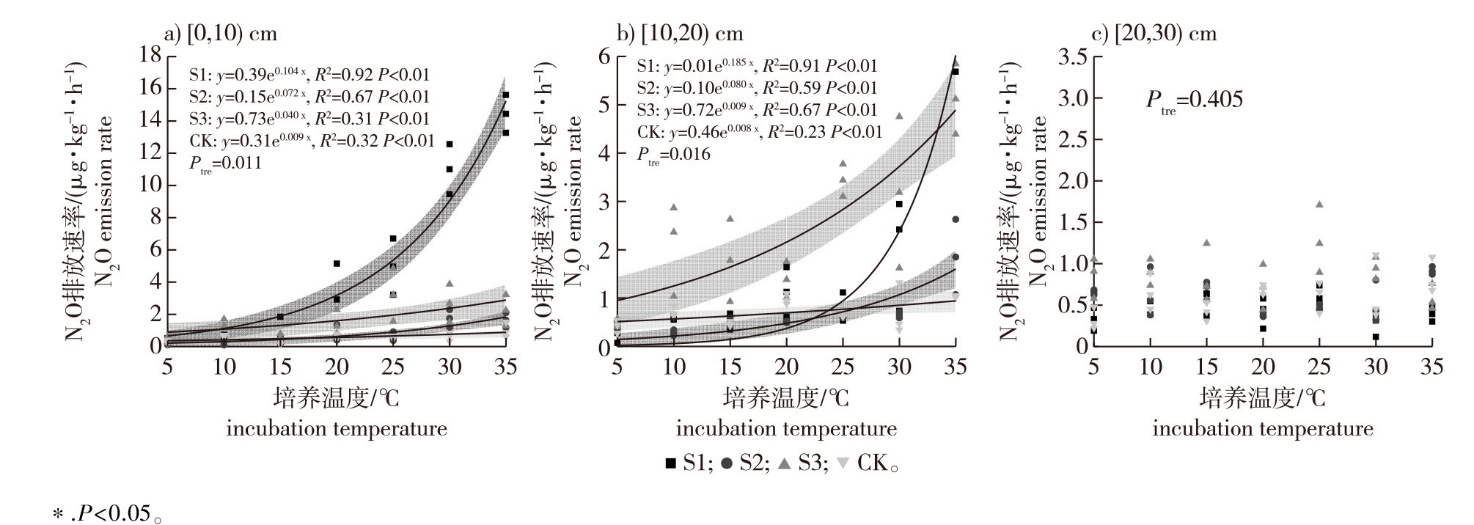
【Objective】This study aims to evaluate how different mulching management practices affect soil physicochemical properties, N2O emissions, and their temperature sensitivity in Lei bamboo (Phyllostachys violascens ‘Prevernalis’) stands. Understanding these effects is crucial for developing sustainable bamboo management strategies that mitigate N2O emissions and promote the long-term sustainability of the bamboo industry.【Method】Four mulching regimes were examined: rice husk mulching for eight years followed by two years of abandonment, fertilized for eight years (S1); continuous rice husk mulching for ten years under optimized age structure and planting density, fertilized for ten years (S2); rice husk mulching for five years followed by five years of abandonment, fertilized for eight years (S3); and no mulching(CK). Soil physicochemical properties were analyzed across different soil depths. N2O emission rates and temperature sensitivity (Q10) were determined using laboratory incubation under controlled temperature gradients, and annual N2O emissions were subsequently estimated.【Result】Mulching management significantly modified soil properties in P. violascens ‘Prevernalis’ stands. Compared with the control, mulching decreased bulk density while increasing soil pH and nutrient contents in the 0-10 cm layer, with the greatest improvements observed under S3. Soil water content (SWC), soil organic carbon (SOC), total nitrogen (TN), and total phosphorus (TP) in S3 were significantly higher than those under other treatments. Among the treatments, S1 showed the highest sensitivity to N2O emissions, exhibiting significantly greater cumulative N2O fluxes in the 0-10 cm layer than the other treatments, while S3 had the highest cumulative N2O emissions in the ≥10-20 and ≥20-30 cm layers. The cumulative N2O emissions of S2 and CK did not differ significantly across soil depths. The Q10 values of N2O emissions ranged from 1.22 to 6.38, with the highest under S1 (2.84 and 6.38 in the 0-10 and ≥10-20 cm layers, respectively) and the lowest under CK (1.35 and 1.22). Estimated annual N2O emissions were also greatest under S1 and lowest under S2 in the 0-10 cm layer. Across all treatments, N2O emission rates in the 0-10 and ≥10-20 cm layers were positively correlated with soil temperature but negatively correlated with bulk density. SOC showed the strongest positive correlation with N2O emissions (R = 0.70).【Conclusion】Mulching practices increased both N2O emissions and their temperature sensitivity (Q10). Among the different management regimes, continuous rice husk mulching (S2) with appropriate stand density and age structure resulted in relatively low N2O emissions while maintaining high productivity. This indicates that S2 represents an environmentally friendly and sustainable management strategy for P. violascens ‘Prevernalis’ cultivation.
bamboo forest land mulching / Phyllostachys violascens ‘Prevernalis’ / N2O emission / soil temperature sensitivity / soil properties
| [1] |
|
| [2] |
|
| [3] |
|
| [4] |
|
| [5] |
|
| [6] |
|
| [7] |
|
| [8] |
|
| [9] |
冯鹏飞, 李玉敏. 2021年中国竹资源报告[J]. 世界竹藤通讯, 2023, 21(2): 100-103.
|
| [10] |
|
| [11] |
|
| [12] |
|
| [13] |
|
| [14] |
|
| [15] |
|
| [16] |
|
| [17] |
|
| [18] |
|
| [19] |
|
| [20] |
|
| [21] |
|
| [22] |
|
| [23] |
|
| [24] |
且天真, 李娟, 王莉, 等. 不同绿肥翻压还田对土壤物理性状的影响[J]. 江苏农业科学, 2024, 52(14): 262-270.
|
| [25] |
|
| [26] |
|
| [27] |
|
| [28] |
孙正, 苏荣琳, 徐鹏, 等. 添加磷对水稻-油菜轮作土壤N2O排放影响[J]. 环境科学, 2019, 40(7): 3355-3360.
|
| [29] |
余洁, 苗淑杰, 乔云发, 等. 小麦秸秆添加对不同类型土壤有机碳矿化的影响[J]. 农业环境科学学报, 2024, 43(9): 2041-2049.
|
| [30] |
|
| [31] |
|
| [32] |
|
| [33] |
|
| [34] |
|
| [35] |
|
| [36] |
|
| [37] |
|
| [38] |
|
| [39] |
|
| [40] |
|
| [41] |
吕晓东, 王婷. 旱地农田氧化亚氮排放研究进展[J]. 甘肃农业科技, 2018(10): 67-73.
|
| [42] |
|
| [43] |
|
| [44] |
|
| [45] |
卢妍, 宋长春, 王毅勇, 等. 植物对沼泽湿地生态系统N2O排放的影响[J]. 生态与农村环境学报, 2007, 23(4): 72-75.
|
| [46] |
|
| [47] |
|
| [48] |
刘丽媛, 徐艳, 朱书豪, 等. 有机肥配施对中国农田土壤容重影响的整合分析[J]. 农业资源与环境学报, 2021, 38(5): 867-873.
|
| [49] |
韩凡香, 陈倩, 包正育, 等. 秸秆带状覆盖种植马铃薯农田土壤温度及其气温响应特征[J]. 甘肃农业大学学报, 2023, 58(3): 67-75.
|
| [50] |
|
/
| 〈 |
|
〉 |