PDF(2096 KB)

Effects of nitrogen addition on fine root decomposition in poplar plantations
HAN Zhe, LIU Wenfang, XU Xia, ZHENG Wenxu, GENG Qinghong, FAN Wei, PENG Fanxi
Journal of Nanjing Forestry University (Natural Sciences Edition) ›› 2026, Vol. 50 ›› Issue (3) : 72-78.
PDF(2096 KB)
 PDF(2096 KB)
Effects of nitrogen addition on fine root decomposition in poplar plantations
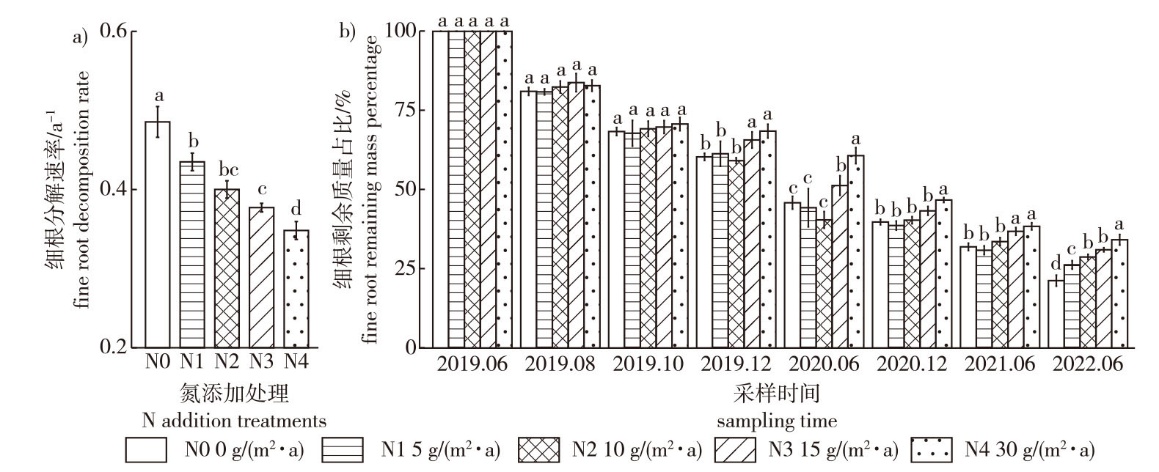
【Objective】This study aims to investigate the impacts of varying nitrogen (N) addition levels on the decomposition dynamics of fine roots in poplar plantations and to elucidate the key regulatory factors influencing this process. The findings are expected to provide critical insights into the role of N deposition in ecosystem carbon (C) cycling and nutrient turnover.【Method】Fine roots of Populus deltoides were collected in 2018 from experimental plots subjected to five different N addition treatments: N0 (0 g/(m2·a)), N1 (5 g/(m2·a)), N2 (10 g/(m2·a)), N3 (15 g/(m2·a)), and N4 (30 g/(m2·a)). After measuring their initial chemical properties, all root samples were buried in the control (N0) plot for decomposition experiments. Samples were collected at seven time points over a three-year period to track residual mass and assess the decomposition patterns and influencing factors associated with different N treatments.【Result】Initial chemical properties of poplar fine roots differed significantly among different N treatments. N concentration in the roots increased with higher N input, while the C/N declined. Decomposition rates decreased with increasing N addition. Although root mass continuously declined over three years, higher N levels consistently resulted in greater residual mass at each time point, indicating that N addition inhibited fine root decomposition. Initial C/N and N concentrations were the primary factors influencing decomposition rate. A higher C/N significantly increased the decomposition rate (R2 = 0.86, P < 0.001), while higher N concentration significantly decreased it (R2 = 0.80, P < 0.001), suggesting that the initial chemical composition of fine roots strongly regulates their decomposition.【Conclusion】In summary, this study demonstrates that nitrogen addition inhibits fine root decomposition by altering root initial chemistry-specifically by increasing N concentration and reducing the C/N which may in turn affect soil organic carbon accumulation in forest ecosystems.
N addition / poplar plantation / fine root decomposition / initial chemical properties of fine roots
| [1] |
|
| [2] |
|
| [3] |
|
| [4] |
孟盈盈, 张黎明, 远勇帅, 等. 土壤水分含量和凋落物特性对陌上菅细根和叶片凋落物分解的影响[J]. 环境科学研究, 2021, 34(3):707-714.
|
| [5] |
|
| [6] |
李璟, 沈雅飞, 王丽君, 等. 人工林土壤碳的影响途径研究进展[J]. 陆地生态系统与保护学报, 2023(3):89-98.
|
| [7] |
|
| [8] |
|
| [9] |
|
| [10] |
|
| [11] |
郭超, 王霖娇. 氮沉降对森林生态系统土壤微生物、酶活性以及细根生产与周转的影响研究进展[J]. 生态学杂志, 2021, 40(11):3730-3741.
|
| [12] |
袁吉有. 大气氮沉降对森林土壤微生物影响的研究进展[J]. 云南大学学报(自然科学版), 2023, 45(1):199-210.
|
| [13] |
|
| [14] |
|
| [15] |
李媛媛, 王正文, 孙涛. 氮添加对温带森林细根长期分解的影响[J]. 植物研究, 2017, 37(6):848-854.
|
| [16] |
|
| [17] |
刘仁, 张宇飞, 金志芳, 等. 温度调控外源氮添加对毛竹细根分解及其养分释放的影响[J]. 生态学杂志, 2019, 38(12):3617-3625.
|
| [18] |
张雨鉴, 王克勤, 宋娅丽, 等. 滇中亚高山地带性植被凋落物分解对模拟氮沉降的响应[J]. 生态学报, 2020, 40(22):8274-8286.
|
| [19] |
许丽颖, 魏统超, 王佳音, 等. 氮、 磷、钾肥对紫穗槐幼苗根叶化学计量特性的影响[J]. 森林工程, 2024, 40(4):29-38.
|
| [20] |
|
| [21] |
|
| [22] |
闫国永, 邢亚娟, 王晓春, 等. 氮沉降对细根动态和形态特征的影响研究进展[J]. 中国农学通报, 2016, 32(15):79-85.
|
| [23] |
|
| [24] |
|
| [25] |
王庆贵, 张晓莹. 土壤微生物对大气氮沉降的响应研究进展[J]. 河南师范大学学报(自然科学版), 2021, 49(6):11-18,69.
|
| [26] |
|
| [27] |
|
| [28] |
|
| [29] |
|
| [30] |
|
| [31] |
冯会丽. 杨树人工林土壤和树干甲烷通量变化特征及微生物作用机制[D]. 南京: 南京林业大学, 2022.
|
| [32] |
|
| [33] |
|
| [34] |
|
| [35] |
|
| [36] |
罗来聪, 王皓, 余雅迪, 等. 不同生态型能源植物柳枝稷凋落物-土壤生态化学计量学特征对氮磷添加的响应[J]. 生态与农村环境学报, 2025, 41(1): 128-137.
|
| [37] |
|
| [38] |
|
| [39] |
|
| [40] |
|
| [41] |
|
| [42] |
|
| [43] |
|
| [44] |
|
| [45] |
|
| [46] |
|
| [47] |
|
/
| 〈 |
|
〉 |