PDF(21611 KB)

Study on the biological characteristics and control techniques of Cydia trasias
Chen Huanwei, Ye Linyan, Jin Linfang, Lai Chao, Ji Jingyong
Journal of Nanjing Forestry University (Natural Sciences Edition) ›› 2026, Vol. 50 ›› Issue (5) : 267-273.
PDF(21611 KB)
 PDF(21611 KB)
Study on the biological characteristics and control techniques of Cydia trasias
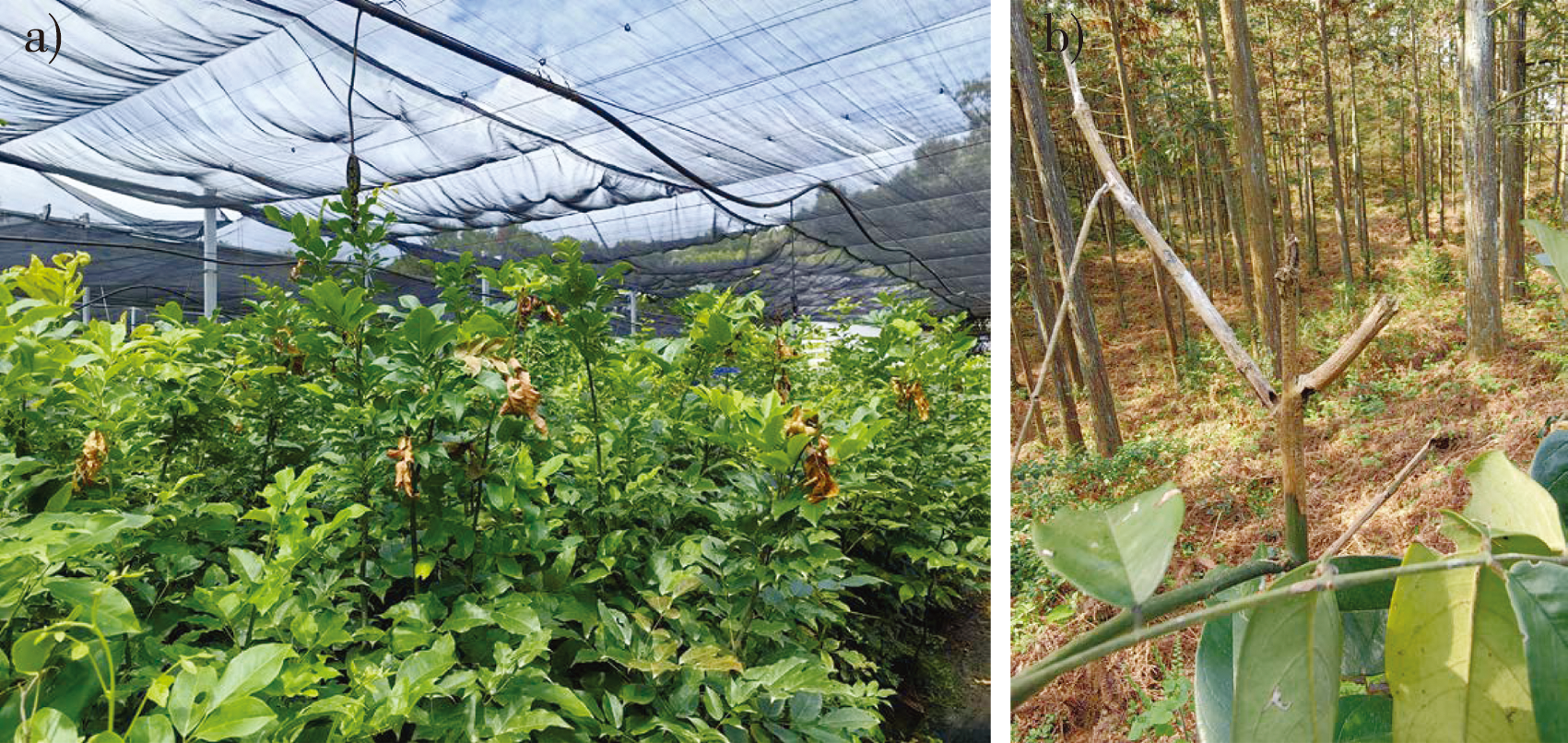
【Objective】Cydia trasias is a shoot-boring pest severely damaging Ormosia hosiei seedlings in Longquan, Zhejiang Province. To date, there are few reports on biological characteristics of this insect in South China. In order to provide a basis for the scientific control of C. trasias, its biological characteristics, damage patterns, and chemical control efficacy were studied in present study. 【Method】The damage rate and larval densities across different tree ages (one-, two-, three-year container seedlings, 6-year plantation saplings) were investigated in field. Morphological features, life history, and behavioral traits of C. trasias were studied and recorded through laboratory rearing. Field trials were conducted with 8% cypermethrin microcapsule suspension and 1.8% abamectin emulsifiable concentrate at 1 500 × and 3 000 × dilutions to evaluate their efficacy against larvae. 【Result】C. trasias larvae bored hollow tunnels in shoots causing wilting. A single larva could infest three-five shoots. Larval density was significantly higher in six-year-old trees than that in younger seedlings (P < 0.05), but damage rate showed no age-related differences (P > 0.05). C. trasias produced four generations each year, and overwintered as mature larvae in tunnels in Longquan. Overwintered larvae pupated in early April; Adults emerged in late April. Larvae infested trees from May to November, and matured for overwintering by late November with the fourth generation. Adults were nocturnal, phototactic, and mated mainly between 18:00-19:30, laying eggs on tender shoots. Cypermethrin (1 500 × dilution is 90.06%; 3 000×dilution is 95.82%) and abamectin (1 500×dilution is 86.26%; 3 000 × dilution is 87.53%) significantly reduced larval density and damage (P < 0.001), with no efficacy difference between concentrations. 【Conclusion】C. trasias had four generations per year in Zhejiang Province, and the damage level was correlated closely with host age. Cypermethrin (1 500 × dilution) showed optimal field efficacy to control C. trasias. Our findings provide critical insights on monitoring and effective control of C. trasias.
Cydia trasias / Ormosia hosiei / morphological feature / biological characteristics / chemical control
| [1] |
吴国华, 叶茂平, 吴孝元, 等. 浙闽山区红豆树自然生长情况调查及保护对策[J]. 安徽农业科学, 2021, 49(7):113-114,117.
|
| [2] |
王明彬, 韦小丽, 韦忆, 等. 川黔地区濒危植物红豆树种群结构与数量动态特征[J]. 广西植物, 2024, 44(1):179-192.
|
| [3] |
李苗苗, 舒金平, 王井田, 等. 油茶织蛾生物学特性研究[J]. 林业科学研究, 2015, 28(6):900-905.
|
| [4] |
庾琴, 郭晓君, 封云涛, 等. 6种杀虫剂对南美番茄潜叶蛾的毒力及田间防效[J]. 生物安全学报, 2022, 31(4):345-350.
|
| [5] |
中国科学院中国动物志编辑委员会. 中国动物志.昆虫纲.第二十七卷,鳞翅目.卷蛾科[M]. 北京: 科学出版社, 2002.
Editorial Committee of Fauna Sinica,Chinese Academy of Sciences. Fauna Sinica.Insecta Vol.27,Lepidoptera.Tortricidae[M]. Beijing: Science Press, 2002.
|
| [6] |
许建娇, 张瀚文, 陈焕文, 等. 长林小蠹对黑松挥发物电生理及行为反应[J]. 森林工程, 2024, 40(3):101-114,124.
|
| [7] |
|
| [8] |
刘雨晴, 钱硕楠, 李后魂. 中国鳞翅目小蛾类昆虫寄主植物分析[J]. 环境昆虫学报, 2019, 41(3):520-532.
|
| [9] |
张玉岱, 王秀绒, 曲日胜, 等. 国槐小卷蛾生物学习性观察与防治[J]. 陕西林业科技, 1983, 11(4):57-62.
|
| [10] |
陈合明, 祁润身. 槐小卷蛾的研究[J]. 植物保护, 1992, 18(3):8-10.
|
| [11] |
项颖颖, 王秀利, 张霞, 等. 槐小卷蛾生物学研究[J]. 昆虫知识, 2010, 47(3):486-490.
|
| [12] |
|
| [13] |
|
| [14] |
|
| [15] |
|
| [16] |
葛庆杰, 刘合胜, 须志良, 等. 宁溧山区松毛虫生物学特性与为害量的研究[J]. 南京林业大学学报(自然科学版), 1986, 10(3):66-76.
|
| [17] |
|
| [18] |
|
| [19] |
陈梅英, 王力加, 汤晓玉, 等. 统防统治对茶农农药减量的影响研究:基于福建和浙江的实证分析[J]. 生态与农村环境学报, 2024, 40 (8):1029-1037.
|
/
| 〈 |
|
〉 |